It seems like more businesses than ever are turning to AI agents to handle their complex processes and workflows. According to Gartner, by 2028, 33% of enterprise software will include Agentic AI frameworks, up from less than 1% in 2024. That means nearly 15% of routine decisions at work could be made without you lifting a finger.
Maybe you’re wondering what is an Agentic AI framework and how this applies to your business. Which framework should you use? How can a team of autonomous AI agents work together to cut down manual tasks and keep operations running smoothly?
This is where AI agentic frameworks come in. They give you the structure and tools to build a network of agents that communicate, collaborate, and solve problems on their own. Whether you’re a business leader exploring your options or a developer designing your own solution, understanding these AI-driven agentic architecture models is the key to making smarter automation a reality.
In this blog, we’ll break it down in simple terms. We’ll explain what is an Agentic AI framework, how they work, and how Wizr AI can help you put them into action in your enterprise. Let’s get started.
Looking to scale smarter? Agentic AI Frameworks let autonomous agents handle workflows, decisions, and multi-step tasks – without human hand-holding.
This blog breaks down how these frameworks boost enterprise automation with memory, reasoning, and multi-agent collaboration – all while integrating into your existing tools.
If you’re exploring next-gen automation that’s adaptable and future-ready, this guide shows how to put Agentic AI to work. Read the full post to learn how Wizr makes it real.
What is Agentic AI Framework?
An Agentic AI Framework is a structured approach to building AI systems composed of autonomous agents that can reason, adapt, and act independently to achieve specific goals. These frameworks enable AI agents to interact with environments, make decisions, and coordinate with other agents without human guidance.
Agentic AI framework components bring together different components of artificial intelligence into a unified system. They provide a clear structure for developing autonomous AI agents that can communicate, collaborate, and make decisions on their own.
Instead of following rigid instructions, these agents adjust their actions based on their goals and surroundings. That means your business can respond more quickly to changing conditions and handle complex tasks without constant human intervention.
Here’s how these AI-powered autonomous agents work:
- They connect components and guide their operations.
- They define how agents communicate and resolve disputes.
- They enable the system to use its knowledge to solve problems.
- They help it adapt when conditions or goals change.
Agentic AI frameworks let you piece together sophisticated and adaptable systems without coding everything from scratch. Whether you need multichannel customer service, automated IT operations, or a smarter copilot for your employees, these Agentic AI workflow frameworks provide a flexible way to make it happen.
Recent research by Stanford HAI highlights that agentic AI systems are expected to drive over 40% of next-gen enterprise automation by 2027. These frameworks are already being used to power dynamic decision-making in sectors like logistics, finance, and IT operations. Businesses adopting agentic AI see improved operational agility and reduced dependency on rule-based systems.
Key Components of Agentic AI Frameworks for Enterprise Automation
Agentic AI frameworks for enterprise automation bring together different components to help your enterprise handle tasks smarter and more efficiently. Each part plays a key role in making sure your automation runs smoothly and delivers results quickly.
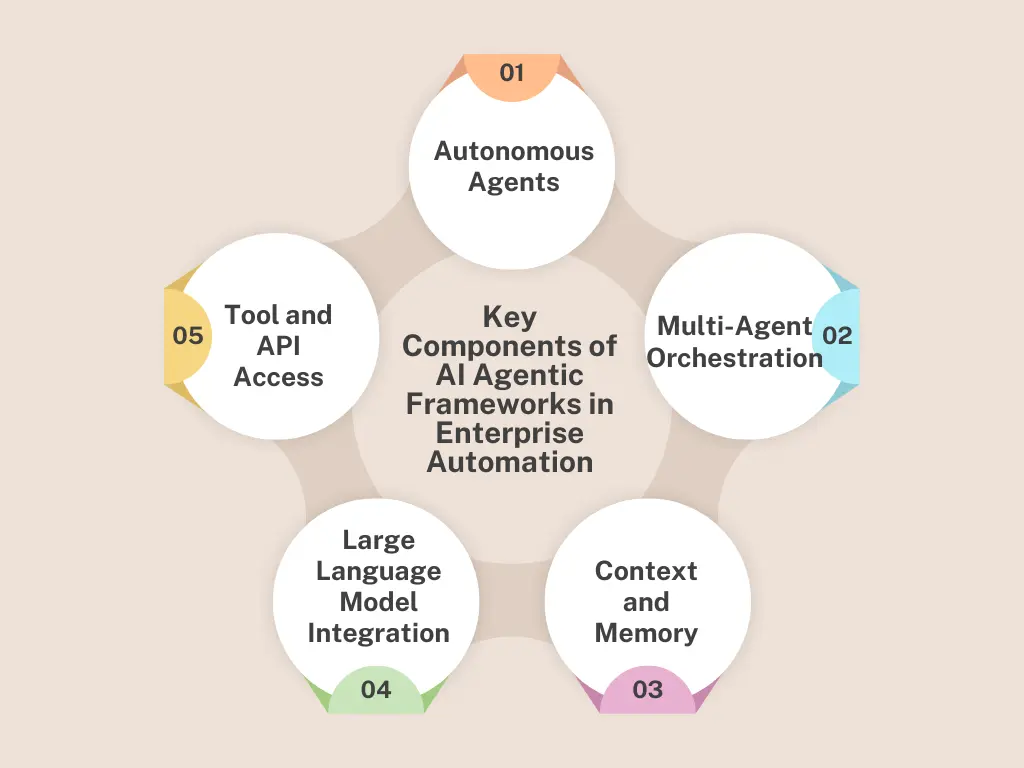
Here are the main components that make these frameworks powerful:
1. Autonomous Agents
At the center of these AI agentic frameworks are autonomous agents. They are small, specialized programs designed to act on your behalf. Instead of waiting for you to tell them what to do, these agents:
- Observe their surroundings
- Make decisions based on available information
- Carry out tasks without needing constant oversight
Whether it’s updating a customer’s record or closing a service ticket, these agents handle responsibilities that previously demanded human intervention. This lets you scale operations without adding more people and highlights enterprise use cases for autonomous AI agents and the best autonomous AI agents in action.
2. Multi-Agent Orchestration
A single agent can do a lot, but a team can do even more. This is where multi-agent orchestration comes in. Instead of addressing tasks in isolation, a group of agents:
- Communicate and collaborate
- Divide large workloads into manageable components
- Handle multistep workflows faster and more accurately
This lets your enterprise resolve complex tasks without bottlenecks and makes your operations more efficient.
3. Context and Memory
To make smarter choices, these agents need context. This is where memory plays a key role.
Each agent:
- Stores past conversations, decisions, and outcomes
- Learns from its own experience
- Uses this knowledge to avoid repeating mistakes and respond more effectively in future tasks
This ability makes your automation more reliable and adaptable over time. These agentic AI framework components support adaptability and align with the future of Agentic AI frameworks 2026.
4. Large Language Model Integration
With context and memory in place, large language models come into play. These models connect to your agents and allow them to:
- Generate human-like responses
- Interpret instructions accurately
- Produce tailored content, whether it’s emails, policy documents, or service messages.
This lets your automation communicate naturally and handle a range of tasks that previously required human judgment, as explored in this enterprise LLM workflows guide.
5. Tool and API Access
Lastly, these components connect directly with your enterprise software stack. Using API and tool integration, your agents can:
- Retrieve customer information from a CRM
- Approve transactions in your ERP
- Update service requests in your ITSM platform
This lets your automation become a true team player within your business, tying all your operations together into a unified whole.
Together, these components form a powerful framework. They enable your enterprise to handle routine tasks more efficiently, respond quickly to changing conditions, and free up your team to focus on more creative and high-impact initiatives. Learn how agentic AI differs from traditional automation and drives smarter enterprise workflows.
Top Benefits of Using Agentic AI Frameworks in Enterprise Automation
Agentic AI frameworks for enterprise automation bring a powerful change to your enterprise operations. They cut back manual effort, speed up delivery, and make your workflows smarter over time. Let’s break down exactly how these frameworks help you achieve all this.
1. Reduce Manual Work
Your team spends a large part of its day on tasks that follow clear patterns. With autonomous agents powered by AI agentic frameworks, these tasks can be finished without human intervention. That means your people can move away from routine responsibilities and focus their energy on more important initiatives, whether it’s designing new products, serving key clients, or solving complex problems.
2. Improve Speed and Efficiency
AI agents can execute tasks in parallel. Instead of bottlenecked workflows where everything waits on a single person or department, multiple processes can progress at once. This cuts delivery time from days to hours and lets you respond faster to changing conditions in your business using Agentic AI workflow frameworks.
3. Boost Accuracy and Reduce Errors
Because these agents follow a clear set of instructions and base their decisions on data, there’s less chance for human oversight or mistakes. The result is greater accuracy in your operations, whether it’s processing transactions, updating inventories, or generating reports – benefits made possible through AI-driven agentic architecture.
4. Adapt and Scale Naturally
As your enterprise grows, you can simply add more agents to handle additional workloads. There’s no need to rebuild your whole automation framework from scratch. The system evolves alongside your operations, making sure you’re always ready to handle whatever comes your way with top agentic AI frameworks that support Agentic AI frameworks 2026 standards.
5. Provide Valuable Context-Aware Actions
AI agents remember past decisions and outcomes. They learn from this context and adjust their future actions to match your goals. That means your automation is not rigid – it evolves and performs smarter and more efficiently over time, leveraging Agentic AI framework components and real-time learning.
6. Align with Rising Enterprise Adoption
Today, many organizations already use this technology to streamline their operations. According to McKinsey, 78% of organizations use AI in at least one business function, up from 55% in early 2023. This shows you’re not alone; companies across industries are adopting Agentic AI reference architecture for enterprise based on their needs and Agentic AI frameworks comparison insights.
AI Agentic Frameworks help you cut back manual effort, increase delivery speed, and make smarter, more accurate decisions across your enterprise. Whether you want to handle growing workloads, minimize human intervention, or streamline operations, these frameworks can help you get there.
Also Read: Agentic AI vs Traditional Automation: Why Enterprises Shift for Better CX [2025]
How Agentic AI Frameworks Drive Next-Gen Enterprise Automation
Agentic AI Frameworks take automation to a whole new level. They do more than just execute simple tasks. They enable your business to put smart, adaptable systems in place, without needing you to oversee every step – a hallmark of AI-driven agentic architecture.
Picture this in action. A customer support ticket drops into your system. Here’s how it plays out:
- First, an agent reviews the ticket and decides what kind of issue it is.
- Then, another pulls a solution from your knowledge base.
- A third draft is a clear and helpful response.
- Finally, a fourth closes the ticket and logs all the details.
All of this happens without human intervention. The chain of actions plays smoothly, just like a well-coordinated team. But this team is available all day, every day, and it performs its tasks faster, more accurately, and more consistently – a key advantage of using AI agentic frameworks.
This approach lets you streamline a range of operations across your enterprise using Agentic AI frameworks for enterprise automation. It’s a perfect match for:
- Customer service, where inquiries come in around the clock.
- IT operations, when you need to resolve issues quickly and efficiently.
- Internal help desks, to handle routine requests without tying up your team’s time.
- Finance, sales, and procurement, where workflows can be automated from start to finish.
The key benefit is that you’re not just adding automation, you’re adding adaptability. The Agentic AI workflow frameworks let your business respond to changing conditions and handle growing workloads gracefully. It performs tasks smarter, faster, and more accurately, freeing up your team to focus on more important and creative initiatives – exactly what Agentic AI framework components are designed to support.
How to Choose an Agentic AI Framework?
Choosing the right solution depends on understanding what is an agentic AI framework and aligning it with your business needs. There’s no one-size-fits-all solution. Each framework comes with its own strengths, and it’s up to you to match them to your goals – whether you’re comparing the best agentic AI frameworks or exploring the Agentic AI frameworks 2026.
Here are a few things to consider when making your choice:
- Your use case: Begin by asking yourself what you want it to do. Are you focusing on customer service, internal operations, or something else? The framework you choose should align with those goals – especially if you’re evaluating enterprise use cases for autonomous AI agents.
- Scalability and flexibility: Your business will grow and change. Look for a Gen AI agentic framework that can scale with you and adapt to future needs without needing a complete rebuild.
- Team expertise: Some open-source agentic AI frameworks require deep coding knowledge, while others are more flexible and easier to implement. Consider your team’s skills and resources.
- Integration with existing systems: Your framework should connect smoothly with your current software stack. It’s a good idea to check for API support and compatibility with your enterprise tools.
- Support and community: An active community and strong support can make a huge difference. Look for a solution with clear documentation, helpful communities, and a reliable team – valuable insights when performing an Agentic AI frameworks comparison.
The right choice lets you handle growing workloads, streamline operations, and respond quickly to changing conditions. Whether you’re referring to an Agentic AI architecture diagram or checking a list of AI-powered autonomous agents, choosing from the top agentic AI frameworks will ensure smarter, scalable automation.
Also Read: How to Build an AI Assistant That Boosts Agent Productivity [2025 Guide]
How Wizr AI Uses Agentic AI Frameworks to Power Enterprise Automation
Wizr AI delivers enterprise-grade automation using Agentic AI frameworks to power intelligent workflows and agents. Our Enterprise AI Services bring together memory, reasoning, and multi-agent collaboration to help teams focus on strategic work instead of manual, repetitive tasks.
1. Memory-Driven Agents
Wizr agents maintain a managed vector memory that retains context from past interactions, documents, and tasks. This enables agents to build on prior work and respond with relevant, up-to-date insights an important capability within modern Agentic AI framework components.
2. Goal-Based Orchestration
Rather than executing isolated prompts, these agents operate within structured workflows aligned to business goals. Whether it’s resolving customer support inquiries, IT service requests, or finance-related workflows, agents collaborate through coordinated sequences to complete complex tasks efficiently a core strength of AI agentic frameworks.
3. LLM‑Powered Reasoning
Each agent integrates with large language models to interpret user intent, generate responses, and plan actions. Combined with retrieval-augmented generation (RAG) for grounded information retrieval, this approach improves accuracy and reliability without relying on static templates—an essential capability in modern GenAI agentic architectures.
4. Seamless Integration with Your Systems
Wizr AI connects with enterprise tools such as CRMs, ticketing systems, knowledge bases, and enterprise applications through APIs and integrations. Organizations can design, implement, test, and deploy multi-agent workflows quickly while maintaining compatibility with their existing technology stack, demonstrating the flexibility of Agentic AI workflow frameworks.
Real-World Impact: Transforming Immigration Support
This approach is already delivering results in real enterprise environments. Wizr worked with a large global immigration firm that needed to manage a growing volume of client inquiries while maintaining accuracy and compliance – one of many enterprise use cases for autonomous AI agents.
Using Agent Assist capabilities, integrated knowledge sources, and automated workflows, the firm streamlined its operations. Routine inquiries were automated, agents gained real-time contextual guidance, and manual workloads were significantly reduced.
The results were dramatic:
- 40% increase in operational efficiency, enabling teams to focus on high-value cases.
- 65% first-interaction resolution rate, improving service delivery and customer satisfaction.
- 60% faster response times, reducing average inquiry resolution from 15 minutes to just 6 minutes.
This transformation improved service quality, reduced operational complexity, and demonstrated how agentic AI workflows can deliver measurable outcomes in complex enterprise environments.
Wizr AI delivers Agentic AI capabilities through Enterprise AI Services, helping organizations integrate intelligent agents and workflows into existing enterprise environments quickly and securely. The result is faster deployment, scalable automation, and intelligent decision support without replacing existing systems or disrupting enterprise technology stacks.
Conclusion
Managing growing operations, making countless routine decisions, and keeping all your workflows efficient can be tough. Your team finds it hard to keep up, and manual tasks drain their time and energy. It’s a challenge to scale without adding more resources or losing oversight. But this is where Agentic AI Frameworks come in. They help you cut through complexity, handle routine tasks on their own, and allow your team to focus on the bigger picture.
This is exactly where Wizr.ai steps in. Wizr helps enterprises put Agentic AI frameworks for enterprise automation into practice through Enterprise AI Services and AI-powered automation capabilities, without needing to rebuild existing systems. It integrates smoothly with your enterprise tools, enables you to define operational goals, and orchestrates AI agents and workflows to execute tasks efficiently.
Whether you want faster customer support responses, more efficient IT service management, or streamlined finance and operational workflows, Wizr helps automate complex processes while keeping humans in control. Your goals become achievable without overwhelming teams, creating bottlenecks, or relying on manual effort.
Don’t let complexity slow you down. Activate a smarter way of working with Wizr and watch your enterprise become more efficient, adaptable, and future-ready.
FAQs
1. What is an Agentic AI Framework and how does it help enterprise automation?
An Agentic AI Framework is a system of intelligent agents AI programs that act autonomously to perform tasks, make decisions, and collaborate with other agents.
It helps enterprise automation by reducing manual work, handling complex multi-step processes, and improving response times without constant human intervention.
Wizr AI applies agentic AI architectures through Enterprise AI Services to help enterprises automate operational workflows and enable teams to focus on strategic work while AI agents assist with routine and complex tasks.
2. What are the key components of Agentic AI Frameworks?
The main components of an Agentic AI Framework include:
- Memory modules: Retain context and past actions
- Goal-based orchestration: Coordinate multiple agents effectively
- LLM-powered reasoning: Understand and act on user intent
- APIs & integrations: Connect seamlessly with enterprise systems
Together, these components form a scalable, adaptive agentic architecture. Wizr AI brings these capabilities together through Enterprise AI Services and implementation expertise, enabling enterprises to design, deploy, and scale AI-driven workflows securely and efficiently.
3. How do Agentic AI Frameworks compare to traditional automation?
Unlike rule-based automation, Agentic AI Frameworks learn, adapt, and make intelligent decisions rather than just follow scripts.
Key differences include:
- Smarter workflows with contextual memory
- Faster response via multi-agent orchestration
- Scalable solutions for growing workloads
- Lower error rates compared to static automation
Wizr AI uses agentic AI capabilities to help enterprises move beyond simple automation, enabling adaptive workflows that improve operational efficiency.
4. What are the top Agentic AI Frameworks for 2025?
The leading Agentic AI frameworks in 2025 combine LLMs, RAG workflows, and modular, scalable architecture. Popular trends include:
- Autonomous AI agents with natural language understanding
- Agentic AI workflow frameworks for enterprise automation
- Architecture designs that support flexible, multi-agent orchestration
Wizr AI helps enterprises implement these capabilities through Enterprise AI Services, enabling organizations to build and deploy AI agents and workflows securely at scale.
5. How does Wizr AI use Agentic AI Frameworks in real enterprise scenarios?
Wizr AI applies agentic AI capabilities across enterprise workflows, including customer support and operational processes, to automate complex tasks and improve service efficiency.
Example impact:
- Automated routine inquiries for a global immigration firm
- Reduced response times by 60%
- Increased first-interaction resolution by 65%
Platform features include:
- Goal-driven orchestration
- Integrated memory & knowledge bases
- LLM-based reasoning and compliance checks
With Wizr AI’s Enterprise AI Services, enterprises can implement scalable automation using modern agentic AI architectures.
6. How do enterprise-grade control frameworks enhance Agentic AI performance?
Enterprise-grade control frameworks provide governance, monitoring, and compliance for agentic AI systems. They ensure AI agents follow organizational rules, track outcomes, and maintain security while performing autonomous tasks.
Wizr AI combines AI Governance capabilities with agentic AI workflows, giving enterprises visibility, compliance oversight, and operational insights while scaling AI-driven automation.
7. What real-world benefits do Gen AI agentic frameworks provide to enterprises?
Gen AI agentic frameworks help enterprises automate multi-step processes, reduce operational errors, and accelerate decision-making. They enable AI agents to collaborate, learn from interactions, and deliver context-aware results across departments.
With Wizr AI, organizations can scale AI-powered automation, improve operational efficiency, and allow teams to focus on higher-value strategic work through practical Enterprise AI Services.
About Wizr AI
Wizr AI helps enterprises build autonomous enterprises and accelerate product and software engineering with practical, production-ready AI. We help organizations automate business workflows, modernize legacy applications and digital platforms, and build intelligent AI solutions.
Our core services include Enterprise AI Services, AI-Powered Engineering & Legacy Modernization, AI Product Engineering, and AI Governance. We also leverage AI Assembly capabilities, including the Agentic AI Framework, Agentic Workflows, Security, and Integrations.
Through our AI solutions, including AI Agents, Pharma & Life Sciences AI, Oracle AI, and Salesforce AI, we help enterprises apply AI across business and technology needs.
See how we can help your enterprise move faster with AI. 👉 Talk to an AI Expert.


![Agentic AI vs AI Agents: Key Differences Every CIO Must Know [2025 Guide]](https://wizr.ai/wp-content/uploads/2025/07/Agentic-AI-vs-AI-Agents.webp)
![Agentic AI vs Traditional Automation: Why Enterprises Shift for Better CX [2025]](https://wizr.ai/wp-content/uploads/2025/06/Agentic-AI-vs-Traditional-Automation.webp)


![11 Real-World AI Agents Examples + Use Cases for Enterprises [2025]](https://wizr.ai/wp-content/uploads/2025/05/AI-Agents-Examples-Use-Cases.webp)