


AI agents are no longer just answering questions. They are taking actions, moving money, changing records, and touching your most sensitive systems. That power is exactly why they need strong guardrails.
Here is the uncomfortable part. McKinsey reports that 80% of organizations have already encountered risky behaviors from AI agents, including improper data exposure and access to systems without authorization. When an agent goes wrong, it does not just give a bad answer. It takes a bad action.
This is where AI Agent Guardrails come in. They are the controls that keep autonomous agents safe, compliant, and predictable, even as they act on their own.
This guide covers what AI agent guardrails are, why enterprises need them, ten best practices for secure deployment, how to test guardrails in production, and how Wizr AI helps you govern agents at scale. The goal is simple: let your agents move fast without putting the business at risk.
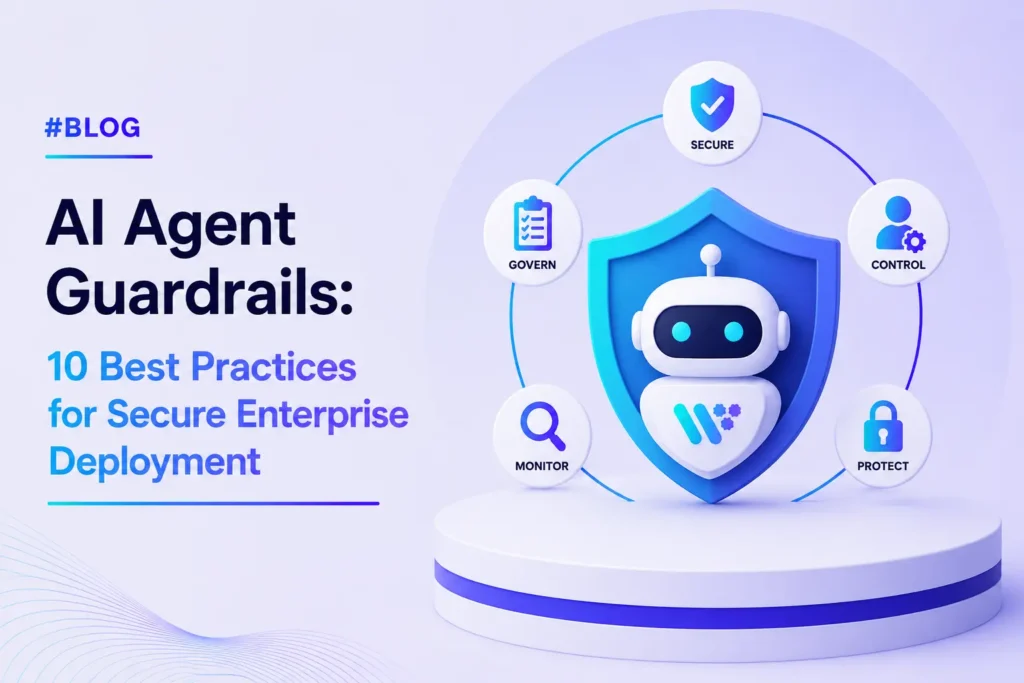
The pressure is real on both sides. Boards want the speed and savings that autonomous agents promise, while security and compliance teams worry about what those agents might do unsupervised. Guardrails are how you satisfy both, giving agents room to work while keeping firm limits around them. Get this balance right, and guardrails stop being a brake on innovation and become the thing that lets you scale it safely.
Throughout this guide, we will keep the language practical and the advice actionable. Whether you are deploying your first agent or already running a fleet, the same principles apply: know your risks, limit access, test often, and keep a human in the loop where it matters most. These are not abstract ideas. They are the difference between an agent you can trust in production and one that becomes tomorrow’s incident report.
What Are AI Agent Guardrails and Why Do Enterprises Need Them?
AI agent guardrails are the rules, limits, and controls that govern what an AI agent can do. They define what data an agent can touch, which tools it can use, what actions need approval, and how the system responds when something looks wrong.
Think of them like guardrails on a mountain road. They do not stop the car from moving. They stop it from going over the edge. Good AI agent safety guardrails let agents do useful work while keeping them inside safe boundaries.
The key difference from older AI safety is action. A chatbot that says something wrong is embarrassing, but an agent that does something wrong can cost real money or break real systems. That is why guardrails for agents have to cover not just what an agent says, but every action it can take.

It helps to picture the layers. Some guardrails sit at the input, screening prompts before the agent even reasons. Others sit around the tools, deciding which systems the agent may touch. And more sit at the output and at runtime, checking results and watching behavior as it happens. Put together, these layers wrap an agent in control at every point where it could cause harm, which is what makes autonomy safe enough to trust.
Why do enterprises need AI agent guardrails?
The short answer is autonomy. Traditional software does exactly what it is told. Agents decide what to do, which makes them powerful and, without controls, unpredictable.
McKinsey describes AI agents as “digital insiders”, entities that operate inside your systems with real privileges. Just like a human insider, an agent can cause harm by accident or if it gets compromised. That is the core of AI agent risks and guardrails: the more an agent can do, the more it needs clear limits. And because agents work at machine speed, a small mistake can spread across systems before anyone notices.
The security stakes are rising fast. IBM found that 97% of organizations that suffered an AI-related breach lacked proper AI access controls. At the same time, Gartner expects 40% of enterprise applications to include task-specific AI agents by the end of 2026, up from less than 5% in 2025. More agents, more autonomy, and weak controls are a risky mix.
Here is why enterprise AI agent guardrails matter so much in 2026:
- Agents act, not just answer. A wrong action can move money, delete data, or break a workflow.
- They have broad access. Agents often reach across many systems, so one compromised agent is a big problem.
- Regulators are watching. The EU AI Act, with major obligations landing in August 2026, expects audit trails, human oversight, and transparency.
- Trust drives adoption. Teams only scale agents they can trust, and guardrails are how you earn that trust.
Put simply, every AI agent guardrails 2026 roadmap has to start with security and access. The shift from AI agent security guardrails 2026 planning to real, enforced controls is what separates safe deployments from risky experiments. The gap is often wide: many teams write strong policies but never turn them into controls the system actually enforces, which is exactly where incidents slip through.
Gartner puts it bluntly in its 2026 Market Guide for Guardian Agents, warning that AI agents “can’t be trusted to follow instructions as intended.” That is not a reason to avoid agents. It is a reason to build guardrails around them. For a deeper look at where agents go wrong, Wizr’s guide on why enterprise AI apps fail and how to fix them is a useful companion.
10 AI Agent Guardrails Best Practices for Secure Enterprise Deployment
These AI agent guardrails best practices help enterprise teams deploy agents safely and at scale. Treat them as a layered system, since no single control is enough on its own. The AI agent guardrails best practices 2026 leaders rely on all share one goal: keeping autonomy useful without letting it become dangerous. Together, they form a practical playbook for AI agent guardrails and safety across your whole fleet.
You do not have to adopt all ten at once. Start with the practices that close your biggest gaps today, prove them on one or two agents, then roll them out as standards everyone follows. The point is steady progress toward a system where safety is built in by default, not bolted on after something goes wrong.
- Map your agent risks first. Before you add controls, list what could go wrong for each agent, from data leaks to wrong actions. This risk map tells you where to focus your strongest guardrails. Clear thinking about AI agent risks and guardrails up front saves painful surprises later. A simple risk register, scored by likelihood and impact, turns a vague worry into a concrete plan for where to spend your effort.
- Enforce least-privilege access. Give each agent only the data and tools it truly needs, and nothing more. Scoped permissions limit the damage if an agent misbehaves or gets compromised. This is the single most important of all AI agent security guardrails. Review those permissions often, since access that made sense at launch can quietly become a liability as the agent’s job changes.
- Use dynamic authorization, not static rules. Static permissions cannot keep up with agents that make decisions in the moment. Dynamic AI agent authorization guardrails check context in real time, granting or denying each action based on who, what, and why. This keeps access tight without blocking legitimate work. It also means an agent that behaves normally all day can still be stopped the instant it tries something out of pattern.
- Add input and output guardrails. Filter what goes into the agent and check what comes out. Input guardrails block prompt injection and unsafe requests, while output guardrails catch PII leaks, toxic content, and off-policy responses before they reach anyone. Together they form a safety sandwich around the model, so a bad input or a bad output is caught before it can cause harm.
- Require human approval for high-risk actions. Not every action should be fully autonomous. AI agent guardrails with approval workflows route sensitive steps, like issuing refunds or changing records, to a person for sign-off. This human-in-the-loop check is your safety net for anything costly or irreversible. Set clear thresholds, so routine work stays fast while only the risky actions wait for a human yes.
- Layer guardrails across the stack. Strong AI agent guardrails architecture uses several layers: data, input, tool use, output, and runtime. If one layer misses a problem, another can catch it. Defense in depth is what makes the whole system reliable. No single control is perfect, so the goal is overlapping checks where a gap in one is covered by the next.
- Set clear tool and action boundaries. Define exactly which tools an agent can call and what each tool may do. Explicit boundaries stop an agent from wandering into systems or actions it was never meant to touch, which is central to safe AI agent guardrails implementation. Treat every new tool you connect as a new door, and decide on purpose whether the agent should have the key.
- Add runtime monitoring and kill switches. Watch agents as they act, and build in circuit breakers that pause an agent when it behaves strangely. A kill switch that stops an agent instantly is essential for any AI agent guardrails production deployment. Test that switch regularly, because a safety control you have never tried is a control you cannot count on in a real incident.
- Log every action for audit. Record what each agent did, why, and with what data. Full audit trails prove compliance, speed up investigations, and are increasingly required by regulators. You cannot govern what you cannot see. Good logs also make it far easier to explain an agent’s decision after the fact, which matters when an auditor or a customer asks what happened.
- Govern by autonomy level and assign an owner. A read-only agent needs lighter controls than one that acts on its own. Match your guardrails to each agent’s autonomy, and give every agent a named human owner who is accountable for it. This tiered approach is at the heart of enterprise AI agent guardrails best practices. An observe-only agent might need basic logging, while a fully autonomous agent needs monitoring, rollback, and enforced limits at every step.
Done together, these controls give you AI agent guardrails enterprise leaders can trust, and a repeatable path to AI agent guardrails enterprise deployment at scale. For teams designing several agents that work together, Wizr’s guide on building multi-agent applications shows how these guardrails fit into a larger architecture. And when choosing your foundation, our roundup of the best AI agent frameworks for enterprise highlights the top AI agent frameworks with safety guardrails built in.
How to Test and Evaluate AI Agent Guardrails in Production
Building guardrails is only half the job. You have to prove they work, both before launch and long after. Guardrails that are never tested tend to fail exactly when you need them. Think of it like fire drills: the point is to find the weak spots while it is safe, not during a real emergency.
Testing also builds confidence across the business. When you can show security, legal, and leadership that your guardrails hold up against real attacks and edge cases, they are far more willing to let agents take on bigger, higher-value work. Evidence beats promises, and a clear testing record is the evidence that earns you room to scale.
Test before you deploy
Start with hard testing in a safe environment. Run adversarial prompts, edge cases, and failure scenarios to see if your guardrails hold. Build a library of these tests, so every agent faces the same tough checks before it ships.
Red-team your agents the way a security team probes an app. Try to make the agent leak data, call the wrong tool, or take an action it should not. Every gap you find here is one that never reaches production. Save these test cases too, so you can rerun them automatically each time the agent changes.
Test AI agent guardrails in production safely
Some behavior only shows up with real traffic. Testing AI agent guardrails in production means using safe methods like shadow mode, where the agent runs alongside a human without acting, and staged rollouts to a small group first.
Canary releases let you prove a change is safe before it reaches everyone. This is how you catch real-world issues without betting the whole business on them. Keep the first group small, watch it closely, and widen access only once the guardrails prove themselves under real conditions. Shadow mode is especially useful, since it lets you compare what the agent would have done against what a human actually did, with zero risk.
Validate continuously after deployment
Guardrails are not set and forget. AI agent guardrails validation after deployment means re-testing every time you change a prompt, tool, or model, since any change can quietly break a control.
Run continuous evaluations, watch for drift, and re-check high-risk actions often. An agent that was safe last month may not be safe after its latest update. Schedule these checks on a regular cadence, so validation becomes a habit rather than something you only remember after an incident.
Measure what matters
Good AI agent guardrails evaluation comes down to a few clear metrics. Track these to know if your guardrails are working:
- Block rate: How often guardrails catch unsafe actions or inputs.
- False positives: How often they block safe actions, since too many hurt usefulness.
- Incidents: The number and severity of issues that slip through.
- Time to detect and respond: How fast you catch and stop a problem.
Watching these numbers turns guardrails from a one-time setup into a living system you can improve. Review them on a regular cadence, and treat a rising incident count or a creeping false-positive rate as a signal to tune your controls. Share these metrics with leadership too, since a simple dashboard of block rates and incidents makes agent safety visible and easy to act on. For more on moving agents from pilot to reliable production, Wizr’s guide on why enterprise AI pilots fail to reach production pairs well with this approach.
How Wizr AI Helps Enterprises Govern and Secure AI Agents at Scale
Wizr AI helps enterprises build, govern, and secure AI agents with guardrails at every layer through its Enterprise AI Services, AI Governance, and AI-powered engineering capabilities. Rather than a generic feature tour, here is how Wizr maps directly to the guardrails best practices in this guide, so you can see how each control can be implemented and governed.
For teams comparing AI agent solutions and platforms with guardrails in 2026, Wizr combines the AI agent safety guardrails enterprise deployments demand with hands-on services. The result is an enterprise AI agent guardrails deployment approach designed to launch quickly while maintaining the controls needed to scale safely.
Least-privilege access and dynamic authorization (practices 2 and 3). Governance and enterprise-grade security are built into Wizr’s AI solutions, with access controls that give each agent only what it needs. Wizr is SOC 2 Type II and ISO 27001 compliant, so scoped permissions and identity controls can be incorporated into the implementation rather than treated as an add-on.
Approval workflows and human oversight (practice 5). Wizr incorporates human-in-the-loop approvals into agentic workflows, so sensitive actions can be routed to a person before they run. Its AI Governance services add the oversight and sign-off processes needed to help keep high-risk actions controlled as your AI agent deployments grow.
Layered architecture and tool boundaries (practices 6 and 7). Wizr’s modular, secure architecture helps establish clear limits on which tools and systems each agent can reach. For controls beyond the standard implementation, Enterprise AI Services can support custom AI application development with the input, output, and tool guardrails required for specific use cases.
Runtime monitoring, audit, and governance (practices 8, 9, and 10). Through governed AI agent implementations, enterprises can establish visibility into agent activity, audit trails, and controls for stopping an agent when something looks wrong. This makes runtime monitoring and governance by autonomy level practical rather than theoretical.
Testing and secure delivery. Wizr’s Enterprise AI Services team helps enterprises design guardrails, test them, and run them in production, while its AI-Powered Engineering & Legacy Modernization capabilities support the development of safe, custom AI solutions around enterprise workflows.
This services-led approach helps enterprises deploy agents quickly without giving up control. Instead of building a guardrail stack from scratch, teams can apply proven patterns with expert support, shortening the path from a first agent to a governed AI agent environment.
The results speak for themselves. For a leading logistics SaaS firm, Wizr drove up to 50% faster response times and deflected around 43% of support tickets, and across customers, 90% of pilots reach production. Enterprises like Chrysler, Project44, and Fragomen build with Wizr. That track record matters because guardrails are only as effective as their implementation, governance, and ongoing enforcement. You can talk to the Wizr team for a tailored approach to securing your AI agents with guardrails at every layer.
Conclusion
AI agents are one of the biggest shifts in enterprise technology, but autonomy without control is a risk no business can afford. Guardrails are what turn a powerful agent into a trustworthy one. They are the difference between an agent you can scale across the business and one you are afraid to let out of a sandbox.
The path is clear. Map your risks, enforce least-privilege access, layer your controls, keep humans in the loop for high-stakes actions, and test your guardrails before and after every change. As McKinsey notes, the goal is agents that work not just with your access, but with your intent.
Remember that guardrails are never truly finished. As your agents take on new tasks, connect to new systems, and face new threats, your controls need to grow with them. The enterprises that treat guardrails as a living practice, reviewed and improved on a regular cadence, are the ones that will scale AI agents safely while others stall after their first bad incident.
Do this well, and you get the best of both worlds: agents that move fast and stay safe. Guardrails are not a tax on innovation. They are what make it possible to scale agents you can actually trust. When you are ready to deploy AI agents with enterprise-grade guardrails, Wizr AI can help you build, secure, govern, and scale them with confidence.
FAQs
1. What are AI agent guardrails?
AI agent guardrails are the rules, limits, and controls that govern what an AI agent can do. They decide what data an agent can access, which tools it can use, which actions need human approval, and how the system reacts when something looks wrong. In short, they keep autonomous agents safe, compliant, and predictable.
Unlike a simple content filter, agent guardrails span the whole system, from input and tool use to output and runtime behavior. They are what let an agent act on its own without putting the business at risk. The goal is not to limit what agents can do, but to make sure everything they do stays inside safe, approved boundaries.
Wizr AI helps enterprises design and implement these guardrails through its Enterprise AI Services and AI Governance capabilities, enabling agents to be deployed with safety and governance from day one.
2. Why do enterprises need AI agent guardrails in 2026?
Enterprises need guardrails because agents now take real actions, not just answer questions. A single unguarded agent can expose data, trigger wrong transactions, or break a workflow at machine speed. With most organizations already reporting risky agent behavior, the risk is real and present, not theoretical.
Guardrails also help with compliance. Regulations increasingly expect audit trails, human oversight, and transparency for autonomous systems. As agents multiply across the business, guardrails are also what keep a growing fleet consistent instead of turning into ungoverned sprawl.
Wizr AI helps enterprises scale AI agents safely through AI Governance, Enterprise AI Services, and secure AI implementation practices.
3. What are the main types of AI agent guardrails?
There are five main types. Input guardrails filter unsafe or malicious prompts, output guardrails catch bad or non-compliant responses, tool guardrails limit which actions an agent can take, identity and access guardrails control what it can reach, and runtime guardrails monitor behavior and can stop an agent mid-action. Most enterprises use all five together as layers.
This layered approach is the key idea. If one guardrail misses something, another can catch it.
Wizr AI supports guardrails across these layers through its Enterprise AI Services, AI Governance, and secure AI agent development capabilities.
4. How do you test AI agent guardrails?
You test guardrails in three stages. First, test before launch with adversarial prompts and edge cases in a safe environment. Second, test in production carefully, using shadow mode and staged rollouts so real traffic does not create real damage. Third, validate continuously after deployment, re-testing whenever a prompt, tool, or model changes.
Track clear metrics like block rate, false positives, and incidents to know if your guardrails are actually working.
Wizr AI helps enterprises design, test, and monitor guardrails as an ongoing practice, rather than treating them as a one-time task.
5. What is the difference between AI agent guardrails and AI governance?
Guardrails are the technical controls that limit what an agent can do in the moment, like access rules, approval steps, and kill switches. AI governance is the broader framework of policies, ownership, and processes that decides how agents are approved, managed, and audited across the enterprise. Guardrails enforce the rules, while governance sets them.
You need both. Governance without guardrails is just paperwork, and guardrails without governance lack direction. The strongest programs connect the two, so every policy has a control that enforces it automatically.
Wizr AI combines both through AI Governance services and the technical implementation of guardrails across enterprise AI solutions.
6. What are the best AI agent guardrails best practices for 2026?
The top AI agent guardrails best practices for 2026 are mapping your risks first, enforcing least-privilege access, using dynamic authorization, adding input and output guardrails, requiring human approval for high-risk actions, layering controls, setting tool boundaries, adding runtime monitoring and kill switches, logging everything, and governing by autonomy level. Used together, they keep autonomous agents safe without slowing them down.
The common thread is layering. No single control is enough, so you stack several so a gap in one is covered by the next.
Wizr AI helps enterprises apply these practices through Enterprise AI Services and AI Governance, reducing the need to assemble and manage every capability independently.
7. How do you test AI agent guardrails in production?
Testing AI agent guardrails in production means proving controls work with real traffic, but without real risk. The safest methods are shadow mode, where the agent runs alongside a human without acting, staged rollouts to a small group, and canary releases that expose a change to a slice of traffic first. You then track metrics like block rate, false positives, and incidents to confirm the guardrails hold.
Validation should continue after every change, since a new prompt, tool, or model can quietly break a control that worked yesterday.
Wizr AI helps enterprises test and monitor guardrails as an ongoing practice, so safety can keep pace with every update.
8. What is AI agent guardrails architecture?
AI agent guardrails architecture is the layered design that places controls at every point where an agent could go wrong. It typically spans data guardrails, input guardrails, tool and action guardrails, output guardrails, and runtime guardrails, all tied together with identity and access controls. Each layer catches a different kind of risk, so the system stays safe even if one control misses something.
Good architecture also includes monitoring and a kill switch, so you can see what agents are doing and stop them instantly if needed.
Wizr AI helps enterprises design and implement this layered architecture through secure AI agent development, Enterprise AI Services, and AI Governance.
9. Do AI agent guardrails slow agents down?
Well-designed guardrails add very little friction while removing a lot of risk. Most controls, like access checks and output filters, run in milliseconds and are invisible to users. Human approval steps are reserved only for high-risk actions, so routine work still runs at full speed.
The real slowdown comes from skipping guardrails and then dealing with an incident. Prevention is almost always faster than cleanup. A single serious breach or bad action can cost far more time than every guardrail check combined.
Wizr AI helps enterprises balance speed and safety by applying appropriate controls to AI agents without unnecessarily disrupting routine workflows.
About Wizr AI
Wizr AI helps enterprises build autonomous enterprises and accelerate product and software engineering with practical, production-ready AI. We help organizations automate business workflows, modernize legacy applications and digital platforms, and build intelligent AI solutions.
Our core services include Enterprise AI Services, AI-Powered Engineering & Legacy Modernization, AI Product Engineering, and AI Governance. We also leverage AI Assembly capabilities, including the Agentic AI Framework, Agentic Workflows, Security, and Integrations.
Through our AI solutions, including AI Agents, Pharma & Life Sciences AI, Oracle AI, and Salesforce AI, we help enterprises apply AI across business and technology needs.
See how we can help your enterprise move faster with AI. 👉 Talk to an AI Expert.


![Agentic AI vs AI Agents: Key Differences Every CIO Must Know [2025 Guide]](https://wizr.ai/wp-content/uploads/2025/07/Agentic-AI-vs-AI-Agents.webp)
![Agentic AI vs Traditional Automation: Why Enterprises Shift for Better CX [2025]](https://wizr.ai/wp-content/uploads/2025/06/Agentic-AI-vs-Traditional-Automation.webp)


![11 Real-World AI Agents Examples + Use Cases for Enterprises [2025]](https://wizr.ai/wp-content/uploads/2025/05/AI-Agents-Examples-Use-Cases.webp)

