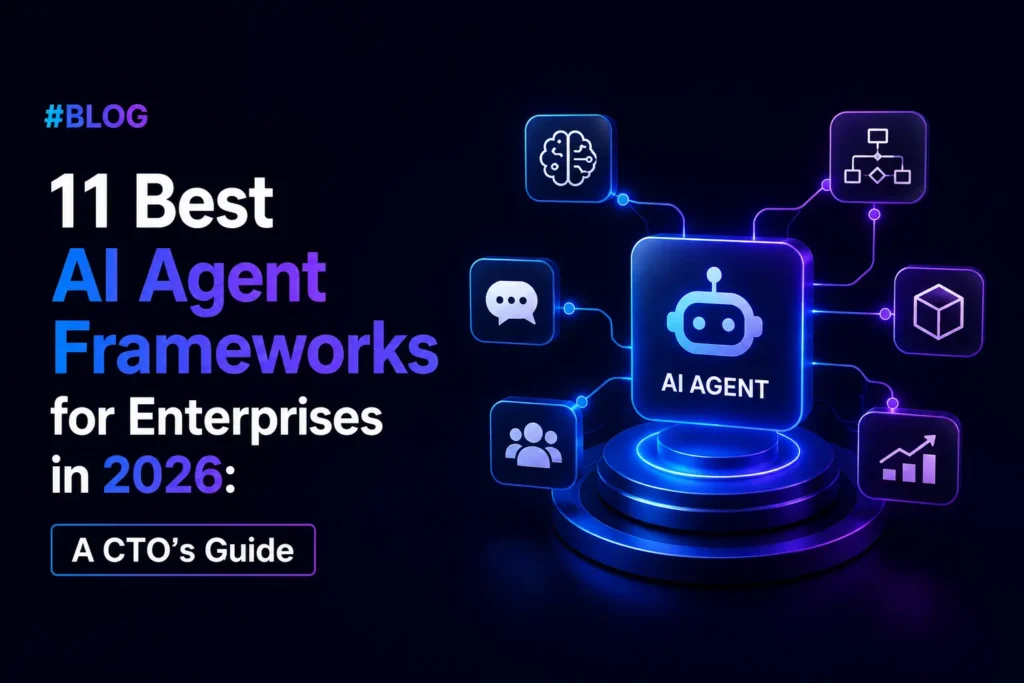
The best AI agent frameworks give your engineers the building blocks to create AI agents that reason, use tools, and complete multi-step work. In 2026, the choice matters more than ever, because the framework you pick shapes your security, governance, and how fast you reach production.
This CTO’s guide compares the 11 best AI agent frameworks for enterprise use, from LangGraph and CrewAI to Microsoft Agent Framework and Rasa. You will get a clear comparison table, how to choose, and where a framework ends and an enterprise AI platform like Wizr AI begins. Consider it a shortlist of the best AI agent frameworks 2026 has produced, written as a practical resource on the top AI agent frameworks for CTOs and engineering leaders.
The momentum is real. The AI agents market is projected to grow from $7.84 billion in 2025 to $52.62 billion by 2030, a 46.3% compound annual growth rate, according to MarketsandMarkets. Picking the right foundation now is how you stay ahead of that curve.
What Is an AI Agent Framework and Why Does It Matter for Enterprises?
An AI agent framework is a developer toolkit for building AI agents that can plan, call tools, remember context, and work together. It handles the hard parts of orchestration, state, and tool use so engineers do not rebuild them for every project.
Think of it as the engine, not the finished car. A framework gives you agent logic and coordination, while you still supply the models, data, hosting, security, and governance around it.
Why does this matter for enterprises? Because the framework sets the ceiling on what your agents can safely do. The right agentic AI framework supports multi-agent systems, connects to your data through RAG and the Model Context Protocol (MCP), and works with models like GPT-5, Claude, Gemini, Llama, and Mistral.
Adoption is climbing fast. Deloitte research shows that 25% of companies using generative AI are running agentic AI pilots in 2025, a share expected to reach 50% by 2027.
Here is what separates enterprise AI agent frameworks from hobby tools:
- Multi-agent orchestration: Coordinating several specialized agents on one goal.
- State and memory: Reliable handling of long-running, multi-step tasks.
- Security and governance: Access controls, audit trails, and guardrails.
- Deployment options: Self-hosting for control, or managed hosting for speed.
- Interoperability: Open standards like MCP and Agent-to-Agent (A2A) messaging.

The strongest options work as enterprise AI agent development frameworks and enterprise AI agent orchestration frameworks, while the enterprise AI agent governance frameworks and enterprise AI agent security frameworks give regulated teams the controls they need. For a deeper look at coordinating agents, see Wizr’s guide on building multi-agent applications.
AI Agent Framework Comparison: Features, Security and Enterprise Readiness
This AI agent frameworks comparison, which doubles as an agentic AI frameworks comparison, focuses on what enterprise buyers actually weigh: open-source status, multi-agent support, enterprise readiness, ideal use, and deployment. GitHub stars are fun, but they do not tell you if a framework will survive production. Because these AI agent orchestration frameworks vendors iterate fast, treat this as a living best AI agent frameworks 2025 2026 comparison.
| Framework | Open Source | Multi-Agent | Enterprise Ready | Best For | Deployment |
| LangGraph | Yes | Yes | High | Stateful production workflows | Self-host or LangGraph Platform |
| CrewAI | Yes | Yes | Medium to High | Role-based multi-agent teams | Self-host or CrewAI AMP |
| Microsoft Agent Framework | Yes (MIT) | Yes | High | Azure and .NET enterprises | Azure AI Foundry or self-host |
| Google ADK | Yes | Yes | High | Gemini and GCP-native agents | Vertex AI Agent Engine or self-host |
| OpenAI Agents SDK | Yes | Yes (handoffs) | Medium | Lightweight OpenAI-based agents | Self-host or OpenAI |
| AutoGen / AG2 | Yes | Yes | Medium | Multi-agent research and prototypes | Self-host |
| Semantic Kernel | Yes | Yes | High | Existing Microsoft enterprise apps | Self-host or Azure |
| LlamaIndex | Yes | Yes | Medium to High | RAG-heavy knowledge agents | Self-host or LlamaCloud |
| Agno | Yes | Yes | Medium | High-throughput agent teams | Self-host or Agno control plane |
| Mastra | Yes | Yes | Medium | TypeScript and web teams | Self-host or Mastra Cloud |
| Rasa | Yes (Rasa Pro) | Partial | High | Governed conversational agents | Self-host |
11 Best AI Agent Frameworks for Enterprise in 2026
Here are the 11 best AI agent frameworks for enterprise teams in 2026. Think of it as our agentic AI frameworks list 2026, covering the top agentic AI frameworks for enterprise and the strongest multi-agent AI frameworks for enterprise 2026. If you want the best agentic AI frameworks for enterprise 2026, start here. Each is a genuine, actively maintained option, with clear strengths and honest limitations.
1. LangGraph
LangGraph, from the LangChain team, is the default choice for stateful, production-grade agents. It models workflows as a graph, giving you explicit control over each step, plus checkpointing, crash recovery, and time-travel debugging.
This is the framework that answers “what happens when step 7 fails.” It powers agents at companies like Uber, LinkedIn, and JPMorgan, which is why it leads many top AI agent frameworks 2026 lists.
- Best for: Complex, stateful production workflows in regulated industries.
- Watch for: A steeper learning curve than lighter frameworks.
2. CrewAI
CrewAI is built around role-based multi-agent teams, or “crews.” You define each agent’s role in natural language, connect tools through MCP, and ship a working prototype in hours.
With more than 50,000 GitHub stars, it is one of the most popular AI agent frameworks 2026 has to offer. It is independent of LangChain and includes built-in memory.
- Best for: Rapid role-based multi-agent prototyping and content or research workflows.
- Watch for: Less low-level control than graph-based frameworks at large scale.
3. Microsoft Agent Framework
Microsoft Agent Framework reached 1.0 general availability in April 2026, unifying AutoGen and Semantic Kernel into one open-source SDK for Python and .NET. It combines AutoGen’s multi-agent orchestration with Semantic Kernel’s enterprise features.
It ships with graph-based workflows, built-in observability through OpenTelemetry, and native MCP and A2A support. Deep Azure AI Foundry integration makes it a natural fit for Microsoft-centric enterprises.
- Best for: Enterprises standardized on Azure and .NET.
- Watch for: Value is strongest inside the Microsoft ecosystem.
4. Google Agent Development Kit (ADK)
Google’s ADK treats agent development like software development. It is optimized for Gemini but stays model-agnostic through LiteLLM, and it offers SDKs for Python, TypeScript, Java, and Go.
It is strong on multi-agent collaboration, native A2A support, and managed deployment through Vertex AI Agent Engine. For GCP-based teams, it removes weeks of plumbing.
- Best for: Gemini and Google Cloud-native, multimodal agents.
- Watch for: Tightest integration is with the Google Cloud stack.
5. OpenAI Agents SDK
The OpenAI Agents SDK is the production evolution of the earlier Swarm experiment. It keeps things lightweight with four primitives: Agents, Handoffs, Guardrails, and Tools.
It now works with 100-plus models through the Chat Completions API, though tracing and advanced features are tuned for OpenAI. It is the fastest path to a working agent for OpenAI-first teams.
- Best for: Lightweight handoff-style agents like triage and routing.
- Watch for: Deepest features assume the OpenAI ecosystem.
6. AutoGen / AG2
AutoGen began as a Microsoft Research framework for event-driven, conversational multi-agent systems. It pioneered patterns like group chat and reflection that many frameworks now use.
AutoGen is now in maintenance mode, with its innovations folded into Microsoft Agent Framework, while AG2 continues as a community-driven fork. It remains useful for research and experimentation.
- Best for: Multi-agent research and academic experimentation.
- Watch for: New enterprise work should target Microsoft Agent Framework.
7. Semantic Kernel
Semantic Kernel is Microsoft’s enterprise-grade SDK for embedding AI into applications, with support for .NET, Python, and Java. It brought session state, type safety, and telemetry to agent development.
Like AutoGen, it is now succeeded by Microsoft Agent Framework, though Microsoft will support it for existing users during the transition. It still suits teams with mature Semantic Kernel deployments.
OpenAI. It is the fastest path to a working agent for OpenAI-first teams.
- Best for: Lightweight handoff-style agents like triage and routing.
- Watch for: Deepest features assume the OpenAI ecosystem.
6. AutoGen / AG2
AutoGen began as a Microsoft Research framework for event-driven, conversational multi-agent systems. It pioneered patterns like group chat and reflection that many frameworks now use.
AutoGen is now in maintenance mode, with its innovations folded into Microsoft Agent Framework, while AG2 continues as a community-driven fork. It remains useful for research and experimentation.
- Best for: Multi-agent research and academic experimentation.
- Watch for: New enterprise work should target Microsoft Agent Framework.
7. Semantic Kernel
Semantic Kernel is Microsoft’s enterprise-grade SDK for embedding AI into applications, with support for .NET, Python, and Java. It brought session state, type safety, and telemetry to agent development.
Like AutoGen, it is now succeeded by Microsoft Agent Framework, though Microsoft will support it for existing users during the transition. It still suits teams with mature Semantic Kernel deployments.
- Best for: Enterprises maintaining existing Semantic Kernel applications.
- Watch for: New projects should plan a path to Microsoft Agent Framework.
8. LlamaIndex
LlamaIndex is the go-to framework when your agents live on top of enterprise knowledge. It excels at Retrieval-Augmented Generation, connecting agents to documents, databases, and vector stores.
Its AgentWorkflow system adds multi-agent orchestration to that strong data foundation. For knowledge-heavy use cases, it reduces hallucinations by grounding answers in your data.
- Best for: RAG-heavy knowledge agents and document intelligence.
- Watch for: Orchestration is less mature than dedicated agent frameworks.
9. Agno
Agno, formerly Phidata, is a high-performance runtime built for speed and scale. It instantiates agents extremely fast and is designed for teams and swarms of specialized agents.
It is model-agnostic, includes built-in memory and knowledge, and adds a control plane to manage deployments at scale. It suits high-throughput workloads over complex orchestration.
- Best for: Large numbers of agents at high request volumes.
- Watch for: Less structured than role- or graph-based frameworks.
10. Mastra
Mastra is a TypeScript-first framework from the team behind Gatsby. It brings agents, workflows, RAG, evals, and memory to the JavaScript ecosystem, with more than 300,000 weekly npm downloads.
Its workflow engine uses intuitive control flow with branching, parallel steps, and human-in-the-loop pauses. For teams already building in TypeScript, it removes the Python tax.
- Best for: TypeScript and web teams building agent-native apps.
- Watch for: A younger ecosystem than the leading Python frameworks.
11. Rasa
Rasa is a mature open-source framework for conversational AI agents. Its CALM approach blends large language models with reliable, controllable dialogue, which matters in regulated settings.
It supports self-hosted, governed deployments, giving enterprises full control and data ownership. Rasa Pro adds commercial, enterprise-grade capabilities on top of the open-source core.
- Best for: Governed, self-hosted conversational assistants.
- Watch for: Requires conversational AI expertise to run well.
How to Choose the Best AI Agent Framework for Your Enterprise in 2026
Choosing the right framework starts with your constraints, not the hype. Follow these steps to narrow the field quickly and pick with confidence.
- Start with your language and stack. Python teams look at LangGraph, CrewAI, or Google ADK. TypeScript teams look at Mastra. Azure and .NET teams look at Microsoft Agent Framework.
- Match complexity to the framework. Use lightweight SDKs for simple agents, and graph-based frameworks like LangGraph for complex, stateful workflows.
- Check multi-agent needs. If several agents must collaborate, prioritize strong orchestration and clear handoffs.
- Weigh security and governance. Confirm access controls, audit trails, and data handling meet your compliance bar.
- Plan deployment. Decide between self-hosting for control and managed hosting for speed.
- Test in production conditions. Run a scoped pilot on real data before you commit.
What is the most common framework selection mistake?
The biggest mistake is choosing popularity instead of fit. A framework that is perfect for rapid prototyping can struggle with stateful, regulated production work, and the reverse is also true.
This is why so many projects stall. Gartner predicts that over 40% of agentic AI projects will be canceled by the end of 2027, often due to unclear value or weak governance. Choosing for production, not demos, is how you avoid that fate.
AI Agent Framework vs. Enterprise AI Platform: Which Is Right for Your Organization?
This is the question most CTOs miss. A framework and an enterprise AI platform solve different problems, and many enterprises need both.
An AI agent framework is a toolkit your engineers use to build agents. You still own the models, data pipelines, hosting, security, governance, and ongoing operations. That means full control, but also full responsibility.
An enterprise AI platform gives you the runtime, governance, integrations, and often pre-built agents to deploy and scale in production. It handles the operational layer that frameworks leave to you.
The clearest way to see the difference is side by side:
| Dimension | AI Agent Framework | Enterprise AI Platform |
| What it is | A developer toolkit to build agents | A managed environment to run and govern agents |
| Who operates it | Your engineering team | The platform, with your team configuring it |
| Time to value | Slower, you build the operational layer | Faster, the runtime and agents are ready |
| Governance and security | Your responsibility to add | Built in, with audit trails and access controls |
| Customization | Very high, full code control | High, within platform guardrails |
| Best owner | AI-mature engineering teams | Teams that need production speed and control |
Think of it as a maturity curve. Early on, a framework gives your engineers room to experiment and learn. As agents move toward production, the operational weight of hosting, monitoring, security, and compliance grows fast, and that is where an enterprise AI platform earns its place. Many enterprises land on a hybrid model, building specialized agents with a framework and running them on a platform for governance and scale.
Here is the simple way to decide:
- Choose a framework if you have strong in-house AI engineering, need deep customization, and want to own every layer.
- Choose an enterprise AI platform if you want faster time to value, built-in governance, and production support.
- Choose both if you want to build custom agents with a framework while running and governing them on a platform.
This matters because building is the easy part. MIT research found that roughly 95% of enterprise generative AI pilots fail to deliver measurable business impact, usually because of weak operations and governance, not weak models. A platform closes that gap. For more, read Wizr’s take on why enterprise AI pilots fail to reach production.
How Wizr AI Helps Enterprises Build, Deploy, and Govern AI Agents at Scale
Wizr AI goes beyond the framework itself by combining Enterprise AI Services and AI-powered solutions to help enterprises build, deploy, govern, and scale AI agents in production. This combination addresses a common gap in framework-only projects, where moving from experimentation to reliable enterprise deployment can require significant engineering and operational effort.
Wizr helps enterprises build AI agents, AI assistants, and agentic workflows using their own data and existing technology environments. Its framework-friendly, model-agnostic approach allows teams to work with agents built using technologies such as LangGraph, CrewAI, or the Microsoft Agentic AI Framework while getting support for deployment, integration, security, monitoring, and governance.
That framework-friendly approach matters for enterprises evaluating the options on this list. Teams can prototype with LangGraph, CrewAI, or the Microsoft Agent Framework and then work with Wizr to deploy, monitor, secure, and govern those agents in production. This gives enterprises the flexibility of open frameworks while reducing the operational complexity involved in managing hosting, security, integrations, and observability.
Governance is an important part of moving AI agents beyond pilots. Wizr is SOC 2 Type II and ISO 27001 compliant, with access controls, audit trails, and human-in-the-loop guardrails designed to support the security and governance requirements of regulated enterprises.
Scaling is another critical consideration. Wizr helps enterprises orchestrate multi-agent workflows across departments, with monitoring and cost controls that support reliable operation as AI use cases expand. This allows organizations to move from individual use cases, such as a customer support agent, toward broader enterprise-wide AI automation without rebuilding their approach for every new workflow.
Wizr also shortens time to value with pre-built, configurable AI agents for customer support, IT support, and finance, so teams do not have to start every use case from scratch. When organizations need additional customization, Wizr’s Enterprise AI Services and custom AI application development services support strategy, custom agent development, implementation, and scaling.
The results show up where it counts. Across customers, 90% of Wizr pilots reach production, addressing the critical stage where many agent projects stall. For one logistics SaaS firm, Wizr’s customer support agents delivered up to 50% faster response times and deflected around 43% of support tickets, turning agent potential into measurable business outcomes. With enterprises such as Chrysler, Project44, and Fragomen already on board, Wizr helps organizations move AI agents from experimentation to enterprise-scale implementation. Talk to the Wizr team to see how it fits your stack.
Conclusion
The best AI agent frameworks in 2026 give enterprises powerful ways to build agents, from LangGraph and CrewAI to Microsoft Agent Framework, Google ADK, and Rasa. The right pick depends on your stack, your complexity, and your governance needs.
But building agents is only part of the journey. Deploying, securing, governing, integrating, and scaling them in production is where organizations need additional engineering and operational support. When you are ready to move from framework experimentation to production, explore how Wizr AI’s Enterprise AI Services and AI-powered solutions can help you build, deploy, and govern AI agents at scale.
FAQs
1. What is the best AI agent framework in 2026?
There is no single best AI agent framework, since the right choice depends on your stack and goals. LangGraph leads for stateful production workflows, CrewAI for rapid multi-agent prototyping, and Microsoft Agent Framework for Azure and .NET teams.
Match the framework to your language, complexity, and governance requirements. If you also need support deploying and governing agents in production, Wizr AI’s Enterprise AI Services complement these frameworks with implementation, integration, deployment, and governance support.
2. What are the best open source AI agent frameworks?
Most leading frameworks are open source, which gives you flexibility and control. Strong open source AI agent frameworks 2026 buyers rely on, and the open source AI agent frameworks 2026 most cited by engineers, include:
- LangGraph for stateful, graph-based orchestration.
- CrewAI for role-based multi-agent teams.
- Microsoft Agent Framework for Azure and .NET, under an MIT license.
- Agno and Mastra for high-throughput and TypeScript teams.
These open source agentic AI frameworks for enterprise give teams control, but organizations still need to manage hosting, security, integrations, monitoring, and governance. Among the best open source AI agent frameworks 2026 has to offer, the key trade-off is operational ownership. Wizr AI provides Enterprise AI Services and AI-powered solutions to help enterprises deploy, integrate, secure, and govern open-source agents in production.
3. What is the difference between an AI agent framework and an enterprise AI platform?
A framework is a toolkit your engineers use to build agents, leaving you to handle models, hosting, security, and operations. An enterprise AI platform provides the runtime, governance, and integrations to deploy and scale agents in production.
Frameworks provide flexibility and development control, while enterprise platforms can help centralize operational capabilities. Wizr AI takes a services-led approach, helping enterprises build, deploy, integrate, govern, and scale AI agents through Enterprise AI Services and AI-powered solutions rather than positioning itself as an AI platform.
4. Do enterprises need multi-agent AI frameworks?
Many do, because complex work often needs several specialized agents that collaborate. Multi-agent AI frameworks for enterprise, like LangGraph, CrewAI, and Microsoft Agent Framework, coordinate these agents on a shared goal.
Single-agent setups can still be appropriate for simpler tasks. Wizr AI helps enterprises design and implement multi-agent workflows, supporting orchestration, integration, monitoring, and governance as organizations scale their AI use cases.
5. How do AI agent frameworks handle security and governance?
Frameworks provide building blocks like guardrails and logging, but most enterprise-grade security and governance is your responsibility to implement. That includes access controls, audit trails, and compliance.
This is a common consideration when moving agents into production. Wizr AI supports enterprise AI governance with SOC 2 Type II and ISO 27001 compliance, role-based access, audit trails, and human-in-the-loop controls, helping organizations establish the security and governance practices needed to operate AI agents at scale.
About Wizr AI
Wizr AI helps enterprises build autonomous enterprises and accelerate product and software engineering with practical, production-ready AI. We help organizations automate business workflows, modernize legacy applications and digital platforms, and build intelligent AI solutions.
Our core services include Enterprise AI Services, AI-Powered Engineering & Legacy Modernization, AI Product Engineering, and AI Governance. We also leverage AI Assembly capabilities, including the Agentic AI Framework, Agentic Workflows, Security, and Integrations.
Through our AI solutions, including AI Agents, Pharma & Life Sciences AI, Oracle AI, and Salesforce AI, we help enterprises apply AI across business and technology needs.
See how we can help your enterprise move faster with AI. 👉 Talk to an AI Expert.


![Agentic AI vs AI Agents: Key Differences Every CIO Must Know [2025 Guide]](https://wizr.ai/wp-content/uploads/2025/07/Agentic-AI-vs-AI-Agents.webp)
![Agentic AI vs Traditional Automation: Why Enterprises Shift for Better CX [2025]](https://wizr.ai/wp-content/uploads/2025/06/Agentic-AI-vs-Traditional-Automation.webp)


![11 Real-World AI Agents Examples + Use Cases for Enterprises [2025]](https://wizr.ai/wp-content/uploads/2025/05/AI-Agents-Examples-Use-Cases.webp)