Finance teams today deal with large volumes of data across multiple systems. At the same time, you must close books quickly, maintain compliance, and provide accurate insights to leadership. Yet many teams still spend hours on routine tasks such as invoice processing, reconciliations, and report preparation.
When too much time goes into manual work, it becomes harder to focus on analysis, forecasting, and planning. As operations grow more complex, finance teams need better ways to manage these processes with finance workflow automation.
Artificial intelligence is starting to change how financial work gets done. According to a survey, 80.5% of finance and accounting professionals believe AI agents in finance and accounting will become standard tools within five years. This shows that many organizations expect automation to play a bigger role in finance operations and highlights the growing benefits of AI agents in the finance industry.
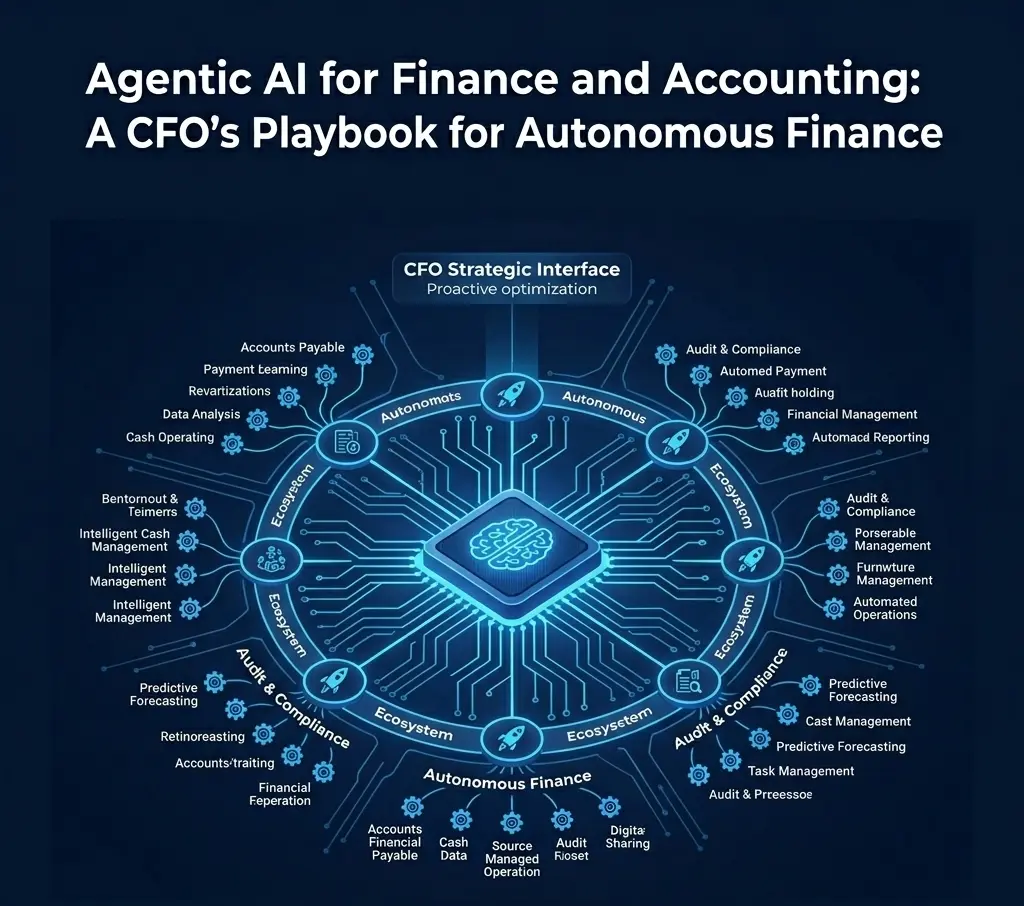
That is why more companies are exploring Agentic AI for Finance and Accounting. AI agents in finance can monitor financial activity, analyze data, and complete routine tasks across systems. Instead of coordinating every step manually, your team can rely on AI to manage these workflows through AI workflow automation for finance.
In this guide, you will learn what autonomous finance means, how agentic AI works in finance operations 2026, and how CFOs can move from manual workflows to AI-driven finance systems.
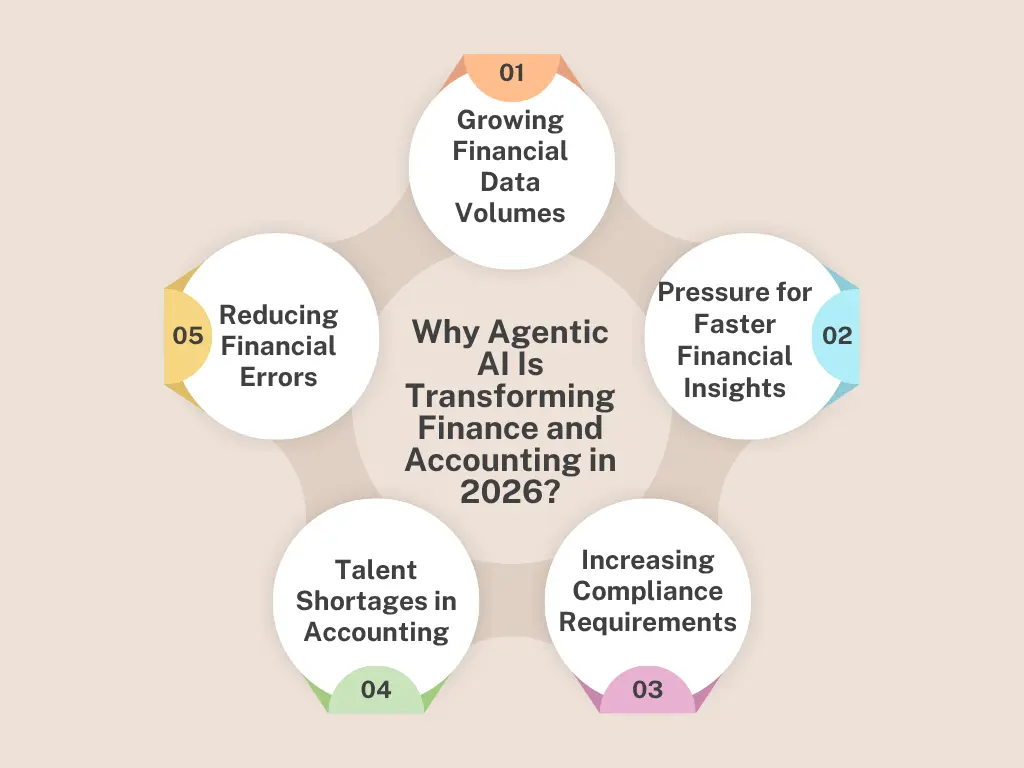
Why Agentic AI Is Transforming Finance and Accounting in 2026?
Finance operations have grown more complex as organizations rely on multiple systems for billing, procurement, payroll, and accounting. Each system produces data that must be verified, reconciled, and analyzed. As expectations for speed and accuracy increase, many teams are exploring Agentic AI in finance and Agentic AI applications in finance to handle this growing operational load.
1. Growing Financial Data Volumes
Modern enterprises process a large number of financial transactions every day. Payments, subscriptions, vendor invoices, payroll updates, and expense claims constantly enter finance systems.
These records move across platforms such as ERP systems, payment gateways, procurement tools, and CRM applications. Finance teams must confirm that data stays consistent across all these systems.
AI agents accounting automation helps manage this volume more effectively. AI agents in finance and accounting review financial data continuously and identify inconsistencies or unusual patterns. Instead of checking transactions manually, your team can rely on automated monitoring to detect issues early.

2. Pressure for Faster Financial Insights
Business leaders increasingly expect real-time visibility into financial performance. Waiting until the end of the month to analyze results often delays important decisions.
Agentic AI in finance tracks financial activity as transactions occur. They can update dashboards, generate alerts, and prepare reports automatically.
This allows finance teams to provide faster insights to leadership. With quicker access to financial data, your organization can respond sooner to revenue shifts, cost increases, or operational changes, one of the key Agentic AI finance use cases.
3. Increasing Compliance Requirements
Regulatory and audit requirements continue to expand across industries. Finance teams must ensure that transactions follow accounting standards, tax regulations, and internal policies.
Manual compliance checks can slow operations and create inconsistencies. Reviewing thousands of transactions individually is not always practical.
AI agents in finance teams can apply compliance rules automatically across financial systems. They validate transactions against defined policies and flag exceptions for review. This reflects how AI agents work in finance teams in real-world scenarios and helps maintain stronger controls while reducing manual oversight.
4. Talent Shortages in Accounting
Many organizations face a shortage of skilled accounting professionals. At the same time, financial workloads continue to increase.
This creates pressure on existing teams to handle more tasks without additional resources.
The benefits of AI agents in the finance industry become clear here. AI agents accounting automation performs repetitive work such as document extraction, invoice matching, and reconciliation tasks. Finance professionals can then focus on financial analysis, forecasting, and business planning.
5. Reducing Financial Errors
Manual financial processes often introduce errors. Incorrect data entry, missed reconciliations, or duplicate records can affect financial reports.
These issues may not appear immediately, but can create complications during financial close cycles or audits.
AI systems validate financial data automatically. They compare information across systems and highlight discrepancies that require attention. This continuous validation helps improve data accuracy and reporting reliability.
Agentic AI applications in finance validate financial data automatically. They compare information across systems and highlight discrepancies that require attention. This supports key Agentic AI use cases in finance by improving data accuracy and reporting reliability.
Also Read: AI Agents in Finance: Automate Workflows & Reporting at Scale
What Autonomous Finance Means for Modern CFOs?
Autonomous finance refers to financial operations where AI agents manage routine workflows with minimal human involvement. These AI agents in finance and accounting monitor financial activity, process transactions, and trigger actions across systems.
For CFOs, this changes how finance teams operate. Instead of coordinating every process manually, your team oversees AI-driven workflows and focuses on financial analysis, planning, and decision support.
To understand this shift, it helps to compare traditional finance operations with an autonomous finance model.
1. Traditional Finance Workflows
Many finance teams still rely on manual steps to manage daily operations. Even with accounting software and ERP systems, several processes require human involvement.
Your team typically handles tasks such as:
- Data entry and transaction validation
- Invoice processing and approval routing
- Purchase order and invoice matching
- Expense audits and policy checks
- Account reconciliations
- Financial report preparation
These workflows often involve multiple systems and departments. Teams must verify data, move information between tools, and coordinate approvals. While these steps maintain financial accuracy, they also slow down operations and reporting cycles.
2. Autonomous Finance Workflows
Autonomous finance replaces many of these manual steps with AI-driven processes. Agentic AI in finance operates across systems and manages workflows continuously.
In this model, AI systems can:
- Collect financial data from enterprise platforms
- Validate transactions and invoices against rules
- Monitor financial activity in real time
- Identify anomalies or compliance risks
- Generate financial reports automatically
- Trigger alerts and approval workflows
Because these agents work continuously, finance operations become faster and more consistent.
Your team then focuses on reviewing outputs, resolving exceptions, and interpreting financial insights. This allows finance leaders to spend more time on planning, forecasting, and performance management.
3. The Shift Toward Autonomous Finance
Adoption of this model is still developing, but interest is increasing quickly. A Wolters Kluwer survey shows that only 6 percent of finance leaders currently use agentic AI, while 44 percent expect to adopt it by 2026.
This trend reflects a growing shift toward Agentic AI for finance and accounting 2026. As transaction volumes increase and reporting timelines tighten, autonomous finance helps organizations maintain accuracy while improving operational speed with AI agents accounting automation.
How Agentic AI Works in Finance and Accounting?
To understand the value of Agentic AI for Finance and Accounting, you need to see how these systems operate inside finance workflows and how agentic AI works in finance 2026.
Traditional automation follows predefined rules and triggers. It executes tasks but cannot interpret context or make decisions. Agentic AI in finance introduces intelligent agents that monitor financial activity, analyze data, and determine the next action based on policies and historical patterns.
This allows finance operations to move from task-based automation to decision-driven workflows. Instead of coordinating every step manually, your systems respond automatically when financial events occur.
Several core components enable this model.
1. AI Agents with Defined Roles
AI agents in finance and accounting systems rely on multiple AI agents, each responsible for a specific finance function.
Each agent monitors certain activities and performs actions when conditions match defined rules. This structure helps finance teams automate processes without losing visibility into operations.
For example, organizations may deploy agents that manage:
- accounts payable workflows
- expense monitoring
- financial reconciliation
- compliance tracking
An accounts payable agent can review invoices and match them with purchase orders. A reconciliation agent can compare transactions across systems and highlight discrepancies.
By assigning clear responsibilities to each agent, finance teams create an organized automation framework where tasks run continuously without constant manual intervention.
2. Integration with Enterprise Systems
Finance data flows through many enterprise systems. Transactions may originate in procurement tools, billing platforms, or customer management systems before appearing in accounting records.
Agentic AI platforms in finance connect directly with these systems to access financial data and execute tasks.
Common integrations include:
- ERP platforms
- accounting systems
- billing and payment platforms
- procurement software
- CRM tools
These integrations allow AI agents to retrieve financial information, validate transactions, and update records across systems. For example, an agent can receive invoice data from a procurement platform, verify it in the ERP system, and update accounting entries automatically.
This connectivity removes the need for manual data movement between systems and keeps financial records synchronized.
3. Decision and Reasoning Models
Agentic AI in finance uses advanced models to interpret financial information and guide decisions.
Large language models and machine learning algorithms analyze both structured data and financial documents. This includes invoices, contracts, payment records, and expense reports.
These models help agents identify key details such as payment terms, transaction patterns, and approval rules. The system then evaluates this information against company policies and accounting standards.
Based on this analysis, the agent determines the appropriate response. It may approve a transaction, flag inconsistencies, or send alerts for further review.
This capability allows AI systems to manage decision-based workflows rather than simply executing predefined instructions.
4. Workflow Execution
After determining the required action, the AI agent completes the workflow automatically using AI workflow automation for finance.
Tasks are executed directly within connected finance systems. This removes the need for teams to manually trigger each step.
Common automated actions include:
- approving invoices that meet policy requirements
- updating financial records in ERP systems
- sending approval requests or alerts
- generating financial summaries and reports
Because these workflows run continuously, transactions move faster through finance processes. Teams can focus on reviewing insights rather than managing operational tasks.
Automation also improves consistency. Every transaction follows the same validation checks and approval logic.
5. Governance and Oversight
Finance operations require strong governance, especially when automated systems execute financial actions.
AI agents in finance teams operate within defined governance frameworks. Agentic AI platforms record every decision and workflow step through detailed audit logs. Finance leaders can review these records to confirm that actions follow internal policies and regulatory requirements.
Clear governance frameworks help organizations maintain transparency and accountability. According to a Deloitte poll, 59.7% of finance professionals say they trust AI agents only when they operate within defined governance structures.
This reinforces an important principle. AI agents can manage routine workflows, but finance teams still maintain oversight and final accountability for financial decisions.
Also Read: AI Agentic Workflows: Key Benefits & Use Cases for Enterprises
Key Finance and Accounting Processes That Agentic AI Can Automate
Many finance workflows follow structured rules and predictable data patterns. Because of this, they are well-suited for automation. Agentic AI for Finance and Accounting can monitor transactions, validate data, and complete routine tasks across systems. This allows your finance team to focus on analysis and decision-making instead of operational work.
Below are key finance processes where agentic AI can support automation.
1. Accounts Payable Automation
Accounts payable teams process large volumes of invoices every month. Each invoice must be reviewed, matched with purchase orders, and approved before payment.
AI agents can:
- Extract invoice data from emails or documents
- Match invoices with purchase orders
- Verify supplier and payment details
- Detect duplicate or incorrect invoices
- Route invoices for approval
This reduces manual effort and helps complete payment cycles faster with AI agents accounting automation.
2. Accounts Receivable Monitoring
Late payments affect cash flow and forecasting. Finance teams must track receivables closely.
AI agents in finance monitor outstanding invoices, send payment reminders, and flag overdue accounts. They can also analyze payment patterns to identify customers who may delay payments.
3. Financial Close and Reconciliation
Financial close requires comparing records across multiple systems. This process often takes significant time.
Agentic AI in finance automatically compares financial data and highlights mismatches. This helps teams complete reconciliations faster and shorten close cycles.
4. Expense Monitoring
Expense reviews require checking receipts, categories, and policy compliance.
AI workflow automation for finance enables AI agents to review expense submissions and verify them against company policies. They can also flag duplicate claims or unusual expenses so teams review only the exceptions.
5. Compliance Monitoring
Finance teams must ensure transactions follow internal policies and regulatory requirements.
Agentic AI applications in finance monitor financial activity continuously, flag policy violations, and maintain audit records. This supports compliance and simplifies audit preparation.
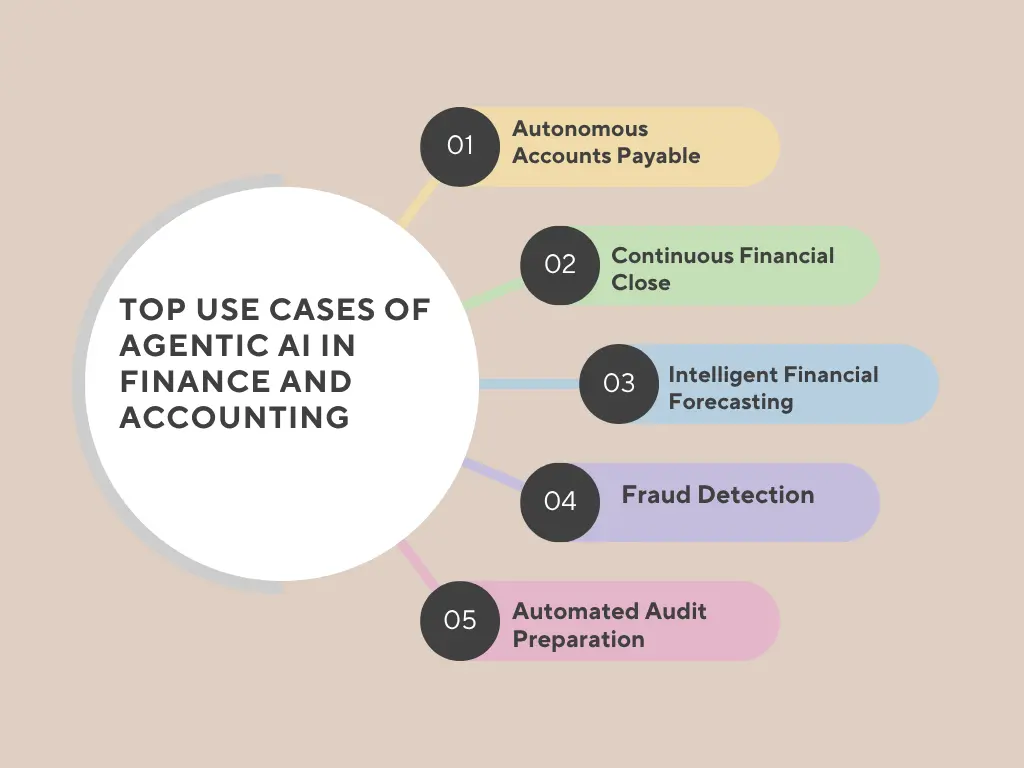
Top Use Cases of Agentic AI in Finance and Accounting
Organizations can apply Agentic AI for Finance and Accounting across several finance workflows. AI agents monitor financial activity, connect data across systems, and complete routine tasks with minimal manual input.
Here are some key use cases.
1. Autonomous Accounts Payable
Accounts payable often involves collecting invoices, verifying details, matching purchase orders, and routing approvals.
AI agents manage this workflow automatically. They capture invoices from email or vendor portals, extract key data, validate supplier information, and match invoices with purchase orders.
Typical steps include:
- Capturing invoices from email or portals
- Extracting invoice details
- Matching invoices with purchase orders
- Validating supplier information
- Triggering payment approvals
This reduces processing time and manual errors.
2. Continuous Financial Close
Month-end closing requires reconciliation across multiple systems.
Agentic AI in finance updates and reconciles financial records throughout the month. This allows teams to detect discrepancies earlier and produce reports faster.
3. Intelligent Financial Forecasting
AI agents analyze historical financial data and identify trends in revenue and expenses.
Agentic AI applications in finance generate forecasts and simulate different scenarios, helping finance leaders make better budgeting and planning decisions.
4. Fraud Detection
AI agents monitor financial transactions continuously and analyze patterns.
When unusual activity appears, the system flags it for review. This helps finance teams detect fraud early and reduce financial risk.
5. Automated Audit Preparation
Audit preparation requires collecting financial records and documentation.
AI workflow automation for finance enables AI agents to organize financial data and generate reports needed by auditors. This shortens preparation time and improves audit readiness.
Also Read: Agentic AI vs. AI Agents: Key Differences Every CIO Must Know [2026 Guide]
How CFOs Can Transition from Manual Finance Processes to Autonomous Finance
Moving to autonomous finance requires a phased approach. Instead of automating everything at once, you start with the right processes, build a reliable data foundation, and expand gradually. This helps you adopt Agentic AI for Finance and Accounting without disrupting existing workflows.
1. Identify Automation Opportunities
Start with finance tasks that involve repetitive manual work. These processes usually follow clear rules and occur frequently.
Common examples include:
- Invoice processing
- Expense validation
- Account reconciliation
- Financial report generation
Automating these areas reduces manual workload and improves operational efficiency.
2. Improve Data Quality
AI systems rely on accurate financial data. Before introducing automation, ensure your financial data is consistent across systems.
Focus on:
- Standardizing financial data formats
- Integrating ERP and accounting platforms
- Validating financial records
Clean data improves the accuracy of AI-driven workflows.
3. Establish Governance Policies
Finance operations require strong oversight. Define policies that guide how AI systems operate.
Key areas include:
- Payment approval thresholds
- Exception handling procedures
- Audit and monitoring controls
Governance ensures AI actions align with financial policies and compliance requirements.
4. Start with Pilot Implementations
Begin with one or two workflows where automation can deliver quick results, such as accounts payable or expense reviews.
Test performance, refine the process, and expand automation gradually.
5. Prepare Finance Teams for AI Collaboration
As automation increases, finance teams focus less on manual tasks and more on analytical work.
Their responsibilities shift toward:
- Financial analysis
- Forecasting
- Strategic planning
Training helps teams adapt to this change and work effectively with AI systems.
Also Read: How Enterprises Are Scaling Agentic AI Beyond Pilots in 2026
How Wizr AI Helps CFOs Build Autonomous Finance with Agentic AI
Moving from manual finance workflows to autonomous operations requires the right technology foundation. You need AI that integrates with your existing systems, adheres to governance policies, and supports decision-making. This is where Wizr AI helps CFOs adopt Agentic AI for Finance and Accounting through enterprise AI services and intelligent automation solutions.
How Wizr AI supports autonomous finance
- Unified system integrations: Connects with ERP, CRM, billing, and finance platforms so AI agents can access and process financial data in real time.
- AI agents for finance workflows: Automates tasks such as invoice validation, reconciliation, expense checks, and document-driven finance workflows like invoice matching and cash application.
- Built-in governance and auditability: Applies approval rules, policy checks, and audit logs to ensure automated finance processes follow compliance requirements, with enterprise-grade security and controls.
- Real-time financial insights: Generates reports, flags anomalies, and helps CFOs track financial performance faster using AI-driven data processing.
Next step for finance leaders
If you want to explore how Agentic AI for Finance and Accounting can support autonomous finance operations, visit and learn how Wizr AI helps enterprises implement AI agents and agentic workflows across finance functions through Enterprise AI Services and AI-powered automation solutions.
Final Thoughts
Finance operations are moving toward a model where routine financial work no longer depends on constant manual effort. With Agentic AI for Finance and Accounting, intelligent agents can monitor transactions, trigger workflows, and complete repetitive finance tasks automatically. This shift helps you close books faster, maintain compliance, and give leadership timely financial insights while your finance team focuses on planning, analysis, and strategic decisions.
Wizr AI supports this transition by helping enterprises design and implement AI-driven workflows across finance systems. Its AI agents can connect with ERP platforms, accounting tools, and enterprise data sources to automate processes such as invoice validation, financial reporting, reconciliation, and exception handling. This allows CFOs to introduce autonomous finance capabilities without disrupting existing operations.
FAQs
1. What is Agentic AI for Finance and Accounting, and how is it different from traditional automation?
Agentic AI for Finance and Accounting uses intelligent AI agents to manage finance workflows end-to-end. Unlike rule-based automation, AI agents in finance and accounting can analyze data, make decisions, and trigger actions autonomously.
For example, instead of just routing invoices, AI agents can validate, detect anomalies, and approve them based on policies.
Wizr AI supports this shift through Enterprise AI Services, AI agents, agentic workflows, and integrations, helping enterprises implement scalable AI workflow automation for finance.
2. How does Agentic AI work in finance teams in 2026?
To understand how agentic AI works in finance 2026, think of AI agents continuously monitoring financial data and acting in real time.
They typically:
- Analyze data from ERP and accounting systems
- Detect anomalies or compliance issues
- Trigger workflows like approvals or reconciliations
This is how AI agents in finance teams move operations from manual tasks to decision-driven workflows.
Wizr AI supports this with Enterprise AI Services and AI Assembly capabilities that help orchestrate AI agents across systems, along with implementation, governance, and optimization services.
3. What are the top Agentic AI finance use cases in finance and accounting?
Common Agentic AI finance use cases include:
- Accounts payable automation
- Financial close and reconciliation
- Expense and compliance monitoring
- Fraud detection
- Audit preparation
These Agentic AI applications in finance help automate repetitive tasks and improve speed and accuracy.
With Wizr AI, enterprises can implement configurable AI agents and automate finance workflows across connected systems.
4. What are the benefits and ROI of implementing AI agents in finance?
The benefits of AI agents in the finance industry include faster processes, fewer errors, and better decision-making.
Key outcomes:
- Faster financial close cycles
- Improved compliance and accuracy
- Real-time financial insights
- Higher team productivity
The ROI of implementing AI agents in finance comes from reduced manual effort and faster reporting.
Wizr AI helps deliver this through secure, scalable AI automation supported by enterprise-grade governance, integrations, and AI services.
5. How can CFOs get started with Agentic AI for finance and accounting?
CFOs should take a phased approach to adopting Agentic AI for finance and accounting 2026.
Start by:
- Automating repetitive processes (AP, expenses)
- Ensuring clean and structured data
- Running pilot use cases
- Setting governance policies
This helps teams understand how do AI agents work in finance teams while minimizing risk.
Wizr AI supports this journey with Enterprise AI Services and AI Assembly capabilities to help enterprises build, implement, and scale AI agents and workflows across finance functions, enabling a smooth transition to autonomous finance.
About Wizr AI
Wizr AI helps enterprises build autonomous enterprises and accelerate product and software engineering with practical, production-ready AI. We help organizations automate business workflows, modernize legacy applications and digital platforms, and build intelligent AI solutions.
Our core services include Enterprise AI Services, AI-Powered Engineering & Legacy Modernization, AI Product Engineering, and AI Governance. We also leverage AI Assembly capabilities, including the Agentic AI Framework, Agentic Workflows, Security, and Integrations.
Through our AI solutions, including AI Agents, Pharma & Life Sciences AI, Oracle AI, and Salesforce AI, we help enterprises apply AI across business and technology needs.
See how we can help your enterprise move faster with AI. 👉 Talk to an AI Expert.




![Agentic AI vs AI Agents: Key Differences Every CIO Must Know [2025 Guide]](https://wizr.ai/wp-content/uploads/2025/07/Agentic-AI-vs-AI-Agents.webp)
![Agentic AI vs Traditional Automation: Why Enterprises Shift for Better CX [2025]](https://wizr.ai/wp-content/uploads/2025/06/Agentic-AI-vs-Traditional-Automation.webp)


![11 Real-World AI Agents Examples + Use Cases for Enterprises [2025]](https://wizr.ai/wp-content/uploads/2025/05/AI-Agents-Examples-Use-Cases.webp)