Enterprise AI teams are sitting at a crossroads in 2026. On one side, traditional keyword and semantic search has served organizations well for years. On the other side, Agentic Retrieval-Augmented Generation (RAG) is rewriting the rules of how AI applications find, reason over, and deliver information.
The question is no longer whether to adopt AI-powered search. Most enterprises already have. The real question is: which retrieval architecture actually fits the complexity of modern enterprise workflows?
In this blog, we break down both approaches, highlight where each one shines, and help you make a smarter architectural decision for your AI application.
What Is Traditional Search in Enterprise AI?
Traditional search in enterprise AI typically refers to keyword-based or vector/semantic search. You have a query, the system scans an index, ranks results by relevance, and returns them. Simple, predictable, and fast.
Many enterprise AI apps built in 2023 and 2024 rely on this model. A user asks a question, the retriever pulls the top-K relevant chunks from a vector store, and a language model synthesizes an answer. Known as basic RAG, it works reasonably well for straightforward, single-hop queries.

Here is what makes traditional search appealing:
- Low latency and high throughput
- Straightforward to implement and maintain
- Well-suited for FAQ systems and document lookups
- Easy to audit since retrieval is deterministic
But here is the catch. Enterprise knowledge is not flat. A single business question often spans multiple documents, databases, APIs, and logic layers. Traditional search retrieves. It does not reason. And in 2026, that gap is becoming a serious bottleneck. Organizations building next-generation AI search and knowledge systems often rely on Custom AI Application Development Services to design agentic architectures, enterprise RAG frameworks, and intelligent retrieval systems tailored to complex business workflows.
Enter Agentic RAG: A Smarter Way to Retrieve and Reason
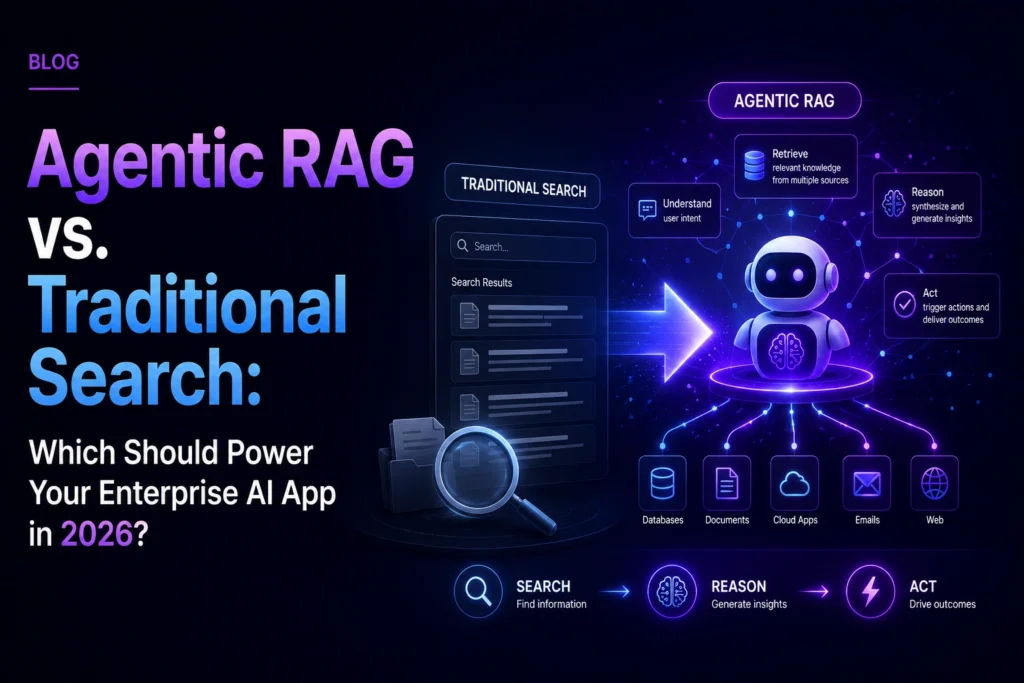
Agentic RAG takes retrieval beyond a single lookup. Instead of firing one query and calling it done, an agentic system breaks complex questions into sub-tasks, decides which tools or data sources to query, iterates based on intermediate results, and synthesizes a final answer with multi-step reasoning.
Think of it as the difference between a search bar and a junior analyst. The search bar gives you links. The analyst reads, cross-references, follows up with clarifying questions, and hands you a reasoned conclusion.
Key capabilities that define Agentic RAG:
- Multi-hop reasoning: Chains multiple retrieval steps to answer complex questions
- Tool use: Calls APIs, databases, calculators, or code interpreters as needed
- Query decomposition: Breaks vague or compound questions into atomic retrieval tasks
- Reflection and self-correction: Evaluates its own intermediate outputs and retries if needed
- Dynamic context building: Assembles the most relevant context progressively rather than in one shot
Frameworks like LangGraph, LlamaIndex Workflows, and AutoGen have matured significantly. Enterprises are now shipping production-grade agentic RAG pipelines across HR, legal, finance, and IT operations.
Head-to-Head: Where Each Approach Wins
1. Query Complexity
Traditional search wins on simple, well-defined queries. Need to pull a product manual section or find a policy document? Done in milliseconds.
Agentic RAG wins when queries are layered. “Compare our Q3 2025 revenue performance against industry benchmarks and flag any anomalies linked to supplier delays” requires reasoning across multiple sources, not just retrieval.
2. Accuracy and Completeness
Basic RAG has a well-documented problem: it retrieves the top-K chunks, but the most relevant information might not always surface in one pass. Hallucinations creep in when context is incomplete.
Agentic RAG mitigates this by verifying intermediate results, re-querying when gaps are detected, and grounding responses in multiple evidence layers. Studies in early 2026
show that agentic systems reduce answer incompleteness by up to 40% on multi- document enterprise tasks.
3. Latency and Cost
Traditional search is fast and cheap. A vector similarity search takes milliseconds. Token costs per query are minimal.
Agentic RAG is slower and more expensive per query due to multiple LLM calls, tool invocations, and iterative retrieval. However, cost optimization techniques like speculative reasoning, query caching, and smaller specialist models are narrowing this gap considerably in 2026.
4. Maintainability and Observability
Traditional RAG pipelines are easier to monitor. You can trace exactly which documents were retrieved and why.
Agentic pipelines are more complex to debug since reasoning paths vary per query. The good news: observability tooling from platforms like LangSmith, Arize, and Weights & Biases now provides step-level tracing for agentic workflows, making them significantly more manageable.
Real Enterprise Use Cases: Which Architecture Fits?
Understanding the theory is one thing. Seeing it applied to actual enterprise scenarios makes the choice clearer.
- Internal IT Helpdesk: Traditional RAG works well here. Queries are repetitive and document-bound. Fast, cheap, accurate.
- Legal Contract Analysis: Agentic RAG wins. The system needs to cross- reference clauses across multiple contracts, flag inconsistencies, and reason over legal context.
- Customer Support Copilot: A hybrid approach often works best. Simple lookup queries go through traditional RAG. Escalated or complex scenarios route to an agentic layer.
- Financial Research Assistant: Agentic RAG is the clear fit. Analysts need multi-source synthesis, calculations, and structured reasoning over market data, filings, and internal reports.
The Hybrid Architecture: Best of Both Worlds
In practice, the smartest enterprise AI apps in 2026 are not choosing one over the other. They are building layered architectures where a routing layer classifies incoming queries and directs them to the right retrieval strategy.
A straightforward factual query goes straight to fast vector search. A multi-layered
analytical question triggers the agentic pipeline. The result is a system that is both cost- efficient and capable of deep reasoning when the task demands it.
Building a smart router does not have to be complex. Even a lightweight classifier or a confidence-threshold check on the query type can route 80% of queries to the faster path while reserving the agentic path for high-value, complex requests.
What Should Your Enterprise Actually Do in 2026?
Here is a practical decision framework to guide your architecture choice:
- Start with traditional RAG if you are building an MVP, working with well- structured documents, or serving high-volume, low-complexity queries.
- Upgrade to Agentic RAG when users report answers that feel incomplete, when queries span multiple data sources, or when your use case requires calculations, comparisons, or conditional logic.
- Build hybrid from the start if you have the engineering capacity. You will thank yourself when query complexity grows, which it always does in enterprise environments.
- Invest in observability before scaling. Whether you go traditional or agentic, instrumentation and tracing will save you from costly debugging cycles down the line.
Final Thoughts
The debate between Agentic RAG and traditional search is not really about which technology is better. It is about which tool fits your problem. Traditional search is reliable, fast, and still highly relevant for a broad class of enterprise queries. Agentic RAG is a step-change in capability for complex, knowledge-intensive workflows where reasoning matters as much as retrieval.
In 2026, the enterprises pulling ahead are not the ones chasing the newest technology for its own sake. They are the ones asking sharper questions about their use case, their data complexity, and their users’ expectations.
Get that right, and your architecture choices will follow naturally.
About Wizr AI
Wizr AI helps enterprises build autonomous enterprises and accelerate product and software engineering with practical, production-ready AI. We help organizations automate business workflows, modernize legacy applications and digital platforms, and build intelligent AI solutions.
Our core services include Enterprise AI Services, AI-Powered Engineering & Legacy Modernization, AI Product Engineering, and AI Governance. We also leverage AI Assembly capabilities, including the Agentic AI Framework, Agentic Workflows, Security, and Integrations.
Through our AI solutions, including AI Agents, Pharma & Life Sciences AI, Oracle AI, and Salesforce AI, we help enterprises apply AI across business and technology needs.
See how we can help your enterprise move faster with AI. 👉 Talk to an AI Expert.


![Agentic AI vs AI Agents: Key Differences Every CIO Must Know [2025 Guide]](https://wizr.ai/wp-content/uploads/2025/07/Agentic-AI-vs-AI-Agents.webp)
![Agentic AI vs Traditional Automation: Why Enterprises Shift for Better CX [2025]](https://wizr.ai/wp-content/uploads/2025/06/Agentic-AI-vs-Traditional-Automation.webp)


![11 Real-World AI Agents Examples + Use Cases for Enterprises [2025]](https://wizr.ai/wp-content/uploads/2025/05/AI-Agents-Examples-Use-Cases.webp)