Modern IT teams need more than reliable tools. Users today want systems that are fast, smart, and easy to interact with. This is especially true in IT service management, where long wait times and manual handling can slow everything down.
AI agents in ITSM are changing that. They act on their own, manage simple requests, solve recurring issues, and guide users instantly. You no longer have to rely on human input for every task.
The adoption is growing fast. In 2024, the global market for agentic AI reached 5.1 billion dollars, according to Statista. This shows a strong move toward autonomous AI agents in ITSM and intelligent IT support.
In this blog, you will see how AI agents reduce escalations, speed up resolutions, and help you build a more efficient ITSM process using the best AI agents for ITSM.

Tired of tickets piling up before your team can react?
AI agents in ITSM handle repetitive tasks, resolve issues proactively, and prevent escalations before they start – giving your team more time to focus on critical work.
Discover how smart automation through AI Agents in ITSM can scale your support and reduce resolution time.
Read the full post to see how Wizr makes it work in real-time.
What Are AI Agents in ITSM?
AI agents in ITSM (IT Service Management) are autonomous systems that use artificial intelligence to automatically handle service requests, incidents, and workflows without human intervention. They rely on machine learning and NLP to understand intent, process tickets, and deliver solutions.
By 2026, 50% of IT service desks are expected to deploy AI-powered virtual agents to automate issue resolution and deflect Level 1 support, according to Gartner. Organizations using AI agents in ITSM have reported up to a 40% reduction in ticket resolution time and a 30% improvement in SLA adherence. This shift is not just about automation – it’s about delivering faster, scalable, and more predictive support experiences.
These AI-powered agents for ITSM can perform a wide range of tasks. For example, they can update ticket statuses, fetch knowledge base articles, reset passwords, and approve common access requests. They do this by analyzing data, understanding context, and taking action in real time.
Their ability to learn and improve is what sets them apart from traditional automation. Over time, they become more accurate and efficient by learning from past interactions.
For your team, AI intelligent agents for ITSM reduce the volume of manual work. For your users, they provide faster, more consistent support. To see this applied in practice, enterprises are increasingly adopting AIOps use cases in IT operations that extend automation, enhance monitoring, and reduce downtime.
Why Escalations Happen in ITSM Workflows
Escalations happen when issues are not resolved on time or when users are unhappy with the support they receive. In many organizations, this problem begins with delays caused by manual processes and repetitive tasks.
Support agents often spend a large part of their day dealing with simple service requests. This leaves limited time for more complex problems, which end up getting delayed or pushed to senior teams.
Several factors contribute to this pattern:
- Routine tasks take up time
When agents focus on basic requests such as password resets or software access, high-priority issues do not get the attention they need.
- Lack of clear context
Without access to full ticket histories, device information, or user data, agents may pass the issue to someone else instead of resolving it.
- Inconsistent handling of requests
Different agents may follow different processes, which can confuse users and lead them to escalate the issue.
- High ticket volume
As the number of requests increases, support teams struggle to respond quickly. Delays create frustration and lead to more escalations.
When these challenges are not addressed, your service desk becomes slower and less efficient. User satisfaction drops. Costs go up.
AI agents in ITSM help solve this by handling routine issues immediately and giving your support team more time and better tools to focus on important work. These are key AI agents examples in ITSM workflows that support productivity. Understanding how AI agents work in ITSM and leveraging custom AI agents for ITSM can significantly improve your service outcomes.
How AI Agents Automate Incident Resolution in ITSM
AI agents in ITSM are transforming how incidents are managed by automating repetitive tasks and quickly resolving common issues. These AI-powered agents for ITSM help reduce manual effort, speed up response times, and improve overall efficiency in your IT service desk.
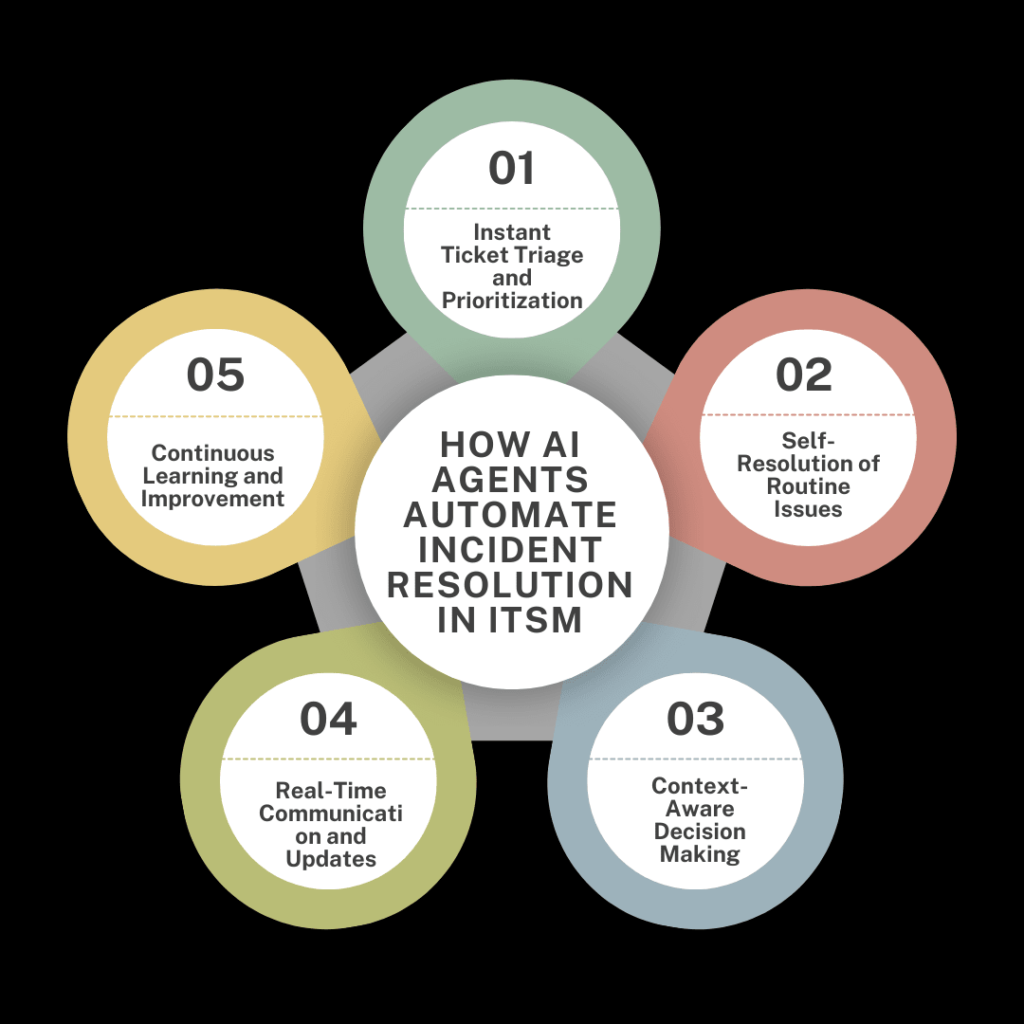
Here’s how AI agents automate the incident resolution process:
1. Instant Ticket Triage and Prioritization
AI agents in ITSM, including some of the best AI agents for ITSM, immediately analyze incoming tickets, categorize them based on priority, and assign them to the right team or agent. They use preset rules and learn from past interactions to determine the urgency of each issue.
- Eliminates manual ticket sorting
This removes the burden of sorting tickets based on severity and department. Autonomous AI agents in ITSM handle this instantly.
- Accurate prioritization
AI intelligent agents for ITSM evaluate incident priority by analyzing key details, ensuring that high-impact issues are addressed first.
2. Self-Resolution of Routine Issues
Many common IT issues, like password resets or software configurations, can be resolved automatically by custom AI agents for ITSM without human intervention. These agents pull from knowledge bases, predefined workflows, and historical data to apply the correct solutions.
- Efficient handling of common problems
Issues that would normally take up support time are resolved in seconds, allowing agents to focus on more complex tasks.
- Reduced resolution time
Automated actions eliminate the delays caused by manual resolutions, improving the overall service desk performance.
3. Context-Aware Decision Making
AI agents explained for ITSM show that these systems analyze all available data, such as ticket history, device details, and user information, to make well-informed decisions. This ensures that agents can resolve issues based on context, providing a more accurate and personalized service.
- Access to historical data
By referencing past incidents, agents in AI for ITSM automation avoid repeating previous mistakes and use proven solutions for quicker resolutions.
- Improved decision accuracy
How do AI agents work in ITSM? They continuously improve their decision-making by learning from new interactions, ensuring better service over time.
4. Real-Time Communication and Updates
Top AI agents used in ITSM keep users informed throughout the resolution process. They send automated updates, request additional information if needed, and provide status reports, all without requiring human oversight.
- Reduced follow-up queries
Users receive proactive updates about their ticket status, which lowers the volume of follow-up inquiries and improves satisfaction.
- Clear communication
Real-time updates ensure transparency, helping users feel more engaged with the resolution process.
5. Continuous Learning and Improvement
Building AI agents for ITSM automation involves creating systems that get smarter with every interaction. By learning from previous resolutions, user feedback, and outcomes, autonomous AI agents in ITSM continuously refine their performance.
- Adapts to new scenarios
The more tickets AI agents handle, the better they become at recognizing patterns and addressing new types of incidents.
- Improves service desk efficiency
Over time, AI agents’ growing intelligence leads to faster resolutions and more efficient processes.
By automating these essential tasks, AI agents business impact in ITSM is clear as they empower your IT team to focus on high-priority issues, reducing the chances of escalation. This not only speeds up resolution times but also enhances the overall user experience.
Also Read: How Generative AI Enhances Enterprise Search & Instant Insights
Real-World Use Cases: How AI Agents Prevent Escalations in ITSM
AI agents in ITSM are changing how you handle service operations. They don’t wait for a ticket to escalate. Instead, they spot the problem, act fast, and often solve it before users even notice. This level of speed and autonomy from autonomous AI agents in ITSM makes a big difference in large enterprises.
According to LangChain, the agentic AI market is projected to grow by over 44% annually. This shows how fast businesses are adopting AI-powered agents for ITSM to handle real-time issues across service desks.
Here are some real examples of how AI agents stop issues from escalating.
1. Fixing Device and Connectivity Problems Automatically
Downtime from slow internet, VPN errors, or frozen systems causes user frustration. If left unresolved, users escalate issues to higher support tiers.
How AI agents help:
- Monitor endpoints for system lag, app crashes, or connectivity drops.
- Trigger real-time fixes such as restarting services or switching network profiles.
- Inform the user and mark the ticket as resolved automatically.
This keeps your support queues lighter and avoids avoidable escalations.
2. Preventing Security Escalations from Policy Violations
When users install unauthorized software or access restricted data, security teams often need to intervene manually.
How AI agents help:
- Detect unusual behavior or non-compliant actions instantly.
- Revoke access, block risky activity, and notify security teams.
- Educate the user with contextual guidance to reduce repeat violations.
This reduces manual triage and keeps your security workflows smooth.
3. Streamlining SaaS Access and Change Requests
Employees frequently raise tickets for tool access or changes in workflows. Delays in fulfilling these requests can cause escalation, especially in fast-moving teams.
How AI agents help:
- Check request validity and user roles automatically.
- Grant access or configure tools based on predefined rules.
- Alert admins only when exceptions occur.
By resolving routine requests autonomously, agents in AI for ITSM automation reduce turnaround time and avoid bottlenecks.
4. Resolving Issues Before Users Raise Tickets
Many backend problems, such as storage overloads or database delays, go unnoticed until users start complaining.
How AI agents help:
- Monitor system health and performance continuously.
- Detect patterns that indicate early-stage issues.
- Run remediation scripts before end users are impacted.
This proactive resolution approach stops escalations before they even start.
5. Preventing License and Compliance-Related Disruptions
Users lose access if software licenses expire or usage limits are breached. These incidents often trigger escalations across teams.
How AI agents help:
- Track software entitlements and renewal dates.
- Auto-initiate renewal workflows or enforce license compliance.
- Notify procurement or IT teams in advance.
With these tasks handled automatically, your teams avoid last-minute scrambles and escalations.
AI agents are not just another support tool. They are decision-makers who act fast, remove delays, and keep your service desk from being overwhelmed. When deployed well, top AI agents used in ITSM become a real-time buffer between small incidents and full-blown escalations, saving time, budget, and team productivity.
Also Read: AI Agentic Workflows: Top Benefits & Use Cases for Enterprises
How Wizr AI Enables Scalable and Proactive ITSM with AI Agents
Wizr AI helps enterprise IT teams reduce escalations, automate tasks, and speed up issue resolution using AI agents in ITSM. It works seamlessly with your existing tools and scales across departments, making support faster and more efficient.
- Intelligent Triage and Resolution: Wizr AI instantly understands ticket context using natural language. These AI-powered agents for ITSM tag, route, and resolve common issues like access errors or password resets without needing human input. This lowers ticket volume for agents and improves response times.
- Seamless Integration with IT Tools: Wizr AI connects directly with tools like ServiceNow, Jira, and Zendesk. It syncs data in real time, so your team always works with the latest information. You can add custom AI agents for ITSM to your existing technology environment without changing your current workflows.
- Real-Time Monitoring and Proactive Fixes: The system monitors your infrastructure around the clock. These autonomous AI agents for ITSM detect issues early and can take action, like restarting services, before users notice. This helps you avoid ticket overload and keeps operations running smoothly.
- Smarter Escalation Control: Wizr only escalates when needed. When it does, it shares full ticket context, history, and suggested actions with your team. This reduces delays and helps agents solve complex issues faster – showcasing the real AI agents’ business impact in ITSM.
- Scalable for Enterprise Needs: Wizr AI handles large volumes and learns from each interaction. It adapts to your environment, whether you’re in pharma, automotive, education, manufacturing, or software and SaaS. It’s designed for building AI agents for ITSM automation and supports high performance across teams.
Wizr AI brings real-time automation, smarter support, and fewer escalations helping your IT service desk work better at scale.
Conclusion
When your service desk is flooded with tickets, delays and escalations are hard to avoid. Manual triage and resolution take time, drain resources, and frustrate users. How do AI agents work in ITSM? They fix this by acting faster than your team ever could. They monitor systems, resolve incidents, and respond to users autonomously without waiting for a human to step in. You save time, reduce pressure on support teams, and improve service quality across departments.
Wizr AI makes this shift possible. With its purpose-built AI agents in ITSM, Wizr helps enterprises like yours automate incident resolution before problems escalate. Whether you manage IT for a global logistics provider, a pharma company, an automotive manufacturer, or a growing SaaS business, our Enterprise AI Services and AI Agents solutions give you scalable, intelligent ITSM support that works in real time. You get fewer escalations, faster service, and a smoother experience for everyone who depends on your systems.
Let Wizr AI agents step in before escalation does, book a live demo and see how fast ITSM can move with AI agents for ITSM.
FAQs
1. What are AI agents in ITSM and how do they work?
AI agents in ITSM are intelligent systems that autonomously manage service desk tasks like ticket triage, incident detection, and resolution. They use machine learning and natural language processing to understand requests, prioritize them, and resolve routine issues automatically. Wizr AI’s ITSM agents integrate with enterprise tools to automate incident handling, reduce manual workload, and accelerate support operations.
2. What are some examples of AI agents used in ITSM workflows?
Examples include:
- Automated ticket classification and tagging
- Password reset bots
- System health monitors
- Intelligent escalation handlers
These agents proactively identify issues, initiate fixes, or route tickets to the correct teams. Wizr AI delivers purpose-built AI agents that enhance efficiency, reduce escalations, and improve resolution times for enterprise IT environments.
3. How do autonomous AI agents prevent escalations in IT service management?
Autonomous AI agents continuously monitor systems, detect anomalies, and resolve incidents before they affect users. By taking instant corrective actions, they minimize unresolved tickets and reduce escalation to higher support tiers. Wizr AI’s ITSM agents are designed to prevent escalations, keeping IT operations smooth and maintaining high service quality without additional staffing.
4. What is the business impact of using AI agents in ITSM?
AI agents in ITSM help lower operational costs, speed up response times, boost customer satisfaction, and increase IT team productivity. They enable proactive support without expanding headcount, making IT operations more efficient and resilient. With Wizr AI’s Enterprise AI Services and AI Agents solutions, enterprises automate key IT workflows, scale support intelligently, and enhance service delivery across all channels.
5. How can enterprises start building AI agents for ITSM automation?
To build AI agents for ITSM:
- Identify repetitive IT tasks that can be automated
- Select AI solutions that are compatible with your existing tools
- Implement adaptive agents that learn and improve over time
Wizr AI offers ready-to-deploy AI agents that integrate with ServiceNow, Jira, Zendesk, and other enterprise technology environments, making ITSM automation fast, seamless, and low-risk.
6. How do AI agents handle incident triage and prioritization automatically?
AI agents use machine learning and historical ticket data to analyze incoming incidents, classify them by type, and assign priority levels. They automatically route tickets to the right team or agent, ensuring urgent issues are addressed first. Wizr AI’s ITSM agents streamline triage processes, reducing response times and ensuring critical incidents get immediate attention.
7. What are best practices for autonomous AI incident resolution in ITSM?
Best practices include:
- Continuously monitoring system performance and ticket patterns
- Setting automated workflows for common incidents
- Using predictive analytics to anticipate potential issues
- Regularly updating AI models with new data for accuracy
Wizr AI’s Enterprise AI Services help enterprises implement these best practices with intelligent ITSM agents that proactively resolve issues, minimize escalations, and maintain service reliability.
About Wizr AI
Wizr AI helps enterprises build autonomous enterprises and accelerate product and software engineering with practical, production-ready AI. We help organizations automate business workflows, modernize legacy applications and digital platforms, and build intelligent AI solutions.
Our core services include Enterprise AI Services, AI-Powered Engineering & Legacy Modernization, AI Product Engineering, and AI Governance. We also leverage AI Assembly capabilities, including the Agentic AI Framework, Agentic Workflows, Security, and Integrations.
Through our AI solutions, including AI Agents, Pharma & Life Sciences AI, Oracle AI, and Salesforce AI, we help enterprises apply AI across business and technology needs.
See how we can help your enterprise move faster with AI. 👉 Talk to an AI Expert.


![Agentic AI vs AI Agents: Key Differences Every CIO Must Know [2025 Guide]](https://wizr.ai/wp-content/uploads/2025/07/Agentic-AI-vs-AI-Agents.webp)
![Agentic AI vs Traditional Automation: Why Enterprises Shift for Better CX [2025]](https://wizr.ai/wp-content/uploads/2025/06/Agentic-AI-vs-Traditional-Automation.webp)


![11 Real-World AI Agents Examples + Use Cases for Enterprises [2025]](https://wizr.ai/wp-content/uploads/2025/05/AI-Agents-Examples-Use-Cases.webp)