Let’s face it. Most automation tools only handle the basics. They are good at repetitive tasks, but when things get more complicated, a person usually has to step in.
That is starting to change.
Autonomous AI Agents for Enterprise Automation are a new kind of solution. They don’t just follow instructions. They can think through problems, make smart decisions, act independently, and learn from experience. That makes a big difference when managing high volumes of requests, complex workflows, or needing to do more with less.
This is not just hype. According to Precedence Research, the global AI Autonomous Agents in Enterprise Solutions market is expected to grow from $7.92 billion in 2025 to $236.03 billion by 2034. This kind of growth shows businesses are ready for smarter automation that goes beyond the basics.
If you’ve been thinking it’s time for something better, you’re not alone. Let’s take a closer look at how Intelligent Agents in Enterprise Automation can work for you.
Tired of basic bots that can’t handle complexity? Autonomous AI Agents take enterprise automation to the next level – thinking, adapting, and acting without constant human input.
This guide explores how these agents transform support, IT, HR, and operations by automating full workflows and driving smarter decision-making at scale.
If you’re ready to upgrade from task automation to intelligent action, this is your deep dive. Read the full post to learn how Wizr helps make it real.
What Are Autonomous AI Agents?
Autonomous AI agents are intelligent software systems that can operate independently, make decisions, and take actions to achieve goals without constant human input. They use AI technologies like machine learning and reasoning engines to interpret data, plan tasks, and execute actions in real time.
These agents are increasingly used in enterprise automation to manage workflows, customer support, and system monitoring autonomously. According to a Deloitte report, 65% of large enterprises plan to deploy autonomous agents within core operations by 2026. They help organizations cut costs, improve agility, and unlock continuous, AI-driven process improvements across departments.
Think of autonomous AI agents as smart digital coworkers. They don’t wait around for you to tell them every little thing. Instead, you give them a goal such as “handle this customer request” or “monitor system alerts,” and they figure out how to get it done.

What makes these agents really useful is that they:
- Break down big goals into smaller steps. Break down big goals into smaller steps. For example, if you ask an agent to onboard a new hire, it can handle scheduling training, setting up accounts, and sending welcome emails on its own.
- Learn and adapt as they go. If something does not work, they change their approach. For instance, if a customer issue is tricky, they might try different answers or escalate it only when needed.
- Work smoothly across your existing tools. They connect to your CRM, help desk, email, and other systems, pulling live data to act quickly and accurately.
Unlike basic bots that only follow fixed rules, Generative AI Agents in Enterprise Automation keep getting smarter over time. They make decisions, learn from outcomes, and take action without constant supervision.
In short, these agents combine thinking, learning, and doing all together.
Key Features to Look For in Best Autonomous AI Agents for Enterprise Automation
If you are thinking about bringing these Autonomous AI Agents into your business, here are some must-have features to look for:
- Multi-step planning: The agent should handle whole workflows, not just single tasks. For example, in finance, it could manage invoice processing from start to finish, including approvals and notifications.
- Real-time data access: It needs to pull the latest information from your systems to act with up-to-date facts. Imagine an AI Autonomous Agent in Enterprise Solutions checking the current order status before replying to a customer.
- Easy integration: The agent should plug right into your existing platforms, such as Salesforce, ServiceNow, or your internal tools, without needing a major tech overhaul.
- Security and compliance: Especially important for enterprises, your agent must follow data privacy rules and protect sensitive information, particularly in industries like healthcare or finance.
- Self-learning ability: With every interaction, the agent gets better. It can learn what responses work best or spot patterns to avoid future problems.
Why Do These Features Matter?
With these capabilities, Autonomous AI Agents for Enterprise Automation do more than help. They become trusted team players. They take on repetitive, time-consuming tasks so your people can focus on higher-value work. They reduce errors and speed up processes. Plus, they help you deliver better service without extra costs.
How Autonomous AI Agents Transform Enterprise Customer Service Automation

Customer service is no longer about just answering questions. It’s about fast, personalized help on any channel, at any time. That’s where Autonomous AI Agents stand out.
These agents aren’t rule-based bots. They combine memory, reasoning, and decision-making to handle full conversations without scripts. They can manage tasks from start to finish, adapting as they go.
Here’s how they improve enterprise-grade customer support:
- Reduce wait times across channels: They respond instantly, whether on chat, email, voice, or app, minimizing customer drop-offs and complaints.
- Improve first-contact resolution (FCR): By pulling customer data (past orders, chat logs, CRM records), AI Autonomous Agents in Enterprise Solutions resolve most issues in a single interaction.
- Support at scale, without hiring more staff: Generative AI Agents in Enterprise Automation can handle thousands of requests at once, making them ideal for handling seasonal spikes or product launches.
- Follow logical flows: They can complete multi-step processes like subscription changes or form submissions without human help.
- Trigger proactive support: If a package is delayed or a payment fails, the agent can notify the customer before they reach out.
- Escalate intelligently: When a human touch is needed, like for complaints or emotional cases, they pass it on with full context, saving time for both sides.
These capabilities let you deliver faster, smarter, and more reliable customer service. With Autonomous AI Agents for Enterprise Automation handling routine and complex tasks alike, your team can focus on building stronger relationships and solving the toughest challenges. This means happier customers and a more efficient support operation overall. Learn more about practical implementations in AI agent examples for enterprises.
Also Read: Intelligent Virtual Agents: How They Work, Benefits & Use Cases
Real-World Use Cases of Autonomous AI Agents in Enterprise Industries
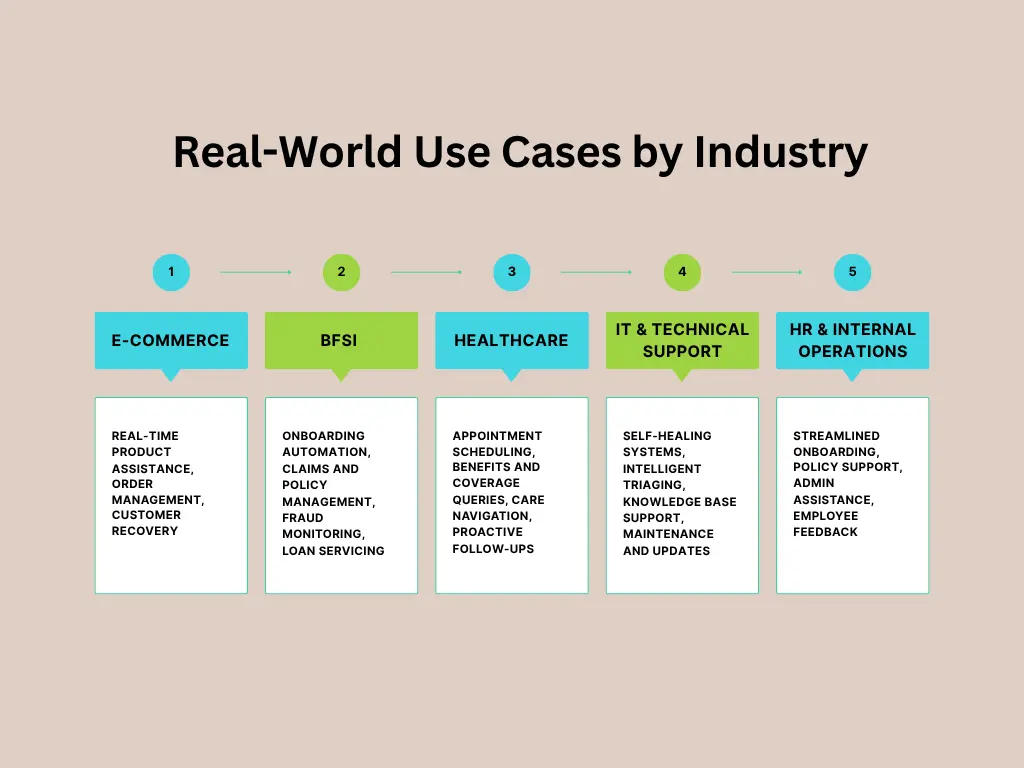
Autonomous AI Agents aren’t just a nice-to-have anymore; they’re quietly transforming how entire industries operate. Especially in areas with high ticket volumes, strict compliance, and repetitive workflows, these Intelligent Agents in Enterprise Automation are stepping in to simplify operations and deliver consistent, human-like support at scale.
1. E-commerce
Online retailers are using Autonomous Agents in AI for Enterprise to boost customer satisfaction while minimizing manual support costs. Here’s what they’re doing:
- Real-time product assistance: Intelligent Virtual Agents for Enterprise Use act as shopping assistants, helping users filter products, compare options, check availability, or suggest bestsellers based on behavior and preferences. This keeps users engaged and reduces drop-offs.
- Order management: From checking order status to processing cancellations and initiating returns, Examples of Intelligent Agents in Enterprise Automation can manage these workflows end-to-end, often in a matter of seconds, without needing a human in the loop.
- Upselling and cross-selling: Based on what’s in a shopper’s cart or browsing history, Generative AI Agents Examples in Enterprise Use recommend complementary products, apply discounts, or even bundle offers, leading to higher average order values.
- Customer recovery: If a customer abandons their cart or exits mid-purchase, AI Agents Examples in Enterprise Context can follow up with personalized nudges, offer assistance, or share promo codes, bringing them back to complete the purchase.
Faster issue resolution, reduced cart abandonment, and better conversion across channels.
2. BFSI (Banking, Financial Services & Insurance)
For heavily regulated sectors like BFSI, accuracy and security are non-negotiable. Robotic Process Automation Tools for Enterprise combined with AI agents are helping institutions deliver instant support while remaining compliant.
- Onboarding automation: Agents walk customers through the KYC process, help upload documents, verify ID info, and provide real-time status updates, all while ensuring data privacy protocols are followed.
- Claims and policy management: Customers can file claims, update nominee details, download policy documents, or track approvals, without waiting on hold or navigating clunky portals.
- Fraud monitoring: Agents integrated with transaction systems can flag suspicious activity (e.g., multiple failed logins or unusual transactions) and trigger real-time customer alerts or verification steps.
- Loan servicing: Whether checking outstanding balances, managing EMIs, or calculating pre-closure fees, AI agents handle these queries instantly and can even initiate actions if authorized.
Greater customer trust, fewer support escalations, and faster compliance-driven workflows.
3. Healthcare
In healthcare, speed and empathy matter. Types of Intelligent Agents in AI for Enterprise Applications ease the burden on front-desk and call center teams while improving access and communication.
- Appointment scheduling: Patients can book, reschedule, or cancel appointments 24/7, even outside clinic hours, without needing to call. Agents can sync with calendars and send confirmations or reminders.
- Benefits and coverage queries: From checking whether a procedure is covered to explaining co-pays or deductibles, agents can simplify insurance complexities for patients in plain language.
- Care navigation: Based on patient symptoms or intent, agents can route them to the right department, doctor, or service, reducing friction and improving outcomes.
- Proactive follow-ups: Agents send reminders for lab tests, medicine refills, or upcoming consultations. They can even check on recovery progress post-discharge through quick questionnaires.
Patients get faster answers. Providers reduce administrative load. Everyone wins.
4. IT & Technical Support
Tech teams are increasingly relying on AI agents to manage common IT tasks and lower helpdesk ticket volumes.
- Self-healing systems: Agents can automatically run scripts or restart services to resolve simple tech issues like login failures, VPN access, or printer connectivity.
- Intelligent triaging: Based on keywords, user history, and system data, agents can tag and prioritize tickets appropriately, reducing delays and ensuring urgent issues are addressed first.
- Knowledge base support: Rather than making users search internal wikis or portals, agents can pull the most relevant answer or article from documentation in seconds.
- Maintenance and updates: Agents can schedule system patching, software updates, or reboot prompts during non-working hours, and even notify users once it’s complete.
Shorter downtime, faster resolution, and fewer escalations to Tier 2 support.
5. HR & Internal Operations
AI agents are becoming essential behind the scenes, especially in HR and operations, where employee queries often overwhelm support teams.
- Streamlined onboarding: From day one, agents help new hires set up devices, access portals, complete paperwork, and learn company policies, without waiting for HR responses.
- Policy support: Whether it’s understanding vacation rules, expense limits, or compliance deadlines, employees can ask questions and get answers anytime.
- Admin assistance: Need to update a phone number? Track laptop delivery? Reset your password? AI agents easily handle these routine tasks, so there is no need to raise tickets.
- Employee feedback: Agents can run pulse surveys, remind employees to complete training, or even check on engagement anonymously.
Less time spent on internal back-and-forth. More time for HR to focus on strategic work.
These use cases aren’t theoretical. Enterprises are already scaling Autonomous AI Agents for Enterprise Automation to handle thousands of queries per day, saving time, reducing costs, and improving accuracy across the board.
Future Outlook: How Autonomous AI Agents Will Shape Enterprise Automation
Autonomous AI Agents will soon move beyond handling simple tasks. They will work together to manage complete workflows across your enterprise. This shift will make business processes smoother and faster.
Here’s what’s coming:
- Agent collaboration: Multiple Autonomous Agents in AI for Enterprise will coordinate to handle complex tasks involving different teams or systems.
- Automatic system updates: Agents will sync data across tools like CRM, inventory, billing, and compliance in real time.
- Action triggers: They will start key processes, such as contract approvals or sales follow-ups, exactly when needed.
This approach cuts down delays and errors while speeding up responses. For example, agents can instantly align support, billing, and shipping teams to resolve customer issues quickly.
The impact on the economy is significant. McKinsey reports:
- Generative AI could add $2.6 to $4.4 trillion annually worldwide.
- The tech, media, and telecom sectors alone might earn up to $690 billion.
This is more than growth; it’s a new way to run your business. Smarter, faster, and more connected automation will open doors to better service, cost savings, and innovation.
If you lead enterprise automation, now is the time to explore how AI Autonomous Agents in Enterprise Solutions can transform your operations.
How Wizr AI’s Autonomous AI Agents Drive Innovation in Enterprise Automation
At Wizr, we design Autonomous AI Agents for real enterprise operations, not just demos or isolated use cases. Our autonomous agents integrate with enterprise systems and workflows, helping organizations automate complex processes and move AI from pilots to production.
Key Features of Wizr AI Agents
- Plug into Your Existing Stack: Our Enterprise AI Services integrate AI agents with enterprise applications such as CRM, ERP, HR systems, databases, and document repositories, enabling organizations to deploy AI agents within their existing technology environment.
- Personalize Interactions: Our AI agents are trained on your organization’s data, allowing them to deliver context-aware responses and automate actions aligned with your specific business processes.
- Automate Enterprise Workflows: Wizr AI agents help automate workflows across areas such as customer support, IT support management, and finance operations, reducing manual intervention and improving operational efficiency.
- Continuous Improvement: AI agents can leverage enterprise data and feedback loops to improve decision-making and workflow automation over time.
- Enterprise-Grade Security: Security and governance are critical for enterprise AI adoption. Wizr’s AI services incorporate enterprise-grade controls including monitoring, access management, and compliance-focused governance.
Real-World Impact
Organizations across industries including SaaS, BPO, healthcare, and financial services use Wizr AI to automate workflows and improve operational efficiency. For example, Wizr CX solutions have helped Fortune 500 companies to reduce support ticket volumes by up to 45% while improving employee productivity and service quality.
Learn more at Wizr AI
Final Thoughts
Enterprise teams today face pressure to move faster, reduce costs, and improve service without adding more staff. Autonomous AI Agents help by automating workflows, learning from data, and cutting manual work across support, sales, HR, and operations.
Wizr delivers this through Enterprise AI Services and AI-powered automation solutions, helping organizations design, deploy, and scale autonomous AI agents within their existing enterprise systems. By combining AI agents, workflows, and enterprise integrations, Wizr enables enterprises to operationalize AI and drive measurable business outcomes.
Let Wizr’s Autonomous AI Agents handle complex workflows while your teams focus on higher-value work. Explore more at Wizr AI
FAQs
1. What are Autonomous AI Agents and how do they impact enterprise automation?
Autonomous AI Agents are intelligent systems that automate tasks and workflows across enterprise applications. They help reduce manual work, improve response times, and enable organizations to scale operations efficiently. For example, Wizr’s AI agents can automate customer support workflows, helping teams reduce ticket volumes and improve resolution efficiency.
2. How do Autonomous AI Agents improve enterprise workflows?
Autonomous AI Agents automate tasks such as ticket triaging, knowledge retrieval, workflow triggers, and process orchestration across systems. This allows enterprise teams to focus on complex decisions while AI agents manage routine operational work.
3. How do AI agents integrate with enterprise systems?
AI agents connect with enterprise applications, data sources, and internal tools to execute workflows and automate processes. By integrating with existing systems, organizations can deploy automation without replacing their current infrastructure.
4. Can you share examples of Intelligent Agents in Enterprise Automation?
Examples include AI agents that assist customer support teams, automate IT service management tasks, or support finance operations through document processing and workflow automation. These use cases demonstrate how autonomous agents can improve efficiency across enterprise functions.
5. Why is adopting Autonomous AI Agents important for future enterprise success?
With growing demand for speed, accuracy, and efficiency, autonomous AI agents enable organizations to scale operations without increasing complexity. As AI adoption accelerates, enterprises that successfully operationalize AI agents will gain a significant advantage in productivity and innovation.
About Wizr AI
Wizr AI helps enterprises build autonomous enterprises and accelerate product and software engineering with practical, production-ready AI. We help organizations automate business workflows, modernize legacy applications and digital platforms, and build intelligent AI solutions.
Our core services include Enterprise AI Services, AI-Powered Engineering & Legacy Modernization, AI Product Engineering, and AI Governance. We also leverage AI Assembly capabilities, including the Agentic AI Framework, Agentic Workflows, Security, and Integrations.
Through our AI solutions, including AI Agents, Pharma & Life Sciences AI, Oracle AI, and Salesforce AI, we help enterprises apply AI across business and technology needs.
See how we can help your enterprise move faster with AI. 👉 Talk to an AI Expert.


![Agentic AI vs AI Agents: Key Differences Every CIO Must Know [2025 Guide]](https://wizr.ai/wp-content/uploads/2025/07/Agentic-AI-vs-AI-Agents.webp)
![Agentic AI vs Traditional Automation: Why Enterprises Shift for Better CX [2025]](https://wizr.ai/wp-content/uploads/2025/06/Agentic-AI-vs-Traditional-Automation.webp)


![11 Real-World AI Agents Examples + Use Cases for Enterprises [2025]](https://wizr.ai/wp-content/uploads/2025/05/AI-Agents-Examples-Use-Cases.webp)