If you’re leading a support team, you’re probably juggling a lot. You need to respond faster, manage more tickets, and keep customers happy, all without burning out your agents. Sound familiar?
One way to make that easier is by bringing in an AI personal assistant. It’s not just another tool, it’s like giving your team a smart coworker – a personal AI assistant that handles the repetitive stuff so they can focus on the work that really matters.
According to Gartner, agentic AI will handle 80% of common customer service issues by 2029, helping businesses cut operational costs by 30%. That’s a big deal if you’re aiming to scale without stretching your team too thin.
![How to Build an AI Assistant That Boosts Agent Productivity [2025 Guide]](https://wizr.ai/wp-content/uploads/2025/06/How-to-Build-an-AI-Assistant-1024x683.webp)
In this blog, you’ll learn how to build an AI assistant that actually boosts productivity. One that helps your agents stay focused, work faster, and feel less overwhelmed.
Thinking about building an AI assistant for your team? The right approach can boost agent productivity, reduce resolution times, and automate routine tasks – without disrupting your stack.
This guide walks you through how to build an AI assistant that’s goal-driven, LLM-powered, and ready to integrate across workflows.
If you’re ready to scale support and free up your team for higher-value work, this is the blueprint. Read the full post to see how Wizr makes it possible.
What Is an AI Assistant?
An AI assistant is an intelligent software system that uses artificial intelligence to understand user input, automate tasks, and deliver contextual responses. It supports users in real time by learning from data, improving accuracy, and enhancing productivity.
An AI assistant or virtual personal assistant AI is a software program that helps people complete tasks faster using artificial intelligence. It understands what you say or type, responds clearly, and improves as it learns from more interactions.

AI personal assistants rely on natural language processing and machine learning to understand requests, analyze data, and carry out actions. These tools don’t just follow fixed commands. They adapt and respond based on real-time context.
In the customer support space, AI assistants can reduce agent workload by up to 35% and significantly improve resolution time. Leading organizations use AI assistants to handle common queries, offer agent guidance, and enhance customer experiences. A Gartner study predicts that by 2026, 80% of customer service interactions will be handled by AI assistants or similar automation technologies.
There are different types of AI assistants you might use or build:
- Voice-activated assistants: These respond to spoken instructions. You’ve likely seen this with Siri or Alexa, which can set alarms, send texts, or play music.
- Task-based assistants: These handle focused actions like scheduling meetings, writing emails, or generating reports.
- Predictive assistants: These make suggestions before you even ask. Based on your past actions, they offer reminders, content, or answers you’re likely to need.
You’ll find AI assistants used across many teams and tools:
- In customer support, they guide users through steps without human help.
- In healthcare, they retrieve and organize patient records.
- In HR, they schedule interviews and send updates to candidates.
- In IT, they handle routine helpdesk requests and reduce ticket volume.
The goal is simple: reduce manual steps and get work done faster.
Benefits of Having an AI Assistant
Adding an AI personal assistant to your team creates real advantages for both users and agents. It cuts repetitive work and gives back time for tasks that require human judgment. You can explore top benefits of AI virtual assistants in customer service to understand how these tools streamline operations and enhance user experiences.
Here’s what an AI assistant can do:
- Respond instantly to common queries, improving service speed
- Handle routine tasks like data updates, tagging, and reminders
- Stay available around the clock, even when your team is offline
- Keep messaging consistent, so your responses are accurate every time
- Support decision-making by offering insights based on past interactions
With the right virtual personal assistant AI, your team works with fewer delays and spends more time on meaningful tasks. That leads to better service and a more focused support process.
Also Read: AI Voice-Enabled Chatbots: Benefits & Use Cases [2025 Guide]
Why Building an AI Assistant Boosts Agent Productivity
Your agents deal with more than just conversations. They constantly switch tools, look for answers, write notes, and update records. It’s tiring, and it slows down resolution time.
When you learn how to build an AI assistant for agent productivity that fits your workflow, it can reduce these extra steps. It doesn’t take over your agent’s job. Instead, it acts as an AI agent personal assistant working in the background – just like the practical AI agent use cases for enterprise teams show.
Here’s how it supports productivity:
- Finds information quickly, like previous tickets or knowledge base articles
- Suggests accurate replies while agents chat with customers
- Summarizes long conversations into key points for easy follow-up
- Auto-fills forms and updates CRMs without extra clicks
This helps your agents focus on solving problems instead of managing tasks. It also lowers the chance of mistakes and improves response quality.
Instead of adding more headcount, you give your existing team the tools to move faster and work smarter. That’s how you boost productivity with the best AI personal assistant for agent productivity without stretching resources.
Key Technologies Powering Effective AI Assistants
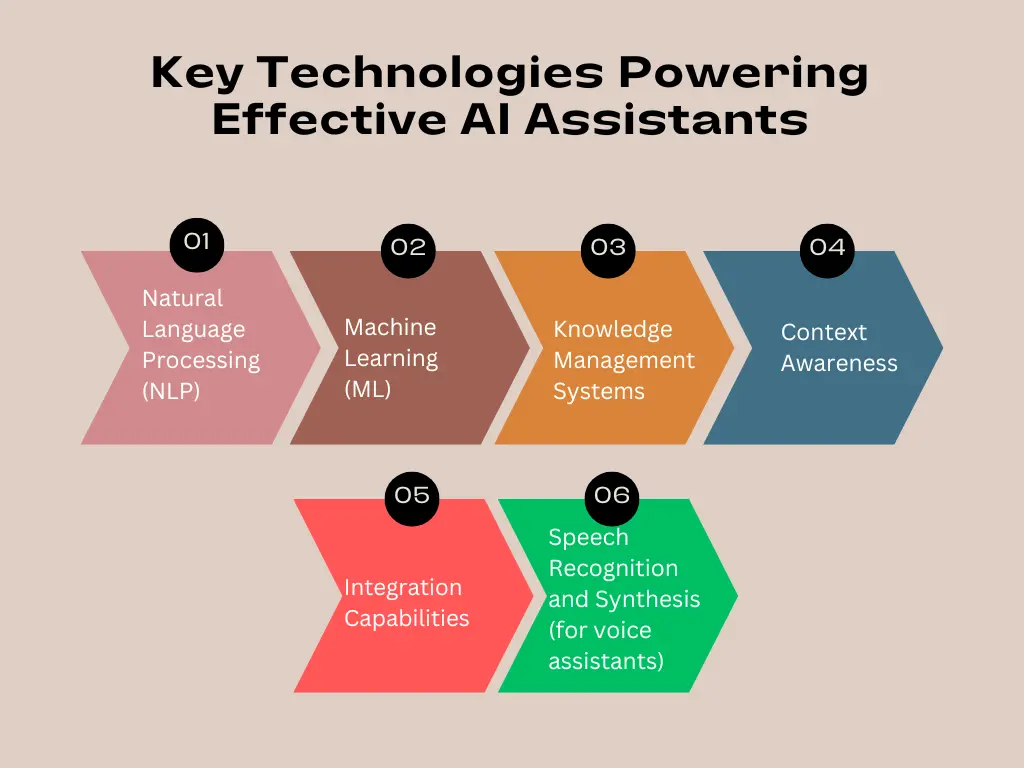
To build an AI personal assistant for business that truly helps your agents, you need to understand the core technologies behind it. These technologies work together to enable your assistant to understand, learn, and respond effectively.
Here are the key components that power effective AI assistants:
- Natural Language Processing (NLP): NLP allows the assistant to understand human language. It processes what users say or write and converts it into data that the system can act on. This helps the AI grasp intent, recognize keywords, and respond naturally.
- Machine Learning (ML): Machine learning helps the assistant improve over time. By analyzing past interactions, it learns patterns and becomes better at predicting what users need. This continuous learning is essential for accuracy and relevance.
- Knowledge Management Systems: An AI personal assistant needs access to organized information. Knowledge management tools store FAQs, manuals, and other documents so the assistant can quickly pull answers or solutions.
- Context Awareness: Context awareness means the AI remembers past interactions and uses that information to offer more relevant responses. This prevents repetitive questions and creates a smoother user experience.
- Integration Capabilities: Your AI assistant integration for user workflows and productivity must connect with other tools your team uses, such as CRM systems, ticketing platforms, or calendars. These integrations let the assistant perform tasks like updating records or scheduling meetings automatically.
- Speech Recognition and Synthesis (for voice assistants): For voice-activated assistants, speech recognition converts spoken words into text. Speech synthesis allows the assistant to respond aloud in a natural voice, making conversations feel more human – core technologies behind advanced speech analytics for call centers.
Combining these technologies lets you build a virtual personal assistant AI that not only answers questions but also helps your team complete tasks faster and more accurately.
Understanding these building blocks gives you a strong foundation. The next step is how to use AI as a personal assistant to boost productivity by integrating your AI personal assistant for work productivity into your workflows to maximize its impact on agent efficiency.
How to Integrate Your AI Assistant to Maximize Agent Productivity
Integrating your AI personal assistant effectively is key to unlocking its full potential. When done right, it becomes a natural extension of your agents’ workflow, helping them work smarter and faster.
Start by focusing on the systems your team relies on most. Your AI personal assistant app for agent productivity should connect seamlessly with these tools to provide real-time access to essential data and functions.
1. Connect to Essential Systems
Link your AI assistant with core platforms such as:
- Customer Relationship Management (CRM) systems
- Ticketing and case management tools
- Knowledge bases and FAQs
- Communication channels (chat, email, voice)
This integration lets the assistant instantly retrieve customer histories, update records automatically, and surface relevant information. It reduces the need for agents to switch between multiple apps and speeds up resolution times.
2. Embed Within Agent Workspaces
Place the virtual personal assistant AI where agents spend their time – inside the support dashboard or communication tools. When the assistant is easily accessible, agents can use its capabilities without interrupting their flow. This encourages frequent use and improves overall efficiency.
3. Define Clear Responsibilities for the AI Assistant
Set specific tasks the assistant should handle, such as:
- Suggesting context-aware replies
- Summarizing conversation threads
- Routing and prioritizing tickets
- Auto-filling forms and updating databases
Clear boundaries prevent confusion and help your team trust the assistant as a reliable partner.
4. Prepare and Support Your Agents
Integration success depends on agent adoption. Invest time in training your team to understand the assistant’s features and benefits. Demonstrate how it reduces repetitive work and frees them to focus on complex problems. Encourage ongoing feedback to identify pain points and improve the assistant’s support.
5. Automate Routine Workflows
Use your AI assistant to take on repetitive tasks, such as:
- Categorizing incoming requests
- Sending follow-up notifications
- Scheduling appointments
- Escalating urgent issues
Automation lightens your agents’ workload and ensures routine processes run consistently and quickly.
6. Continuously Monitor and Improve
Integration isn’t a one-time event. Regularly track how the AI-based personal assistant performs and how agents engage with it. Measure key metrics like response time, ticket resolution rates, and user satisfaction. Use these insights to fine-tune the assistant and your workflows.
By connecting your personal AI assistant for Android closely with your existing tools, defining clear roles, and supporting your agents throughout, you build an environment where technology enhances productivity naturally. This approach helps your team respond faster, reduce errors, and deliver better service every day.
Also Read: AI Chatbots vs. AI Virtual Assistants: What’s the Difference? [2025 Guide]
Tracking and Measuring AI Assistant Impact on Agent Performance
Once your AI personal assistant is up and running, you need to know if it’s actually helping your agents. This isn’t just about having the latest tech, it’s about measurable value.
Start by defining what success looks like for your team. Do you want to reduce handling time? Improve accuracy? Cut down on repetitive tasks? Your goals should guide what you track.
It’s also worth considering the bigger picture. AI assistants, including AI agent personal assistants and virtual personal assistant AI, aren’t a passing phase. In 2024, the market value of agentic AI reached $5.1 billion. It’s projected to grow to $47 billion by 2029, with a 44% compound annual growth rate. This growth reflects how more companies are investing in tools that improve efficiency and scale human support.
1. Key Metrics to Track
Use these metrics to understand the assistant’s real impact:
- Average Handling Time (AHT): A shorter AHT means agents are solving issues faster with the help of the best AI personal assistant for agent productivity.
- First Response Time: Measure how quickly the AI personal assistant app for agent productivity helps deliver the first reply.
- Ticket Deflection Rate: Look at how many queries are resolved by the personal AI assistant without needing a human.
- Agent Utilization: Track how much time agents spend on meaningful tasks instead of manual work using your AI assistant development for agent efficiency.
- Customer Satisfaction (CSAT): Check if customers are more satisfied with faster and more accurate support enabled by the AI personal assistant for work productivity.
- Assistant Usage Rate: Monitor how often agents actually rely on the AI-based personal assistant in their workflow.
2. Combine Data With Feedback
Data tells you what’s happening. Feedback tells you why.
Talk to your team regularly. Ask them:
- Which tasks does the personal assistant AI make easier?
- What feels clunky or unhelpful
- What changes could make it more useful
This helps you identify gaps and build something agents truly want to use.
3. Keep Improving Over Time
Measuring performance shouldn’t be a one-time task. Schedule regular reviews. Use the insights to:
- Fine-tune how the AI virtual personal assistant responds
- Remove any friction agents from the face
- Test different suggestions or response formats
As your goals evolve, so should your assistant.
By combining performance metrics with real agent feedback, you get a complete picture of how your AI personal assistant for business is performing. This isn’t just about proving ROI. It’s about creating a smarter, more efficient support system that grows with your business.
The more you refine your assistant, the more value your team gets from it. And as usage increases, so does the impact on speed, consistency, and overall agent satisfaction.
Once you’re confident in its performance, you’re ready to scale your personal AI assistant for Android and other platforms across teams, tools, and channels.
Also Read: Intelligent Virtual Agents: How They Work, Benefits & Use Cases
How Wizr AI’s Solutions Help Build AI Assistants That Drive Agent Productivity
Wizr AI provides enterprise-ready AI automation and services, helping teams enhance efficiency, reduce ticket volumes, and improve resolution quality from the outset.
Key Features of WIZR AI:
- Pre-Built AI Agents: Rapidly deploy AI agents for Customer Support, IT Support Management, and Finance & Accounting, configurable to fit your enterprise processes.
- AI Assistants and Agentic Workflows: Use AI-powered workflow capabilities to connect LLMs, enterprise data, APIs, and business systems to automate complex support processes and build intelligent AI assistants.
- CX Agent Assist: Provide real-time assistance to agents with response suggestions, ticket summaries, and contextual insights without manual searching.
- CX Auto Solve: Automate issue resolution with AI-driven customer service automation, reducing manual workload and improving efficiency.
- Enterprise-Grade Security: Ensure data security with SOC 2 Type II and ISO 27001 certifications, supporting enterprise compliance requirements.
Deployment and Integration:
Wizr AI helps organizations deploy AI assistants quickly through enterprise AI services and AI-powered automation, integrating seamlessly with existing systems and workflows. Enterprises can start with a focused use case and scale AI assistants across teams and processes over time.
Ready to enhance your team’s productivity? Explore WIZR AI’s solutions here.
FAQs
1. How do I start building an AI Personal Assistant for business use?
To build an AI Personal Assistant that boosts agent productivity, start with a clear use case. Identify repetitive tasks like responding to FAQs, updating records, or routing tickets and automate those first. Enterprise AI services can help integrate AI assistants with enterprise data and tools, accelerating AI assistant deployment and improving workflow efficiency.
2. What are the top benefits of using an AI Personal Assistant App for agent productivity?
An AI Personal Assistant App streamlines repetitive tasks and lets agents focus on high-value work. Key benefits include:
- Improved accuracy: AI learns from past interactions to suggest better responses.
- Faster response times: Instant knowledge retrieval speeds up ticket handling.
- Reduced workload: Smart suggestions and auto-fill reduce repetitive manual work.
Wizr AI’s personal assistant capabilities enhance agent productivity by delivering these benefits in real time.
3. How can I ensure my AI Personal Assistant fits our workflows?
Ensure your AI assistant integrates with existing tools like CRMs, ticketing systems, or knowledge bases. Wizr AI helps connect enterprise data with AI assistants, enabling contextual understanding and helping agents work more efficiently. Testing within live workflows ensures the assistant adapts to real-world scenarios.
4. Is there a cost-effective way to get started with a Personal AI Assistant?
Yes! Start with pre-built AI agents and configurable workflows through Wizr AI’s enterprise AI services, focusing on high-impact tasks such as automated responses and ticket triage. Then expand capabilities as needs grow, reducing costs while demonstrating immediate value.
5. How does an AI Personal Assistant improve agent productivity in real-time?
A best AI personal assistant for agent productivity enhances performance by:
- Flagging urgent issues automatically
- Suggesting responses to customer queries
- Summarizing lengthy conversations
- Auto-filling forms and updating CRM systems
These real-time features allow agents to focus on complex cases while the AI assistant handles repetitive tasks. Wizr AI’s intelligent personal assistant ensures faster resolution, reduced fatigue, and higher customer satisfaction.
6. Can AI Personal Assistants help with multi-channel support?
Yes! AI Personal Assistants can manage customer queries across multiple channels, including email, chat, and messaging apps. Wizr AI ensures agents receive context-aware suggestions regardless of the channel, helping maintain consistent, efficient support across customer interactions.
7. How can AI Personal Assistants improve decision-making for support agents?
AI Personal Assistants provide real-time insights, summarize customer interactions, and highlight key trends in tickets. This allows agents to make informed decisions quickly and resolve issues more effectively. With Wizr AI, teams get actionable recommendations that optimize workflows and enhance overall customer experience.
About Wizr AI
Wizr AI helps enterprises build autonomous enterprises and accelerate product and software engineering with practical, production-ready AI. We help organizations automate business workflows, modernize legacy applications and digital platforms, and build intelligent AI solutions.
Our core services include Enterprise AI Services, AI-Powered Engineering & Legacy Modernization, AI Product Engineering, and AI Governance. We also leverage AI Assembly capabilities, including the Agentic AI Framework, Agentic Workflows, Security, and Integrations.
Through our AI solutions, including AI Agents, Pharma & Life Sciences AI, Oracle AI, and Salesforce AI, we help enterprises apply AI across business and technology needs.
See how we can help your enterprise move faster with AI. 👉 Talk to an AI Expert.


![Agentic AI vs AI Agents: Key Differences Every CIO Must Know [2025 Guide]](https://wizr.ai/wp-content/uploads/2025/07/Agentic-AI-vs-AI-Agents.webp)
![Agentic AI vs Traditional Automation: Why Enterprises Shift for Better CX [2025]](https://wizr.ai/wp-content/uploads/2025/06/Agentic-AI-vs-Traditional-Automation.webp)


![11 Real-World AI Agents Examples + Use Cases for Enterprises [2025]](https://wizr.ai/wp-content/uploads/2025/05/AI-Agents-Examples-Use-Cases.webp)