Artificial intelligence is no longer something enterprises test as a side project. You are probably already seeing it across customer support, IT operations, HR workflows, compliance checks, fraud detection, and sales automation. But while many businesses have started adopting AI, turning those experiments into real business results is still a challenge.
According to McKinsey’s 2025 State of AI report, 88% of organizations already use AI in at least one business function. Yet, nearly two-thirds are still stuck in the pilot or experimentation stage. This usually happens when companies invest in AI tools without checking whether the provider can support enterprise-scale integration, governance, security, and long-term operations. Businesses are increasingly evaluating AI-powered software development tools to accelerate enterprise AI adoption while maintaining scalability, security, and operational control.
![How to Evaluate AI Software Development Services for Enterprise Needs [2026]](https://wizr.ai/wp-content/uploads/2026/05/How-to-Evaluate-AI-Software-Development-Services-2026-1024x683.webp)
That is why choosing the right AI Software Development Services matters more than ever in 2026. You need more than a vendor that can build a chatbot or deploy a model. You need a partner that understands how enterprise systems work, how to connect AI with existing workflows, and how to deliver measurable business outcomes.
In this blog, you will learn how to evaluate AI Software Development Services for your enterprise needs, what technical capabilities you should look for, how to compare external vendors with in-house teams, and how to assess pricing, scalability, and long-term ROI.
Why Enterprises Are Investing in AI Software Development Services
Some common enterprise AI use cases include:
- AI-powered enterprise search
- Automated ticket classification
- AI copilots for customer support
- Workflow automation
- AI agents for ITSM operations
- Fraud detection systems
- Predictive analytics
- Document processing and summarization
However, enterprise AI projects are more complex than traditional software deployments. You need to manage:
- Large-scale data integration
- Security and compliance
- Model governance
- Legacy systems
- Cross-team collaboration
- Continuous monitoring
This is why many enterprises work with AI Software Development Services providers. The right partner can help you integrate AI into existing systems, support enterprise-scale deployment, and manage long-term performance. Organizations tackling these challenges often combine AI initiatives with legacy application transformation strategies to modernize infrastructure, improve integration, and accelerate enterprise AI adoption.
Also Read: 9 Best Enterprise Generative AI Tools for 2026 [CIO’s Guide]
Key Criteria to Evaluate AI Software Development Services
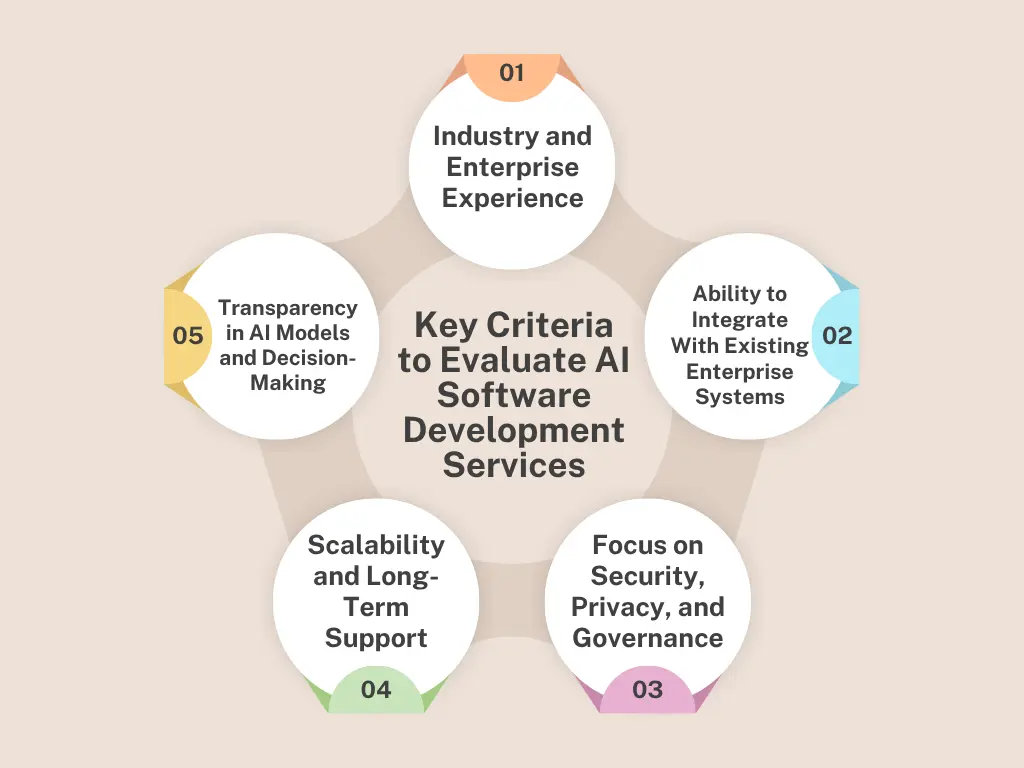
Choosing the right AI partner involves more than comparing features or pricing. You need to evaluate whether the provider can support your enterprise workflows, security requirements, integration needs, and long-term AI goals without creating operational challenges later.
1. Industry and Enterprise Experience
Start by checking whether the provider has experience in your industry.
AI implementation for healthcare differs from AI implementation for retail or banking. A vendor that understands your workflows, regulations, and customer expectations can reduce deployment risks.
Ask questions like:
- Have they worked with enterprise-scale organizations?
- Do they understand compliance standards?
- Can they handle high-volume enterprise data?
- Have they deployed AI in production environments?
For example, healthcare enterprises may need HIPAA-ready AI systems, while BFSI companies may require explainable AI for compliance audits.
Do not rely only on demo projects. Ask for production use cases and measurable outcomes.
2. Ability to Integrate With Existing Enterprise Systems
Many AI projects fail because the AI system works separately from enterprise workflows.
Your AI solution should connect with:
- CRM platforms
- ERP systems
- ITSM tools
- Contact center platforms
- Knowledge bases
- Internal databases
- Cloud infrastructure
If the provider cannot integrate AI into your current systems, employees may stop using it after initial testing.
According to recent enterprise AI discussions, poor integration and missing production architecture are major reasons why AI projects never move beyond proof-of-concept stages.
3. Focus on Security, Privacy, and Governance
Enterprise AI systems often process sensitive business data.
Before choosing AI Software Development Services, evaluate how the provider handles:
- Data encryption
- Access control
- Role-based permissions
- Audit logs
- Data residency
- Compliance reporting
- AI governance policies
You should also check whether they support:
- Private model deployment
- On-premise deployment
- Hybrid cloud environments
- Secure API integrations
This becomes especially important for industries like healthcare, legal, finance, and insurance.
4. Scalability and Long-Term Support
Many vendors can build AI prototypes. Fewer can support enterprise-scale deployment.
You need to check whether the provider can:
- Handle large workloads
- Support multi-region deployments
- Monitor model performance
- Retrain models regularly
- Reduce downtime
- Manage production environments
Enterprise AI is not a one-time deployment. Models need updates, monitoring, and optimization over time.
McKinsey research shows that organizations seeing the best AI results redesign workflows and invest in long-term operational support rather than treating AI as a short-term experiment.
5. Transparency in AI Models and Decision-Making
Enterprises increasingly need explainable AI systems.
This is important when AI impacts:
- Loan approvals
- Insurance claims
- Fraud detection
- Hiring recommendations
- Legal workflows
- Healthcare decisions
Ask vendors:
- How does the model make decisions?
- Can outputs be audited?
- Can employees review AI reasoning?
- How do they reduce hallucinations?
Transparent systems improve trust and simplify compliance reviews.
Choosing AI Software Development Services becomes easier when you focus on business fit instead of vendor promises alone. The right provider should support your existing systems, security requirements, operational goals, and long-term AI strategy.
Also Read: 11 Best AI-Powered Software Development Tools for Enterprise Teams in 2026
Technical Capabilities to Look for in AI Software Development Services
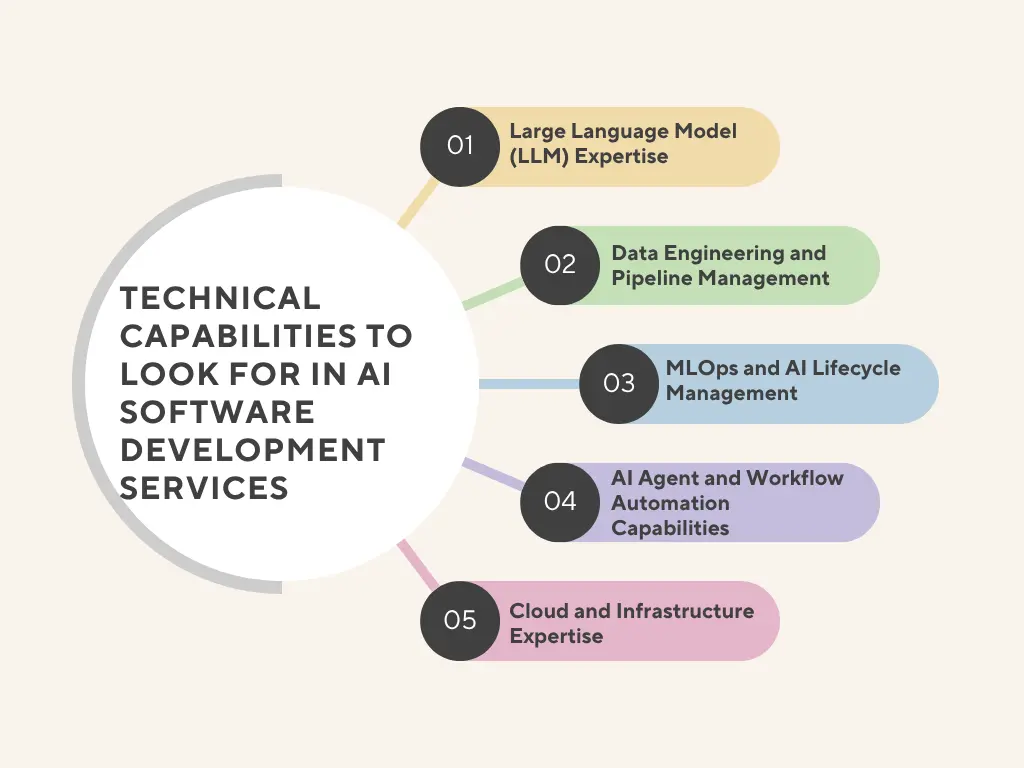
Once you evaluate industry experience and enterprise readiness, the next step is checking the provider’s technical capabilities. This matters because enterprise AI projects involve much more than building prompts or deploying a chatbot. Your AI systems need reliable infrastructure, clean data pipelines, monitoring, and long-term performance management.
Here are the key technical capabilities you should evaluate before choosing AI Software Development Services.
- Large Language Model (LLM) Expertise
Large Language Models are now part of many enterprise AI applications, from AI copilots to enterprise search and workflow automation. But deploying LLMs in enterprise environments requires strong technical expertise.
Your provider should understand:
- Fine-tuning
- Retrieval-Augmented Generation (RAG)
- Prompt optimization
- AI grounding
- Hallucination reduction
- Multi-model orchestration
These capabilities help improve response accuracy, reduce unreliable outputs, and make AI systems more useful for enterprise workflows.
- Data Engineering and Pipeline Management
AI systems are only as good as the data behind them. If your enterprise data is incomplete, outdated, or poorly structured, AI performance will suffer.
Your provider should support:
- Data preprocessing
- Data labeling
- Real-time pipelines
- Vector databases
- Knowledge indexing
- ETL workflows
Strong data engineering helps AI systems deliver faster, more accurate, and context-aware responses across enterprise operations.
- MLOps and AI Lifecycle Management
AI deployment does not end after implementation. Enterprise AI models need continuous monitoring, updates, and performance management.
Look for providers with expertise in:
- MLOps
- CI/CD for AI
- Model monitoring
- Version control
- Drift detection
- Automated retraining
Without proper lifecycle management, AI systems can become inaccurate or unreliable over time. This is especially important for enterprises handling large-scale operations, customer interactions, and compliance-sensitive workflows.
- AI Agent and Workflow Automation Capabilities
Many enterprises are now moving beyond basic AI assistants and exploring AI agents for workflow automation. These systems can handle repetitive tasks, trigger actions across tools, and support employees during complex workflows.
McKinsey reports that 62% of organizations are already experimenting with AI agents. This shows how quickly enterprises are adopting agent-based automation across operations. Businesses are increasingly adopting enterprise AI automation platforms and services to manage AI lifecycle operations, automate workflows, and scale intelligent enterprise processes securely.
Your AI Software Development Services provider should understand:
- Agent orchestration
- Multi-step workflows
- Tool integrations
- Enterprise task automation
- Human-in-the-loop workflows
These capabilities are becoming increasingly important for ITSM, customer experience operations, enterprise support, and internal workflow management. Organizations evaluating these automation strategies are also investing in AI text analysis tools, techniques, and use cases to improve decision-making, workflow intelligence, and enterprise data analysis.
- Cloud and Infrastructure Expertise
Enterprise AI systems usually depend on scalable cloud infrastructure. Without the right infrastructure setup, AI performance, response speed, and operational costs can become difficult to manage.
Check whether the provider supports:
- AWS
- Azure
- Google Cloud
- Kubernetes
- Containerized deployments
- GPU optimization
Strong infrastructure expertise helps ensure better scalability, stable performance, and smoother enterprise-wide AI deployment.
The right technical foundation can directly affect how well your AI systems perform at scale. Before choosing AI Software Development Services, make sure the provider can support your data, infrastructure, automation, and long-term operational needs.
Also Read: 15 Best Enterprise AI Solutions in 2026 (+Tools Built for Scale)
AI Software Development Services vs In-House Teams: What Should Enterprises Choose?
Once you identify the technical and operational requirements for your AI initiatives, the next decision is choosing how you want to build and manage them. Many enterprises struggle with whether to create an internal AI team or work with external AI Software Development Services providers.
The right approach depends on your business goals, available budget, deployment timelines, and internal expertise.
- When In-House Teams Make Sense
Building an internal AI team can work well if your organization already has strong technical resources and long-term AI plans.
An in-house approach may be suitable if you:
- Already have experienced AI engineers
- Need complete control over AI models
- Plan to invest in AI for the long term
- Require highly customized AI systems
However, building enterprise AI capabilities internally requires significant time and investment. You may need to hire:
- AI engineers
- Data scientists
- MLOps specialists
- Infrastructure teams
- Security experts
Hiring and managing these teams can become expensive, especially as demand for AI talent continues to grow.
- When AI Software Development Services Make More Sense
For many enterprises, working with external AI Software Development Services providers is often the faster and more practical option.
This approach may work better if you:
- Need faster deployment
- Do not have internal AI expertise
- Want to reduce implementation risks
- Need enterprise integration support
- Require continuous AI optimization
Experienced providers offering AI application development services, AI and ML development services, and Enterprise AI development services already have deployment frameworks, integration workflows, and operational processes in place. This can help your teams move from pilot projects to production environments more quickly.
Reuters recently reported that enterprise demand for AI implementation expertise is increasing as businesses look for specialists who can integrate AI into existing enterprise systems.
- Hybrid Models Are Becoming More Common
Many enterprises now combine internal teams with external AI partners instead of choosing one approach entirely.
In a hybrid model:
- External providers manage deployment and technical architecture
- Internal teams handle governance, operations, and business decisions
This approach helps enterprises scale AI faster while maintaining internal oversight and operational control.
The best approach depends on how quickly you want to deploy AI, how much internal expertise you have, and how involved you want your teams to be in long-term AI operations.
How to Assess Cost, Pricing Models, and ROI of AI Software Development Services
Once you narrow down potential AI partners, the next step is understanding the actual cost of deployment and long-term operations. AI pricing can vary widely between vendors, especially when infrastructure, model usage, and ongoing support are involved.
Before signing agreements, make sure you understand the complete pricing structure instead of focusing only on initial development costs.
- Common Pricing Models for AI Software Development Services
Different AI Software Development Services providers use different pricing models depending on the project scope and support requirements.
Fixed Pricing
This model is usually suitable for:
- Small AI projects
- Clearly defined requirements
- Limited project scope
It works best when the deliverables, timelines, and implementation needs are already finalized.
- Time and Material Pricing
This model is more suitable for:
- Evolving AI projects
- Long-term development
- Experimental deployments
Since enterprise AI requirements often change during implementation, this pricing model offers more flexibility. Many organizations evaluating deployment costs also compare leading enterprise AI agent platforms to understand scalability, governance, and long-term operational value.
- Subscription or Managed Service Pricing
This approach is commonly used for:
- Ongoing AI support
- Enterprise AI operations
- Continuous monitoring and optimization
It is often preferred by enterprises that need long-term AI management after deployment.
- Hidden Costs to Watch in AI Software Development Services
Many enterprises underestimate the operational costs involved in enterprise AI deployments.
Before choosing a provider, check for costs related to:
- Model retraining
- API usage
- Infrastructure
- GPU consumption
- Monitoring tools
- System integrations
- Security and compliance requirements
Research on enterprise AI cost transparency also highlights how token-based pricing can create unpredictable operational expenses over time.
- How to Measure ROI from AI Software Development Solutions
You should not evaluate AI success based only on deployment speed or automation capabilities. The real value comes from measurable business outcomes.
Track ROI using metrics like:
- Reduction in resolution time
- Lower operational costs
- Faster ticket handling
- Increased employee productivity
- Higher customer satisfaction
- Reduced manual effort
- Faster onboarding
- Revenue growth
McKinsey research found that leading AI-driven software organizations achieved 16% to 30% improvements in productivity, customer experience, and time-to-market.
Understanding pricing, operational costs, and expected business outcomes can help you choose AI Software Development Services that deliver long-term value instead of short-term results.
Questions You Should Ask Before Choosing an AI Partner
Even if a provider has strong technical capabilities, you should still evaluate how well they can support your enterprise requirements in real-world environments. Asking the right questions early can help you identify gaps in scalability, security, operational support, and long-term value.
Before finalizing AI Software Development Services, focus on these key areas during vendor discussions.
- Technical Questions
Start by understanding the provider’s technical capabilities and deployment approach.
Ask questions like:
- Which AI models do you support?
- How do you handle hallucinations?
- What monitoring systems do you provide?
- Can your solution scale across enterprise operations?
These questions can help you assess whether the provider can support production-level AI deployments instead of limited pilot projects.
- Security Questions
Enterprise AI systems often handle sensitive customer, employee, and operational data. That is why security and compliance should be part of every evaluation.
Ask questions like:
- How do you secure enterprise data?
- Do you support private deployments?
- What compliance standards do you follow?
This is especially important for industries with strict regulatory requirements, such as healthcare, BFSI, and legal services.
- Operational Questions
AI systems need continuous monitoring and maintenance after deployment. Make sure the provider can support long-term operations.
Ask questions like:
- What support do you provide after deployment?
- How do you manage updates and retraining?
- What SLAs do you offer?
Strong operational support can help reduce downtime and maintain consistent AI performance.
- Business Questions
Finally, evaluate whether the provider can deliver measurable business outcomes instead of just technical implementation.
Ask questions like:
- What measurable outcomes have you delivered?
- Can you share enterprise case studies?
- How do you calculate ROI?
These discussions can help you move beyond product demos and assess whether the provider can support your long-term business goals.
How Wizr AI Helps Enterprises Evaluate and Deliver AI Software Development Services
WIZR AI helps enterprises build and deploy AI solutions that fit real business workflows.
Instead of offering isolated AI tools, WIZR AI focuses on production-ready enterprise AI solutions, AI-powered automation, and AI-driven software engineering that support automation, knowledge management, customer operations, finance workflows, and employee productivity.
WIZR AI supports enterprises with:
- AI-powered enterprise search
- AI agents and AI assistants
- Agentic workflow automation
- Secure enterprise AI implementation
- Knowledge management systems
- Integration with enterprise systems and applications
- AI-powered software engineering and modernization
- Scalable AI solutions and infrastructure
For enterprises in customer support, ITSM, finance and accounting, pharma, education, automotive, SaaS, logistics, and enterprise operations, this helps reduce implementation complexity and improve adoption across teams.
WIZR AI also focuses on enterprise governance, scalability, security, integrations, and workflow orchestration, which are important for long-term AI success. Organizations exploring AI solutions for pharma companies and other enterprise AI use cases are increasingly prioritizing secure, scalable, and workflow-driven AI solutions that can integrate with existing business processes.
Final Thoughts
Choosing the right AI Software Development Services provider can directly affect your enterprise AI outcomes.
A strong provider does more than build models. They help you integrate AI into existing workflows, support long-term scalability, manage governance requirements, and improve business operations over time.
As enterprise AI adoption grows in 2026, companies that focus on integration, measurable ROI, security, and workflow alignment will see better results than companies that deploy AI without a long-term strategy.
Before making a decision, evaluate vendors carefully, compare implementation approaches, and focus on business outcomes instead of short-term AI trends.
FAQs
1. What should enterprises look for in AI Software Development Services?
When evaluating AI Software Development Services, enterprises should focus on scalability, integration capabilities, security, and long-term operational support. A provider may build a working AI model, but enterprise AI success depends on whether the solution fits into existing workflows and systems.
You should also evaluate whether the provider offers:
- Enterprise AI deployment experience
- AI and ML development services
- Security and compliance support
- Workflow automation capabilities
- AI-powered software engineering and modernization expertise
- Long-term monitoring and optimization
Wizr AI helps enterprises implement scalable AI solutions, AI agents, AI assistants, agentic workflows, and workflow automation solutions that integrate with ITSM, customer support, finance, and enterprise operations.
2. Why are Generative AI development services important for enterprises in 2026?
Generative AI development services are becoming critical because enterprises are moving beyond basic automation and using AI for enterprise search, AI assistants, knowledge management, agentic workflows, and workflow orchestration. According to McKinsey & Company, organizations using generative AI are already seeing productivity improvements across software engineering, customer support, and operations.
Today, many enterprises use Generative AI software development services to improve response times, automate repetitive tasks, accelerate software delivery, and reduce operational overhead. This is especially important in industries like pharma, automotive, education, finance, SaaS, and enterprise support operations.
Wizr AI helps enterprises implement generative AI solutions with enterprise-grade governance, AI agents, AI assistants, workflow automation, and secure integrations across enterprise systems.
3. What is the difference between AI Software Development Services and in-house AI teams?
An internal AI team gives enterprises more direct control over AI systems, but building and maintaining that team requires significant investment in AI engineers, infrastructure, MLOps, security expertise, and ongoing AI operations.
Many businesses choose external Artificial Intelligence development services providers because they offer faster deployment, proven frameworks, enterprise AI expertise, and integration experience. This helps organizations move from AI pilots to production environments more efficiently.
Wizr AI supports enterprises with Enterprise AI Services, AI-powered engineering and modernization, AI agents, AI assistants, and agentic workflow automation solutions that reduce implementation complexity and improve scalability.
4. How do enterprises measure ROI from AI software development solutions?
The success of AI software development solutions should be measured using business outcomes, not just technical deployment. Enterprises usually track metrics like operational efficiency, customer experience improvements, software delivery acceleration, and reduced manual effort.
Common ROI metrics include:
- Faster ticket resolution
- Lower support costs
- Increased employee productivity
- Reduced manual workflows
- Improved customer satisfaction
- Faster onboarding and response times
- Accelerated software development and modernization cycles
McKinsey research shows that leading AI-driven organizations achieved productivity gains between 16% and 30% in several operational areas.
Wizr AI helps enterprises improve operational efficiency through AI-powered workflow automation, AI agents, enterprise search, AI-driven software engineering, and real-time support systems.
5. Why is enterprise integration important when choosing AI application development services?
Many AI projects fail because the AI system works separately from existing enterprise systems. Strong AI application development services should support integration with CRM systems, ITSM tools, knowledge bases, ERP systems, cloud infrastructure, and enterprise data sources.
Without integration, employees may stop using AI tools after initial testing because the workflows become disconnected from daily operations. That is why enterprises increasingly prefer providers offering Enterprise AI development services with strong integration, governance, and workflow orchestration capabilities.
Wizr AI focuses on enterprise AI integration by connecting AI agents, AI assistants, and automation workflows with existing enterprise systems to improve adoption, operational efficiency, and long-term AI performance.
About Wizr AI
Wizr AI helps enterprises build autonomous enterprises and accelerate product and software engineering with practical, production-ready AI. We help organizations automate business workflows, modernize legacy applications and digital platforms, and build intelligent AI solutions.
Our core services include Enterprise AI Services, AI-Powered Engineering & Legacy Modernization, AI Product Engineering, and AI Governance. We also leverage AI Assembly capabilities, including the Agentic AI Framework, Agentic Workflows, Security, and Integrations.
Through our AI solutions, including AI Agents, Pharma & Life Sciences AI, Oracle AI, and Salesforce AI, we help enterprises apply AI across business and technology needs.
See how we can help your enterprise move faster with AI. 👉 Talk to an AI Expert.


![Agentic AI vs AI Agents: Key Differences Every CIO Must Know [2025 Guide]](https://wizr.ai/wp-content/uploads/2025/07/Agentic-AI-vs-AI-Agents.webp)
![Agentic AI vs Traditional Automation: Why Enterprises Shift for Better CX [2025]](https://wizr.ai/wp-content/uploads/2025/06/Agentic-AI-vs-Traditional-Automation.webp)


![11 Real-World AI Agents Examples + Use Cases for Enterprises [2025]](https://wizr.ai/wp-content/uploads/2025/05/AI-Agents-Examples-Use-Cases.webp)