Your legacy systems are costing you more than you think. They may still keep your core operations running, but they also slow down your development cycles, increase maintenance costs, and create friction across your teams. As customer expectations keep rising and digital demands keep shifting, these outdated systems often make it harder for your teams to move at the speed the business needs.
According to Gartner, nearly 40% of enterprise infrastructure systems still carry technical debt concerns. That means a large part of your IT environment is harder to scale, harder to modernize, and slower to support modern delivery needs.
This is exactly why many organizations like yours are now prioritizing AI-powered Legacy Application Modernization. Instead of long, manual, and complex modernization efforts, you can now use AI to understand legacy systems faster, automate repetitive work, improve migration planning, and speed up software delivery.
In this blog, you will learn what Legacy Application Modernization really means, why legacy systems slow down enterprise innovation, how AI-driven legacy system modernization is changing modernization projects, the common AI Legacy system modernization challenges you may face, and how WIZR helps you modernize at enterprise scale through its Custom AI Application Development Services.
What Is Legacy Application Modernization?
Legacy Application Modernization is the process of upgrading old software systems, applications, and infrastructure so they can support current and future business needs. The focus is simple. You improve performance, scalability, security, and delivery speed without disrupting day-to-day operations through a strong Application modernization strategy.
Most enterprise applications were built on older architectures, programming languages, or on-premise setups. Over time, these systems become harder to maintain and more expensive to scale. They also start creating friction when you try to connect them with cloud platforms, AI tools, APIs, and modern customer-facing applications as part of Enterprise application modernization efforts.
Modernization does not always mean rebuilding everything from scratch. You usually choose an approach based on your business goals, timelines, and how complex your current systems are as part of your Legacy application modernization strategy.
Common modernization approaches
- Rehosting applications to the cloud
- Refactoring monolithic systems into microservices
- Replacing outdated user interfaces
- Upgrading databases and core infrastructure
- Adding AI and automation capabilities using AI Legacy application modernization tools
- Retiring applications that no longer add value
You may also take a phased approach instead of changing everything at once as part of your Legacy application modernization strategies.
For example:
- In BFSI, you might modernize a legacy claims processing system to speed up approvals and support AI-based fraud detection through AI-powered legacy system modernization.
- In retail, you might upgrade inventory systems to enable real-time tracking and better omnichannel experiences using AI for enterprise legacy modernization.
The direction is clear. You want systems that help your business move faster, not systems that slow your teams down while Modernizing legacy systems using AI Legacy system modernization best practices.
Also Read: AI-Driven SDLC: How Engineering Agents Speed Up Delivery in 2026
Why Legacy Systems Are Slowing Enterprise Innovation in 2026
Legacy systems still power core operations across industries like banking, healthcare, telecom, manufacturing, and retail. They keep businesses running, but they also slow down how fast your teams can build, scale, and innovate. This is why Legacy Application Modernization is becoming critical priorities for enterprises in 2026.
Most of the friction shows up in delivery speed. Instead of focusing on new features or customer experience, your teams spend a large share of time maintaining outdated systems as part of ongoing Legacy software modernization efforts.
Where you feel the slowdown
Legacy systems typically limit you in key areas:
- Cloud-native integration becomes complex, impacting your Cloud application modernization strategy
- AI-driven workflows take longer to implement without AI-powered legacy application modernization
- Scaling during peak demand is harder during Enterprise legacy system modernization
- Security updates are slower and risk-prone
- Cross-system connectivity stays fragmented
- Customer experience improvements get delayed
According to Gartner Peer Community, 93% of engineering leaders are dealing with technical debt inside their organizations. This means most teams are already working around system limitations rather than moving forward with a strong Application modernization strategy.
Knowledge gaps add pressure
Legacy systems often depend on outdated technologies and limited skill sets.
This creates challenges like:
- Dependency on niche or aging expertise
- Slow onboarding for new developers
- Higher maintenance risk over time during the AI Legacy system modernization process
For example, many banking and insurance systems still run on COBOL. As skilled developers become harder to find, maintaining these systems gets more difficult each year. This creates additional AI Legacy system modernization challenges for enterprises adopting AI-driven legacy system modernization initiatives.
Security and experience gaps widen
Older systems were not built for modern security or user expectations. You often see:
- Limited modern authentication support
- Weak API-level security
- Slower response to security updates
- Lack of real-time system visibility
At the same time, customers expect fast, personalized, and always-on digital experiences. Legacy systems struggle to keep up with that pace.
This is why Legacy Application Modernization is now a 2026 priority. It is not just about updating systems. It is about helping your business move faster, stay secure, and meet modern expectations using AI-powered Legacy system modernization.
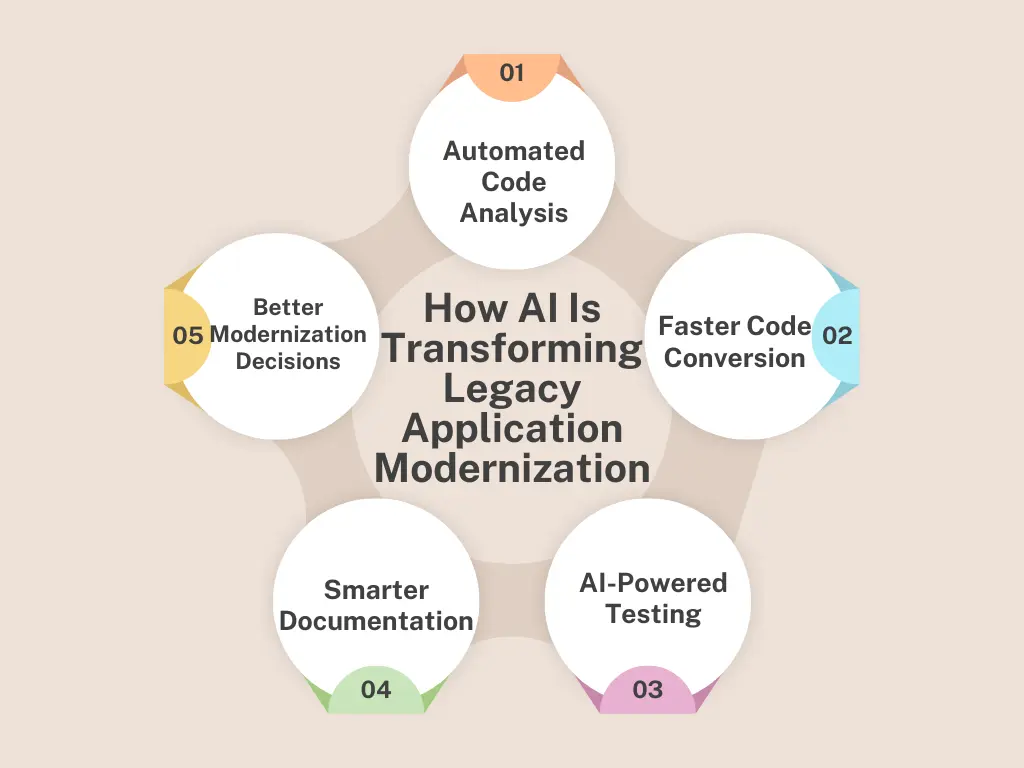
How AI Is Transforming Legacy Application Modernization
Traditional Legacy Application Modernization projects are slow and resource-heavy. You often deal with manual code reviews, long testing cycles, large engineering teams, and high operational risks. This is why many Enterprise legacy application modernization programs stretch across years instead of months.
AI is changing this in a more practical way through AI-powered legacy application modernization.
Today, you can use AI Legacy application modernization tools to:
- Analyze large codebases in minutes instead of weeks
- Identify hidden dependencies across systems
- Automate the documentation that was earlier manual
- Generate migration recommendations
- Reduce repetitive engineering work
Instead of going through millions of lines of legacy code manually, AI helps you spot patterns, risks, and relationships much faster. This improves both speed and accuracy in decision-making during the AI Legacy system modernization process.
1. Automated Code Analysis
AI tools help you scan legacy systems at scale and quickly highlight areas that need attention.
You can identify:
- Redundant or unused code
- Security vulnerabilities
- Performance bottlenecks
- Deprecated libraries
- Complex integration dependencies
- Refactoring opportunities
This reduces the time your engineering teams spend on manual analysis and helps you plan modernization with more clarity through a stronger Legacy application modernization strategy.
2. Faster Code Conversion
With generative AI, you can convert legacy code into modern frameworks with far less manual effort.
Common transformation paths include:
- COBOL to Java
- Monolithic systems to microservices
- On-premise applications to cloud-native architectures
This helps you reduce migration effort and speeds up delivery timelines without starting from scratch as part of your Cloud application modernization strategy.
3. AI-Powered Testing
Testing is often one of the biggest delays in modernization projects. It takes time, resources, and careful validation.
AI helps you simplify this by:
- Automatically generating test cases
- Detecting anomalies early
- Identifying regression issues
- Predicting potential system failures
- Reducing repetitive testing cycles
The result is better software quality with fewer delays in deployment while reducing common AI Legacy system modernization challenges.
4. Smarter Documentation
Legacy systems often come with limited or outdated documentation, which slows down onboarding and troubleshooting.
AI solves this by generating documentation directly from:
- Application logic
- Workflows
- APIs and system interactions
This helps your teams understand systems faster and reduces dependency on a few experienced developers while supporting AI Legacy system modernization best practices.
5. Better Modernization Decisions
Not every system needs to be modernized at the same time. The challenge is knowing where to start.
AI helps you prioritize by identifying:
- High-risk applications
- High-cost systems
- Customer-impacting applications
- Performance-heavy workloads
This allows you to focus your efforts on modernization areas that actually move the business forward, instead of spreading resources too thin while using effective Legacy application modernization strategies.
Also Read: Top 10 Enterprise AI Platforms Transforming Workflows in 2026
Top AI Legacy Application Modernization Strategies for Modern Enterprises
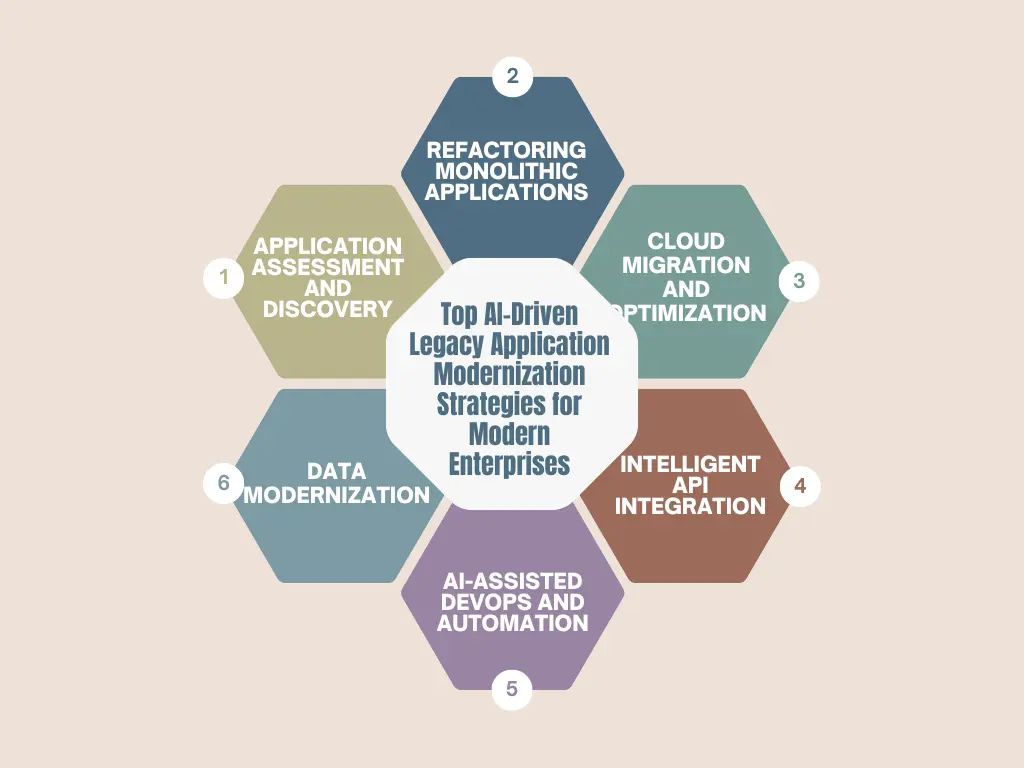
Every enterprise approaches modernization differently. Some prioritize cloud migration, others focus on AI adoption, and many look at improving delivery speed or customer experience. The right strategy depends on your current systems, business goals, and how fast you need to move during your Enterprise application modernization journey.
Below are the most effective AI-driven Legacy application modernization strategies you can apply in your modernization journey.
1. Application Assessment and Discovery
Before you change anything, you need full visibility into your systems. Without it, modernization becomes guesswork.
AI Legacy application modernization tools help you map your entire application landscape, including:
- Application dependencies
- Infrastructure usage
- Business workflows
- Integration points
- Security risks
This gives you a clear starting point and helps you build a realistic Legacy application modernization strategy.
2. Refactoring Monolithic Applications
Many legacy systems are still built as monoliths. That means everything is tightly connected, which makes updates slow and risky.
AI helps you break these systems into smaller, independent microservices using advanced AI Legacy system modernization approaches. This shift improves:
- Deployment speed
- Scalability
- System flexibility
- Maintenance efficiency
For example, in an e-commerce setup, you can modernize payment, inventory, and recommendation systems separately instead of handling them as one large block. This allows faster releases without impacting the entire system during Enterprise legacy application modernization.
3. Cloud Migration and Optimization
Cloud adoption remains a major priority for enterprises, but migration is often complex and resource-heavy.
AI simplifies this by helping you:
- Identify migration dependencies
- Recommend infrastructure changes
- Estimate cloud costs
- Monitor workload performance
- Optimize resource allocation
This reduces uncertainty during migration and helps you avoid unnecessary costs while improving performance through a stronger Cloud application modernization strategy and Legacy software modernization approach.
4. Intelligent API Integration
Legacy systems rarely operate in isolation. They need to work with modern tools and platforms across your enterprise.
AI-powered integration platforms help you build APIs faster and connect legacy systems with:
- CRM platforms
- ITSM tools
- HR systems
- Customer support platforms
- Analytics tools
- AI copilots
This creates smoother data flow across departments and improves visibility across your operations while supporting AI for enterprise legacy modernization.
5. AI-Assisted DevOps and Automation
Modernization projects involve continuous development, testing, and deployment cycles. Manual effort here slows everything down.
With AI-assisted DevOps, you can automate key areas like:
- CI/CD workflows
- Infrastructure monitoring
- Incident management
- Deployment testing
- Performance optimization
This helps your teams release faster while reducing operational load and errors during the AI Legacy system modernization process and reducing common AI Legacy system modernization challenges.
6. Data Modernization
Legacy systems often store data in fragmented or outdated formats. This makes it difficult to use that data for decision-making or AI-driven initiatives.
AI helps you modernize data by:
- Cleaning legacy datasets
- Detecting duplicates
- Improving data quality
- Enabling real-time analytics
- Preparing data for AI applications
This is especially important if you work in BFSI, healthcare, retail, or telecom, where large volumes of operational data drive business decisions using AI-powered legacy application modernization.
These strategies give you a clear path to modernize legacy systems without disrupting core operations. When applied together, they help you move faster, reduce complexity, and build a more adaptable enterprise architecture.
Also Read: 15 Best Enterprise AI Solutions in 2026 (+Tools Built for Scale)
How Enterprises Accelerate Software Delivery with AI-Powered Legacy Modernization
AI-powered Legacy Application Modernization helps enterprises speed up software delivery by removing engineering bottlenecks like manual testing, dependency checks, and infrastructure work. AI automates these repetitive tasks, improving release speed and efficiency across Enterprise application modernization initiatives.
According to Grand View Research, demand for AI-driven legacy system modernization continues to rise sharply through 2030 as organizations invest in faster access to data and improved operational efficiency.
Here is how AI directly helps you accelerate software delivery:
- Reduced manual engineering work
AI automates routine tasks such as code analysis, test generation, dependency mapping, documentation, and migration suggestions using advanced AI Legacy application modernization tools.
This gives your teams more time to focus on core development work. - Faster release cycles
AI-enabled DevOps pipelines help you detect issues earlier, automate testing, and reduce rollback risks.
As a result, your release cycles become shorter and more predictable. - Better prioritization of work
AI helps you identify which applications need modernization first based on impact and risk.
This ensures your team focuses on high-value work instead of spreading efforts thin. - Improved developer productivity
Legacy systems often lack documentation. AI-generated summaries and code explanations help developers understand systems faster and reduce onboarding time. - Lower downtime during migration
AI monitoring tools identify risks early in the migration process.
This helps you avoid unexpected disruptions and maintain business continuity during the AI Legacy system modernization process.
While AI improves speed and efficiency, modernization still comes with practical challenges that you need to plan for.
Common Challenges Enterprises Face During AI-Powered Legacy Modernization
AI makes modernization easier, but it does not remove real-world complexity. You still need to manage data, systems, teams, and compliance carefully.
Here are the key challenges you are likely to face:
1. Data quality issues
Legacy systems often contain inconsistent or duplicate data.
If this is not fixed early, it affects AI accuracy, integrations, and migration outcomes while creating major AI Legacy system modernization challenges.
2. Integration complexity
Legacy applications are deeply connected across business functions.
Modernizing one system without impacting others requires careful dependency management, especially in BFSI, telecom, and healthcare setups using different AI Legacy system modernization approaches.
3. Security and compliance risks
Modernization involves moving sensitive data across environments.
You need to maintain compliance with standards like GDPR, HIPAA, PCI DSS, and SOC 2 throughout the process while following AI Legacy system modernization best practices.
4. Change management challenges
Modernization changes how teams work. Without proper communication and training, adoption slows down even if the technology is ready.
5. Cost and timeline control
Without a clear roadmap, modernization projects can expand in scope and cost.
This often leads to delays and operational disruption without a structured Legacy application modernization strategy.
6. AI governance concerns
As AI becomes part of modernization, governance becomes essential.
You need controls for model monitoring, data access, responsible AI usage, and human validation.
These challenges show why enterprises need more than just tools. They need a structured, AI-driven approach to modernization at scale through Legacy application modernization strategies.
Also Read: Top 10 Enterprise AI Platforms Transforming Workflows in 2026
How Wizr AI Accelerates AI-Driven Legacy Application Modernization at Scale
Modernizing legacy systems is not just about upgrading applications. Enterprises also need connected workflows, AI-assisted engineering, faster access to information, and better operational visibility across teams during Enterprise legacy application modernization initiatives.
This is where WIZR AI helps.
Wizr helps enterprises modernize legacy applications faster through AI-powered software engineering, intelligent automation, and Enterprise AI Services. Combining AI-driven engineering expertise with intelligent automation and enterprise integrations, Wizr AI helps organizations accelerate modernization, automate workflows, and improve software delivery at enterprise scale.
With WIZR, you can:
- Accelerate application modernization with AI-assisted development
- Automate repetitive engineering and operational workflows
- Improve enterprise-wide knowledge access across legacy and modern systems
- Modernize legacy applications with AI-powered testing and defect resolution
- Connect enterprise applications through intelligent workflows and integrations
- Improve operational visibility across teams and systems
This helps enterprise teams reduce manual effort, accelerate software delivery, improve developer productivity, and modernize operations without disrupting business continuity during Enterprise legacy system modernization efforts.
As modernization initiatives grow, Wizr AI helps enterprises scale AI-driven legacy modernization through AI-powered engineering, intelligent automation, enterprise integrations, and governed AI operations using effective AI legacy system modernization approaches.
Conclusion
Legacy systems continue to slow software delivery, increase operational costs, and limit enterprise innovation.
At the same time, modernization projects are becoming more complex as enterprises manage cloud adoption, AI integration, cybersecurity, compliance, and customer expectations.
AI-powered Legacy Application Modernization helps enterprises modernize faster by reducing manual effort, improving developer productivity, automating testing, accelerating migration workflows, and enabling AI-assisted engineering using advanced AI Legacy application modernization tools.
However, successful modernization requires the right legacy application modernization strategy, governance, enterprise integrations, and operational visibility while addressing common AI legacy system modernization challenges.
As your enterprise modernizes applications and workflows, Wizr AI helps teams accelerate modernization through AI-powered engineering, intelligent automation, enterprise workflow orchestration, and enterprise-scale AI services during the AI legacy system modernization process.
The goal is not just replacing outdated systems. It is building a faster, AI-enabled, and more connected enterprise that can adapt to future business demands through cloud application modernization strategy initiatives.
FAQs
1. What is AI-powered Legacy Application Modernization?
AI-powered Legacy Application Modernization is the process of upgrading outdated enterprise applications using AI to automate code analysis, testing, migration planning, documentation, and software engineering workflows. It helps enterprises modernize faster while reducing manual effort and operational risks.
This approach improves scalability, developer productivity, and software delivery speed across Enterprise application modernization initiatives.
Wizr AI helps enterprises accelerate modernization through AI-powered engineering, intelligent workflows, enterprise integrations, and automation across legacy and modern systems.
2. How does AI accelerate Enterprise Legacy Application Modernization?
AI helps enterprises reduce delays by automating repetitive engineering and operational tasks during the AI Legacy system modernization process.
Some key benefits include:
- Faster code analysis
- AI-assisted development and testing
- Automated documentation
- Better migration planning
- Reduced operational bottlenecks
- Faster software release cycles
Wizr AI supports enterprise legacy application modernization through AI-powered software engineering, workflow automation, intelligent defect resolution, and enterprise-wide knowledge access.
3. What are the biggest AI Legacy System Modernization challenges?
Some common AI Legacy system modernization challenges include integration complexity, outdated architectures, data quality issues, compliance risks, governance requirements, and change management.
Enterprises also struggle with maintaining business continuity while modernizing critical applications and infrastructure.
Wizr AI helps enterprises simplify AI-driven legacy system modernization through AI-powered engineering, intelligent automation, connected workflows, and scalable enterprise AI services.
4. What are the best AI Legacy System Modernization approaches?
The most effective AI Legacy system modernization approaches depend on business goals, existing infrastructure, and modernization priorities.
Common strategies include:
- Cloud migration
- Refactoring monolithic applications
- API modernization
- AI-powered testing automation
- DevOps and workflow automation
- AI-assisted software engineering
A strong Legacy application modernization strategy helps enterprises modernize systems faster without disrupting operations.
Wizr AI supports AI-powered Legacy system modernization with AI-powered engineering, workflow automation, enterprise integrations, and intelligent modernization capabilities.
5. Why is Legacy Application Modernization important in 2026?
Legacy Application Modernization is important because outdated systems slow innovation, increase operational costs, create security risks, and limit scalability.
Modern enterprises need AI-ready, cloud-connected systems that support faster software delivery, automation, operational efficiency, and better customer experiences through effective Legacy software modernization and Cloud application modernization strategy initiatives.
Wizr AI helps enterprises modernize applications and operations with AI-powered engineering, intelligent automation, Enterprise AI Services, and scalable AI solutions designed for enterprise transformation.
About Wizr AI
Wizr AI helps enterprises build autonomous enterprises and accelerate product and software engineering with practical, production-ready AI. We help organizations automate business workflows, modernize legacy applications and digital platforms, and build intelligent AI solutions.
Our core services include Enterprise AI Services, AI-Powered Engineering & Legacy Modernization, AI Product Engineering, and AI Governance. We also leverage AI Assembly capabilities, including the Agentic AI Framework, Agentic Workflows, Security, and Integrations.
Through our AI solutions, including AI Agents, Pharma & Life Sciences AI, Oracle AI, and Salesforce AI, we help enterprises apply AI across business and technology needs.
See how we can help your enterprise move faster with AI. 👉 Talk to an AI Expert.

![Agentic AI vs AI Agents: Key Differences Every CIO Must Know [2025 Guide]](https://wizr.ai/wp-content/uploads/2025/07/Agentic-AI-vs-AI-Agents.webp)
![Agentic AI vs Traditional Automation: Why Enterprises Shift for Better CX [2025]](https://wizr.ai/wp-content/uploads/2025/06/Agentic-AI-vs-Traditional-Automation.webp)

![11 Real-World AI Agents Examples + Use Cases for Enterprises [2025]](https://wizr.ai/wp-content/uploads/2025/05/AI-Agents-Examples-Use-Cases.webp)