In today’s data-driven world, AI text analysis powered by natural language processing (NLP) is reshaping how organizations derive insights from unstructured data. Whether it’s understanding customer sentiment, automating document processing, or identifying trends in massive datasets, AI text analysis tools and AI text analysis software are becoming indispensable. According to a recent report, the global AI text analysis market is projected to reach $13.9 billion by 2027, growing at a CAGR of 19.6% from 2023. This article explores the fundamentals, leading tools, techniques, and practical use cases of AI text analysis, helping you navigate this transformative technology with modern AI solutions for enterprise.
AI text analysis is turning raw data into real-time business insight – automating sentiment detection, trend tracking, and customer feedback analysis at scale.
This guide breaks down the best tools, key techniques, and enterprise use cases so you can unlock value from unstructured text across industries.
Read the full post to explore how AI text analysis is transforming how teams make smarter, faster decisions.
What Is AI Text Analysis?
AI text analysis is the process of using artificial intelligence and natural language processing (NLP) techniques to automatically understand, interpret, and extract insights from textual data. It enables machines to detect patterns, sentiments, intent, and topics within unstructured text at scale.
AI text analysis plays a critical role in modern enterprises, especially as over 80% of enterprise data is unstructured, with text as its largest component. By automating text interpretation, businesses can uncover trends, improve customer interactions, and streamline operations. According to IDC, AI-powered analytics is projected to grow 27% annually as organizations invest in extracting value from unstructured content. To support these initiatives, many organizations are adopting enterprise AI platforms that enable scalable AI-driven analytics and automation across enterprise data workflows.
AI text analysis involves using machine learning (ML) and AI for natural language processing (NLP) in text analysis to interpret, classify, and extract meaningful insights from textual data. By transforming raw text into structured information, organizations can improve decision-making, customer experiences, and operational efficiency. Studies show that 80% of enterprise data is unstructured, with text data being the largest component, making AI text mining software for analysis essential for unlocking its value.
Key Features:
- Automated Text Understanding: AI text analysis tools process large volumes of text quickly, providing summaries, insights, or classifications.
- Contextual Awareness: AI text analytics techniques in natural language processing allow systems to understand not just words but also the context behind them, enhancing accuracy.
- Scalability: AI text analysis software can handle vast amounts of data, making them suitable for enterprises of any size.
- Sentiment Analysis: Detects and interprets emotions and opinions in text using NLP sentiment analysis for text to gauge customer satisfaction or public sentiment. A recent survey shows that 74% of companies use AI-based sentiment analysis tools for text understanding to enhance customer experience.
- Keyword Extraction: Identifies key terms and phrases from large datasets for better indexing and analysis using AI text mining techniques.
- Topic Modeling: Discovers hidden themes or patterns within a corpus of text, providing deeper insights.
- Entity Recognition: Automatically identifies and categorizes entities such as names, locations, and dates in text, leveraging named entity recognition (NER) for AI text analysis.
- Language Detection: Determines the language of a given text to enable multilingual processing.
- Text Summarization: Condenses lengthy documents into concise summaries using AI text summarization tools without losing essential information.
- Real-Time Analysis: Processes text data as it is generated for instant insights and decision-making with AI text analyzer for sentiment and summarization.
- Customizable Models: Adapts to specific industries or use cases through fine-tuning and training on relevant datasets using deep learning for natural language processing in text analysis.
Key Techniques in AI Text Analysis: How AI Text Analyzers Work

1. Natural Language Processing (NLP)
Natural Language Processing (NLP) is the foundation of AI text analysis, enabling machines to interpret and engage with human language in a meaningful way. Techniques like tokenization, POS tagging, and Named Entity Recognition (NER) for AI Text Analysis drive applications like chatbots, translation tools, and intelligent search systems. Gartner predicts that by 2026, 50% of enterprises will use NLP in customer service to streamline interactions and processes, increasing the demand for enterprise AI solutions across industries.
2. Sentiment Analysis
Sentiment analysis determines the emotional tone behind a piece of text, offering insights into customer feelings about products, services, or events. For instance, analyzing reviews with AI text sentiment analysis techniques helps identify phrases like “I love this app” (positive) or “Terrible user experience” (negative). Using NLP sentiment analysis for text, companies track satisfaction and identify areas for improvement.

3. Text Classification
AI text classification models are key for organizing text into predefined categories based on content. Applications include filtering spam emails and categorizing support tickets by issue type (e.g., billing, technical support). These tasks are streamlined with AI text analysis software, enabling improved response efficiency.
4. Text Summarization
Text summarization condenses lengthy documents into concise, coherent summaries, allowing users to quickly grasp the most important information. Industries like legal, research, and news rely on AI text summarization tools and generative AI text summarization tools to enhance productivity and maintain accuracy.
5. Topic Modeling
Topic modeling identifies overarching themes within a collection of documents. For example, analyzing customer reviews with AI text analytics tools may uncover recurring themes like delivery issues or product quality. Text mining AI techniques for text data help businesses address concerns proactively and stay ahead of trends.
Top 6 AI Text Analyzers: How to Choose the Best AI Text Analysis Tools (2026)
Choosing the right AI text analysis software depends on your specific needs, such as the volume of data, required accuracy, and industry. Here are some of the top tools in 2024 that leverage AI text mining techniques and NLP sentiment analysis for text to deliver exceptional results:

1. IBM Watson Natural Language Understanding
IBM Watson’s Natural Language Understanding tool is renowned for its reliability and flexibility. It excels in analyzing large volumes of unstructured data using advanced AI text analysis tools. Key features include customer sentiment analysis, named entity recognition (NER) for AI text analysis, and keyword extraction. With robust API integration capabilities, it seamlessly fits into existing workflows, making it an ideal choice for enterprise-level applications. Businesses use it to monitor customer sentiment and conduct market research with precision, leveraging AI-based text analytics platforms for text analysis.
2. Wizr AI
Wizr AI helps enterprises analyze large volumes of unstructured text using AI-powered automation, Natural Language Processing (NLP), and Enterprise AI Services. It supports text analysis across customer feedback, support tickets, surveys, emails, documents, chat conversations, and enterprise knowledge sources.
With capabilities such as sentiment analysis, text classification, summarization, entity extraction, trend detection, and contextual recommendations, Wizr AI helps enterprises uncover actionable insights and improve decision-making. These capabilities can support customer support, IT support management, finance and accounting, compliance, and other enterprise workflows.
3. Google Cloud Natural Language API
Google’s Cloud Natural Language API offers a comprehensive suite of NLP features, including sentiment analysis, entity recognition, syntax analysis, and content classification. Its algorithms support real-time processing of multilingual text, making it a popular choice for global businesses. This tool integrates effectively with other Google Cloud services, enabling end-to-end data analysis and machine learning workflows. As one of the leading AI text analytics tools, it simplifies deployment for developers and analysts alike while supporting advanced AI text classification models.
4. MonkeyLearn
MonkeyLearn is a versatile tool known for its ease of use and customization. It provides pre-built AI text analysis models alongside tools to train custom models tailored to specific needs. Businesses utilize MonkeyLearn for tasks such as categorizing customer reviews and extracting key data points from emails. Its user-friendly interface requires minimal technical expertise, enabling teams to deploy effective AI-based sentiment analysis tools for text understanding quickly. This makes it an excellent option for small to mid-sized businesses exploring AI text analytics techniques in natural language processing.
5. Lexalytics
Lexalytics specializes in analyzing social media content and customer feedback. It offers advanced AI text sentiment analysis techniques like intent detection and opinion mining to understand public sentiment at scale. This tool is ideal for tracking brand reputation and identifying trends, utilizing cutting-edge AI for natural language processing (NLP) in text analysis. Organizations benefit from its ability to measure the impact of campaigns and enhance customer engagement strategies using text analytics AI for text mining.
6. Kapiche
Kapiche focuses on helping customer experience (CX) professionals understand and act on feedback data. Its AI-driven platform excels at analyzing surveys, reviews, and support tickets, revealing actionable insights through AI text mining software for analysis. Kapiche identifies recurring themes and correlates them with satisfaction metrics, enabling businesses to prioritize meaningful improvements. Its emphasis on CX makes it an invaluable tool for improving loyalty and retention, employing AI tools for text analysis and sentiment detection.
Key Factors to Consider When Choosing AI Text Analysis Software
When selecting the right AI text analysis software, it’s essential to evaluate tools based on various factors to ensure they meet your business needs. Here’s a comprehensive guide to help you choose the best AI text analysis tools for your requirements:
1. Integration Ease
Ensure the AI text analytics tool integrates seamlessly with your existing software, such as CRM or analytics platforms. Compatibility with APIs and plugins reduces deployment time and effort, enabling smooth implementation of AI-based text analytics platforms for text analysis.
2. Customization
Choose a solution that allows for customization to match your industry or specific workflows. Flexibility in creating AI text classification models or reports ensures the tool adapts to your needs, making it ideal for specialized tasks such as AI tool for text analysis and sentiment detection.
3. Cost vs. Value
Evaluate whether the features offered justify the cost and provide a strong ROI. Consider hidden expenses like setup, training, or scaling fees. Many tools, including AI text analytics free options, balance affordability with advanced AI text mining techniques.
4. Scalability
Opt for a tool that can handle growing data volumes and more complex requirements over time. Scalable tools, such as those leveraging deep learning for natural language processing in text analysis, save costs in the long run by avoiding frequent upgrades.
5. User-Friendliness
A simple, intuitive interface ensures faster adoption and minimal training needs. Tools with clear workflows and reports improve productivity and are better suited for implementing AI text summarization tools or AI for natural language processing (NLP) in text analysis.
6. Accuracy and Reliability
Verify the tool’s performance by checking reviews, trials, or case studies relevant to your industry. Accurate insights from NLP sentiment analysis for text and AI text sentiment analysis techniques reduce errors and enhance decision-making processes.
7. Security and Compliance
The tool must comply with data protection standards like GDPR or HIPAA for sensitive information. Strong encryption and certifications such as ISO 27001 ensure data safety, especially for tools specializing in artificial intelligence text analysis for text mining.
8. Support and Updates
Look for vendors that offer responsive customer support and detailed documentation. Regular updates with new features, such as generative AI text summarization tools, indicate a commitment to innovation in text mining AI techniques for text data.
9. Specialized Features
Identify features that align with your goals, such as sentiment analysis, multilingual support, or named entity recognition (NER) for AI text analysis. Tools with unique capabilities, like AI-based sentiment analysis tools for text understanding, can provide a significant competitive advantage.
Real-World Use Cases of AI Text Analysis Across Industries
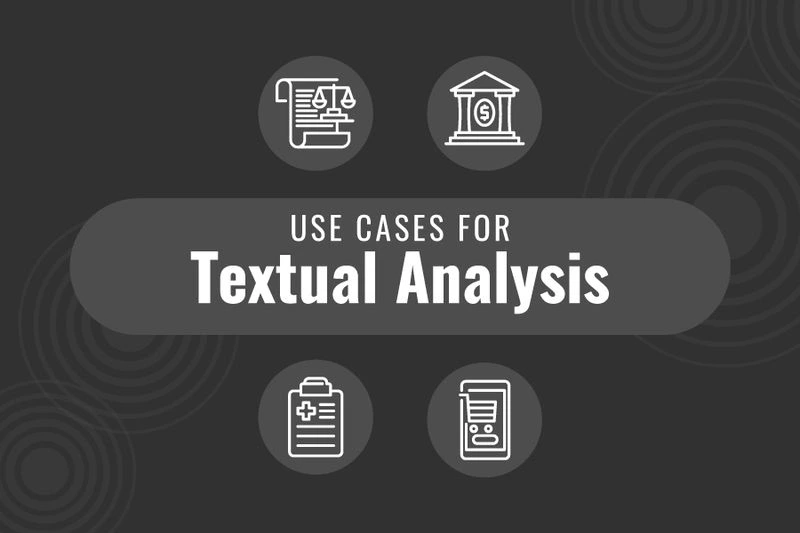
AI Text Analysis in Healthcare
AI text analysis tools streamline the automation of medical records, extracting valuable patient information to enhance healthcare delivery. By leveraging AI for natural language processing (NLP) in text analysis, healthcare providers improve diagnostic accuracy through the identification of patterns or anomalies in clinical notes. The use of NLP sentiment analysis for text also aids in patient feedback analysis.
AI Text Analytics in Retail & E-commerce
Retailers utilize AI text mining techniques to analyze customer reviews and extract actionable insights for product improvements. Personalized shopping experiences are driven by AI text classification models, enabling dynamic product recommendations. Tools like AI text analytics software ensure scalability for businesses handling extensive customer data. Many retailers are adopting enterprise AI software solutions to improve customer intelligence and automate large-scale text analysis workflows.
AI Text Analysis Tools in Finance
In the financial sector, AI-based text analytics platforms for text analysis automate document-intensive tasks such as loan approvals and compliance reporting. Advanced AI text sentiment analysis techniques help in fraud detection and risk assessment by identifying patterns in textual data, enhancing decision-making accuracy.
AI Text Analysis Software in the Legal Sector
Legal professionals rely on AI text analysis software for tasks like contract reviews and legal research. Using text analytics AI for text mining, legal teams can efficiently analyze case laws and identify relevant precedents, reducing manual errors. Techniques such as named entity recognition (NER) for AI text analysis further improve document comprehension.
Marketing & Customer Support with AI Text Summarization Tools
Marketers employ AI text analytics tools for sentiment analysis, gauging public opinion to refine strategies. Generative AI text summarization tools help create concise summaries of feedback, boosting decision-making. In customer support, AI tools for text analysis and sentiment detection enhance query handling through chatbots, improving customer satisfaction and reducing response times.
Challenges & Limitations of AI Text Analysis: What to Watch For
While AI text analysis offers numerous benefits, there are challenges:
Language Complexity
AI may struggle to understand sarcasm, idiomatic expressions, and cultural references that vary across languages. These linguistic challenges can result in misinterpretations or inaccurate insights from AI text analysis tools and AI text mining techniques.
Data Privacy
In industries like healthcare and finance, AI must handle sensitive data carefully to avoid breaches or misuse. Ensuring data privacy is essential, as mishandling can lead to significant legal and reputational risks. AI-based text analytics platforms for text analysis need to be compliant with industry regulations.
Bias in Algorithms
AI text sentiment analysis techniques may inherit biases from the data used to train them, leading to skewed results or unfair outcomes. Addressing these biases requires careful consideration and diverse datasets for more accurate and equitable analysis. Companies can leverage AI text classification models to reduce bias.
Cost of Implementation
While AI text analysis software can deliver valuable insights, the initial cost of deploying and maintaining these systems can be significant. Smaller businesses may face barriers to entry due to high costs and resource requirements. Evaluating AI text analytics free tools is an option for businesses with limited budgets.
Data Quality
AI text mining software for analysis and text analytics AI for text mining depend on data quality. Inconsistent or noisy data can lead to incorrect analysis, undermining the reliability of AI text analysis tools.
Scalability Issues
As data volumes grow, scaling AI systems to handle increased demand becomes a challenge. Businesses must ensure their AI text analytics tools are scalable enough to manage expanding datasets effectively. Using deep learning for natural language processing in text analysis can help scale solutions.
Future Trends in AI Text Analysis: Emerging Technologies & Innovations
Multilingual Capabilities
AI tools are improving in their ability to process and analyze multiple languages and dialects. This development will help businesses reach broader audiences and handle global markets more effectively with AI text analysis tools. Leveraging AI text mining techniques will enable businesses to analyze diverse languages for enhanced NLP sentiment analysis for text.
Explainable AI (XAI)
The push for explainable AI (XAI) ensures that businesses can understand how AI makes decisions. This transparency will build trust and allow for more informed decision-making in critical applications like AI-based sentiment analysis tools for text understanding and AI text sentiment analysis techniques.
Real-Time Text Analysis
As computing power increases, AI for natural language processing (NLP) in text analysis will enable real-time text analysis, allowing for immediate insights. This capability will be especially useful in dynamic fields like customer service, finance, and social media monitoring, powered by AI text mining software for analysis and AI text analysis free tools.
Integration with Other Technologies
AI text analysis will increasingly integrate with technologies like IoT, blockchain, and AR/VR to provide more immersive and innovative applications. This synergy will create new opportunities for businesses to harness the power of text analytics AI for text mining and enhance workflows through AI-based text analytics platforms for text analysis.
Emotion Recognition
AI will advance in understanding and analyzing emotions conveyed through text, enabling more empathetic customer interactions. This trend will enhance user experience in areas like marketing, healthcare, and customer service, powered by AI text analyzer for sentiment and summarization and AI text sentiment analysis techniques.
Automated Content Generation
AI text analysis will evolve to assist in generating relevant content automatically, from marketing copy to customer communications. This automation will streamline content creation, leveraging Generative AI text summarization tools and AI text summarization tools to help businesses remain agile in fast-paced environments.
Conclusion
AI text analysis is revolutionizing how organizations leverage textual data to drive insights and decision-making. With AI text analysis tools such as AI text classification models and Named Entity Recognition (NER) for AI text analysis, businesses can enhance operational efficiency and customer satisfaction. By utilizing AI text mining techniques and AI-based text analytics platforms for text analysis, companies gain deeper insights from vast datasets, enabling smarter business strategies and more informed actions. As these tools evolve, advancements in deep learning for natural language processing (NLP) in text analysis and generative AI text summarization tools will continue to redefine how businesses approach data interpretation and sentiment analysis.
FAQs
1. What is AI Text Analysis, and why is it important?
AI Text Analysis is the process of using Artificial Intelligence (AI) and Natural Language Processing (NLP) to extract insights from unstructured text.
It is important because it helps businesses:
- Understand customer sentiment through sentiment analysis
- Automate document, email, and content processing
- Improve decision-making through text classification and trend detection
- Identify recurring issues, patterns, and emerging risks
With Wizr AI, enterprises can combine sentiment analysis, text mining, contextual understanding, and workflow automation to make customer and operational insights faster, more accurate, and more actionable.
2. What are the best AI text analysis tools available in 2026?
Some of the leading AI text analysis tools in 2026 include:
- OpenAI for sentiment analysis and text generation
- Google Cloud Natural Language for entity extraction and sentiment analysis
- IBM Watson Natural Language Understanding for text analytics
- Microsoft Azure AI Language for text classification and summarization
- AI-powered enterprise text analytics platforms for customer feedback and workflow automation
Wizr AI helps enterprises support text analysis through NLP, sentiment analysis, entity extraction, summarization, and Enterprise AI Services that support customer support, ITSM, finance, and other business functions.
3. How does AI-powered text analysis improve business operations?
AI-powered text analysis automates text classification, data extraction, sentiment analysis, and issue detection, helping businesses reduce manual effort and improve accuracy.
Businesses can use it to:
- Analyze customer feedback in real time
- Detect trends in support tickets and surveys
- Improve agent productivity through contextual recommendations
- Automate document review and operational workflows
Wizr AI helps enterprises improve operations through AI-powered automation, intelligent insights, and workflow orchestration across business functions.
4. Can AI text analysis improve sentiment detection in customer feedback?
Yes. AI sentiment analysis can detect emotions in customer feedback with high accuracy using NLP models. AI text analysis can also detect customer sentiment by analyzing language, tone, urgency, context, and intent.
It allows companies to:
- Identify recurring customer issues
- Categorize feedback as positive, neutral, negative, or mixed
- Detect dissatisfaction before it escalates
- Improve customer support and response strategies
Wizr AI combines sentiment analysis, contextual intelligence, customer support automation, and workflow orchestration to help enterprises act on customer feedback more effectively.
5. What are the top AI text analysis use cases in 2026?
Common AI text analysis use cases include:
- Customer feedback analysis
- Support ticket analysis and routing
- Survey and sentiment analysis
- Document processing and summarization
- Compliance and legal document review
- Market research and trend detection
- IT support management and knowledge discovery
Wizr AI supports these use cases through AI-powered text analysis, configurable workflows, enterprise integrations, and Enterprise AI Services.
6. How to choose the right AI text analysis tool for your business?
When choosing an AI text analysis tool, businesses should consider:
- Features such as sentiment analysis, summarization, entity recognition, and text classification
- Integration with CRM, helpdesk, ERP, and enterprise systems
- Scalability to process large volumes of text
- Security, governance, and compliance requirements
- Availability of implementation support and enterprise services
Wizr AI helps enterprises implement AI text analysis through secure AI automation, configurable workflows, integrations, and Enterprise AI Services tailored to enterprise needs.
About Wizr AI
Wizr AI helps enterprises build autonomous enterprises and accelerate product and software engineering with practical, production-ready AI. We help organizations automate business workflows, modernize legacy applications and digital platforms, and build intelligent AI solutions.
Our core services include Enterprise AI Services, AI-Powered Engineering & Legacy Modernization, AI Product Engineering, and AI Governance. We also leverage AI Assembly capabilities, including the Agentic AI Framework, Agentic Workflows, Security, and Integrations.
Through our AI solutions, including AI Agents, Pharma & Life Sciences AI, Oracle AI, and Salesforce AI, we help enterprises apply AI across business and technology needs.
See how we can help your enterprise move faster with AI. 👉 Talk to an AI Expert.




![Agentic AI vs AI Agents: Key Differences Every CIO Must Know [2025 Guide]](https://wizr.ai/wp-content/uploads/2025/07/Agentic-AI-vs-AI-Agents.webp)
![Agentic AI vs Traditional Automation: Why Enterprises Shift for Better CX [2025]](https://wizr.ai/wp-content/uploads/2025/06/Agentic-AI-vs-Traditional-Automation.webp)


![11 Real-World AI Agents Examples + Use Cases for Enterprises [2025]](https://wizr.ai/wp-content/uploads/2025/05/AI-Agents-Examples-Use-Cases.webp)