Running an MSP today is not simple. One client wants faster response times. Another expects tighter security controls. A third demands full visibility into performance. At the same time, your team is handling more tickets, more tools, and more environments than ever before.
And this shift is not slowing down. According to Gartner, worldwide IT spending is projected to reach $5.74 trillion in 2025, with significant investment going into AI in IT operations and AI automation in IT operations across enterprise environments. Enterprises are actively funding smarter systems to reduce manual effort and improve service delivery.
To keep pace with these expectations, many MSPs are adopting AI agents for IT support management, enabling automated ticket handling, proactive issue resolution, and more scalable, efficient service operations across complex IT environments.
So the real question is not whether automation matters. It is how you plan for it. In this guide, you will see how to approach AI Automation for Managed Service Providers in a practical way, so you can improve operations, support your teams, and scale with confidence.
![AI Automation for Managed Service Providers: A CIO Guide to IT Ops [2026]](https://wizr.ai/wp-content/uploads/2026/02/AI-Automation-for-Managed-Service-Providers-A-CIO-Guide-1024x650.webp)
Why MSPs Are Adopting AI Automation for IT Operations in 2026
If you run an MSP in 2026, your environment looks very different from five years ago. Clients operate across hybrid cloud, SaaS platforms, remote endpoints, and strict security frameworks. Each new layer adds more alerts, more dependencies, and more pressure on your service desk.
As your client base grows, complexity increases faster than your team size. Monitoring tools generate thousands of alerts daily. Many are duplicates. Some are low priority. A few are urgent but buried in noise. Your engineers spend valuable time separating signal from distraction.
This is where AI automation for MSPs becomes essential.
AI systems correlate alerts across tools. They detect patterns across infrastructure, endpoints, and applications using AI-powered IT operations (AIOps) and advanced AI automation in IT operations management. They suppress duplicate events and highlight probable root causes. Instead of reacting to individual alerts, your team responds to consolidated incidents with context.
To see how enterprises are implementing this in practice, explore enterprise ITSM automation with AI, where modern platforms leverage AIOps, intelligent workflows, and automation to reduce alert noise, accelerate resolution, and improve overall IT service performance.
The demand for this shift is not theoretical. According to Grand View Research, the global AIOps market is projected to reach $36.07 billion by 2030. This growth reflects strong enterprise investment in AI-driven IT operations platforms for MSPs.

For you as a CIO, this trend carries a clear message. Enterprise clients expect intelligent automation to be part of managed services. They want proactive monitoring, faster resolutions, and predictable performance.
MSPs are adopting AI automation for managed service providers to:
- Maintain SLA compliance across complex environments
- Reduce operational overhead without increasing headcount
- Detect anomalies before users report issues
- Improve response speed during high-impact incidents
Without automation, scaling becomes expensive and inefficient. With structured AI automation for enterprise MSPs, your operations become more predictable and resilient.
To understand how leading organizations are achieving this, explore enterprise AI automation platforms and services, which outline how AI-driven orchestration, intelligent workflows, and automation frameworks help MSPs scale efficiently while maintaining consistency and control.
How CIOs Should Plan an AI Automation Strategy for MSP Environments?
Adopting AI Automation for Managed Service Providers requires more than deploying a tool. You need a clear plan aligned with business outcomes.
Start with intent. Define what success looks like for your MSP when adopting AI for managed service providers capabilities.
Ask yourself:
- Where do we see repeated SLA breaches?
- Which tickets consume the most engineering time?
- Which processes depend heavily on manual intervention?
- What compliance risks exist in our current workflows?
These questions help you prioritize where AI automation in IT operations will have a measurable impact.
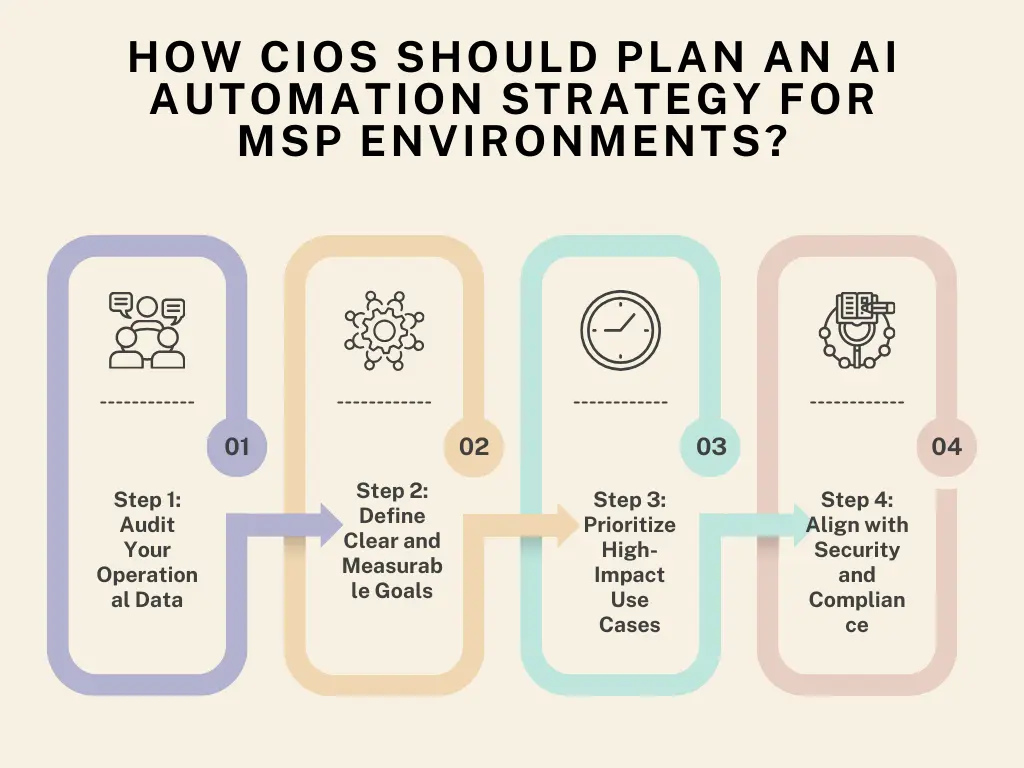
Step 1: Audit Your Operational Data
AI models used in AI-powered IT operations (AIOps) depend on structured and reliable data. Review:
- Ticket categories and resolution notes
- Alert severity labels
- Escalation patterns
- Change management logs
- Mean time to resolution metrics
Identify inconsistencies. If ticket tagging varies across engineers, clean and standardize it. If alert severity is unclear, redefine classification rules. Clean data strengthens AI automation in IT operations management accuracy and trust.
To operationalize this effectively, enterprises are adopting AI agents for IT support management, which help enforce standardized data structures, improve ticket classification, and ensure consistent, reliable automation across IT service workflows.
Step 2: Define Clear and Measurable Goals
Avoid vague objectives like “increase efficiency.” Instead, define outcomes tied to operational metrics for AI automation for managed service providers.
For example:
- Reduce repetitive L1 tickets by 25–30%
- Cut mean time to resolution by 20%
- Decrease duplicate alerts by 40%
- Improve first-contact resolution rate
These targets allow you to track progress and justify investment. When AI automation for enterprise MSPs improves measurable KPIs, executive support increases.
Step 3: Prioritize High-Impact Use Cases
You do not need full automation from day one. Begin with workflows that are:
- High volume
- Predictable
- Low risk
Examples include password resets, service restarts, access approvals, and patch verification.
Early success builds internal confidence. Once foundational workflows stabilize, expand into advanced areas such as predictive failure detection or automated remediation playbooks supported by Agentic AI in IT operations.
Step 4: Align with Security and Compliance
MSPs serve regulated industries such as BFSI, healthcare, and retail. Your automation must respect:
- Role-based access control
- Data encryption policies
- Audit logging standards
- Regulatory requirements
Ensure that every automated action is traceable and documented. Transparency builds trust with enterprise clients and strengthens the credibility of AI-enabled managed service providers.
When you approach AI Automation for Managed Service Providers methodically, you expand capabilities without increasing risk.
Also Read: AI Workflow Automation: Top 7 Tools & Strategies to Get Started [2026 Guide]
Integrating AI Automation with Service Desk, Monitoring, and Existing MSP Tools
You do not need to replace your IT stack to benefit from AI Automation for Managed Service Providers. Instead, treat AI as an intelligence layer across your current tools to enable AI-powered automation for MSPs.
1. Service Desk Systems
Your service desk is often the first point of contact for users. AI in IT operations improves efficiency in several ways.
AI can:
- Classify incoming tickets based on historical patterns
- Detect urgency from user language
- Assign priority according to business impact
- Route tickets automatically to the right team
This eliminates manual triage and reduces delays through AI automation in IT operations management.
AI can also power self-service portals and virtual assistants using Generative AI in IT operations. Users receive instant responses for common issues such as password resets or software access requests. This reduces ticket inflow while improving user experience.
2. Monitoring and Event Management Tools
Monitoring systems collect large volumes of infrastructure data. Without correlation, engineers face alert fatigue.
AI analyzes:
- Cross-system dependencies
- Historical failure trends
- Performance baselines
- Anomaly deviations
Instead of hundreds of separate alerts, your team sees consolidated incidents with likely root causes using AIOps platforms for MSPs. Engineers begin investigation with context. This shortens resolution time and reduces unnecessary escalations.
3. RMM and ITSM Platforms
When integrated with RMM and ITSM platforms, AI automation for MSPs goes beyond analysis. It can trigger actions through AI agents for IT operations.
For example:
- Restarting services after detecting failure
- Validating patch deployment success
- Isolating compromised endpoints
- Updating ticket logs automatically
These actions reduce routine work while ensuring audit accuracy for AI-powered managed service providers.
By integrating AI across your ecosystem, you create coordinated workflows instead of disconnected automation scripts. This increases operational clarity without overwhelming your teams.
Also read: Autonomous AI Agents: How They’re Shaping Enterprise Automation [2026]
How MSP Teams Use AI for Ticket Prioritization, Resolution, and Proactive Support
AI strengthens daily operations at the service desk and beyond for AI Automation for Managed Service Providers.
1. Ticket Prioritization
AI evaluates:
- Affected business units
- System dependencies
- Historical severity
- SLA timelines
Critical tickets move to the top automatically. This prevents high-impact incidents from being overlooked and improves efficiency in AI-powered IT operations (AIOps).
2. Resolution Assistance
AI analyzes previous tickets and knowledge base articles. It suggests step-by-step remediation instructions to engineers in real time using AI agents for IT operations.
This reduces reliance on individual memory. Junior engineers resolve cases faster. Senior engineers spend less time on repetitive fixes.
According to Gitnux, AI automation in IT operations can reduce average ticket resolution time by up to 40% in MSP environments. This improvement directly affects SLA performance and operational efficiency.
3. Proactive Support
The most valuable shift is prevention.
AI identifies subtle patterns across endpoints and cloud workloads using AIOps platforms for MSPs. It flags issues such as:
- Increasing memory consumption
- Gradual storage depletion
- Unusual login behavior
- Network latency spikes
Instead of waiting for client complaints, you act early. This proactive approach reduces downtime and strengthens client confidence.
Over time, your MSP transitions from a reactive support provider to a proactive operations partner using AI-powered automation for MSPs.
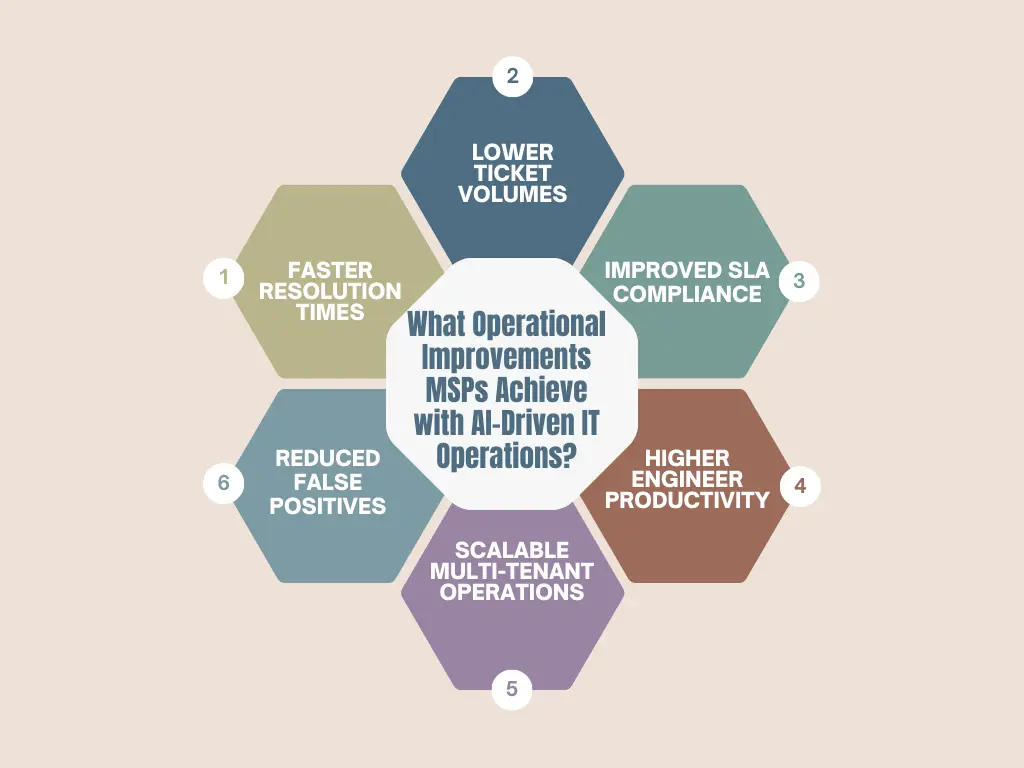
What Operational Improvements MSPs Achieve with AI-Driven IT Operations?
When AI becomes embedded in your AI-driven IT operations for MSPs, performance improvements appear across multiple dimensions.
1. Faster Resolution Times
Automated triage and guided remediation reduce diagnostic delays. Engineers start with context rather than searching for clues.
2. Lower Ticket Volumes
Self-service automation and self-healing scripts resolve repetitive issues before they reach the queue. This reflects practical AI use cases in IT operations.
3. Improved SLA Compliance
AI prioritization ensures high-risk incidents receive immediate attention. Escalation workflows trigger automatically when thresholds are met.
4. Higher Engineer Productivity
Engineers focus on architecture planning, optimization, and security hardening instead of repetitive troubleshooting. This improves job satisfaction and retention.
5. Scalable Multi-Tenant Operations
AI learns patterns across environments. Insights from one client help optimize workflows for others. This enables you to grow your client base without proportional increases in staffing, supporting AI-enabled managed service providers.
6. Reduced False Positives
Alert correlation improves monitoring accuracy. Engineers spend less time chasing non-issues and more time solving meaningful problems.
These improvements compound over time. Operational costs stabilize. Service quality becomes consistent. Your MSP gains a stronger competitive position.
In 2026, AI Automation for Managed Service Providers is not an experiment. It is an operational standard. When planned carefully and integrated thoughtfully, AI Automation for Managed Service Providers becomes the backbone of scalable, efficient, and enterprise-ready IT operations.
Also Read: Top 11 Real-World AI Agents Examples + Use Cases for Enterprises [2026]
How Wizr Helps Managed Service Providers Deploy AI Automation Across IT Ops
Adopting AI is one thing. Deploying it across real MSP environments is another.
Wizr AI helps managed service providers operationalize AI automation across their IT stack through enterprise AI services, intelligent agents, and AI-powered workflows in a structured and secure way. Wizr integrates AI with the systems your teams already use, enabling AI automation for MSPs and AI automation in IT operations.
With Wizr, you can:
- Connect AI to your existing ITSM, service desk, and RMM platforms
- Automate ticket classification, routing, and prioritization
- Detect infrastructure anomalies before they impact users
- Trigger automated remediation workflows based on defined policies
- Maintain audit-ready logs with role-based access and compliance controls
Instead of running disconnected automation scripts, Wizr helps you implement coordinated AI-powered workflows across monitoring, service management, and endpoint systems. This supports AI-powered automation for MSPs and enables AI-driven IT operations for MSPs.
Wizr also supports multi-tenant MSP environments. Whether you serve SaaS companies, BFSI institutions, healthcare providers, retail brands, or contact centers, you can standardize automation without compromising data isolation or governance. This approach supports AI-enabled managed service providers.
For your team, this means:
- Fewer repetitive tickets
- Faster triage and resolution
- Better SLA performance
- Clear visibility into automation impact
Wizr helps you move from reactive support to AI-driven IT operations for MSPs with measurable results. With the right AI services, integrations, and workflows, you can deploy automation with control, transparency, and scale in mind.
Final Thoughts
Running a modern MSP means balancing growth, complexity, and rising client expectations. You are expected to deliver faster resolutions, stronger security, and proactive service across multi-tenant environments without increasing operational costs at the same pace.
AI Automation for Managed Service Providers gives you a structured way to meet those demands. When you plan carefully, integrate intelligently, and measure outcomes, automation becomes more than efficiency. It becomes a strategic advantage. In 2026 and beyond, the MSPs that scale successfully will be the ones that embed AI into daily IT operations with control, visibility, and purpose.
If you are ready to modernize your IT operations, Wizr can help you implement AI automation for managed service providers through enterprise AI services, AI agents, and intelligent workflows across your MSP environment with structure and confidence.
Book a demo with Wizr today to see how you can reduce ticket volumes, improve SLA performance, and scale your managed services without increasing operational strain.
FAQs
1. What is AI Automation for Managed Service Providers?
AI Automation for Managed Service Providers uses AI to automate routine IT operations such as ticket routing, alert correlation, and incident response. Instead of manually handling every issue, AI automation for MSPs analyzes infrastructure data and triggers automated workflows.
For example, AI-powered IT operations (AIOps) can prioritize critical incidents, detect anomalies, and recommend fixes based on historical data.
With Wizr AI, MSP teams can deploy AI-driven IT operations for MSPs by integrating AI agents and intelligent workflows with service desk, monitoring, and RMM systems to automate workflows across IT environments.
2. Why are MSPs adopting AI automation in IT operations?
MSPs manage complex environments across cloud, endpoints, and applications. Handling this manually leads to alert fatigue and slower resolution.
That’s why many organizations are adopting AI automation in IT operations to improve service delivery. Key benefits include:
- Faster ticket prioritization
- Reduced alert noise with AIOps platforms for MSPs
- Automated remediation workflows
Wizr AI helps MSPs implement AI automation through enterprise AI services, intelligent workflows, and system integrations to improve operational efficiency across IT operations.
3. What are common AI use cases in IT operations for MSPs?
Some of the most practical AI use cases in IT operations include:
- Automated ticket classification and routing
- Infrastructure anomaly detection
- Predictive monitoring using AI-powered IT operations (AIOps)
- Automated remediation workflows
These capabilities help MSPs become AI-enabled managed service providers delivering faster and more proactive support.
With Wizr AI, teams can deploy AI agents and workflows for IT Support Management that automate ticket triage, detect system anomalies, and trigger remediation actions.
4. How do Generative AI and AI agents help MSP teams?
Technologies like Generative AI in IT operations and AI agents for IT operations help engineers troubleshoot faster and automate workflows.
For example, AI can analyze historical incidents and suggest remediation steps or trigger automated responses to system alerts.
With Wizr AI, MSPs can deploy agentic AI workflows and AI agents through Enterprise AI Services, integrating them with service desk, monitoring, and IT operations systems to automate service desk tasks, detect anomalies, and manage IT operations across enterprise environments.
5. How can CIOs implement AI automation for MSP environments?
CIOs should start with high-impact workflows such as ticket triage, monitoring alerts, and remediation automation.
A simple approach includes:
- Identify repetitive IT operations tasks
- Clean operational data for accurate AI insights
- Deploy AI automation in IT operations management gradually
Wizr AI helps CIOs implement AI automation for managed service environments through Enterprise AI Services, governed workflows, integrations, AI agents, and scalable automation across IT operations.
About Wizr AI
Wizr AI helps enterprises build autonomous enterprises and accelerate product and software engineering with practical, production-ready AI. We help organizations automate business workflows, modernize legacy applications and digital platforms, and build intelligent AI solutions.
Our core services include Enterprise AI Services, AI-Powered Engineering & Legacy Modernization, AI Product Engineering, and AI Governance. We also leverage AI Assembly capabilities, including the Agentic AI Framework, Agentic Workflows, Security, and Integrations.
Through our AI solutions, including AI Agents, Pharma & Life Sciences AI, Oracle AI, and Salesforce AI, we help enterprises apply AI across business and technology needs.
See how we can help your enterprise move faster with AI. 👉 Talk to an AI Expert.


![Agentic AI vs AI Agents: Key Differences Every CIO Must Know [2025 Guide]](https://wizr.ai/wp-content/uploads/2025/07/Agentic-AI-vs-AI-Agents.webp)
![Agentic AI vs Traditional Automation: Why Enterprises Shift for Better CX [2025]](https://wizr.ai/wp-content/uploads/2025/06/Agentic-AI-vs-Traditional-Automation.webp)


![11 Real-World AI Agents Examples + Use Cases for Enterprises [2025]](https://wizr.ai/wp-content/uploads/2025/05/AI-Agents-Examples-Use-Cases.webp)