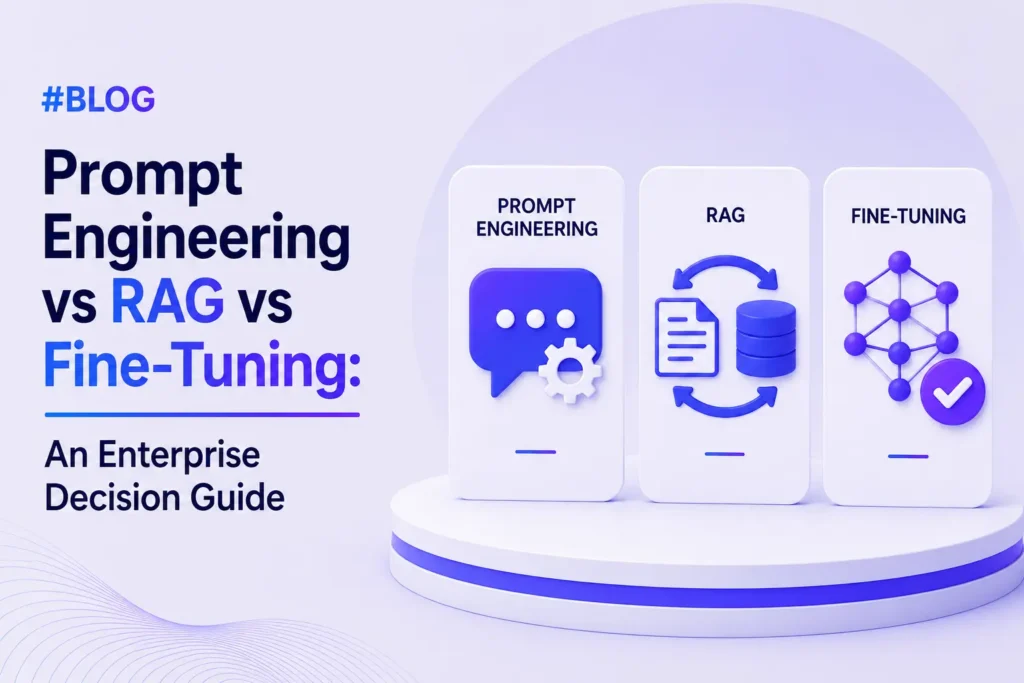
Choosing between prompt engineering, RAG, and fine-tuning comes down to one question: does your AI need to change how it formats output, learn new facts, or adopt new behavior? Prompt engineering shapes tone and structure without touching the model. Retrieval-augmented generation (RAG) connects the model to external data so answers stay current and grounded. Fine-tuning adjusts the model’s weights to embed domain-specific patterns and behavior.
Picking the wrong method is expensive. Teams routinely fine-tune when they should use RAG, burning compute on a knowledge problem that weights cannot reliably solve. This guide gives engineering and AI leaders a clear decision framework: what each method does, when to use it, how the three compare on cost and freshness, why the strongest enterprise systems combine them, and the mistakes that create avoidable technical debt. Read it as a blueprint for matching the mechanism to the problem before you provision a single GPU.
Key Takeaways
- Match method to problem. Use prompt engineering for format and tone, RAG for facts, and fine-tuning for behavior.
- Fine-tuning is not for knowledge recall. Weights compress data probabilistically, so exact factual recall is unreliable.
- RAG keeps answers current. Retrieval grounds the model in live data without retraining.
- The best systems are hybrid. Production architectures often combine prompting, RAG, and fine-tuning.
- Start with the cheapest method that works. Escalate only when a simpler approach cannot meet the requirement.
Why Choosing the Right LLM Customization Method Matters
Getting the customization decision right is now a core enterprise skill, not a niche engineering detail. Gartner predicts that more than 50% of the generative AI models enterprises use will be domain-specific by 2027, up from about 1% in 2024. Most of those domain models are not trained from scratch. They are built by layering RAG and fine-tuning on top of foundation models, which is exactly the decision this guide addresses.

Data quality decides whether these approaches work. Gartner also predicts that through 2026, organizations will abandon 60% of AI projects that lack AI-ready data, a warning that hits RAG especially hard, since retrieval is only as good as the data behind it.
The cost of choosing wrong is high. MIT research found that roughly 95% of enterprise generative AI pilots deliver no measurable business impact, and a mismatched customization strategy is a common reason. Matching the method to the problem is one of the clearest ways to land in the successful minority.
What Are Prompt Engineering, RAG, and Fine-Tuning?
Before comparing the three, it helps to define each clearly, since they solve different problems.
Prompt Engineering
Prompt engineering is the practice of crafting the instructions, context, and examples you send to a model to shape its output. It changes nothing inside the model. Instead, it guides the model’s existing capabilities toward the tone, format, or reasoning you want. Techniques include clear instructions, few-shot examples, and structured reasoning prompts.
Prompt engineering is fast, cheap, and the right starting point for most use cases. It works best when the base model already knows the subject and you simply need to control how it responds.
Retrieval-Augmented Generation (RAG)
RAG connects a model to an external knowledge source so it can answer using current, verifiable data. The system converts your documents into embeddings, stores them in a vector database, retrieves the most relevant chunks for each query, and injects them into the prompt. The model then answers using that retrieved context.
RAG is the correct choice when answers depend on facts that change or that the base model never learned. It grounds responses in your data, which sharply reduces hallucination, and it updates the moment your source data updates. Wizr explains the modern evolution of this approach in its guide on agentic RAG versus traditional search.
Fine-Tuning
Fine-tuning adjusts a model’s internal weights by training it further on a curated set of examples. It teaches the model new behavior, style, or format, and it can help the model understand domain-specific language. Parameter-efficient methods like LoRA have made fine-tuning far cheaper than full retraining, though it still requires quality data and MLOps discipline.
Fine-tuning shines for consistent behavior at scale, such as a specific brand voice or a specialized output structure. It is the wrong tool for factual recall, because models store training data as probabilities, not as a lookup table.
What Is the Core Evaluation Question for LLM Customization?
Large language model customization means aligning business data and requirements with model capabilities. The decision hinges on a single question: does the AI need to learn new facts, adopt new behavior, or simply format its output differently?
Each answer points to a different method. New facts point to RAG. New behavior points to fine-tuning. New formatting points to prompt engineering. Selecting the wrong method creates technical debt and caps scalability, so the evaluation should start with the nature of the problem, not the appeal of the technique.
Cost, context-window limits, and hallucination risk shape the decision too. A method that looks powerful can be wasteful if a simpler approach meets the requirement, which is why disciplined teams escalate from prompting to RAG to fine-tuning only as the problem demands.
Why Do Common AI Evaluation Approaches Fail?
Common evaluation approaches treat fine-tuning as a universal fix for knowledge gaps, and the assumption is costly. Adjusting weights does not guarantee factual recall, so teams spend heavily on compute without resolving hallucinations.
Many organizations default to fine-tuning the moment a base model falls short, assuming that a training run will make the model memorize internal documents. In practice, LLMs compress data into probabilistic weights, which makes exact recall unreliable. Using fine-tuning for retrieval rather than behavior produces high costs and a model that still returns outdated or invented answers.
The fix is to separate the two problems. When the issue is knowledge, ground the model in data with RAG. When the issue is behavior, adjust the model with fine-tuning. Conflating the two is the single most common and expensive mistake in LLM customization.
What Criteria Separate Effective AI Architectures From Inefficient Ones?
An effective architecture matches the mechanism to data volatility, behavioral requirements, and latency. Getting that match right prevents over-engineering and can meaningfully reduce operational overhead, since a simpler method avoids the cost and maintenance of a heavier one.
The thresholds below are examples to adapt, but the logic is durable. Define clear conditions for each path before you build.
- Data volatility: if the underlying data changes faster than you can retrain, fine-tuning is high risk. Deploy RAG for real-time retrieval instead.
- Behavioral deviation: if the desired output differs substantially from the base model’s default behavior, prompt engineering alone will struggle. Fine-tuning adjusts the model to close the gap.
- Context utilization: if a single query would consume most of the context window, loading full documents is costly and slow. RAG retrieves only the relevant chunks.
- Baseline performance: if the base model already answers accurately in zero-shot tests, prompt engineering is enough, with no extra infrastructure.
Applying these checks in order keeps teams on the cheapest effective path and prevents the reflex to fine-tune everything.
Prompt Engineering vs RAG vs Fine-Tuning: A Comparison
The three methods trade off differently on speed, cost, freshness, and control. The table below summarizes the differences to guide a first-pass decision.
| Factor | Prompt Engineering | RAG | Fine-Tuning |
|---|---|---|---|
| Core mechanism | Context and instruction | Vector retrieval | Weight adjustment |
| Best for | Tone and format control | Dynamic, factual knowledge | Custom behavior and style |
| Data freshness | Static | Real-time | Point-in-time |
| Implementation time | Hours | Days to weeks | Weeks to months |
| Hallucination control | Limited | Strong for factual grounding | Weak for facts |
| Cost profile | Low, token cost | Medium, database plus tokens | High, compute plus tokens |
| Maintenance | Low | Update the data source | Retrain to update |
The comparison makes the pattern clear. Prompt engineering is the fast, cheap default, RAG is the answer for knowledge that changes, and fine-tuning is the investment for consistent, specialized behavior.
What Are the Trade-offs, and When Should You Use Each?
Every method has boundaries, and knowing them prevents expensive detours. Consider these limits before committing.
- Fine-tuning is a poor fit when data changes frequently, since retraining for every update is cost-prohibitive.
- RAG cannot teach a model an entirely new skill or syntax, because retrieval supplies context, not structural understanding.
- Prompt engineering degrades when the required context is very large, raising cost and latency and reducing reasoning quality even on long-context models.
A simple rule helps in practice. Start with prompt engineering, add RAG when answers depend on your data, and reserve fine-tuning for behavior that prompting and retrieval cannot deliver consistently. Escalating only when needed keeps architecture lean.
The Hybrid Approach: Combining Prompting, RAG, and Fine-Tuning
The methods are not mutually exclusive, and the strongest enterprise systems use all three. A hybrid architecture fine-tunes a model for domain language and behavior, layers RAG on top for current facts, and uses prompt engineering to control each interaction.
A practical example is an enterprise support assistant. Fine-tuning gives it the right tone and an understanding of internal terminology, RAG pulls the latest policy or product data, and prompt engineering enforces the response format and guardrails. The result speaks the company’s language, cites accurate information, and behaves predictably.
The industry is moving toward this composite pattern, often coordinated by agents. Agentic systems decide when to retrieve, when to call a tool, and how to sequence steps, which turns static customization into dynamic problem-solving. Wizr’s guide on building multi-agent applications shows how these pieces fit together in production.
How Does a Misaligned AI Strategy Impact Engineering Teams?
A misaligned strategy forces engineering teams into endless maintenance and wasted compute. The right architecture reduces technical debt and ties spending to business value. The illustrative example below shows the difference.
A product engineering team at a financial analytics firm needs a customer-facing chatbot to answer questions about internal compliance documents. The VP of Engineering assumes the model must learn the documents permanently and authorizes a fine-tuning initiative. The data science team spends three weeks turning 50,000 internal PDFs into training pairs and runs a costly fine-tuning job on a GPU cluster.
Deployment fails immediately. When a user asks about a policy updated yesterday, the chatbot confidently invents an answer from three-week-old training data. The team cannot rerun an expensive training job every time a policy changes, so the product is stuck with stale information and high overhead. The root cause is treating a knowledge retrieval problem as a behavioral training problem.
The same use case built with RAG produces a very different result. The team chunks the compliance PDFs into embeddings, stores them in a vector database, and retrieves the exact relevant paragraph at query time. The answer is accurate, reflects data updated minutes ago, and costs a fraction of a cent per query. The lesson is to diagnose the problem before choosing the mechanism.
A Decision Framework for LLM Customization
A short decision sequence turns the criteria above into a repeatable choice. Work through it in order for each use case.
- Can the base model already do this with better instructions? If yes, use prompt engineering and stop.
- Does the task depend on facts that change or that the model never learned? If yes, add RAG.
- Does the model need consistent new behavior, tone, or format that prompting cannot deliver? If yes, fine-tune.
- Do you need both current facts and specialized behavior? If yes, combine RAG and fine-tuning.
- Does the workflow require multiple steps or tools? If yes, orchestrate the methods with an agentic layer.
Documenting the answer for each use case keeps architecture decisions consistent and defensible across teams.
Common Mistakes to Avoid
A few recurring mistakes drive most wasted effort in LLM customization:
- Fine-tuning to add knowledge that RAG should supply.
- Skipping prompt engineering and jumping straight to heavier methods.
- Building RAG on messy, ungoverned data and expecting clean answers.
- Ignoring evaluation, so teams cannot tell which method actually improved results.
- Treating customization as one-time, rather than maintaining data and prompts over time.
- Overloading the context window instead of retrieving only what each query needs.
How to Start Building the Right LLM Architecture
Building a scalable architecture starts with auditing your data and defining clear latency and accuracy requirements. Map each use case to the method it actually needs before provisioning cloud resources.
Begin by classifying the core challenge as factual accuracy or behavioral formatting, since that split points to RAG or fine-tuning respectively. Confirm your data is accessible and governed, run a small proof of concept with the simplest viable method, and measure results against a baseline before scaling. Wizr’s analysis of why enterprise AI apps fail covers the foundational gaps that derail these projects.
How Wizr AI Helps Enterprises Choose and Build the Right LLM Architecture
Wizr AI is not only a services provider. It combines Enterprise AI Services, AI-powered engineering, and AI capabilities to help teams choose the right customization method and actually build it. The hard part is rarely understanding the options. It is implementing prompting, RAG, fine-tuning, and orchestration together in a governed, production-grade system, which is where Wizr focuses.
Here is how Wizr maps to the decision framework in this guide.
- For RAG and grounding: Wizr AI helps ground models in enterprise data through retrieval, so answers stay accurate and current without retraining.
- For orchestration: AI Assembly capabilities, including Agentic Workflows, coordinate retrieval, tools, and reasoning across multi-step processes, turning individual methods into a working system.
- For custom behavior: custom AI application development services handle fine-tuning and bespoke builds when a use case needs specialized behavior or domain language.
- For integration and data: Wizr’s engineering and integration capabilities connect models to the systems and data that RAG depends on.
- For strategy: Enterprise AI Services help evaluate use cases and select the most cost-effective approach, backed by SOC 2 Type II, ISO 27001, and GDPR compliance.
With enterprises like Chrysler, Project44, and Fragomen working with Wizr AI and 90% of pilots reaching production, the focus is on shipping the right architecture rather than the trendiest one. To map these methods to your use cases, talk to the Wizr team.
Conclusion
Prompt engineering, RAG, and fine-tuning are not competitors. They are tools for different jobs, and the skill is matching the tool to the problem. Use prompting for format, RAG for facts, fine-tuning for behavior, and combine them when the use case demands both current knowledge and specialized behavior.
Start with the simplest method that works, ground everything in clean data, and escalate only when the requirement is clear. When you are ready to turn the decision into a governed, production-grade system, Wizr AI can help you choose the right architecture and build it to scale through Enterprise AI Services and AI-powered engineering.
FAQs
1. How do RAG and fine-tuning work together in a hybrid AI system?
A hybrid system uses fine-tuning to teach the model how to format responses and understand domain-specific language, while RAG retrieves the actual real-time facts. The combination lets the model speak the right language and cite accurate, up-to-date data at the same time. Most production-grade enterprise assistants use this pattern.
Wizr AI helps build these hybrid systems, grounding models in live data while supporting custom behavior through its Enterprise AI Services and AI-powered engineering capabilities.
2. What are the technical prerequisites for implementing RAG?
Implementing RAG requires a few core components:
- An embedding model to convert text into numerical vectors.
- A vector database to store and index those embeddings.
- An orchestration layer to retrieve relevant context and inject it into the prompt.
Clean, governed source data underpins all three. Wizr AI provides the engineering, integration, and AI services needed to build and implement this pipeline without requiring enterprises to assemble every component from scratch.
3. What is the ROI timeframe for deploying a fine-tuned model?
The ROI timeframe for fine-tuning typically runs 3 to 6 months, depending on the quality of training data. The upfront compute cost is offset over time by lower prompt-token usage and more reliable task automation. Parameter-efficient methods like LoRA can shorten payback by cutting training cost.
Wizr AI helps enterprises weigh this trade-off and implement fine-tuning only where it genuinely outperforms simpler methods through its Enterprise AI Services and AI-powered engineering capabilities.
4. When is prompt engineering enough on its own?
Prompt engineering is sufficient when the base model already has the needed knowledge and you only need to enforce a format, control tone, or guide reasoning. It is the fastest and cheapest option, so it should always be the first thing you try before adding infrastructure.
Wizr AI applies strong prompt design across its enterprise AI solutions, escalating to RAG or fine-tuning only when a use case requires it.
5. Which method is best for controlling AI tone and style?
Prompt engineering handles basic tone adjustments well, while fine-tuning delivers superior control for a complex, highly specific brand voice that must stay consistent across thousands of interactions. The choice depends on how strict and repeatable the style requirement is.
Wizr AI supports both approaches, helping enterprises decide when prompt design is enough and when fine-tuning is worth the investment.
6. How do you choose a method based on hallucination risk?
If hallucinations come from missing factual knowledge, RAG is the fix, because it grounds the model in verifiable documents. If they come from the model failing to follow complex rules, fine-tuning or stronger prompt engineering is the answer. Diagnosing the source of the error points to the right method.
Wizr AI helps reduce hallucination risk by grounding outputs in governed enterprise data and supporting explainable and auditable AI implementations.
7. What is agentic RAG, and how is it different?
Agentic RAG adds a reasoning layer that decides when and what to retrieve, rather than always fetching a fixed set of chunks. An agent can reformulate the query, retrieve in multiple steps, and combine sources, which improves accuracy on complex questions. It is a natural evolution of standard RAG for enterprise workloads.
Wizr AI can build agentic retrieval solutions using its Agentic AI Framework and Agentic Workflows, enabling complex queries to retrieve the right context rather than relying on a single lookup.
About Wizr AI
Wizr AI helps enterprises build autonomous enterprises and accelerate product and software engineering with practical, production-ready AI. We help organizations automate business workflows, modernize legacy applications and digital platforms, and build intelligent AI solutions.
Our core services include Enterprise AI Services, AI-Powered Engineering & Legacy Modernization, AI Product Engineering, and AI Governance. We also leverage AI Assembly capabilities, including the Agentic AI Framework, Agentic Workflows, Security, and Integrations.
Through our AI solutions, including AI Agents, Pharma & Life Sciences AI, Oracle AI, and Salesforce AI, we help enterprises apply AI across business and technology needs.
See how we can help your enterprise move faster with AI. 👉 Talk to an AI Expert.

![15 Best AI Chatbot Development Companies in the USA [2026 Buyer's Guide]](https://wizr.ai/wp-content/uploads/2026/06/Best-AI-chatbot-development-companies.webp)
![12 Best AI Legacy Application Modernization Services in 2026 [CIO's Guide]](https://wizr.ai/wp-content/uploads/2026/06/12-Best-AI-Legacy-Application-Modernization-Services.webp)
![12 Best AI Agent Development Companies in the USA: A CIO's Guide [2026]](https://wizr.ai/wp-content/uploads/2026/07/12-Best-AI-Agent-Development-Companies.webp)
![Custom AI development vs Off-the-Shelf AI: An Enterprise Decision Framework [2026]](https://wizr.ai/wp-content/uploads/2026/08/Custom-AI-vs-Off-the-Shelf-AI.webp)


![Security and Compliance for Enterprise AI Implementation: A Practical Guide [2026]](https://wizr.ai/wp-content/uploads/2026/07/Security-and-Compliance-for-Enterprise-AI.webp)