Enterprise AI architecture is the blueprint that turns scattered AI experiments into secure, scalable systems that actually run in production. It defines how your data, models, agents, security, and governance fit together as one dependable whole.
Getting it right is now a competitive necessity. McKinsey estimates that generative AI could add $2.6 trillion to $4.4 trillion in value each year, but only enterprises with the right architecture will capture much of it. The market is moving just as fast, with the AI agents segment alone projected to grow from $7.84 billion in 2025 to $52.62 billion by 2030, according to MarketsandMarkets.
This guide breaks down what enterprise AI architecture is, why it matters, its 7 core components, the main frameworks, and the best practices for building AI systems that scale. To see these ideas in action, explore how Wizr AI supports production-ready enterprise AI.
What Is Enterprise AI Architecture?
Enterprise AI architecture is the structured design of the technology, data, and governance layers that let an organization build, deploy, and scale AI safely. It is the set of decisions that connect your models, data pipelines, agents, and controls into a coherent system.
Think of it like the architecture of a building. You would not add floors without a structural plan, and you should not add AI without a design for how it connects, secures data, and scales.
A strong AI enterprise architecture covers more than models. It spans data architecture, retrieval, orchestration, integration, security, and operations, so AI works reliably across the business rather than in isolated pockets.
This is different from a single AI tool or model. Generative AI enterprise architecture and agentic AI enterprise architecture describe whole systems, where models like GPT-5, Claude, and Gemini, plus AI agents, work together on real workflows using your enterprise data.

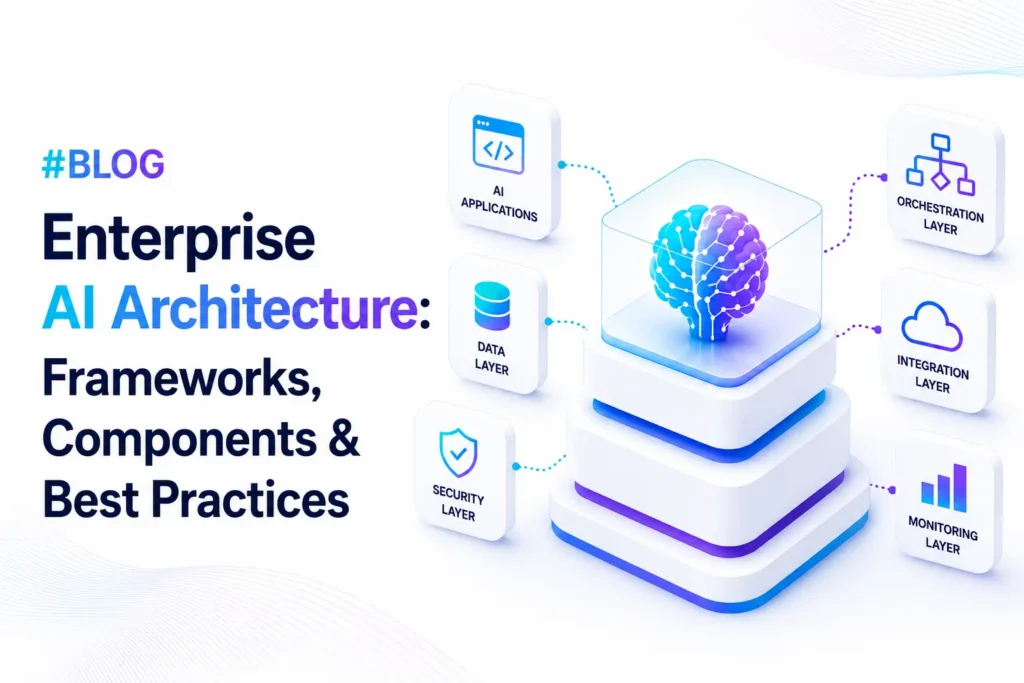
For large organizations, AI in enterprise architecture is no longer optional, it is the plan for how intelligence flows through the whole business. A helpful way to picture it is as an enterprise AI stack. At the bottom sits your data, in the middle your models and retrieval, and near the top your agents, integrations, and controls. Each layer depends on the ones below it, which is why skipping the foundation causes so many AI projects to collapse later.
Why Enterprise AI Architecture Is Essential for Successful AI Adoption
Most enterprises have adopted AI, but few have scaled it. McKinsey’s 2025 State of AI research found that 88% of organizations use AI in at least one business function, yet only about a third have begun to scale it enterprise-wide.
The gap is rarely the model. It is the architecture underneath. Without a solid foundation, AI projects stall between a promising pilot and real production value.
Data is the most common failure point. Gartner predicts that through 2026, organizations will abandon 60% of AI projects that are not supported by AI-ready data. Good enterprise AI data architecture is what keeps projects alive.
Here is why a deliberate enterprise AI architecture design matters:
- Scale: A shared foundation lets you launch new AI use cases fast, without rebuilding each time.
- Security: Enterprise AI security architecture bakes in access control, encryption, and audit trails from the start.
- Governance: Enterprise AI governance architecture keeps AI compliant, explainable, and accountable.
- Cost control: Clear architecture avoids duplicated tools and runaway model spend.
- Speed: Reusable components and patterns cut time to production dramatically.
Agentic AI raises the stakes further. As AI agents start to plan and act on their own, weak architecture no longer just wastes money, it creates real operational and compliance risk. That is why enterprise AI agent architecture and governance now sit at the center of most 2026 architecture reviews.
The takeaway is simple. Adoption is easy, but durable value comes from architecture. To understand where projects break down, read Wizr’s guide on why enterprise AI apps fail.
7 Core Components of Enterprise AI Architecture Every Organization Needs
Every production-grade enterprise AI architecture is built from the same core layers. Think of these as the seven components you cannot skip.
1. Data Architecture and Pipelines
This is the foundation. It covers data ingestion, cleaning, storage, and governance, plus vector databases and embedding models that make enterprise data usable by AI. Without AI-ready data, everything above it wobbles. In practice, this is where most enterprises should start, because clean, governed, well-modeled data is the hardest and most valuable part to get right. Vector databases and embedding models sit here too, turning documents and records into searchable meaning for AI.
2. Model Layer
This layer manages the AI models themselves, from foundation models like GPT-5, Claude, Gemini, Llama, and Mistral to fine-tuned or smaller task-specific models. A model gateway routes each request to the best model for the job on cost and accuracy. A model-agnostic design protects you from lock-in and lets you adopt new models like GPT-5 or the latest Claude and Gemini releases as they launch. It also lets you match each task to the most cost-effective model instead of overpaying for one giant model everywhere.
3. Retrieval and Knowledge Layer
This is where Retrieval-Augmented Generation (RAG) lives. It connects models to your documents and data through vector databases and the Model Context Protocol (MCP), grounding answers in real company knowledge and cutting hallucinations. For example, a support agent can pull the exact refund policy from your knowledge base before answering, so responses stay accurate and current. This retrieval step is what makes generative AI enterprise architecture trustworthy enough for real customer and employee use.
4. Orchestration Layer
The orchestration layer coordinates AI agents and multi-agent systems across multi-step tasks. Strong enterprise AI agent orchestration architecture lets specialized agents plan, hand off work, and collaborate under central control. This is what turns a single chatbot into a coordinated digital workforce that can run end-to-end processes. Enterprise AI agent platform architecture lives here too, defining how agents are created, coordinated, and governed at scale.
5. Integration Layer
AI is only useful when it can act. This enterprise AI integration architecture connects agents to your CRM, ERP, ITSM, and other systems through APIs and MCP, so AI can complete real work, not just answer questions. A well-designed integration layer is often the difference between an impressive demo and a system that delivers measurable outcomes. Standard APIs and MCP connections mean each new agent plugs into existing systems instead of needing custom work.
6. Security and Governance Layer
This layer enforces AI security, responsible AI, and compliance. It includes role-based access, encryption, audit trails, guardrails, and human-in-the-loop checkpoints that keep autonomous systems safe and accountable. In regulated industries, this layer is non-negotiable, since every autonomous action must trace back to a clear reason and owner. Enterprise AI security architecture and governance work together here to keep trust high and risk low.
7. Observability and Operations Layer
This is where LLMOps and MLOps keep everything healthy in production. It covers monitoring, evaluation, retraining, and cost management, so performance and spend stay under control as usage grows. Without it, AI quietly degrades, costs creep up, and small errors compound before anyone notices. Continuous evaluation is what keeps a production system reliable month after month.
Enterprise AI Architecture Frameworks: Key Models and Implementation Approaches
Enterprise AI architecture frameworks give you proven patterns instead of a blank page. The best enterprise AI architecture frameworks 2026 offers combine a few recognized models rather than inventing one from scratch. These enterprise AI architecture patterns are shortcuts that mature teams reuse across projects, and an enterprise agentic AI architecture framework simply adds agent orchestration and governance on top of the classic stack.
This shift is accelerating.The most common architecture patterns include:
- Layered enterprise AI stack: The reference architecture above, with clear data, model, retrieval, orchestration, integration, security, and operations layers.
- RAG architecture: Grounds model outputs in enterprise data using embeddings and vector search.
- Multi-agent system architecture: In this multi-agent system architecture enterprise AI pattern, specialized agents collaborate on complex workflows under an orchestrator.
- Event-driven architecture: Agents and services react to events in real time, which suits high-volume automation.
Most real systems blend these patterns. A single enterprise AI architecture might use a layered stack overall, RAG for knowledge retrieval, and a multi-agent design for complex workflows, all coordinated through one enterprise AI orchestration architecture. The skill is combining them cleanly instead of bolting them together.
When it comes to implementation, most enterprises choose one of three approaches. This comparison helps you decide.
| Approach | What It Is | Best For | Trade-off |
| Centralized AI platform | One enterprise AI platform architecture for all AI | Speed, governance, and consistent control | Less low-level flexibility |
| Composable and best-of-breed | Assemble separate tools for each layer | Deep customization and control | Heavy integration and upkeep |
| Hybrid | A platform core plus select custom components | Balancing speed with flexibility | Needs clear ownership boundaries |
There is no single right answer here. Many enterprises begin with a centralized enterprise AI platform architecture to move fast and stay governed, then add composable components for specialized needs as they mature. The key is to choose deliberately, document the decision, and revisit it as your AI portfolio grows.
The right AI tools for enterprise architecture 2026 include model gateways, vector databases, orchestration frameworks, and observability platforms. A useful enterprise AI reference architecture also plans for LLMOps and MLOps from day one, not as an afterthought. For a closer look at agent coordination, see Wizr’s guide on building multi-agent applications, and for grounding models in data, read agentic RAG vs traditional search.
Enterprise AI Architecture Best Practices for Building Secure, Scalable AI Systems
Strong architecture is about discipline as much as design. These enterprise AI architecture best practices separate systems that scale from pilots that stall.
The stakes are high. MIT research found that roughly 95% of enterprise generative AI pilots fail to deliver measurable business impact, usually because of weak data and integration, not weak models. Good architecture is the fix.
Follow these best practices:
- Start with the data foundation. Invest in AI-ready data, governance, and quality before you scale models. This is the single biggest predictor of success.
- Design security in from the start. Treat enterprise AI security architecture as structural, with zero-trust access, encryption, and SOC 2 Type II and ISO 27001 controls, not add-ons.
- Build modular and composable. Use loosely coupled components so you can swap models as GPT-5, Claude, or Gemini evolve, without rewriting everything.
- Bake in governance early. Apply responsible AI, audit trails, and human-in-the-loop controls across every agent and workflow.
- Plan for observability. Add LLMOps and MLOps monitoring, evaluation, and cost tracking so you catch drift and overspend fast.
- Adopt enterprise AI agent architecture best practices. Give agents clear permissions, boundaries, and guardrails, and start supervised before expanding autonomy.
- Deploy for scale. Design your enterprise AI deployment architecture for many use cases, with reusable patterns and clear ownership.
A few mistakes show up again and again. Teams chase flashy use cases before fixing their data, treat security as a final step, or skip observability and lose track of cost and quality. Avoiding these is often more valuable than any single tool choice.
A quick takeaway: architecture is a program, not a project. The enterprises that win treat it as an evolving foundation, adding capabilities as their AI matures.
How Wizr AI Helps Enterprises Build Production-Ready Enterprise AI Architecture
Everything above describes the architecture you need. The hard part is assembling those layers into one secure, governed system that actually runs in production. That is the exact gap Wizr AI helps enterprises close through Enterprise AI Services, AI-powered automation, and hands-on implementation expertise.
The seven layers, brought together through services and solutions Instead of stitching the core components together yourself, Wizr AI helps enterprises design and implement the key components of an enterprise AI architecture. Its AI capabilities connect data and retrieval layers to leading models like GPT-5, Claude, and Gemini, support agentic workflows and multi-agent orchestration, and enable integrations and AI observability across enterprise environments. AI Assembly brings together capabilities such as agentic workflows, integrations, and security to support these implementations.
This approach helps reduce the number of disconnected tools to manage and minimize gaps between architectural layers, which is often where enterprise AI implementations break down.
The best practices, built into the implementation This guide stresses security-first design, strong governance, and modularity. Wizr follows the same playbook. It is SOC 2 Type II, ISO 27001, and GDPR compliant, with role-based access, encryption, audit trails, and human-in-the-loop guardrails, so your enterprise AI security architecture and governance architecture are considered from day one rather than retrofitted later.
Its modular approach also allows enterprises to adapt model choices as GPT-5, Claude, Gemini, and other models evolve without requiring a complete rebuild of the architecture.
The data and custom work, handled by services. Because AI-ready data and custom agents are where many architectures stall, Wizr combines its AI capabilities with hands-on services. As a generative AI software development company, its Enterprise AI Services and custom AI application development services cover architecture design, data readiness, custom agent development, integration, and scaling.
Pre-built AI Agents for customer support, IT, and finance provide a production-ready starting point alongside these services, helping enterprises move from architectural planning toward real-world implementation.
The outcome that matters. Architecture only counts if it reaches production, which is exactly where the earlier failure stats bite. Across customers, 90% of Wizr pilots make it to production, and enterprises like Chrysler, Project44, and Fragomen have worked with Wizr on AI initiatives. That is the difference between a reference architecture on a slide and AI that runs and scales in the real world. Talk to the Wizr team to map these layers to your own environment.
Conclusion
Enterprise AI architecture is what separates companies that experiment with AI from those that scale it. The right design connects data, models, agents, security, and operations into a system that delivers real, repeatable value.
The pattern across successful enterprises is consistent. They treat architecture as a first-class investment, fix their data before scaling models, and design for governance and observability from day one. The result is AI that compounds in value instead of stalling after the first pilot.
Start with a strong data foundation, build security and governance into every layer, and choose an implementation approach that fits your team. When you are ready to move from blueprint to production, explore how Wizr AI helps enterprises build production-ready enterprise AI architecture through Enterprise AI Services, AI-powered engineering, and practical AI solutions.
FAQs
1. What is enterprise AI architecture?
Enterprise AI architecture is the structured design of the data, models, agents, security, and governance layers that let an organization build and scale AI in production. It connects these parts into one coherent, reliable system rather than isolated tools.
In short, it is the blueprint for doing AI safely at scale. Wizr AI helps enterprises implement production-ready enterprise AI architecture through services, AI capabilities, and tailored solutions, providing a practical foundation for moving from planning to deployment.
2. What are the core components of enterprise AI architecture?
A complete enterprise AI architecture has seven core layers:
- Data architecture and pipelines, including vector databases and embeddings.
- Model layer for foundation and task-specific models.
- Retrieval layer using RAG and MCP.
- Orchestration for AI agents and multi-agent systems.
- Integration, security, and observability layers to connect, protect, and monitor everything.
Each layer matters, and weakness in one undermines the rest. Wizr AI helps enterprises design, integrate, and implement these components through Enterprise AI Services and AI-powered solutions, reducing the risk of gaps between architectural layers.
3. Why do most enterprise AI projects fail?
Most fail because of architecture, not models. Poor data readiness, weak integration, and missing governance stop pilots from reaching production, which is why Gartner and MIT both link failure to foundations rather than algorithms.
Fixing the architecture is the fix. Wizr AI helps enterprises close these gaps with governed data flows, enterprise integrations, AI-powered automation, and production-grade controls.
4. What is the best enterprise AI architecture framework?
There is no single best framework. Most enterprises combine a layered AI stack, RAG architecture, and multi-agent architecture, then choose a centralized, composable, or hybrid implementation based on their team and goals.
The right choice depends on your need for speed versus control. Wizr AI works with enterprises to design and implement an architecture that fits their specific requirements, combining AI services, reusable capabilities, and custom components where needed.
5. How does enterprise AI architecture handle security and governance?
Security and governance should be built into every layer, with access control, encryption, audit trails, responsible AI, and human-in-the-loop guardrails. Retrofitting them later is slow, costly, and risky.
This is a core design principle, not a feature. Wizr AI is SOC 2 Type II and ISO 27001 compliant, with security and governance considered throughout its AI implementations to support enterprise and regulated environments.
6. How long does it take to build enterprise AI architecture?
It depends on your starting point, but most enterprises build in phases rather than all at once. A first production use case on a solid data foundation can take a few months, while a full, multi-layer architecture matures over a year or more.
The fastest path is to start with one high-value use case and expand. Wizr AI helps shorten this timeline through Enterprise AI Services, reusable AI capabilities, and pre-built AI Agents, allowing enterprises to build on an established foundation rather than starting every component from scratch.
About Wizr AI
Wizr AI helps enterprises build autonomous enterprises and accelerate product and software engineering with practical, production-ready AI. We help organizations automate business workflows, modernize legacy applications and digital platforms, and build intelligent AI solutions.
Our core services include Enterprise AI Services, AI-Powered Engineering & Legacy Modernization, AI Product Engineering, and AI Governance. We also leverage AI Assembly capabilities, including the Agentic AI Framework, Agentic Workflows, Security, and Integrations.
Through our AI solutions, including AI Agents, Pharma & Life Sciences AI, Oracle AI, and Salesforce AI, we help enterprises apply AI across business and technology needs.
See how we can help your enterprise move faster with AI. 👉 Talk to an AI Expert.

![15 Best AI Chatbot Development Companies in the USA [2026 Buyer's Guide]](https://wizr.ai/wp-content/uploads/2026/06/Best-AI-chatbot-development-companies.webp)
![12 Best AI Legacy Application Modernization Services in 2026 [CIO's Guide]](https://wizr.ai/wp-content/uploads/2026/06/12-Best-AI-Legacy-Application-Modernization-Services.webp)
![12 Best AI Agent Development Companies in the USA: A CIO's Guide [2026]](https://wizr.ai/wp-content/uploads/2026/07/12-Best-AI-Agent-Development-Companies.webp)
![Custom AI development vs Off-the-Shelf AI: An Enterprise Decision Framework [2026]](https://wizr.ai/wp-content/uploads/2026/08/Custom-AI-vs-Off-the-Shelf-AI.webp)

![Security and Compliance for Enterprise AI Implementation: A Practical Guide [2026]](https://wizr.ai/wp-content/uploads/2026/07/Security-and-Compliance-for-Enterprise-AI.webp)