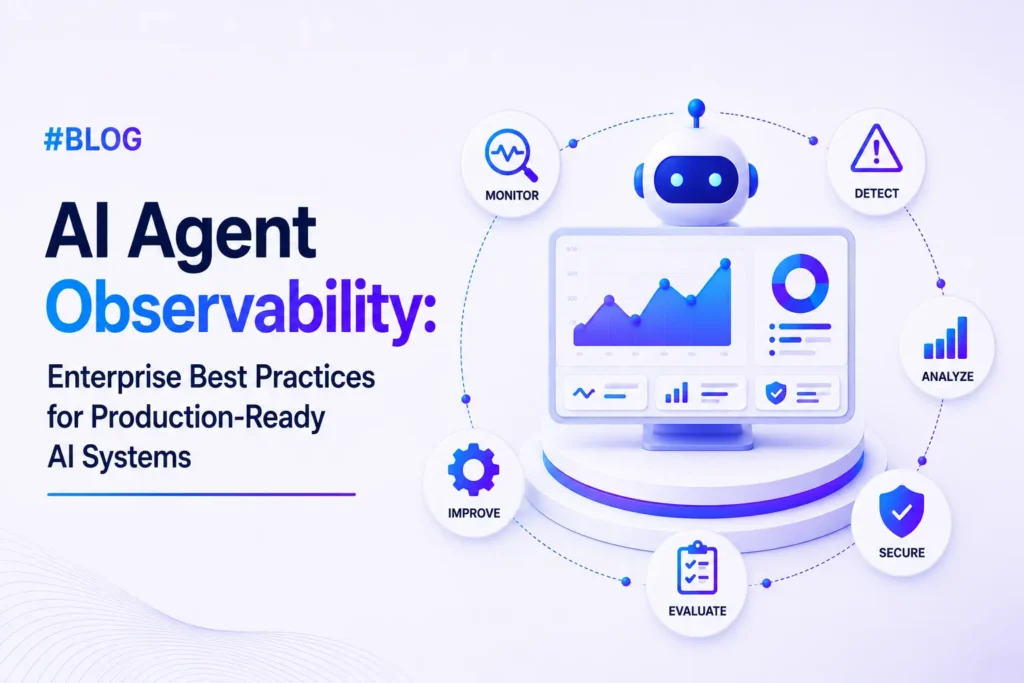
AI agent observability is the practice of tracing, monitoring, and evaluating autonomous AI agents in production, so you can see exactly what an agent did, why it did it, and whether it did it well. It captures every model call, tool use, retrieval, and reasoning step as structured data, then assembles those steps into replayable traces.
This matters because agents fail quietly. A chatbot that returns a wrong answer looks fine on a standard dashboard, even as it picks the wrong tool or invents a policy. Traditional monitoring watches outputs. AI agent observability explains the chain of decisions behind them.
This guide covers what AI agent observability is, why it is critical for production-ready AI systems, its core components, 10 best practices, and how to implement it in the enterprise. It is written for CIOs, CTOs, and engineering leaders who need agents they can trust. If you are still moving agents out of pilots, Wizr’s guide on why enterprise AI pilots fail to reach production is a useful companion.
What Is AI Agent Observability?
AI agent observability is the discipline of capturing, analyzing, and evaluating the full decision path of an AI agent running in production. It goes beyond logging outputs and instead records the reasoning, tool calls, retrievals, and handoffs that lead to each result.
Think of it as the difference between a receipt and a security camera. A receipt shows what was bought. A camera shows how the whole thing happened, step by step. That is what agent-level visibility gives you.

In practice, that visibility comes from instrumenting agents to emit structured data at every step, then feeding it into tools that store, search, and score the traces. The payoff is a clear, queryable record of agent behavior you can use to debug, improve, and prove compliance.
How AI agent observability differs from LLM and MLOps observability
Many teams already run some form of monitoring, so it helps to be precise about what is new here. The layers build on each other, and each answers a different question.
- MLOps observability tracks model health, data drift, and accuracy for traditional machine learning models. It is the foundation, and MLOps observability practices still apply.
- LLM observability watches prompts, responses, token usage, latency, and cost for a single model call. It is useful but stops at the output.
- AI agent observability captures the multi-step reasoning between the request and the response, including which tools an agent chose and why.
The core difference is simple. Standard AI monitoring observes outputs, while AI agent observability explains the decisions that produced them. For agents that plan, call tools, and act on their own, that explanation is the whole point.
Why agents need their own observability layer
Agents introduce variability that traditional software never had. Given the same input, an agent can take a different path, call a different tool, or reason its way to a different answer. This breaks the assumptions behind normal logging.
A production agent conversation can span a CRM lookup, an authentication check, an order update, and a policy decision across many turns. When something goes wrong, you need to replay that trajectory, not just read the final message. This is why observability AI for multi-agent systems has become its own field in 2026.
Why AI Agent Observability Is Critical for Production-Ready AI Systems
AI agent observability is critical because agents now make real decisions with real consequences, and you cannot govern what you cannot see. Without it, a single bad reasoning step can trigger wrong refunds, compliance violations, or silent customer churn, and no one notices until the damage is done. The more autonomy you give an agent, the more this visibility matters, because the agent is now making choices a human used to review.
The adoption data shows why this is urgent. According to PwC’s AI Agent Survey, 79% of companies say they are already adopting AI agents. Yet McKinsey reported in late 2025 that only about 23% of organizations have scaled agents in even one business function. Most agents are stuck between pilot and production, and weak visibility is a big reason why.
The risk is just as clear. Gartner predicts that over 40% of agentic AI projects will be canceled by the end of 2027, citing rising costs, unclear value, and weak controls. Observability is the discipline that keeps projects on the right side of that line.
Here is the business case for AI agent observability, framed as problem, solution, and outcome:
- Problem: agents fail silently. A wrong tool call or hallucinated fact looks normal on an output dashboard. Solution: trace-level visibility surfaces the faulty step. Outcome: faster debugging and fewer production incidents.
- Problem: costs spiral. Agents can loop, retry, and burn tokens without warning. Solution: track token, tool, and step costs per run. Outcome: predictable spend at scale.
- Problem: compliance gaps. Regulators want proof of what an agent decided. Solution: immutable audit trails for every action. Outcome: audit-ready AI operations.
- Problem: eroding trust. Teams disable agents they cannot explain. Solution: clear behavior monitoring and explainability. Outcome: confident, expanding adoption.
For a deeper look at the failure patterns behind stalled projects, see Wizr’s analysis of why enterprise AI apps fail and how to fix them.
Real-world example: observability in enterprise customer support
Picture a bank running an AI agent that handles card disputes. Without observability, the team only sees the final message the customer receives. When the agent quietly starts approving disputes it should escalate, the first signal is a spike in fraud losses weeks later.
With AI agent observability monitoring in place, every step is traced. The team sees the agent misreading a policy field, fixes the retrieval step, and adds a guardrail, all within hours. The problem becomes a quick fix instead of a costly incident. This is the difference between watching outputs and understanding decisions.
Key takeaway: Observability turns silent, expensive agent failures into fast, contained fixes, which is exactly what makes production-ready AI systems possible.
Benefits of AI agent observability for the enterprise
Strong observability pays off in ways leaders can measure. The main benefits include:
- Faster debugging: Trace-level visibility cuts mean time to resolution from days to hours.
- Lower risk: Early detection of drift, errors, and security issues prevents costly incidents.
- Predictable cost: Per-run cost tracking stops runaway token spend before it scales.
- Audit readiness: Immutable logs give compliance teams the proof regulators expect.
- Higher trust: Explainable agents earn the confidence teams need to expand adoption.
- Better decisions: KPIs tied to traces turn raw data into product and operations improvements.
Together, these benefits move agents from risky experiments to dependable enterprise assets. They also explain why observability now sits alongside AI governance and AI security as a board-level priority.
Core Components of AI Agent Observability for Enterprise AI
Enterprise AI agent observability rests on a few core components that work together. Each one captures a different signal, and together they turn an opaque agent into a system you can measure, debug, and govern.
1. Tracing and spans
Tracing is the foundation. Every model call, tool use, retrieval, and reasoning step is recorded as a structured span, and the spans assemble into a full, replayable trace. Adopting OpenTelemetry GenAI conventions keeps these traces consistent across tools and vendors. For example, a retail agent that mishandles a return can be replayed span by span to find the exact step that failed.
2. Monitoring and metrics
AI agent monitoring tracks the health signals you need in real time, including latency, error rates, token cost, and task success. Good enterprise AI agent performance monitoring turns these into dashboards and alerts, so problems surface before users feel them. Enterprise AI agent monitoring at this level is what lets an operations team catch a latency spike during a product launch before customers start complaining.
3. Evaluation
Evaluation scores the quality of agent behavior, not just uptime. It checks whether the agent chose the right tool, followed instructions, and produced an accurate result. AI agent evaluation and observability work best together, since traces give evals the context they need. A logistics agent, for instance, can be scored on whether it chose the correct carrier API, not just whether it replied.
4. Logging and audit trails
Logging records every input, output, guardrail decision, and override in a durable, tamper-resistant form. This is what makes AI operations audit-ready, and it maps directly to regulatory duties like the EU AI Act’s traceability and logging requirements for high-risk systems. A healthcare enterprise, for example, must show exactly which data an agent used to make a recommendation.
5. Cost and token tracking
Agents produce a lot of telemetry and can rack up cost fast. Tracking token, tool, and step cost per run keeps spend visible and prevents runaway loops from surprising your finance team. One common example is an agent that retries a failing tool dozens of times, quietly turning a one-cent task into a costly loop.
6. Security monitoring
Enterprise AI agent security monitoring watches for prompt injection, data leakage, unusual tool use, and access violations. Because agents can take real actions, a security lapse is not just a bad answer, it is a real breach risk. Imagine an agent tricked by prompt injection into exporting customer records, and you can see why this layer is non-negotiable.
7. Behavior and drift monitoring
AI agent behavior monitoring tracks how an agent acts over time and flags drift when performance or decisions shift. Data changes, models update, and prompts evolve, so continuous checks keep quality from slipping quietly. A support agent that slowly drifts toward wrong answers after a knowledge-base update is a classic case that drift monitoring catches early.
Key takeaway: These components are not optional add-ons. Together they form the instrumentation layer that makes enterprise AI agent monitoring, security, and governance possible.
AI Agent Observability Tools and Platforms
Enterprises rarely buy one tool for everything. Most combine an open standard for instrumentation with one or more AI agent observability platforms for tracing, evaluation, and dashboards. The table below compares common categories to guide a tools comparison.
| Tool category | What it does | Good fit for |
|---|---|---|
| Open standards (OpenTelemetry) | Vendor-neutral tracing and span conventions | Teams avoiding lock-in across the stack |
| Tracing and eval platforms | Trace capture, scoring, and production feedback loops | Engineering teams debugging agents in production |
| Enterprise governance platforms | Compliance monitoring, ML and LLM governance | Regulated industries with audit needs |
| MLOps-native platforms | Extending existing ML monitoring to agents | Teams already running MLOps observability |
| Integrated agent platforms | Build, run, monitor, and govern in one place | Enterprises wanting fewer moving parts |
When you compare the best AI agent observability tools 2026 has to offer, weigh trace depth, evaluation quality, security, data residency, and how well each fits your existing stack. The strongest enterprise AI agent observability tools support AI agent monitoring and orchestration together, not as separate silos. For teams running many agents, an AI agent and LLM observability platform that unifies both layers is easier to operate. A useful AI agent observability tools comparison looks past features to fit, since the best enterprise AI agent monitoring tools are the ones your team will actually run every day. Production-ready AI agent observability platforms should also prove themselves under real traffic, not just in a demo, and strong AI agent performance monitoring tools make that easy to verify.
Observability for multi-agent systems
Single-agent tracing is hard enough. Multi-agent systems raise the bar, because work passes between agents that each reason, call tools, and make decisions. When an outcome is wrong, the failure could sit in any one agent or in a handoff between them.
Observability AI for multi-agent systems must therefore capture the full topology, not just individual runs. You need to see which agent did what, in what order, and where context was passed or lost. A supervisor agent coordinating specialists is only trustworthy if you can trace every delegation.
This is where AI agent monitoring and orchestration come together. Orchestration decides how agents collaborate, and observability proves whether that collaboration actually worked. A blind spot between agents is where the hardest bugs hide, so treat cross-agent tracing as a first-class requirement. For a deeper look, see Wizr’s guides on agentic RAG versus traditional search and the best AI agent frameworks for enterprise.
10 AI Agent Observability Best Practices for Production-Ready AI Systems
These 10 AI agent observability best practices move you from scattered logs to a real operational discipline. They are ordered from the foundation up, so start at the top and build.
1. Instrument Before You Scale
Do not add agents to production without traceable telemetry. Retrofitting observability into a sprawling agent fleet costs far more than building it in from the start. The cost gap is often an order of magnitude, so this first practice protects every practice that follows.
Picture a team that ships 40 agents in a quarter, then spends the next two quarters bolting on telemetry after a costly outage. Make traceability part of your definition of done, so no agent reaches production without emitting spans. Bake instrumentation into your agent templates and CI checks, and observability stops being an afterthought. The common mistake is treating instrumentation as optional groundwork to add later, which almost always costs far more.
2. Capture the Full Reasoning Trace
Record every model call, tool use, retrieval, and decision as a span. Output-only logging hides the exact step where things break.
The goal is a replayable trace, so when an agent gives a wrong answer you can walk the whole path and find the faulty step. For example, a support agent that quotes the wrong refund policy may have retrieved the right document but reasoned poorly, and only a full trace shows that. Capture inputs, outputs, prompts, tool arguments, and timing at every step. The common mistake is logging only the final response, which tells you something failed but never why.
3. Adopt Open Standards
Use OpenTelemetry GenAI conventions so traces stay consistent across tools and you avoid vendor lock-in.
Open standards let you switch or combine AI agent observability platforms without re-instrumenting every agent, which protects your investment as the market shifts. They also make it easier to correlate agent traces with the rest of your stack, from APIs to databases, in one view. Most enterprise AI agent observability tools now support OpenTelemetry, so standardizing early keeps your options open. The common mistake is hard-wiring one proprietary format, then paying to rebuild instrumentation when you outgrow the tool.
4. Evaluate Continuously, Not Just at Launch
Run automated evals on real production traffic to catch quality drops early. Turn real failures into test cases so the same issue never ships twice. For example, a travel agent that books the wrong fare class becomes a permanent test that guards against a repeat.
Launch-day accuracy means little if quality slips a month later after a model or data change. Score agents on tool choice, instruction-following, and factual accuracy, not just whether they replied. Pair AI agent evaluation and observability so every eval has the trace context it needs to explain a low score. The common mistake is treating evaluation as a one-time gate before launch, when it should run continuously against live traffic.
5. Monitor Cost Per Run
Track token, tool, and step cost for every agent run. This is the practice most teams adopt only after a surprise bill arrives.
Agents can loop, retry, and call expensive tools without warning, so cost per run is a core health metric, not a finance afterthought. Set budgets and alerts per agent, and flag runs that exceed a step or token threshold. For example, an agent stuck retrying a failing API can turn a routine task into a runaway expense overnight. The common mistake is watching only monthly totals, which hide the specific agents and workflows quietly draining the budget.
6. Watch for Drift
Deploy drift detection on performance and behavior, and act on the signal before it reaches customers.
Agents degrade quietly as data, models, and prompts change, so drift monitoring is your early warning system. Track accuracy, tool-selection patterns, and response quality over time, and alert when they move outside a normal range. For example, a support agent may slowly start giving outdated answers after a knowledge-base refresh, long before anyone files a complaint. The common mistake is assuming an agent that worked at launch will keep working, then finding the drift only through customer churn.
7. Build Audit-Grade Logging
Keep immutable logs with role-based access on trace data. Record every guardrail decision and override for the audit trail. In regulated sectors, this is often the difference between passing and failing an audit.
Audit-grade means the logs cannot be quietly changed and clearly show who did what and when. Store every input, output, guardrail trigger, and human override, and align retention with your regulatory rules. This maps directly to duties like the EU AI Act’s logging requirements for high-risk systems. For example, a bank must be able to show exactly why an agent approved or denied a request months later. The common mistake is keeping mutable, unstructured logs that fall apart under real audit scrutiny.
8. Monitor Security Continuously
Screen for prompt injection, data exfiltration, and abnormal tool use as part of enterprise AI agent security monitoring, not as an afterthought.
Because agents take real actions, a security gap becomes a real breach, not just a bad answer. Watch for unusual tool calls, unexpected data access, and inputs that try to override instructions. For example, a malicious prompt that tries to make an agent export customer records should trigger an alert and a block, not a silent success. Feed security signals into the same traces you use for debugging, so investigations move fast. The common mistake is treating security as a separate, occasional review instead of continuous monitoring.
9. Govern Telemetry at the Source
Filter, aggregate, and redact sensitive data before it reaches your backend. This controls cost and keeps regulated data where it belongs. Redacting personal data at the source also keeps you aligned with GDPR and similar rules.
A fleet of agents can emit a flood of spans, so sending everything raw recreates the cost problem telemetry pipelines were built to solve. Mask sensitive fields, drop low-value spans, and summarize before data leaves the source. For agents at the edge, process telemetry locally so observability survives spotty connectivity and private data never leaves the site. The common mistake is shipping all raw telemetry to one backend, which inflates cost and creates new compliance risk.
10. Tie Observability to KPIs
Connect traces to business metrics like resolution rate, deflection, and CSAT, so observability drives outcomes, not just charts. When leaders can see observability moving a real number, funding and adoption follow naturally.
Observability earns its budget when it maps to outcomes the business already cares about. Link trace data to metrics like cost per resolved request, escalation rate, and time to resolution, and review them on a set cadence. For example, showing that better tracing cut escalations by a fifth makes the next investment easy to justify. The common mistake is drowning in technical dashboards no executive reads, instead of a few KPIs that connect agent behavior to business value.
A quick word on common mistakes. The biggest one is treating observability as a dashboard you check after launch, rather than instrumentation you build in first. The second is monitoring outputs while ignoring the reasoning path, which leaves you blind to why an agent failed. Sound AI agent monitoring best practices treat the trace, not the final message, as the source of truth.
Key takeaway: Follow these AI agent observability best practices in order. Instrumentation and tracing come first, because every later practice depends on the data they produce. Wizr’s guide on building multi-agent applications shows how these practices fit into real agent design.
How to Implement AI Agent Observability in Enterprise Production Environments
Implementing AI agent observability works best as a phased rollout, not a big-bang project. The goal is to instrument early, prove value on one workflow, then scale with governance in place. Here is a practical, step-by-step path.
- Set your goals and KPIs. Define what good looks like, using metrics like task success, resolution rate, cost per run, and mean time to detect issues. Align these with business outcomes before you write any code.
- Instrument your agents. Add tracing to every agent using OpenTelemetry conventions, so each model call, tool use, and retrieval emits a span. Confirm agents are traceable before they touch production. Treat an un-instrumented agent the way you would treat untested code, as something that is not ready to ship.
- Choose your tools. Select the observability platform or platforms that fit your stack, security needs, and data residency rules. Many enterprises pair an open standard with a dedicated tracing and evaluation platform. Run a short bake-off on real traffic so you compare platforms on your data, not on marketing claims.
- Connect evaluation. Wire your observability data into an automated evaluation framework, and set up production A/B testing for agent updates so changes are validated, not guessed.
- Add governance and security. Turn on audit-grade logging, role-based access, and security monitoring. Map retention schedules to your regulatory requirements from day one. Document the whole observability program as part of your AI governance framework, so audits become routine rather than stressful.
- Pilot, then scale. Prove value on one high-volume workflow, measure against your baseline, then expand across teams. Treat agent traces as durable business assets, not throwaway logs.
KPIs and success metrics for AI agent observability
You cannot improve what you do not measure, so define success metrics before you scale. Clear KPIs turn observability data into decisions and keep AI operations tied to business value.
| KPI | What it measures | Why it matters |
|---|---|---|
| Task success rate | Share of runs that complete the goal correctly | Core quality signal |
| Resolution or deflection rate | Requests resolved without human escalation | Direct ROI driver |
| Mean time to detect | How fast issues surface in traces | Limits the blast radius of failures |
| Cost per run | Tokens, tool calls, and steps per task | Keeps spend predictable at scale |
| Hallucination or error rate | Responses with inaccurate output | Protects trust and compliance |
| Drift indicators | Shifts in behavior or accuracy over time | Early warning of degradation |
Track these with your AI agent performance monitoring tools and review them on a regular cadence. The point of enterprise AI agent monitoring is not more charts, it is faster, better decisions.
Enterprise deployment considerations
Deploying observability at enterprise scale raises questions a pilot never does. Plan for data residency, so traces from a regulated jurisdiction stay where the regulator allows. Plan for telemetry volume, since a fleet of agents emits a constant stream of spans that can overwhelm a backend if you do not filter at the source.
Also plan for access and ownership. Decide who can view trace data, how long you retain it, and how observability fits your broader AI governance program. Getting these right early avoids expensive rework later.
Instrumentation and integration are where many teams stall, because agents must connect cleanly to real systems while staying observable. This is where custom AI application development services help, building agents that are production-ready and fully instrumented from the first line. For a broader view of running agents in production, Wizr’s piece on enterprise AI pilots that fail to reach production pairs well with this checklist.
How Wizr AI Helps Enterprises Build Production-Ready AI Systems with AI Agent Observability
Everything in this guide points to the same hard part: turning observable agents into governed systems that actually run in production. Wizr AI helps enterprises close that gap through Enterprise AI Services, AI-powered engineering, and AI governance not just dashboards. Here is how Wizr maps to the practices above.
Building instrumented, production-ready agents. The core challenge in the implementation section is shipping agents that are traceable from day one. Wizr’s AI Assembly capabilities and agentic workflows help enterprises build AI agents, AI assistants, and multi-agent systems on their own data, with reasoning steps and tool calls captured as they run. Because Wizr combines Enterprise AI Services with AI-powered software engineering, teams get engineering support to instrument complex, real-world agents not just a tool to configure.
Governance, compliance, and audit trails. The best-practices and core-components sections stress audit-grade logging and governance. Wizr supports this with SOC 2 Type II, ISO 27001, and GDPR compliance, role-based access, and human-in-the-loop controls. Its AI Governance services give enterprises the audit trails and oversight that regulators increasingly expect for high-risk AI. That means observability data is not just collected; it is turned into evidence you can show an auditor or a board.
Monitoring multi-agent workflows in production. This guide highlights observability for multi-agent systems as a distinct challenge. Wizr helps enterprises coordinate multiple agents through governed agentic workflows, with integrations and security designed to keep behavior visible and controllable as agents hand off work across departments.
Enterprise deployment and KPIs. The implementation section ties observability to business outcomes. Wizr’s Enterprise AI Services and AI-powered engineering cover strategy through production operations, so success metrics are built into the rollout. The results show up in production. For one logistics SaaS firm, Wizr agents drove up to 50% faster response times and deflected around 43% of support tickets, and across customers, 90% of pilots reach production.
The takeaway is simple. Observability tells you what your agents are doing, and Wizr helps you build, govern, and scale agents that are worth observing. Enterprises like Chrysler, Project44, and Fragomen already work with Wizr. You can see more in the case studies or talk to the Wizr team.
Conclusion
AI agent observability has become the operational foundation for production-ready AI systems in 2026. As agents take on more decisions, the ability to trace, monitor, and evaluate their behavior is what separates a reliable digital workforce from a risky black box.
The path forward is clear. Instrument early, capture the full reasoning trace, evaluate continuously, and tie everything back to governance and business outcomes. Do that, and you avoid the stalled-pilot trap that catches so many agentic AI projects. Remember that observability is not a one-time setup. It is an ongoing discipline that grows with your agent fleet, your regulations, and your business goals.
When you are ready to build, govern, and scale agents that are worth observing, Wizr AI brings together Enterprise AI Services, AI-powered engineering, AI governance, and agentic AI capabilities to support production-ready implementations. Explore Wizr’s enterprise AI services or talk to the team to map AI agent observability to your own production goals.
FAQs
1. What is AI agent observability?
AI agent observability is the practice of tracing, monitoring, and evaluating autonomous AI agents in production. It captures every model call, tool use, retrieval, and reasoning step, then assembles them into replayable traces. This lets teams see not just what an agent produced, but the full chain of decisions behind it.
Wizr AI helps enterprises build this visibility into their AI agent implementations, so teams can run AI agents they can actually explain and govern.
2. How is AI agent observability different from AI agent monitoring?
Monitoring and observability are related but not the same. AI agent monitoring tracks known signals like latency, errors, and cost, answering “is the agent healthy right now?” Observability goes deeper, letting you explore why an agent behaved a certain way, even for problems you did not predict.
In short, monitoring tells you something is wrong, and observability helps you understand why. Wizr AI supports both, pairing performance monitoring with trace-level visibility across multi-agent workflows.
3. What are the best AI agent observability tools in 2026?
ew categories:
- Open standards like OpenTelemetry for vendor-neutral tracing.
- Tracing and evaluation platforms for debugging and scoring agents.
- Governance platforms for compliance-heavy industries.
- Integrated agent platforms that build, run, and monitor in one place.
Weigh trace depth, security, and data residency when you compare options. Wizr AI supports enterprises through AI agent development, governance, and production operations, with services and solutions designed to help build, govern, and operate agents at scale.
4. Why is AI agent observability important for enterprise AI security?
Agents can take real actions, so a single lapse can become a real breach, not just a wrong answer. Enterprise AI agent security monitoring watches for prompt injection, data leakage, and abnormal tool use, and observability provides the traces needed to investigate incidents.
This is why security and observability belong together. Wizr AI treats security as a core part of enterprise AI delivery, with SOC 2 Type II and ISO 27001 compliance, audit trails, and human-in-the-loop guardrails supporting secure AI implementations.
5. How do I make my AI agents production-ready?
Start by instrumenting agents for full tracing before you scale, then add continuous evaluation, cost tracking, security monitoring, and audit-grade logging. Prove value on one workflow, measure against a baseline, and expand with governance in place. The goal is agents you can trust, explain, and control at scale.
Wizr AI accelerates this through Enterprise AI Services, AI-powered engineering, AI governance, and agentic AI capabilities, which is one reason 90% of Wizr pilots reach production.
About Wizr AI
Wizr AI helps enterprises build autonomous enterprises and accelerate product and software engineering with practical, production-ready AI. We help organizations automate business workflows, modernize legacy applications and digital platforms, and build intelligent AI solutions.
Our core services include Enterprise AI Services, AI-Powered Engineering & Legacy Modernization, AI Product Engineering, and AI Governance. We also leverage AI Assembly capabilities, including the Agentic AI Framework, Agentic Workflows, Security, and Integrations.
Through our AI solutions, including AI Agents, Pharma & Life Sciences AI, Oracle AI, and Salesforce AI, we help enterprises apply AI across business and technology needs.
See how we can help your enterprise move faster with AI. 👉 Talk to an AI Expert.
![15 Best AI Chatbot Development Companies in the USA [2026 Buyer's Guide]](https://wizr.ai/wp-content/uploads/2026/06/Best-AI-chatbot-development-companies.webp)
![12 Best AI Legacy Application Modernization Services in 2026 [CIO's Guide]](https://wizr.ai/wp-content/uploads/2026/06/12-Best-AI-Legacy-Application-Modernization-Services.webp)
![12 Best AI Agent Development Companies in the USA: A CIO's Guide [2026]](https://wizr.ai/wp-content/uploads/2026/07/12-Best-AI-Agent-Development-Companies.webp)
![Custom AI development vs Off-the-Shelf AI: An Enterprise Decision Framework [2026]](https://wizr.ai/wp-content/uploads/2026/08/Custom-AI-vs-Off-the-Shelf-AI.webp)


![Security and Compliance for Enterprise AI Implementation: A Practical Guide [2026]](https://wizr.ai/wp-content/uploads/2026/07/Security-and-Compliance-for-Enterprise-AI.webp)