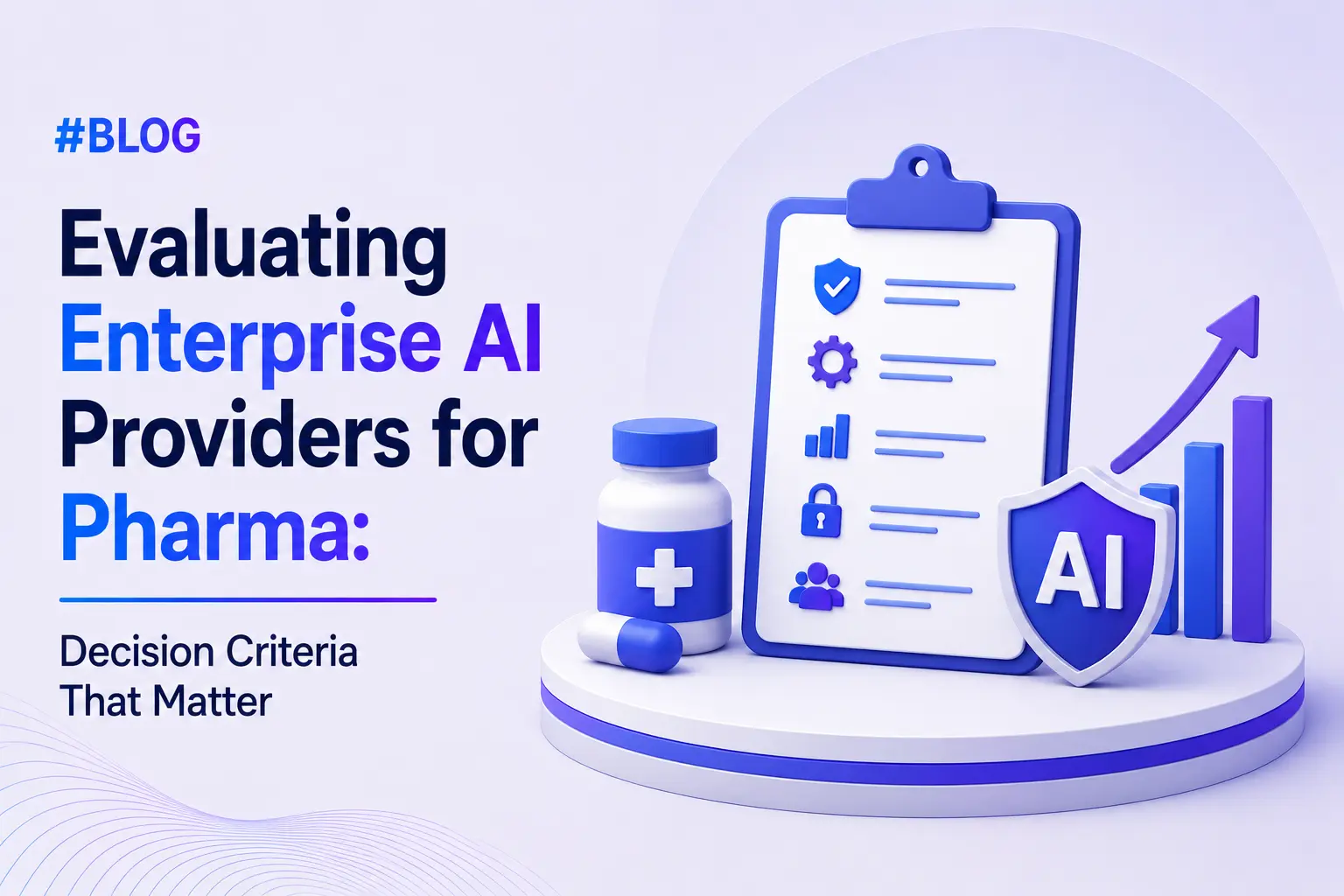
Enterprise AI for pharmacovigilance applies natural language processing to turn unstructured adverse event reports into structured safety data, automating case intake, MedDRA coding, and signal triage. Done well, it filters noise from real-world data so safety teams can focus on the cases that matter, and it shortens Individual Case Safety Report (ICSR) processing without adding headcount.
Evaluating these platforms well is harder than it looks. The decision is not about which tool has the most features. It is about whether the system can extract clinical context from messy source documents, code it accurately, and prove every output for a regulator. This guide gives safety, quality, and technology leaders a practical framework: the criteria that matter, the standards to map to, the trade-offs, an implementation roadmap, and the questions that separate a compliant platform from a costly mistake.

Key Takeaways
- Judge extraction, not keywords. The core test is whether the system understands clinical context, not whether it matches terms.
- Real-world data is unstructured. Most safety data arrives as emails, notes, and call transcripts, so structured-file handling alone is not enough.
- Provenance is mandatory. Every AI output must trace back to the exact source text for GxP and regulatory defensibility.
- Keep humans in the loop. Safety scientists must review AI-drafted narratives and seriousness scores, especially early on.
- Validate before you scale. A proof of concept on raw, messy data prevents misclassification in production.
Why Pharmacovigilance Automation Matters Now
The volume of safety data has outgrown manual processing. The FDA’s FAERS database has collected more than 30 million adverse event reports, and the EU’s EudraVigilance holds a comparable volume, with both receiving millions of new cases every year. Reading and coding that flood by hand no longer scales.
The economic case for AI is strong too. The McKinsey Global Institute estimates that generative AI could generate $60 billion to $110 billion a year in economic value for the pharmaceutical and medical-product industries, with safety and regulatory operations among the functions poised to benefit.
The pressure is not only about cost. Missing a 15-day expedited reporting deadline for a serious ICSR carries regulatory and patient-safety consequences. Automating the routine extraction and coding work lets scarce safety scientists spend their time on judgment, which is where they add the most value.
The business impact reaches beyond the safety department. Faster, more consistent case processing lowers compliance risk, reduces the cost per case, and frees experienced scientists for the signal work that protects both patients and product reputation. Yet many life sciences AI programs stall between a promising pilot and validated production, a gap Wizr examines in its analysis of why enterprise AI pilots fail to reach production.
What Is Pharmacovigilance, and Where Does AI Fit?
Pharmacovigilance is the science of detecting, assessing, understanding, and preventing adverse effects of medicines. Safety teams collect adverse event reports, process them into standardized records, and analyze them to spot emerging risks. Regulators run large surveillance systems for this purpose, including the FDA’s FAERS, the EMA’s EudraVigilance, and the World Health Organization’s VigiBase, each holding millions of case reports. The sheer scale of these databases is exactly why manual review alone can no longer keep pace with incoming safety data.
The end-to-end workflow follows a clear path, and AI can support each stage:
- Case intake: gather reports from emails, portals, literature, and call centers.
- Data entry and coding: extract clinical details and map them to MedDRA terms.
- Medical review: draft the case narrative and assess seriousness and causality.
- Submission: file compliant ICSRs, often using the ICH E2B(R3) standard.
- Signal detection: analyze aggregated data to identify true safety signals.
Enterprise AI platforms use NLP to parse unstructured text, machine learning to rank and route cases by severity, and retrieval methods to ground outputs in source data. The goal is not to remove the safety scientist, but to hand them clean, pre-processed cases with the evidence attached.
Why Do Traditional Pharmacovigilance Evaluation Models Fail?
Traditional evaluation models assume manual data entry and measure systems by how well they ingest structured files. The approach breaks down because it ignores how modern safety data actually arrives.
Most critical safety information comes as unformatted emails, unstructured physician notes, and raw call center transcripts, not tidy XML. Scoring a platform on flat-file or web-form ingestion misses the hardest and most important capability: reading messy, real-world text. Adding more offshore reviewers to handle that text simply moves the bottleneck rather than removing it.
The right evaluation shifts the question from human data-entry speed to algorithmic accuracy on unstructured inputs. A platform that shines on clean test files can still fail the moment a product launch floods the inbox with free-text reports.
What Criteria Define Effective Pharmacovigilance Automation?
Effective evaluation tests whether the platform extracts clinical context, not just keywords. The system must tell the difference between a patient’s historical condition and an active adverse event caused by a recently administered drug. Assess each vendor against the criteria below.
- Contextual extraction: accurate parsing of unstructured emails, literature, and transcripts into structured safety data.
- MedDRA coding accuracy: correct, context-aware mapping to standardized medical terms, measured against expert coders.
- Signal triage precision: a measurable reduction in false positives without suppressing true signals.
- Data provenance: every extracted data point links back to the exact source sentence for auditability.
- Human-in-the-loop design: clear review, override, and approval steps for safety scientists.
- Integration: compliant connectors to safety databases like Oracle Argus and ArisGlobal, using standards such as E2B(R3).
- Security and compliance: encryption, access control, and alignment with GxP and data-privacy rules.
- Explainability: transparent reasoning that a reviewer and an auditor can follow.
Test these on your own data, not a vendor demo. A structured proof of concept against real, messy documents is the only reliable way to confirm the system performs in production conditions.
The Standards and Compliance Landscape for Pharmacovigilance AI
Mapping a platform’s controls to recognized standards is what makes automation defensible in an inspection. Align each capability to the frameworks below rather than trusting vendor claims.
| Standard | What It Governs | Why It Matters for PV AI |
|---|---|---|
| GVP (Good Pharmacovigilance Practices) | EU pharmacovigilance obligations | The baseline for compliant safety operations |
| ICH E2B(R3) | Electronic transmission of ICSRs | Required format for exchanging safety reports |
| 21 CFR Part 11 | Electronic records and signatures (FDA) | Ensures auditable, trustworthy electronic data |
| GxP and GAMP 5 | Quality practices and system validation | Guides how to validate AI systems for regulated use |
| HIPAA and GDPR | Patient data protection | Governs personal data in case processing |
| EU AI Act | Risk-tiered AI regulation | Adds obligations for higher-risk health AI from 2026 |
A practical method maps each control to one or more standards and keeps auditable evidence for every mapping. Regulatory expectations are also tightening, with health authorities publishing guidance on AI in the drug lifecycle, so treat compliance as a moving target rather than a one-time checkbox.
What Does the Cost of Poor AI Evaluation Look Like in Practice?
A flawed evaluation surfaces its costs only after deployment. The illustrative scenario below shows how a narrow scoring approach creates real regulatory risk.
A global safety operations team at a mid-sized biopharma company faces a backlog of 4,000 adverse event reports. Six months earlier, the procurement committee evaluated the automation tool solely on its ability to ingest structured XML from regulatory portals, assuming unstructured data handling was standard across modern platforms.
The gap surfaces after a product launch. Thousands of unstructured patient emails and physician call transcripts flood the intake inbox, and the system fails to parse the clinical context. It misclassifies serious adverse events as non-serious because it cannot separate historical conditions from active symptoms. Safety scientists end up opening every email and re-coding MedDRA terms by hand, and the team misses critical 15-day ICSR submission windows.
A correctly evaluated platform catches the flaw during the proof of concept. By testing against raw, unstructured physician transcripts before deployment, the team validates the model’s ability to extract contextual clinical entities. The rigorous evaluation prevents the compliance breach and removes the manual triage bottleneck. Rigor early is far cheaper than remediation later, a pattern Wizr explores in its guide on why enterprise AI apps fail.
How Does Enterprise AI Compare to Traditional Manual Workflows?
Enterprise AI platforms use machine learning classifiers to rank and route adverse events by severity and causality, replacing first-in-first-out queues so critical signals reach a scientist quickly. The table below compares the two approaches, though actual gains depend on data quality and validation.
| Capability | Enterprise AI PV Platforms | Traditional Manual Workflows |
|---|---|---|
| Data extraction | NLP-driven parsing of unstructured text | Manual reading and data entry |
| Signal triage | Algorithmic noise filtering and prioritization | Human review of every incoming alert |
| MedDRA coding | Automated, context-aware mapping | Manual dictionary lookups |
| ICSR processing | Often 40% to 60% faster in reported deployments | Scales linearly with headcount |
| Consistency | Uniform rules applied at scale | Varies by reviewer and workload |
The point is not that automation removes people. It reallocates them, moving safety scientists from repetitive coding to the higher-value work of medical judgment and signal assessment.
What Are the Trade-offs of Adopting AI for Signal Triage?
AI in signal triage brings clear benefits and real limitations, and a balanced view is essential before committing. On the upside, automation improves speed, consistency, and scale, and it surfaces high-priority signals faster than manual queues.
The limitations deserve equal attention:
- Small or low-quality historical datasets can make models hard to train accurately.
- Meaningful data cleansing is often needed before integration with Oracle Argus or ArisGlobal.
- Continuous human-in-the-loop oversight is required to validate AI-generated narratives and scores.
- Initial GxP validation adds real upfront effort and time.
The honest conclusion is that AI augments pharmacovigilance rather than replacing human expertise. The best programs pair automation for volume with expert review for judgment, and they plan for the validation work rather than treating it as an afterthought.
The direction of travel is toward agentic systems that coordinate the full case lifecycle, from intake through submission, under human supervision. As real-world data sources multiply, from social media to wearables, the ability to filter noise and surface genuine signals at scale will only grow more valuable. Teams that build a governed, auditable foundation now will adapt to that future far more easily than those bolting controls on later.
How Do Organizations Validate GxP Compliance for AI Models?
Validating AI for GxP use means proving that automated coding and scoring stay within defined tolerances, continuously. Organizations typically enforce threshold logic like the following, tuned to their own risk appetite.
- Model drift validation: a deviation above 5% in MedDRA coding accuracy is high risk and should halt automated processing and trigger retraining. Below 2% passes.
- Data provenance check: traceability must be complete, with every AI-generated data point linked to its exact source sentence. Anything less fails.
- Confidence threshold: seriousness scoring below an agreed confidence level, often around 85%, routes to a human, while higher-confidence cases proceed automatically.
Validation is not a one-time gate. Models drift as products, populations, and reporting patterns change, so continuous monitoring and periodic revalidation keep the system compliant over time.
An Evaluation and Implementation Roadmap
A clear sequence turns the framework into action, from shortlist to safe production use.
- Assemble a cross-functional team spanning safety science, data science, quality, and IT.
- Define requirements and map each to GVP, E2B(R3), 21 CFR Part 11, and GAMP 5.
- Run a proof of concept on your own unstructured, real-world reports, not vendor sample data.
- Measure extraction accuracy, MedDRA coding quality, and false-positive rates against expert baselines.
- Validate integration with your safety database and confirm provenance for every field.
- Complete GxP validation before production, with documented evidence.
- Deploy with human-in-the-loop review, then monitor drift and audit readiness continuously.
Common Mistakes to Avoid
A few recurring mistakes undermine otherwise strong programs:
- Testing only on clean, structured files instead of messy real-world text.
- Treating provenance and explainability as optional rather than mandatory.
- Removing human review too early to chase efficiency numbers.
- Underestimating data cleansing and validation timelines.
- Ignoring model drift after go-live.
- Choosing a platform on features alone without confirming regulatory fit.
How Wizr AI Supports Governed AI Workflows for Regulated Operations
Wizr AI combines Enterprise AI Services, AI-powered engineering, and AI governance to support the enterprise-grade foundations required for pharmacovigilance automation. Wizr provides tailored AI solutions and engineering support rather than a packaged PV product, so teams should scope PV-specific requirements such as MedDRA coding, E2B(R3), and GxP validation for their own use case, while relying on Wizr for the underlying AI, integration, security, and governance capabilities.
Here is how Wizr aligns with the criteria in this guide.
- For unstructured data and multi-step processing: Wizr’s agentic workflows and AI services can extract structured information from messy documents and coordinate multi-stage processing, with retrieval that grounds outputs in source data, an approach explained in Wizr’s guide on agentic RAG versus traditional search.
- For human-in-the-loop and auditability: Built-in guardrails, approval steps, and audit trails support the review and provenance that regulated work demands, reinforced by Wizr’s AI Governance services.
- For security and compliance: Wizr provides security controls including encryption and role-based access, and is SOC 2 Type II, ISO 27001, and GDPR compliant.
- For domain fit: Wizr’s Enterprise AI Services and AI application development capabilities can tailor workflows to specific safety and regulatory processes when off-the-shelf tools fall short.
- For integration: Wizr’s integration capabilities and AI-powered engineering services connect AI solutions with existing enterprise systems, reducing the custom engineering effort that can delay deployment.
For teams that want help designing and validating the program, Wizr’s enterprise AI services cover strategy through implementation. To assess fit and confirm regulatory scope, talk to the Wizr team.
Conclusion
Evaluating enterprise AI for pharmacovigilance is a test of substance over features. The programs that succeed judge platforms on contextual extraction, provenance, and regulatory fit, validate them on real-world data, and keep safety scientists firmly in the loop.
Start with a cross-functional evaluation, prove performance on your own messy documents, and map every control to a recognized standard. When you are ready to move from evaluation to a governed, auditable deployment, Wizr AI can help design and implement the enterprise AI solutions, engineering capabilities, and governance foundation that safe, compliant automation requires. The right approach does not just promise efficiency; it proves accuracy, provenance, and compliance on your own data before a single case is processed in production.
FAQs
1. What are the challenges of integrating AI with safety databases like Oracle Argus or ArisGlobal?
Integrating AI with legacy safety databases usually requires middleware to handle complex XML structures and the E2B(R3) standard. The main challenge is mapping AI-generated outputs to the predefined fields of Oracle Argus or ArisGlobal without triggering validation errors. Pre-built, compliant connectors reduce this effort significantly.
Wizr AI helps here through its AI-powered engineering and integration capabilities, connecting AI solutions with enterprise systems so teams spend less time on custom engineering and more on validation.
2. What is the typical ROI timeframe for pharmacovigilance automation?
Many organizations report a positive return within 12 to 18 months, driven by large reductions in manual data-entry hours and by avoiding fines tied to late reporting. Actual timing depends heavily on data readiness and validation effort, so treat any promise of instant ROI with caution.
Wizr AI supports faster time to value through reusable agentic workflows and Enterprise AI Services, while keeping governance and security intact.
3. How does enterprise AI handle the end-to-end pharmacovigilance workflow?
Enterprise AI ingests varied data formats, extracts clinical entities, and populates safety databases, then applies machine learning to assess seriousness and causality. High-priority cases are routed to safety scientists for final review, so automation handles volume while humans handle judgment.
Wizr AI’s agentic workflows and Enterprise AI Services support this type of governed, multi-step workflow, with human-in-the-loop checkpoints throughout.
4. What does a safety scientist’s workflow look like with AI in place?
With AI in place, a safety scientist typically works through a few clear steps:
- Open a pre-populated case with an AI-drafted narrative and a preliminary seriousness score.
- Review the highlighted evidence linked to the source document.
- Approve or override the AI’s suggestions.
- Finalize the report for submission.
The scientist stays in control of every clinical decision. Wizr AI supports this model with transparent, auditable outputs that reviewers can trace and correct, helping keep human experts involved in clinical and regulatory decisions.
5. How does AI-powered signal triage filter noise from real-world data?
AI-powered signal triage uses semantic analysis to separate known adverse events from novel clinical patterns, then cross-references incoming reports against historical safety profiles. It suppresses redundant data and elevates statistically significant anomalies, so scientists focus on genuine signals rather than noise.
Wizr AI can support this type of analysis through governed AI workflows and enterprise data integration, helping reduce false positives while keeping results explainable.
6. What standards should a pharmacovigilance AI platform support?
At a minimum, a PV AI platform should align with GVP, ICH E2B(R3) for ICSR exchange, 21 CFR Part 11 for electronic records, and GAMP 5 for system validation, plus HIPAA and GDPR for data protection. Emerging AI regulation such as the EU AI Act is increasingly relevant for higher-risk health applications.
Wizr AI provides security and governance capabilities that support these requirements, with PV-specific validation confirmed per deployment.
7. Does AI replace safety scientists in pharmacovigilance?
No. AI automates repetitive extraction, coding, and triage, but safety scientists remain responsible for medical judgment, causality assessment, and final sign-off. The strongest programs use AI to handle volume so experts can focus on the cases and signals that need human expertise.
Wizr AI supports this human-in-the-loop model, keeping people in control of clinical and regulatory decisions.
About Wizr AI
Wizr AI helps enterprises build autonomous enterprises and accelerate product and software engineering with practical, production-ready AI. We help organizations automate business workflows, modernize legacy applications and digital platforms, and build intelligent AI solutions.
Our core services include Enterprise AI Services, AI-Powered Engineering & Legacy Modernization, AI Product Engineering, and AI Governance. We also leverage AI Assembly capabilities, including the Agentic AI Framework, Agentic Workflows, Security, and Integrations.
Through our AI solutions, including AI Agents, Pharma & Life Sciences AI, Oracle AI, and Salesforce AI, we help enterprises apply AI across business and technology needs.
See how we can help your enterprise move faster with AI. 👉 Talk to an AI Expert.

![15 Best AI Chatbot Development Companies in the USA [2026 Buyer's Guide]](https://wizr.ai/wp-content/uploads/2026/06/Best-AI-chatbot-development-companies.webp)
![12 Best AI Legacy Application Modernization Services in 2026 [CIO's Guide]](https://wizr.ai/wp-content/uploads/2026/06/12-Best-AI-Legacy-Application-Modernization-Services.webp)
![12 Best AI Agent Development Companies in the USA: A CIO's Guide [2026]](https://wizr.ai/wp-content/uploads/2026/07/12-Best-AI-Agent-Development-Companies.webp)
![Custom AI development vs Off-the-Shelf AI: An Enterprise Decision Framework [2026]](https://wizr.ai/wp-content/uploads/2026/08/Custom-AI-vs-Off-the-Shelf-AI.webp)


![Security and Compliance for Enterprise AI Implementation: A Practical Guide [2026]](https://wizr.ai/wp-content/uploads/2026/07/Security-and-Compliance-for-Enterprise-AI.webp)