An enterprise AI security checklist is your practical guide to deploying AI without opening the door to attackers. It turns a huge, fast-moving risk into a clear, repeatable set of steps that your engineering, security, and compliance teams can actually follow together.
The need is urgent. IBM found that 13% of organizations reported breaches of their AI models or applications, and 97% of those lacked proper AI access controls. AI adoption is racing ahead of AI security, and that gap is exactly where breaches happen.
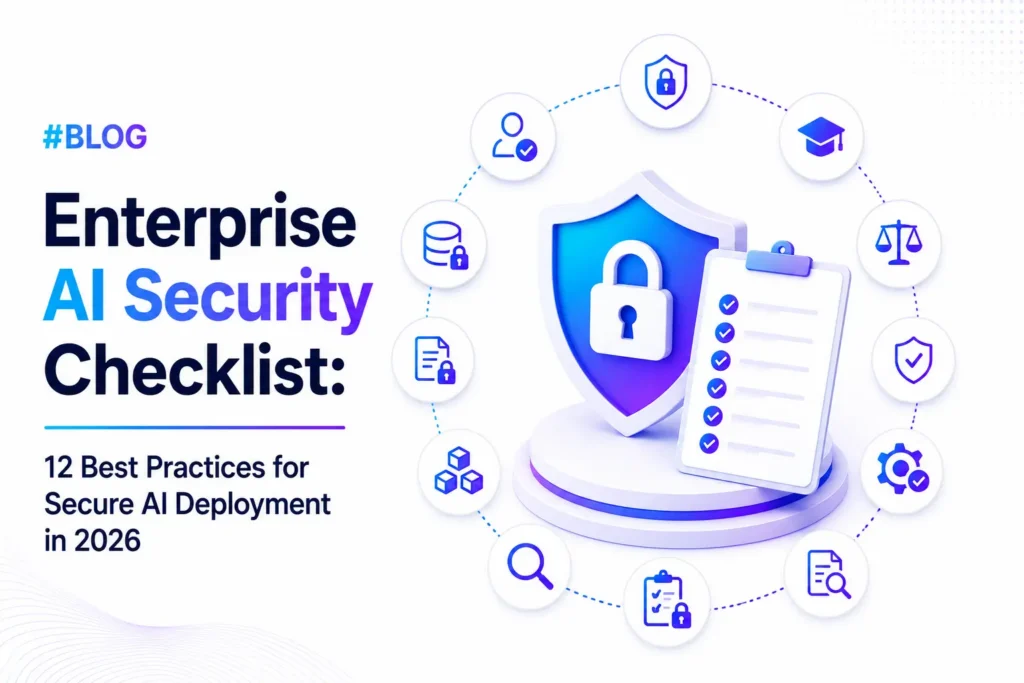
This guide gives you a 12-point enterprise AI security checklist, the top risks to watch, how to choose the right tools, and how a platform-plus-services partner like Wizr AI helps you secure, govern, and scale. To see security built into a platform, explore Wizr’s enterprise AI security approach.
What Is an Enterprise AI Security Checklist?
An enterprise AI security checklist is a structured list of controls and best practices for protecting AI systems across their whole lifecycle. It covers data, models, agents, pipelines, and the people who use them.
Think of it like a pre-flight checklist for a pilot. Even expert teams use one, because a single missed step, like a weak access control, can cause a serious failure.
A good checklist is not a one-time task. It is a living standard you apply every time you build, deploy, or update an AI system. The strongest enterprise AI security programs treat it as part of daily engineering, not a box ticked once a year.

A complete checklist spans four layers. It protects the data that feeds your AI, the models and LLMs themselves, the agents and pipelines that put them to work, and the people and processes around them. Miss one layer, and attackers simply move to the weakest link.
It also differs from a generic compliance checklist. Compliance asks whether you followed the rules, while security asks whether you are actually safe. The best programs do both, mapping every control to a real threat and a real regulation at the same time.
Unlike traditional software security, AI security must also handle new risks like prompt injection, model theft, and autonomous agents that take real actions. That is why enterprise AI security best practices 2026 look different from the security playbooks of even two years ago.
A checklist also creates shared language across teams. When engineering, security, and compliance all work from the same list, fewer things fall through the cracks, and audits become far less painful.
Why Enterprise AI Security Is Critical for Secure AI Deployment
AI has become a high-value target, and attackers know it. The same systems that hold your best data and take real actions are often the least protected.
The numbers make the risk clear. In IBM’s research, 60% of AI-related security incidents led to compromised data and 31% caused operational disruption. When AI breaks or is breached, the damage hits both your data and your operations at once.
The attack surface is also exploding. Gartner predicts that 40% of enterprise applications will include task-specific AI agents by the end of 2026, up from less than 5% in early 2025. Every new agent is a new door that must be secured.
Here is why enterprise AI security is now a board-level priority:
- Bigger blast radius: AI agents act autonomously, so one compromised agent can do real damage fast.
- Sensitive data exposure: RAG systems and agents touch your most valuable data and IP.
- New attack types: Prompt injection, data poisoning, and model theft do not exist in normal apps.
- Rising regulation: Rules like the EU AI Act carry heavy fines for weak governance.
- Reputation risk: A public AI breach erodes customer trust quickly.
Regulation adds to the pressure. Frameworks like the NIST AI RMF and ISO 42001 now set the bar for responsible AI, and the EU AI Act carries fines of up to 15 million euros or 3% of global turnover for serious violations of its high-risk rules. Aligning your enterprise AI security checklist to these standards is no longer optional for global companies.
The threat side is just as real. Attackers now use unauthenticated APIs, injection flaws, and stolen credentials to reach AI systems, and because those systems hold concentrated, sensitive data, a single gap can expose enormous volumes of information in minutes.
The good news is that security pays off. IBM found that organizations using AI and automation extensively in their security operations saved about $1.9 million per breach compared to those that did not. Strong enterprise AI security is not just protection, it is a competitive advantage.
There is a trust dividend too. Customers, partners, and regulators increasingly ask how you secure AI before they will do business. A clear, well-run security program becomes a selling point, not just a safeguard.
12 Enterprise AI Security Best Practices for Secure AI Deployment in 2026
This is the core enterprise AI security checklist. Work through all 12 practices before and during every AI deployment, and revisit them as your systems grow.
It helps to group the checklist by lifecycle stage. Practices one through five secure how you build, covering identity, data, and inputs. Practices six through nine secure how you deploy, covering agents, generative outputs, governance, and architecture. Practices ten through twelve secure how you run, covering testing, human oversight, and incident response. If you are short on time, start with access control, data governance, and monitoring, since those three prevent the most damage.
- Built on a Zero Trust AI security framework. Never trust, always verify. The Zero Trust AI security framework enterprise 2026 teams now assume every user, model, and agent could be compromised, so each must prove its identity and earn access for each action. A real example is requiring an agent to re-authenticate before it reaches a new system, even mid-task.
- Enforce least-privilege access controls. Since 97% of breached organizations lacked AI access controls, this is step one. Treat AI models and agents as identities, and give each only the access it needs for its specific task. If an agent only needs to read orders, it should never be able to delete them.
- Secure your data pipeline end to end. Strong enterprise AI pipeline security best practices mean encrypting data in transit and at rest, classifying sensitive data, and governing what flows into training and RAG. This is the heart of the best enterprise data security solutions for AI. Track data lineage too, so you always know where your training and RAG data came from.
- Defend against prompt injection and adversarial attacks. Follow LLM security best practices by validating and sanitizing inputs, isolating untrusted content, and constraining what a model can do. These AI model security best practices stop attackers from hijacking your models. Treat every external document or web page an agent reads as untrusted until proven safe.
- Find and govern shadow AI. Employees using unsanctioned AI tools quietly leak data. Discover shadow AI, set clear usage policies, and give teams safe, approved alternatives so they do not go around security. Browser-level controls and AI-aware data loss prevention help you catch risky uploads before they happen.
- Secure AI agents and their tool integrations. Agentic AI security best practices give each agent scoped permissions, approval gates for risky actions, and full logging. Apply LLM tool integration security best practices so an agent can only call the tools and data it truly needs. Give each agent a narrow role, so a single compromised agent cannot reach your whole environment.
- Ground generative AI safely. Generative AI security best practices include grounding outputs in trusted data through RAG, adding content guardrails, and filtering responses, so models stay accurate, on-brand, and safe. Never let a model send data or take an action without passing through a policy check first.
- Put AI governance and compliance in place. Strong enterprise AI security governance maps controls to frameworks like the NIST AI RMF, ISO 42001, and the EU AI Act. Keep audit trails and clear ownership for every AI system. Assign a named owner to each one, so accountability is never unclear.
- Design a secure enterprise AI security architecture. Bake security into the architecture itself, with network segmentation, secure model gateways, and isolation between environments, so a breach in one area cannot spread. Keeping development, testing, and production separate limits how far any single incident can travel.
- Test and red-team continuously. Use adversarial testing and the OWASP LLM Top 10 to probe your systems before attackers do. AI security assessment services for enterprises can validate your defenses with expert, independent testing. Run these tests on a regular cadence, since new attack techniques appear all the time.
- Keep humans in the loop. For high-risk actions, require human approval. Human-in-the-loop controls are your safety net when an agent behaves in an unexpected way. Set clear thresholds, so low-risk tasks run automatically while high-risk ones wait for approval.
- Build an AI incident response plan. Assume a breach will happen and plan for it. Define how you detect, contain, and recover from an AI incident, and rehearse it so your team is ready. Include a kill switch that can pause an agent instantly if it starts to misbehave.
Common Enterprise AI Security Risks and How to Mitigate Them
Knowing the threats makes the checklist above concrete. These are the most common gen AI security risks in enterprise environments, and how to reduce each one.
| Risk | What It Is | How to Mitigate It |
| Prompt injection | Malicious input that hijacks a model’s behavior | Input validation, content isolation, and output filtering |
| Data poisoning | Corrupt data injected to skew model behavior | Vet data sources, validate training data, and monitor drift |
| Model theft and inversion | Stealing a model or extracting its training data | Access controls, rate limiting, and encryption |
| Shadow AI | Unsanctioned AI tools used without oversight | Discovery, clear policies, and approved alternatives |
| Agent exploitation | Attackers abusing an autonomous agent’s permissions | Scoped permissions, approval gates, and full logging |
| Sensitive data leakage | AI exposing PII or IP in responses | Data classification, guardrails, and RAG access controls |
| AI supply chain risk | Vulnerabilities in third-party models or tools | Vendor risk checks, model provenance, and monitoring |
The pattern is clear. Most AI risks come from weak access, poor data governance, and blind spots in monitoring. Fix those three, and you close the door on the majority of attacks. The rest of the checklist then hardens what remains, turning a wide-open attack surface into a small, well-guarded one.
A few risks are rising especially fast. Agentic AI multiplies exposure, since an autonomous agent with broad permissions can be turned into an insider threat. Wizr’s guide on building multi-agent applications shows how to orchestrate agents without opening these gaps. AI supply chain risk is growing too, as most enterprises rely on third-party models and tools they did not build. And shadow AI keeps spreading, because employees adopt new tools faster than security teams can review them.
To prioritize, lean on established references. The OWASP LLM Top 10 lists the most critical language-model risks, and mapping your systems against it is a fast way to find your biggest gaps before an attacker does.
Key takeaway: You do not need to do all 12 at once, but you cannot skip access control, data governance, and monitoring. Those three carry the most risk and the most reward.
How to Choose the Right Enterprise AI Security Solutions
The market for enterprise AI security solutions is crowded, so focus on fit, not features. The right choice depends on your stack, your risk, and your team.
Use these criteria to evaluate any option:
- Full lifecycle coverage: Look for protection across data, models, agents, and pipelines, not just one layer.
- Agent-aware controls: The best enterprise AI agent security solutions understand autonomous agents, like Wizr’s customer support AI agents, not just chatbots.
- Strong access and identity: Confirm fine-grained, least-privilege controls for both people and AI.
- Monitoring and detection: Real-time observability to catch drift, abuse, and anomalies.
- Governance built in: Support for audit trails, compliance frameworks, and responsible AI.
- Integration: AI agent security tools for enterprise should fit your existing security stack cleanly.
- Expert support: Access to AI security assessment services for enterprise for testing and validation.
One key decision is build versus buy versus partner. Point tools solve single problems, but they can leave gaps between layers. A platform that bakes security into how AI is built and run often closes those gaps more reliably, especially when paired with expert services.
Whatever you choose, tie it back to this checklist. The best enterprise AI security solutions are the ones that help you cover every practice above with the least effort, then keep covering them as your AI footprint grows. If a tool only secures one layer, plan for how you will protect the rest.
Before you commit, put every vendor through a few sharp questions. Ask how they secure autonomous agents, how they handle access for non-human identities, how they detect shadow AI, and how they prove compliance with frameworks like the NIST AI RMF. Vague answers are a warning sign, and often a symptom of the deeper problems Wizr breaks down in why enterprise AI apps fail.
It also helps to weigh three paths honestly. Point tools are quick but leave integration gaps. Building in-house gives control but demands rare, expensive talent. A platform-plus-services partner covers the most ground fastest, which is why many enterprises now choose that route for AI security.
How Wizr AI Helps Enterprises Secure, Govern, and Scale AI Deployments
Look back at the 12-point checklist above, and one thing stands out: security is hard because it has to live in every layer at once. Wizr AI helps enterprises implement these controls through Enterprise AI Services and secure AI solutions, backed by expert services. Here is how Wizr maps to what this checklist asks for.
It puts the access and governance controls in place for you. The checklist starts with Zero Trust, least-privilege access, and governance, the exact areas where 97% of breached organizations fell short. Wizr AI supports secure, governed AI deployments with SOC 2 Type II, ISO 27001, and GDPR compliance, along with role-based access, audit trails, and human-in-the-loop guardrails, so these controls are structural, not an afterthought.
It secures agents and their tool access.The checklist calls for scoped agent permissions and safe tool integration. Wizr governs AI agents and workflows, so each agent only reaches the data and tools it needs, with full logging of what it did and why. That directly addresses the fastest-growing part of your attack surface.
It is not only software it is a service too. Securing AI is not just about technology. Wizr combines its Enterprise AI Services and custom AI application development services with hands-on expertise from AI consultants and engineers. This helps enterprises design a secure architecture, harden their pipelines, and validate controls, so the checklist gets implemented, not just read.
It lets you scale securely. The whole point of a checklist is to keep security consistent as you grow. Wizr helps enterprises apply governance and monitoring consistently as AI agents and workflows scale, so adding your tenth or hundredth agent does not mean re-solving security each time. Across customers, 90% of Wizr pilots reach production, with security holding as they scale.
It watches AI in production. The checklist ends with continuous monitoring, testing, and incident response, and Wizr supports all three. Its observability capabilities track agent behavior, flag anomalies, and maintain a full audit trail, so you can spot and contain a problem before it spreads. When something does go wrong, human-in-the-loop controls and clear logs make your response fast and precise.
With enterprises like Chrysler, Project44, and Fragomen already on board, Wizr helps teams deploy AI that is secure and governed from day one. Talk to the Wizr team to turn this checklist into a running system.
Conclusion
Secure AI deployment is not about slowing down. It is about moving fast without breaking trust. This enterprise AI security checklist gives you a clear, repeatable way to protect your data, models, and agents at every step, from the first pilot to enterprise-wide rollout.
Do not wait for a breach to take this seriously, since the cost of prevention is always lower than the cost of recovery. Start with access control and governance, address the top risks, and choose solutions that cover the full lifecycle. When you want security and governance built into how your AI is created and run, explore how Wizr AI helps enterprises secure, govern, and scale AI deployments through Enterprise AI Services and secure AI solutions.
FAQs
1. What is an enterprise AI security checklist?
An enterprise AI security checklist is a structured set of best practices for protecting AI systems across data, models, agents, and pipelines. It covers access control, governance, monitoring, testing, and incident response.
The goal is consistency, so security does not depend on any one person remembering every step. Wizr AI supports this through capabilities such as access management and audit trails as part of its secure AI services and solutions.
2. What are the biggest enterprise AI security risks in 2026?
The top gen AI security risks in enterprise environments include prompt injection, data poisoning, model theft, shadow AI, and agent exploitation. Autonomous agents raise the stakes, since a compromised agent can take real actions.
Most of these trace back to weak access and governance. Wizr AI helps reduce this risk with least-privilege controls, guardrails, and governance across AI agents and workflows.
3. What are the best LLM security best practices?
Strong LLM security best practices include validating and sanitizing inputs, isolating untrusted content, grounding outputs with RAG, filtering responses, and logging every interaction. Enterprise LLM security best practices add access control, monitoring, and human oversight for high-risk actions.
Layering these defenses is what works. Wizr AI applies these practices through its secure AI services and solutions, helping enterprises keep models grounded, governed, and safe in production.
4. How do I secure AI agents in the enterprise?
Enterprise AI agent security best practices give each agent scoped permissions, approval gates for risky actions, and complete logging. Treat every agent as an identity, and apply the same access discipline you use for people.
This is exactly where many tools fall short. Wizr AI governs agents centrally, so each one only touches the data and tools it needs, with full oversight.
5. How do I choose enterprise AI security solutions?
Look for full lifecycle coverage, agent-aware controls, strong access management, real-time monitoring, and built-in governance. The best enterprise data security solutions for AI protect data, models, and pipelines together, not in isolation.
Fit and integration matter most. Wizr AI combines these capabilities with AI security assessment and delivery services, helping enterprises implement secure AI solutions across their environments.
6. Does AI security really reduce costs?
Yes. IBM found that organizations using AI and automation extensively in security saved about $1.9 million per breach. Strong governance also lowers regulatory and reputational risk.
In short, security is an investment, not just a cost. Wizr AI helps you capture that value by making secure deployment the default, not an extra project.
7. How does the EU AI Act affect enterprise AI security?
The EU AI Act sets legal requirements for AI systems, especially high-risk ones, with fines that can reach millions of euros for serious violations. It pushes enterprises to document, govern, and secure their AI, not just deploy it.
In practice, it turns your enterprise AI security checklist into a compliance asset, not just a technical one. Wizr AI helps by implementing governance, audit trails, and access controls as part of its secure AI services and solutions.
About Wizr AI
Wizr AI helps enterprises build autonomous enterprises and accelerate product and software engineering with practical, production-ready AI. We help organizations automate business workflows, modernize legacy applications and digital platforms, and build intelligent AI solutions.
Our core services include Enterprise AI Services, AI-Powered Engineering & Legacy Modernization, AI Product Engineering, and AI Governance. We also leverage AI Assembly capabilities, including the Agentic AI Framework, Agentic Workflows, Security, and Integrations.
Through our AI solutions, including AI Agents, Pharma & Life Sciences AI, Oracle AI, and Salesforce AI, we help enterprises apply AI across business and technology needs.
See how we can help your enterprise move faster with AI. 👉 Talk to an AI Expert.

![15 Best AI Chatbot Development Companies in the USA [2026 Buyer's Guide]](https://wizr.ai/wp-content/uploads/2026/06/Best-AI-chatbot-development-companies.webp)
![12 Best AI Legacy Application Modernization Services in 2026 [CIO's Guide]](https://wizr.ai/wp-content/uploads/2026/06/12-Best-AI-Legacy-Application-Modernization-Services.webp)
![12 Best AI Agent Development Companies in the USA: A CIO's Guide [2026]](https://wizr.ai/wp-content/uploads/2026/07/12-Best-AI-Agent-Development-Companies.webp)
![Custom AI development vs Off-the-Shelf AI: An Enterprise Decision Framework [2026]](https://wizr.ai/wp-content/uploads/2026/08/Custom-AI-vs-Off-the-Shelf-AI.webp)

![Security and Compliance for Enterprise AI Implementation: A Practical Guide [2026]](https://wizr.ai/wp-content/uploads/2026/07/Security-and-Compliance-for-Enterprise-AI.webp)