Most enterprises do not have an AI problem. They have an operating model problem.
The pilots work. The demos impress the board. Then the project stalls, and the promised value never shows up at scale. If that sounds familiar, you are not alone. An MIT report found that around 95% of generative AI pilots deliver no measurable return, even as spending climbs.
The reason is rarely the technology. It is the lack of a repeatable system for building, governing, and scaling AI across the business. That system is your Enterprise AI Operating Model.
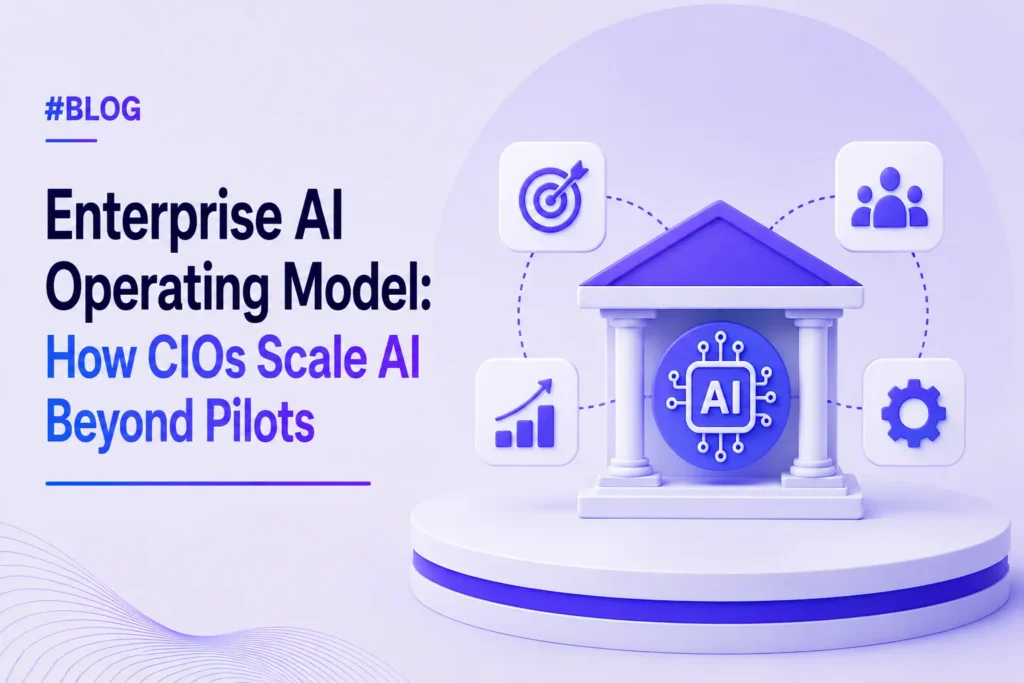
This guide breaks down what an Enterprise AI Operating Model is, the core components of a strong framework, and how CIOs use it to move AI beyond pilots in 2026. The goal is simple: turn scattered experiments into a governed, value-generating capability.
Whether you lead a bank, a manufacturer, or a software company, the pattern is the same. The enterprises pulling ahead in 2026 are not the ones with the fanciest models. They are the ones that treat AI as a managed capability, with clear owners, guardrails, and a shared platform. Get the operating model right, and every future AI investment compounds instead of stalling. Get it wrong, and you keep paying for pilots that never grow up.
What Is an Enterprise AI Operating Model?
An Enterprise AI Operating Model is the blueprint for how an organization builds, deploys, governs, and scales AI across teams and functions. It defines who owns AI, how decisions get made, how risk is managed, and how value is measured.
Think of it as the operating system for AI in your business. Individual tools and models are the apps. The operating model is what lets them run reliably, securely, and at scale.
Here is the difference in plain terms. Without an operating model, each team buys its own tools, runs its own pilots, and repeats the same mistakes. With one, the whole enterprise shares a common approach to strategy, governance, data, and delivery.
An operating model also sets the pace of change. It decides how quickly a new use case can move from idea to production, and how safely it gets there. When the model is clear, teams stop reinventing the wheel and start reusing what already works. That is how a handful of early wins turns into an enterprise-wide capability instead of a pile of disconnected experiments.
Organizations building this foundation can leverage Custom AI Application Development Services to design scalable AI architectures, integrate enterprise workflows, and establish governance practices that support AI adoption across the organization.
What is an AI operating model for large enterprises?
For large enterprises, the stakes are higher. You are coordinating dozens of use cases, multiple business units, strict compliance rules, and real budgets. A clear AI operating model for large enterprises answers four questions:
- Who owns AI? A named executive and a cross-functional team, not a scattered set of side projects.
- How is it governed? Clear policies, audit trails, and human oversight built in from day one.
- What runs where? A shared platform and data foundation, not a tangle of disconnected tools.
- How do we measure success? Business outcomes, not model accuracy alone.
People often ask, what is the AI operating model for large enterprises really about? The honest answer is structure over tools. An Enterprise AI operating model 2026 leaders trust is less about buying the newest model and more about running AI as a disciplined, repeatable business capability across every function.
The bigger the enterprise, the more these questions compound. A single team can improvise its way through one project. Fifty teams cannot. That is why large organizations need an operating model that makes good decisions repeatable, so every business unit inherits the same standards instead of learning the same lessons the hard way.
This matters more every year. Deloitte’s 2026 research puts it plainly: scaling AI is now “an enterprise operating model challenge,” not a technology one. Nearly three-quarters of technology leaders expect their operating model to change within 12 to 18 months.
The same thinking applies whether you call it a generative AI operating model, a gen AI operating model, or an agentic AI enterprise operating model. The label changes with the technology. The need for structure does not.
Enterprise AI Operating Model Framework: Core Components for Enterprise AI Success
A strong Enterprise AI operating model framework rests on six connected components. Miss one, and AI tends to stall between pilot and production. Get all six working together, and you have an effective enterprise AI operating model that scales. The components are not a checklist you complete once. They are a system you keep tuning as your AI estate grows.
Here is a quick view of the framework before we go deeper:
| Component | What It Covers | Why It Matters |
|---|---|---|
| Strategy and ownership | Vision, use-case selection, executive owner | Ties AI to business outcomes |
| Governance and risk | Policies, audit trails, human oversight | Keeps AI safe, compliant, and trusted |
| Operating structure | Roles, teams, CoE or federated model | Decides how work gets done |
| Data and platform | AI-ready data, shared platform, integrations | Provides the technical foundation |
| Delivery and lifecycle | Build, deploy, monitor, improve | Moves AI from idea to production |
| Value and adoption | ROI tracking, change management | Turns deployment into real impact |
1. Strategy and ownership
Every AI operating model framework starts with a clear strategy. That means choosing use cases tied to real business outcomes, not chasing hype. It also means naming a single accountable owner, often the CIO or a Chief AI Officer.
Without clear ownership, AI becomes everyone’s idea and no one’s responsibility. A named leader keeps priorities focused and budgets honest.
Strong strategy also means saying no. For every use case you fund, several others should wait. A simple scoring method, based on business value, feasibility, and risk, keeps the portfolio focused. This is the foundation of an effective enterprise AI operating model, since everything downstream depends on picking the right problems to solve first.
2. Governance and risk
This is the heart of any enterprise AI governance operating model. Governance covers the policies, guardrails, audit trails, and human oversight that keep AI safe and compliant. Enterprise AI operating model governance is what keeps autonomous systems accountable as they scale, and a hybrid structure is often the best operating model for enterprise AI governance as well.
A good AI governance operating model framework answers hard questions before they become incidents. Who can approve an agent’s action? What happens when a model gets something wrong? How do you prove compliance to an auditor?
For agentic systems, this matters even more. Gartner’s Anushree Verma warns that many agentic projects are “driven by hype and are often misapplied,” and the same research expects over 40% of agentic AI projects to be canceled by the end of 2027. Strong governance is what separates the survivors. If you want a deeper view, Wizr’s guide on why enterprise AI apps fail and how to fix them is a useful companion.
Good governance is not about slowing teams down. It is about making speed safe. When approval paths, guardrails, and audit trails are clear, teams move faster because they are not guessing about what is allowed. That balance of freedom and control is the real mark of a mature enterprise AI governance operating model, and it is what regulators increasingly expect to see.
3. Operating structure and talent
Structure decides how AI work actually gets done. Most enterprises choose one of three shapes:
- Centralized (Center of Excellence): One team owns tools and governance. Strong consistency, but it can slow execution.
- Federated: Business units build their own solutions. Fast and close to the work, but risks duplication.
- Hybrid: A central team sets standards while units deliver. This blend is often the best operating model for enterprise AI adoption.
Structure is also where the human plus AI operating model at enterprise scale takes shape. The point is not to replace people. It is to let AI handle routine work while people own judgment, exceptions, and outcomes. This is also where you define new roles, from AI product owners to model risk leads, so accountability is clear at every level.
Talent is the other half of this component. Even the best platform fails without people who can build, govern, and use it well. Plan for upskilling, clear career paths, and a healthy mix of in-house and partner expertise, so your operating model never depends on a single hard-to-hire person. The goal is a team that gets stronger with every project, not one that burns out on the first.
4. Data and platform foundation
AI is only as good as the data and platform beneath it. This component covers AI-ready data, a shared enterprise platform, and clean integrations into your core systems.
Fragmented tools are a silent killer here. When every team runs its own stack, costs rise and governance breaks. A common platform is what makes enterprise AI operating model design practical instead of theoretical. Wizr’s take on building multi-agent applications shows why a shared foundation matters as agents multiply.
Security lives here too. Sensitive data needs masking, access controls, and clear residency rules before it ever reaches a model. A platform that bakes in these controls saves you from bolting on security later, which is always harder, slower, and riskier. Treat the data foundation as a first-class part of the operating model, not an afterthought you fix once something breaks.
5. Delivery and lifecycle
This component moves AI from idea to production and keeps it healthy there. It covers how you build, test, deploy, monitor, and improve models and agents over time.
Delivery is where many pilots die. A repeatable lifecycle, with monitoring and clear handoffs, is what turns a promising demo into a system people can trust. Continuous monitoring also catches drift and errors early, before they reach a customer or an auditor. Wizr’s breakdown of why enterprise AI pilots fail to reach production digs into this exact gap.
Speed matters as much as safety. Pre-built agents, reusable components, and templates cut the time from idea to live workflow. The faster you can offer a safe, governed path to production, the more use cases your operating model can support without piling on risk. Over time, this repeatable delivery engine becomes one of your biggest competitive advantages.
6. Value and adoption
The last component is the one teams skip most often. It covers how you measure ROI and how you drive adoption once a system goes live.
Adoption is not automatic. Deloitte found that 84% of organizations have not redesigned jobs or workflows around AI, which is why so much value leaks away. If people revert to old habits, even a great model delivers nothing. The fix is to track adoption weekly and tie it to the managers who own each workflow.
Measurement should start on day one, not after launch. Define what success looks like before you build, so you can prove impact later without arguing over the numbers. Tie every use case to a clear metric, whether that is hours saved, tickets deflected, or revenue gained, and review it often. Value you can measure is value you can defend at budget time.
How CIOs Scale AI Beyond Pilots with an Enterprise AI Operating Model
Knowing the framework is one thing. Using it to escape the pilot trap is another. Here is how CIOs put an Enterprise AI Operating Model to work and finally scale AI beyond pilots.
Think of these as six moves you can run in order or in parallel. Each one closes a common failure point, and together they form a repeatable playbook you can reuse for every new AI initiative. The aim is not a single big-bang rollout. It is a steady rhythm where each win makes the next one easier and safer.
Step 1: Diagnose why your pilots stall
Start by naming the real blocker. Most pilots do not fail on model quality. They fail on missing governance, unclear ownership, messy data, or workflows no one redesigned.
Be honest about which gap is yours. The fix looks very different for a data problem than for an adoption problem. Run a short audit across all six components of your framework, and the weak link usually becomes obvious fast.
Write the blocker down and share it with your team. Naming the problem openly turns a vague sense of failure into a specific, fixable issue, and it gets everyone aligned on what to solve first. Most enterprises are surprised to find the real barrier is organizational, not technical.
Step 2: Put governance in place first
Do not bolt governance later. Set up your enterprise AI governance operating model before you scale, with clear policies, audit trails, and human-in-the-loop controls.
This is what makes the difference in regulated industries. When security and oversight are built in, you can scale with confidence instead of crossing your fingers.
Start small but firm. Even a lightweight governance model, with named approvers and basic audit logging, beats none at all. You can tighten the controls as you scale, but you cannot retrofit trust after an incident has already happened. Getting this right early is what makes fast, safe scaling possible later.
Step 3: Standardize on a shared platform
Replace the tangle of one-off tools with a common platform and data foundation. This cuts cost, improves security, and makes every new use case faster to launch.
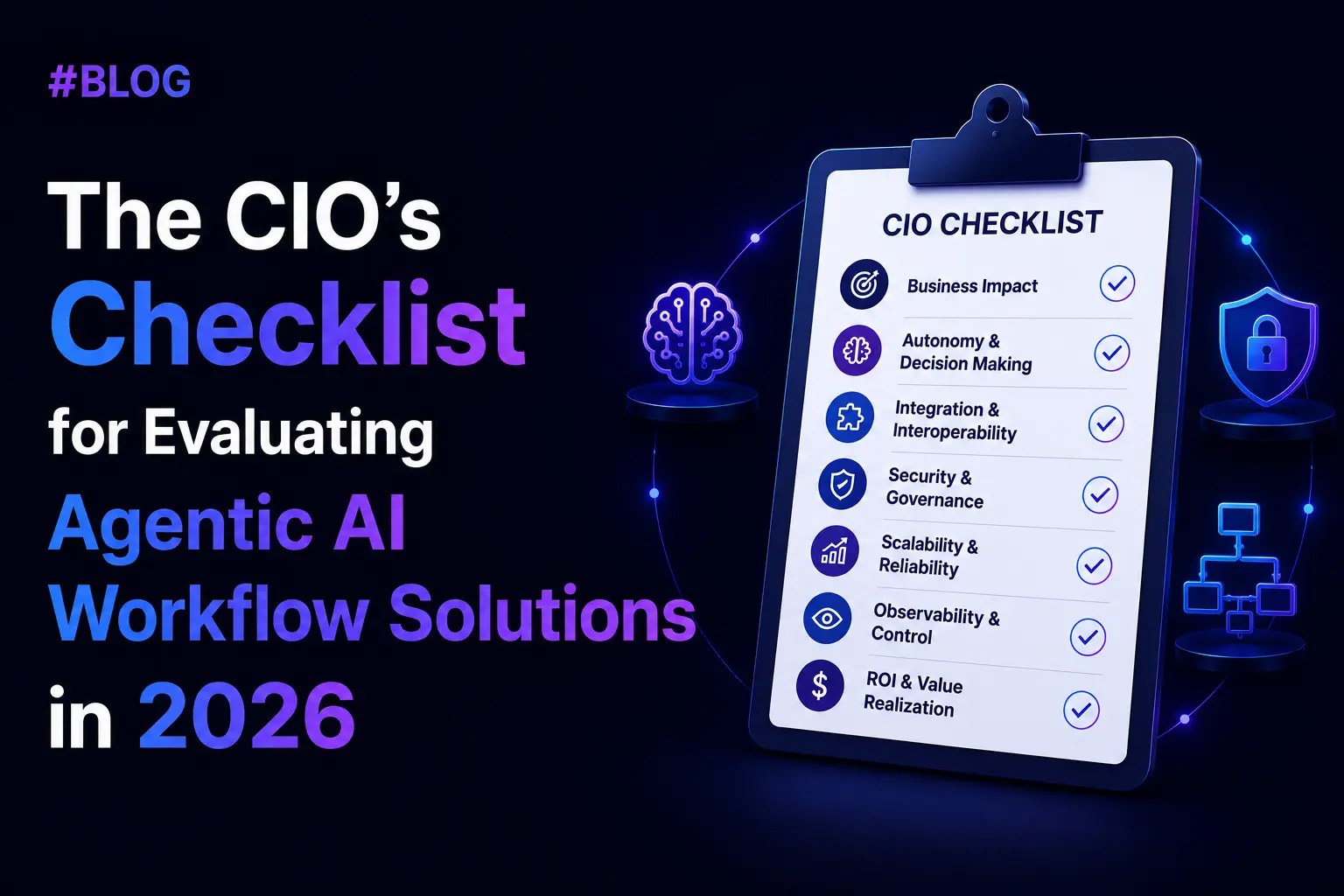
A shared platform is also what enables real agentic AI workflow orchestration across departments. Our CIO’s checklist for evaluating agentic AI workflow solutions is a practical tool for this step.
Consolidation pays off quickly. Every tool you retire is one less thing to secure, patch, and govern. A single platform also gives leaders one clear view of cost, usage, and risk across the whole AI estate, which makes budgeting and compliance far simpler. Standardization is not about limiting teams. It is about giving them a faster, safer road to build on.
Step 4: Redesign workflows around AI
This is the step most enterprises miss. Adding AI to an old process rarely works. You have to redesign the workflow so people and agents each do what they do best.
Map every step the AI changes. Document the new process. Train your team on what to do when the AI gets something wrong. That exception-handling habit is what makes adoption stick.
Bring the people who do the work into the redesign from the start. They know where the process really breaks and where an agent can help most. Their input makes the new workflow better, and their buy-in is what makes it stick once it goes live. Redesign done with your team, not to them, is the version that actually survives contact with daily operations.
Step 5: Build the human plus AI operating model
At scale, your best results come from people and AI working together, not from either alone. Let agents handle high-volume, repetitive work. Keep humans on judgment calls, sensitive cases, and final accountability.
This human plus AI operating model at enterprise scale is how you grow capacity without losing control. It also builds trust, since people stay in the loop where it counts. Designing for a human plus AI operating model enterprise scale from day one keeps that balance intact as you grow.
Set clear rules for when a human must step in. High-value, sensitive, or ambiguous decisions should always route to a person, while routine work runs on autopilot. This keeps the system safe and gives your team the confidence to lean on AI for everything else. Over time, those boundaries can flex as trust in the system grows.
For enterprises building this balance into production systems, our Generative AI Software Development Company helps design AI agents and workflows with human oversight, enterprise governance, and continuous optimization built into the development lifecycle.
Step 6: Measure value and scale what works
Finally, track business outcomes, not vanity metrics. Prove ROI on one workflow, then repeat the pattern across the enterprise.
Scaling smartly beats scaling fast. When you expand only what works, every rollout gets more predictable and more valuable. Strong enterprise AI operating model governance adoption across teams is what makes this repeatable, since each new use case inherits the same guardrails and standards. For teams modernizing older systems along the way, Wizr’s guide to AI legacy application modernization services pairs well with this approach.
Share the wins widely. When teams see a peer cut hours of manual work or resolve tickets in seconds, adoption spreads on its own. Momentum, backed by real numbers, is the cheapest and most durable way to scale AI across the enterprise. The best operating models turn each success story into fuel for the next one.
How Wizr AI Helps Enterprises Build and Scale an Enterprise AI Operating Model
Wizr AI helps enterprises design, govern, and scale a full Enterprise AI Operating Model through Enterprise AI Services, AI-powered automation, AI-powered engineering, and hands-on delivery. Rather than simply providing technology, Wizr works alongside enterprise teams from strategy and advisory through implementation and production scale.
Founded in 2023, Wizr AI focuses on enterprise AI automation and AI-driven software engineering, the two capabilities most operating models depend on. That focus means Wizr does not just hand you tools and walk away. It works alongside your team from the first strategy workshop to full production scale.
Strategy and advisory. Wizr’s Enterprise AI Services team works with you to define your AI strategy, identify high-value use cases, and shape your operating model. This is AI operating model consulting in practice, pairing advisory work with hands-on delivery so plans actually move into production.
Wizr provides the AI advisory services enterprise operating model teams need to move from slideware to shipped systems. From there, Wizr helps you sequence use cases into a practical roadmap, so early wins can support the next wave of adoption instead of stalling in committee.
Governance and risk. Governance is embedded throughout Wizr’s AI solutions and delivery approach rather than treated as an afterthought. With enterprise-grade security, audit trails, and human-in-the-loop controls, Wizr helps enterprises establish a governance operating model that can support regulated environments.
Wizr is also SOC 2 Type II, ISO 27001, and GDPR compliant, and its AI agent governance capabilities provide oversight as your AI initiatives grow. This helps enterprises maintain visibility and control while supporting compliance requirements without unnecessarily slowing delivery.
Platform and data foundation. Instead of relying on disconnected tools and point solutions, Wizr helps enterprises design integrated AI solutions, agentic workflows, and connections to core enterprise systems. AI Assembly brings together capabilities such as the Agentic AI Framework, Agentic Workflows, Security, and Integrations to support practical enterprise AI delivery.
This approach provides a consistent foundation for enterprise AI operating model design while allowing organizations to integrate AI into their existing technology environments. It also supports the adoption of different AI models and technologies as enterprise requirements evolve.
Delivery and lifecycle. Pre-built agents for customer support, IT support, and finance let teams launch in weeks, not quarters. For custom requirements, AI-Powered Engineering & Legacy Modernization and the Glidepath AI SDLC accelerator help speed delivery while maintaining quality and governance.
This combination of ready-to-use AI solutions and custom engineering helps turn an operating model from a plan on paper into working systems that enterprise teams can actually use.
Structure and human oversight. Wizr supports different operating structures, whether a central Center of Excellence or a federated model where business units develop their own solutions within shared standards.
Humans remain in control of decisions that require judgment, accountability, and oversight. This human-plus-AI operating model allows enterprises to increase capacity through automation while keeping people accountable for outcomes. The result is greater automation without giving up control.
Value and adoption. This is where the operating model delivers measurable business value. For a leading logistics SaaS firm, Wizr drove up to 50% faster response times and deflected around 43% of support tickets, and across customers, 90% of pilots reached production.
These results demonstrate the value of combining strategy, delivery, governance, and adoption into a repeatable approach. A strong operating model helps enterprises measure value, drive adoption, and scale what works across teams.
The proof is in the work. Enterprises like Chrysler, Project44, and Fragomen build with Wizr. You can see more in the case studies, or talk to the Wizr team for a tailored look at your operating model. In short, Wizr AI combines enterprise AI advisory, implementation, AI automation, engineering, and governance services to help large enterprises move from AI strategy to production scale.
FAQs
1. What is an enterprise AI operating model?
An enterprise AI operating model is the blueprint for how an organization builds, deploys, governs, and scales AI across the business. It defines who owns AI, how decisions and risks are managed, how data and platforms are shared, and how value is measured. In short, it is the system that turns scattered AI pilots into a reliable, enterprise-wide capability.
Think of it as the operating system for AI. Tools and models are the apps that run on top, while the operating model keeps everything secure, consistent, and aligned to business goals. Without it, AI stays stuck in scattered pilots that never add up to real impact.
Wizr AI helps enterprises design and run this model end to end, combining Enterprise AI Services, AI automation, governance, engineering, and implementation support.
2. Why do enterprise AI pilots fail to scale?
Most pilots fail to scale for organizational reasons, not technical ones. Common causes include no clear owner, weak governance, fragmented tools, poor-quality data, and workflows that were never redesigned around AI. The pilot works in a controlled setting, then breaks when it meets real operations, real compliance, and real users.
The fix is structure. An operating model gives AI the ownership, governance, and shared platform it needs to move from demo to production and stay there. It also sets clear success metrics, so teams know what scaling actually looks like.
Wizr AI focuses on this pilot-to-production gap, helping enterprises turn promising AI initiatives into scaled, governed systems through advisory and hands-on delivery.
3. What are the core components of an AI operating model framework?
A strong AI operating model framework has six core components: strategy and ownership, governance and risk, operating structure and talent, data and technology foundation, delivery and lifecycle, and value and adoption.
Each component supports the others, and a weakness in any single area can stall AI before it reaches scale.
The key is balance. Strategy without governance can create risk, while strong technology without adoption may fail to deliver business value. All six components need to work together, and the framework should evolve as use cases, data, and regulations change.
Wizr AI supports these components through AI advisory, governance, AI solutions, AI-powered engineering, implementation, and adoption support.
4. What is the best operating model for enterprise AI adoption?
There is no single template, but the best operating model for enterprise AI adoption is usually a hybrid one. A central team sets shared standards, governance, and platform choices, while business units build and run the use cases closest to their work. This blend gives you consistency where it matters and speed where it counts.
Pure centralization tends to slow teams down, and pure decentralization creates duplication and risk. The hybrid middle path scales best for large enterprises because it balances control with local ownership.
Wizr AI supports different organizational structures and helps enterprises establish the governance, delivery processes, AI solutions, and engineering capabilities needed to operate them.
5. What is a generative AI operating model?
A generative AI operating model is an operating model tuned for the specific demands of generative and agentic AI. On top of the usual strategy, governance, and delivery, it adds controls for things like model selection, prompt management, data grounding, hallucination risk, and human review of AI-generated output. The core idea is the same as any operating model, but the risks and controls are shaped around generative technology.
Whether you call it a generative AI operating model or a gen AI operating model, the goal is to use these powerful tools safely and at scale, not just in a lab.
Wizr AI supports enterprises with generative and agentic AI solutions, AI governance, AI agents, and hands-on implementation designed around enterprise requirements.
6. How do you design an enterprise AI operating model?
Enterprise AI operating model design starts with your business goals, not the technology. First, name an executive owner and a cross-functional team. Next, define your governance rules, choose a shared platform and data foundation, and decide how work will be structured across central and business-unit teams. Finally, set up a delivery lifecycle and clear metrics for value and adoption.
The key is to design all six components together, since they depend on each other. A model that nails governance but ignores adoption will still fail to deliver value.
Wizr AI helps enterprises design and implement this model through Enterprise AI Services, AI governance, AI-powered engineering, and hands-on delivery, helping translate the operating model into production-ready systems.
7. How is an AI governance operating model different from AI governance?
AI governance is the set of rules and controls for using AI responsibly. An AI governance operating model is broader. It defines how those rules are owned, applied, and enforced across the whole enterprise, including roles, approval paths, audit processes, and escalation when something goes wrong.
In other words, governance is the policy, and the governance operating model is how that policy actually runs day to day across teams and systems. One is the rulebook, the other is the referee, the whistle, and the replay booth working together.
Wizr AI provides AI Governance services to help enterprises secure, govern, monitor, and scale AI with responsible controls, monitoring, compliance, and ongoing oversight.
8. Who should own the enterprise AI operating model?
Ownership should sit with a single, named executive, usually the CIO, CTO, or a dedicated Chief AI Officer, supported by a cross-functional team. That team typically spans IT, data, security, legal, and the business units that use AI every day. Clear ownership prevents AI from becoming a set of disconnected side projects with no accountability.
The owner sets priorities, controls the budget, and answers for outcomes. Everyone else knows exactly where decisions are made. This clarity is often what separates enterprises that scale AI from those that stay stuck in pilots.
Wizr AI works alongside these leaders as an implementation and AI services partner, helping enterprises establish and operate the capabilities needed to scale AI.
9. What does a human plus AI operating model look like at scale?
A human plus AI operating model at enterprise scale splits work by strength. AI agents handle high-volume, repetitive, and time-sensitive tasks, while people own judgment calls, sensitive decisions, and final accountability. The two work as a team, with clear handoffs and human oversight built into every critical step.
Done well, this expands capacity without losing control. People stay in the loop where it matters, which builds trust and keeps quality high as you scale. It also frees your best people to focus on the work only humans can do.
Wizr AI supports this balance through AI Agents, agentic workflows, governance, and human-in-the-loop controls, helping enterprises apply automation while maintaining the oversight required for responsible AI at scale.
About Wizr AI
Wizr AI helps enterprises build autonomous enterprises and accelerate product and software engineering with practical, production-ready AI. We help organizations automate business workflows, modernize legacy applications and digital platforms, and build intelligent AI solutions.
Our core services include Enterprise AI Services, AI-Powered Engineering & Legacy Modernization, AI Product Engineering, and AI Governance. We also leverage AI Assembly capabilities, including the Agentic AI Framework, Agentic Workflows, Security, and Integrations.
Through our AI solutions, including AI Agents, Pharma & Life Sciences AI, Oracle AI, and Salesforce AI, we help enterprises apply AI across business and technology needs.
See how we can help your enterprise move faster with AI. 👉 Talk to an AI Expert.

![15 Best AI Chatbot Development Companies in the USA [2026 Buyer's Guide]](https://wizr.ai/wp-content/uploads/2026/06/Best-AI-chatbot-development-companies.webp)
![12 Best AI Legacy Application Modernization Services in 2026 [CIO's Guide]](https://wizr.ai/wp-content/uploads/2026/06/12-Best-AI-Legacy-Application-Modernization-Services.webp)
![12 Best AI Agent Development Companies in the USA: A CIO's Guide [2026]](https://wizr.ai/wp-content/uploads/2026/07/12-Best-AI-Agent-Development-Companies.webp)
![Custom AI development vs Off-the-Shelf AI: An Enterprise Decision Framework [2026]](https://wizr.ai/wp-content/uploads/2026/08/Custom-AI-vs-Off-the-Shelf-AI.webp)


![Security and Compliance for Enterprise AI Implementation: A Practical Guide [2026]](https://wizr.ai/wp-content/uploads/2026/07/Security-and-Compliance-for-Enterprise-AI.webp)