Enterprises are not deploying one AI agent. They are deploying dozens, then hundreds. Support agents, IT agents, finance agents, coding agents, each one making decisions and taking action on real systems.
That growth is exciting, but it creates a new problem. Without a clear way to build, govern, and retire these agents, you end up with sprawl, risk, and agents no one owns. Gartner expects 40% of enterprise applications to include task-specific AI agents by the end of 2026, up from less than 5% in 2025.
This is where AI Agent Lifecycle Management comes in. It is the discipline that keeps your agents safe, reliable, and valuable from the first idea to the day you switch them off.
This guide explains what AI Agent Lifecycle Management is, why enterprise teams need it, the full lifecycle from planning to retirement, ten best practices, and the tools that make it work. The goal is simple: help you run a fleet of agents with control instead of chaos.
The stakes are only getting higher. As agents move from simple chatbots to autonomous systems that touch payments, customer data, and core operations, a single unmanaged agent can create real financial and reputational risk. The enterprises that win in 2026 will not be the ones with the most agents. They will be the ones that manage each agent with the same care they give to software and staff, from the first design review to the day it is retired.
What Is AI Agent Lifecycle Management?
AI Agent Lifecycle Management is the end-to-end process of planning, building, deploying, governing, monitoring, and retiring AI agents. It treats each agent as a managed product with a full lifecycle, not a one-off script that gets forgotten after launch.
Think of it like employee management, but for digital workers. You onboard an agent, give it clear permissions, review its performance, retrain it when needed, and offboard it when its job is done. Every stage has owners, checks, and records.
What is AI agent lifecycle management, in simple terms?
In plain language, it answers a few key questions for every agent you run:
- Who owns this agent, and what is it allowed to do?
- How was it tested before it went live?
- How do we know it is still working well today?
- What happens when it makes a mistake or needs an update?
- When and how do we retire safely?
Enterprise AI agent lifecycle management scales this thinking across your whole fleet. Instead of managing agents one by one, you apply the same standards, guardrails, and records to all of them. That consistency is what turns a pile of experiments into a trusted digital workforce. For teams building several agents that work together, Wizr’s guide on building multi-agent applications shows why this structure matters early.
It also changes how teams work together. Instead of developers, security, and operations each doing their own thing, lifecycle management gives them one shared playbook. Everyone knows who owns an agent, how it was tested, and what to do when it misbehaves. That shared clarity is what makes AI agent lifecycle management enterprise-ready, rather than a nice idea that falls apart at scale.
Why Enterprise Teams Need AI Agent Lifecycle Management
Here is the hard truth. Most agent projects do not fail because the model is weak. They fail because no one managed the agent after launch. Governance gaps, security holes, and silent performance drift are what kill them. An agent that launched perfectly can quietly go wrong six weeks later, and without lifecycle management, no one notices until it causes real damage.
The numbers back this up. Gartner predicts that over 40% of agentic AI projects will be canceled by the end of 2027, often due to unclear value, rising costs, and weak controls. Gartner’s Anushree Verma notes that many agentic projects are “driven by hype and are often misapplied.” Lifecycle management is how you avoid becoming one of those statistics.
Security is the other big driver. Agents act on your systems, so a poorly governed agent is a live risk. IBM found that 13% of organizations reported breaches of AI models or applications, and 97% of those lacked proper AI access controls. That is a direct warning about weak identity and access management in the agent lifecycle.
There are three clear reasons enterprise teams need AI agent lifecycle management enterprise-wide:
- Scale without chaos. As agents multiply, manual oversight breaks down. A lifecycle approach keeps hundreds of agents consistent and accountable.
- Governance and trust. Clear ownership, audit trails, and guardrails prevent the compliance failures that get projects shut down.
- Lasting value. Agents drift over time. Continuous monitoring and optimization keep them accurate and worth their cost.
The market is moving fast, too. The AI agents market is projected to grow from 7.84 billion dollars in 2025 to 52.62 billion dollars by 2030. As spend rises, so does the need to manage these agents properly. If you want a deeper look at why agents fail in production, Wizr’s guide on why enterprise AI apps fail and how to fix them is a useful companion.
There is a cost angle here as well. Agents that run without oversight can rack up surprising bills from token usage, tool calls, and idle sessions. Lifecycle management gives you a clear view of what each agent costs and whether it still earns its keep. That visibility often pays for itself, since it lets you retire or fix underperforming agents before they drain the budget.
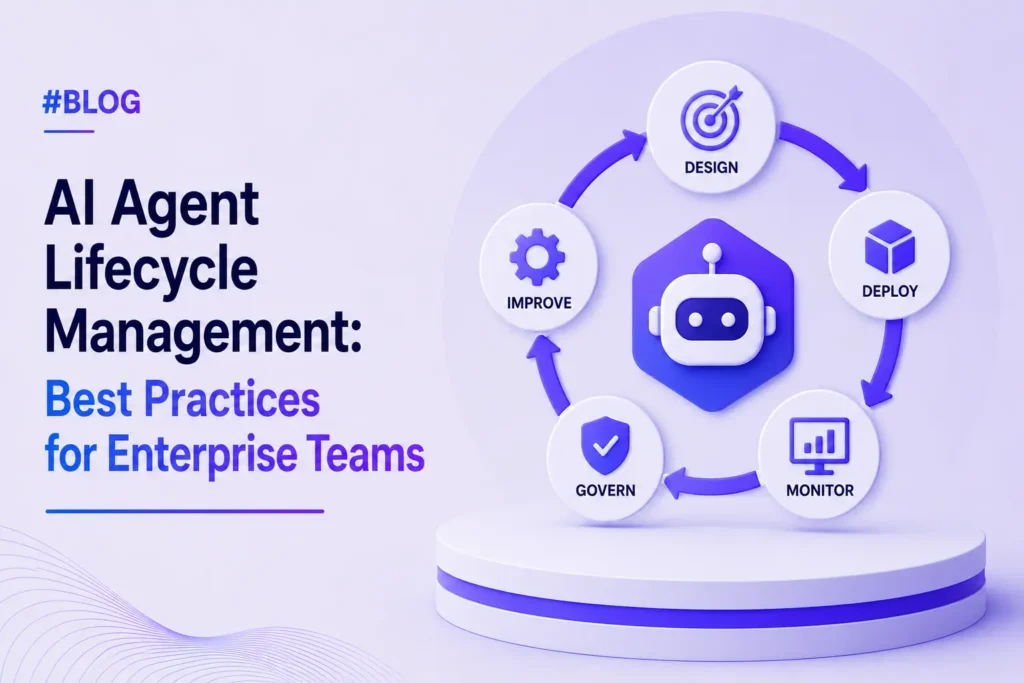
The Complete AI Agent Lifecycle: From Planning to Retirement
A healthy agent moves through clear stages. Skipping any of them is where risk creeps in. Here is the complete lifecycle, from first idea to safe retirement.
1. Planning and design
Start with the problem, not the technology. Define the agent’s goal, its scope, the data it needs, and the actions it may take. Set success metrics and name an owner before anyone writes a line of code. This is also the moment to decide what the agent must never do, since clear boundaries set now save you from painful surprises later.
2. Development and testing
Build the agent, connect its tools, and test it hard. Test for accuracy, safety, and edge cases, not just the happy path. Choosing the right framework matters here, and Wizr’s roundup of the best AI agent frameworks for enterprise is a good starting point. Treat evaluation as an ongoing habit, not a one-time gate, and save your test cases so you can rerun them every time the agent changes.
3. Deployment
Release the agent to production in a controlled way. Use staged rollouts, so a small group tries it first before you scale to everyone. This is where continuous delivery and safe rollback plans earn their keep. Keep the first version tightly scoped, watch it closely, and widen access only once it proves itself in the real world.
4. Monitoring and observability
Once live, watch the agent closely. Track accuracy, latency, cost, tool calls, and errors in real time. Good observability is what lets you catch problems before your users or auditors do. Set clear alerts and thresholds, so the system tells you when an agent starts drifting instead of leaving you to find out from an angry customer.
5. Optimization and continuous improvement
Use real production data to make the agent better. Refine prompts, update tools, and retrain where needed. Small, steady improvements keep the agent sharp and cost-effective over time. Feed real failures back into your test set, so the same mistake never reaches production twice and every fix makes the whole fleet smarter.
6. Governance and security
This stage runs across the whole lifecycle. It covers identity, access controls, audit trails, guardrails, and compliance. Every action an agent takes should be traceable and within clear boundaries. Because governance touches every other stage, it works best when it is built into the platform from the start, not stapled on after an incident forces the issue.
7. Retirement and decommissioning
Agents do not live forever. When one is outdated or replaced, retire it cleanly. Revoke its access, archive its records, and document why it was retired, so nothing is left running in the dark. Forgotten agents with live credentials are a serious security risk, which is why a clean offboarding process matters just as much as a careful launch.
10 AI Agent Lifecycle Management Best Practices for Enterprise Teams
These AI agent lifecycle management best practices help enterprise teams run agents safely and at scale. Treat them as a checklist you revisit as your fleet grows. None of them is complicated on its own, but together they are the difference between a managed digital workforce and a set of risky, unowned bots. Start with the ones that fix your biggest gaps today, then build the rest into how your teams work.
- Assign a clear owner to every agent. Each agent needs a named person or team responsible for its behavior, cost, and outcomes. Ownerless agents are how sprawl and risk begin. Keep a simple registry of every agent and its owner, so nothing runs in the shadows and someone is always accountable when a question comes up.
- Set design standards up front. Agree on shared patterns for prompts, tools, memory, and guardrails. Standards make every new agent faster to build and easier to govern. A reusable template library also means your tenth agent is safer and quicker to ship than your first, because good decisions get baked in once and reused everywhere.
- Test for safety, not just accuracy. Run agents through edge cases, adversarial prompts, and failure scenarios before launch. Catching bad behavior early is far cheaper than fixing it in production. Red-team your agents the way a security team probes an app, and treat any unsafe action in testing as a blocker, not a minor bug to fix later.
- Use versioning for everything. Versioning in AI agent lifecycle management applies to agents, prompts, tools, and models. Version control lets you roll back fast when an update goes wrong and see exactly what changed. When a prompt tweak quietly breaks behavior, a clear version history turns a stressful outage into a one-click rollback and a quick root-cause review.
- Treat agent identity as first-class. AI agent identity lifecycle management gives each agent its own identity, scoped permissions, and credentials. This limits what a compromised agent can do and creates a clear audit trail. Dedicated AI agent identity lifecycle management solutions automate this across your whole fleet. Follow the principle of least privilege, so every agent gets only the access it truly needs and nothing more.
- Deploy with continuous delivery and rollbacks. Use staged rollouts and automated pipelines so changes ship safely. Look for AI lifecycle management tools continuous delivery support, so you can move fast without breaking production and roll back the moment something looks wrong. Canary releases to a small slice of traffic let you prove a change is safe before it reaches every user.
- Monitor agents in production continuously. Track accuracy, cost, latency, and errors in real time. Set alerts for drift, so a slowly failing agent does not quietly cause damage. Watch business metrics too, not just technical ones, since an agent can hit every uptime target while still frustrating customers or making poor decisions.
- Put governance and guardrails at the center. Define what each agent can and cannot do, with human-in-the-loop approvals for sensitive actions. The best governance tools for AI lifecycle management make these controls easy to enforce. Route high-value or irreversible actions, like issuing refunds or changing records, through a human check until the agent has earned your trust.
- Close compliance and audit gaps early. Weak controls are the leading cause of AI lifecycle management tools compliance failures. Keep full audit logs and prove compliance before regulators ask. Map your controls to frameworks like SOC 2, ISO 27001, and GDPR from the start, so an audit becomes a routine export rather than a fire drill.
- Plan optimization and retirement from day one. Decide how you will improve, replace, and retire each agent before you launch it. Agents that are never reviewed become stale, costly, and risky. Schedule regular reviews, and be willing to switch off an agent that no longer earns its keep, since a smaller, healthier fleet is easier to trust than a sprawling one.
For a broader view on evaluating agent platforms against criteria like these, our CIO’s checklist for agentic AI workflow solutions pairs well with this list.
Essential AI Agent Lifecycle Management Capabilities, Tools, and Enterprise Solutions
The right tools make lifecycle management practical. Some platforms cover the full journey, while others focus on one stage like observability or governance. The best tools for AI model lifecycle management share a few core capabilities: versioning, testing and evaluation, deployment, monitoring, identity, and governance.
Here is how leading AI agent lifecycle management platforms and tools compare. This is not a ranking, since the right fit depends on your stack and needs.
| Platform / Tool | Type | Lifecycle Focus | Governance and Security | Best For |
|---|---|---|---|---|
| Wizr AI | Enterprise AI services and solutions | End-to-end build, govern, scale, plus advisory and implementation support | SOC 2 Type II, ISO 27001, GDPR, audit trails, human oversight | Enterprises wanting governed AI agents with implementation support |
| Amazon Bedrock AgentCore | Cloud platform | Build, deploy, operate, observe, evaluate | Identity, observability, IAM, VPC isolation | AWS-native teams building custom agents |
| Microsoft Azure AI Foundry | Cloud platform | Build, ground, govern, and deploy agents | Policy controls, observability, Microsoft 365 identity | Microsoft-centric enterprises |
| Google Vertex AI Agent Builder | Cloud platform | Build, deploy, and manage agents with ADK | Built-in observability, IAM controls | Google Cloud and Gemini users |
| LangSmith | Observability and evaluation tool | Testing, tracing, evaluation, monitoring | Access controls, audit logs | Teams needing deep agent observability |
| Arize AI | Observability tool | Monitoring, evaluation, drift detection | Enterprise access controls | Agent and model observability at scale |
| IBM watsonx.governance | Governance tool | Model and agent governance and risk | Policy, audit, compliance workflows | Regulated enterprises needing governance |
A few things stand out. Hyperscaler platforms are strong when you are already on their cloud. Specialized AI model lifecycle management tools like LangSmith and Arize go deep on observability and evaluation. Governance-first tools like IBM watsonx.governance focus on risk and compliance. No single tool does everything equally well, so most enterprises end up combining two or three, which is exactly why integration and shared governance matter so much.
The best AI lifecycle management tools do more than monitor. They manage versioning, identity, and governance together, so nothing slips between stages. For teams extending this discipline to code, the best AI tools for software lifecycle management bring the same rigor to the software development lifecycle, connecting agent management with how you ship software. When off-the-shelf tools do not fit, custom AI application development services can build the exact lifecycle controls your enterprise needs.
The gap for many enterprises is the glue between them. That is where a single AI agent operation platform lifecycle management approach, paired with services, helps you run the whole lifecycle in one place. For teams weighing build versus buy, Wizr’s guide on why enterprise AI pilots fail to reach production explains why integrated management beats stitched-together tools.
How Wizr AI Helps Enterprises Govern and Manage the AI Agent Lifecycle at Scale
Wizr AI helps enterprises manage the full AI agent lifecycle, from initial design and development to deployment, governance, optimization, and eventual retirement. Its Enterprise AI Services, AI Agents, AI Governance, and AI-powered engineering capabilities support the lifecycle and best practices outlined in this guide, giving enterprises the implementation and governance support needed to scale AI agents responsibly.
Founded in 2023, Wizr AI focuses on enterprise AI automation and AI-driven software engineering, covering both AI agents and the engineering discipline required to build, integrate, govern, and scale them. That combination matters for lifecycle management because managing agents effectively requires both technical implementation and strong governance processes.
Plan and build. Wizr’s AI Agents and Enterprise AI Services help teams design and launch agents for use cases such as customer support, IT support, and finance. Teams can start with proven patterns instead of building everything from scratch. When a bespoke solution is required, Wizr’s AI-powered software engineering services can build custom agents and applications around specific enterprise workflows.
Govern and secure. Governance is built into the lifecycle rather than treated as a final step. With enterprise-grade security, audit trails, and human-in-the-loop controls, Wizr helps enterprises establish the guardrails recommended in this guide.
Wizr is SOC 2 Type II, ISO 27001, and GDPR compliant, while its AI Governance capabilities support oversight and identity controls as AI deployments grow. This helps give every agent a clear owner, scoped permissions, and an auditable record of activity controls that are important for enterprise security and compliance teams.
Deploy and integrate. Wizr’s agentic workflows and integrations help AI agents operate across existing enterprise systems. Staged rollouts and structured implementation support make continuous delivery more manageable while reducing deployment risks.
Because Wizr supports model-agnostic AI implementations, enterprises can adopt new models as they emerge without necessarily rebuilding their agents from scratch.
Version and control. Wizr helps enterprises maintain records of agents, prompts, tools, and their versions, making it easier to track changes and roll back when required. This supports the versioning and identity practices discussed in this guide and provides greater control as multiple AI agents evolve simultaneously.
Monitor and optimize. Wizr’s AI services and governance capabilities help enterprises monitor agent performance, identify potential drift, and understand operational costs. A coordinated approach to monitoring makes it easier to identify issues and apply improvements across the agents that need them.
Scale and support. This is where the combination of AI services and engineering expertise becomes important. For a leading logistics SaaS firm, Wizr drove up to 50% faster response times and deflected around 43% of support tickets, while across customers, 90% of pilots reach production. For custom AI implementations and modernization initiatives, Enterprise AI Services and AI-Powered Engineering & Legacy Modernization provide hands-on support throughout the lifecycle. This combination helps enterprises manage AI agents without having to build a large in-house AI operations team.
The proof is in the work. Enterprises such as Chrysler, Project44, and Fragomen have worked with Wizr. You can see more in the case studies, or talk to the Wizr team for a tailored look at managing your agent lifecycle at scale. In short, Wizr AI gives you both the platform and the people to run AI agent lifecycle management with confidence, from first design to safe retirement.
In short, Wizr AI combines AI services, engineering expertise, governance, and implementation support to help enterprises manage AI agent lifecycle management from initial design through safe retirement.
FAQs
1. What is AI agent lifecycle management?
AI agent lifecycle management is the end-to-end process of planning, building, deploying, governing, monitoring, and retiring AI agents. It treats each agent as a managed product with a full lifecycle, complete with owners, guardrails, and records. The goal is to keep every agent safe, reliable, and valuable from launch to retirement.
In practice, it is what stops AI agents from becoming unmanaged risks. It brings the same discipline to digital workers that you already apply to software and staff. Every agent gets an owner, a set of rules, and a clear record of what it does.
Wizr AI helps enterprises manage this full lifecycle through Enterprise AI Services, AI Governance, AI Agents, and hands-on implementation support.
2. Why is AI agent lifecycle management important for enterprises?
It is important because agents act on real systems, so unmanaged agents create real risk. Without lifecycle management, enterprises face security gaps, compliance failures, silent performance drift, and rising costs. These are the very issues that cause most agentic projects to stall or get canceled.
A lifecycle approach keeps agents accountable as they scale. It gives each one clear ownership, guardrails, monitoring, and a plan for updates and retirement. That structure is what lets an enterprise run hundreds of agents without losing control of any of them.
Wizr AI focuses on helping enterprises scale AI agents with governance, engineering support, and operational control.
3. What are the stages of the AI agent lifecycle?
The AI agent lifecycle has seven core stages. These are planning and design, development and testing, deployment, monitoring and observability, optimization and continuous improvement, governance and security, and retirement. Governance and security run across every stage rather than sitting in just one.
Each stage has its own checks and owners. Skipping a stage, especially testing or monitoring, is where most problems begin.
Wizr AI supports these lifecycle stages through its Enterprise AI Services, AI Agents, AI Governance, agentic workflows, and AI-powered engineering capabilities.
4. What are the best practices for AI agent lifecycle management?
The core best practices are clear ownership, shared design standards, rigorous testing, versioning, strong agent identity and access controls, safe continuous delivery, constant monitoring, central governance, closing compliance gaps, and planning retirement early. Together, they keep a growing fleet of agents safe and accountable.
The theme across all of them is control. You want to know what every agent is doing, why, and whether it is still working well.
Wizr AI supports these practices through its AI Governance, Enterprise AI Services, AI Agents, and AI-powered engineering services, helping enterprises implement lifecycle controls without relying entirely on disconnected tools.
5. What is AI agent identity lifecycle management?
AI agent identity lifecycle management is the practice of giving each agent its own identity, credentials, and scoped permissions, then managing them over time. It controls what an agent can access, revokes rights when they are no longer needed, and logs every action for audit. This limits the damage a compromised or misbehaving agent can cause.
It matters because most AI-related breaches trace back to weak access controls. Treating agent identity as first-class is one of the strongest safeguards you can put in place.
Wizr AI supports identity and access controls through its AI Governance capabilities, helping keep agents accountable throughout their lifecycle.
6. How do you choose AI agent lifecycle management tools?
Start with the stages you struggle with most, whether that is testing, deployment, monitoring, or governance. Look for tools that cover versioning, evaluation, observability, identity, and audit, and that fit your existing cloud and security stack. For many enterprises, an integrated platform plus services beats stitching together separate point tools.
Also weigh security certifications, ease of integration, and how well the tool scales as your agent fleet grows. Run a short pilot on a real agent before you commit, since the best tool on paper is not always the best fit for your team.
Wizr AI combines Enterprise AI Services, AI Governance, AI Agents, and implementation expertise to help enterprises manage the full agent lifecycle at scale.
7. What are the best AI agent lifecycle management platforms in 2026?
The best AI agent lifecycle management platforms in 2026 include hyperscaler options like Amazon Bedrock AgentCore, Microsoft Azure AI Foundry, and Google Vertex AI, specialized observability tools like LangSmith and Arize AI, and governance-first tools like IBM watsonx.governance. Wizr AI approaches the same lifecycle challenge through enterprise AI services and solutions, combining AI agent development, governance, engineering, integrations, and implementation support.
The right choice depends on your cloud environment, security requirements, existing technology stack, and how much hands-on support your team needs. Enterprises should evaluate these factors against their specific lifecycle requirements.
Wizr AI is suited to teams looking for an integrated services-led approach with expert support across AI agent development, governance, deployment, and scaling.
8. What causes compliance failures in AI lifecycle management?
Most AI lifecycle management tools compliance failures trace back to weak controls. The usual culprits are missing audit trails, agents with too much access, no human oversight on sensitive actions, and no record of what changed or why. When something goes wrong, teams cannot explain the agent’s decision or prove it followed policy.
The fix is to build governance from the start. Clear ownership, scoped permissions, full logs, and version history turn compliance from a scramble into a routine.
Wizr AI supports these controls through its AI Governance and enterprise AI services, making governance part of the AI lifecycle rather than a last-minute activity.
9. What is the difference between AI agent and AI model lifecycle management?
AI model lifecycle management focuses on a single model, covering training, deployment, monitoring, and retraining. AI agent lifecycle management is broader, since an agent uses one or more models plus tools, memory, and the ability to take action. Managing an agent means managing its identity, permissions, tool access, and behavior, not just the model behind it.
In short, the model lifecycle is a part of the agent lifecycle. Agents add decisions and actions, which raises the stakes for governance and security.
Wizr AI supports the broader agent lifecycle through AI Agents, Enterprise AI Services, AI Governance, and AI-powered engineering, including the models, tools, integrations, and guardrails that sit around each agent.
About Wizr AI
Wizr AI helps enterprises build autonomous enterprises and accelerate product and software engineering with practical, production-ready AI. We help organizations automate business workflows, modernize legacy applications and digital platforms, and build intelligent AI solutions.
Our core services include Enterprise AI Services, AI-Powered Engineering & Legacy Modernization, AI Product Engineering, and AI Governance. We also leverage AI Assembly capabilities, including the Agentic AI Framework, Agentic Workflows, Security, and Integrations.
Through our AI solutions, including AI Agents, Pharma & Life Sciences AI, Oracle AI, and Salesforce AI, we help enterprises apply AI across business and technology needs.
See how we can help your enterprise move faster with AI. 👉 Talk to an AI Expert.

![15 Best AI Chatbot Development Companies in the USA [2026 Buyer's Guide]](https://wizr.ai/wp-content/uploads/2026/06/Best-AI-chatbot-development-companies.webp)
![12 Best AI Legacy Application Modernization Services in 2026 [CIO's Guide]](https://wizr.ai/wp-content/uploads/2026/06/12-Best-AI-Legacy-Application-Modernization-Services.webp)
![12 Best AI Agent Development Companies in the USA: A CIO's Guide [2026]](https://wizr.ai/wp-content/uploads/2026/07/12-Best-AI-Agent-Development-Companies.webp)
![Custom AI development vs Off-the-Shelf AI: An Enterprise Decision Framework [2026]](https://wizr.ai/wp-content/uploads/2026/08/Custom-AI-vs-Off-the-Shelf-AI.webp)


![Security and Compliance for Enterprise AI Implementation: A Practical Guide [2026]](https://wizr.ai/wp-content/uploads/2026/07/Security-and-Compliance-for-Enterprise-AI.webp)