Enterprise AI consulting services help large organizations plan, build, and scale AI in a way that is secure, governed, and tied to real business outcomes. The right partner turns AI ambition into production systems. The wrong one leaves you with expensive pilots that never ship.
Choosing well matters more than ever in 2026. The AI consulting services market is growing fast, from roughly $9 billion in 2026 toward nearly $19.5 billion by 2030, according to The Business Research Company. With so many providers, telling a true partner from a slick pitch is a real challenge.
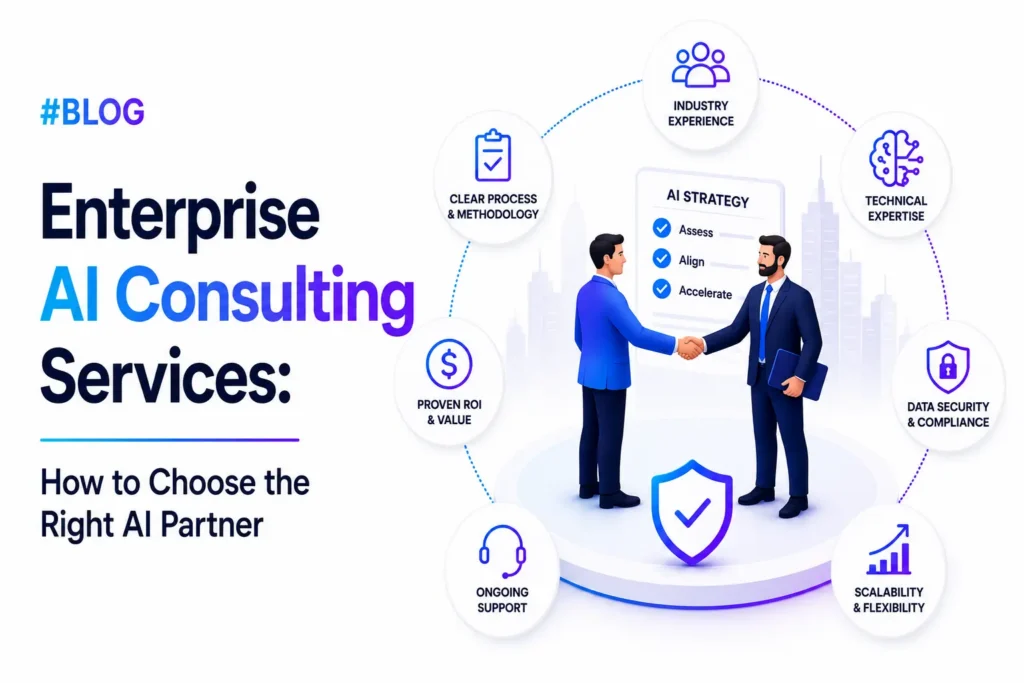
This guide explains what enterprise AI consulting services are, when you need them, the main types, and exactly how to choose the right partner. It is written for CIOs, CTOs, and enterprise leaders who need real, measurable results, not buzzwords or hype. The stakes are high, since the gap between a partner who ships and one who stalls can mean millions in wasted budget and a year of lost time. To see how strategy connects to delivery, explore Wizr’s enterprise AI services.
What Is an Enterprise AI Consulting Service?
Enterprise AI consulting services are expert advisory and delivery services that help large organizations adopt AI successfully. They cover strategy, use case selection, data readiness, model and platform choices, security, governance, and the path to production.
Think of it as a guide for a hard climb. You could attempt it alone, but an experienced partner helps you pick the safe route, avoid known traps, and reach the top faster. The value is not just speed. It is avoiding the costly wrong turns that sink so many AI projects before they deliver anything.
AgenticGood consulting is not just slides and strategy. The best enterprise AI consulting firm pairs advice with hands-on engineering, so plans turn into working AI agents workflow, RAG systems, and automations built on your own data. That blend of advisory and delivery is what separates real partners from pure talkers.
It helps to know the landscape. Broadly, three kinds of firms offer enterprise AI consulting services. Global consultancies and system integrators like Accenture, Deloitte, and IBM bring scale and brand recognition. Boutique AI specialists bring depth and speed. Platform-led providers pair consulting with their own technology to shorten the path to production. Each model trades off cost, speed, and control differently.
A strong engagement also produces concrete deliverables, not just advice. Expect an AI opportunity assessment, a prioritized use case roadmap, a data and architecture review, a governance and security plan, and a working pilot built on real data. The best partners tie every deliverable to a business metric, so you see value at each stage instead of waiting for one big reveal at the end.
Here is a real-world example. A bank might first ask a partner to prioritize AI use cases, then have that same partner build a governed customer-service agent, integrate it with core systems, and monitor it in production. One relationship covers strategy, build, and run, which is how modern enterprise AI consulting services are meant to work.
When Do Enterprises Need Enterprise AI Consulting Services?
Enterprises need AI consulting when the gap between ambition and execution grows too wide to cross alone. Most companies have adopted AI, but far fewer have scaled it. McKinsey reports that most organizations now use AI in at least one function, yet only about a third have scaled it enterprise-wide.
That gap is exactly where consulting earns its keep. Here are the clearest signs it is time to bring in a partner:
- Stuck in pilots: Your AI proofs of concept work in demos but never reach production. A partner who has crossed that gap before spots the integration and governance blockers early, before they quietly stall your project for months.
- No clear strategy: You have an AI budget but no roadmap tied to business value. Consultants help you rank use cases by business impact and effort, so your budget flows to the ones that pay back fastest.
- Data is not ready: Fragmented, ungoverned data blocks every project. A good partner starts with a data readiness review, since clean, accessible, well-governed data is the single biggest predictor of AI success.
- Skills gaps: Your team lacks deep AI, MLOps, or governance experience. The right firm delivers the work and transfers knowledge as it goes, so your internal team is stronger and more independent after the engagement ends.
- Compliance pressure: You need AI security and governance built in, not bolted on. This is especially urgent in finance, healthcare, and other regulated sectors, where a single governance gap can carry real legal and reputational risk.
- Scaling struggles: One use case works, but you cannot repeat it across the business. Consultants help you build reusable components and a shared platform, so your second and third use cases ship far faster and cheaper than the first.
The pattern is consistent. Companies rarely fail because AI cannot help them. They fail because strategy, data, skills, and governance are not aligned, and a strong partner brings all four together.
Consider a common scenario. A company builds an impressive internal chatbot, leadership loves the demo, and then it stalls for months because no one planned for data access, security review, or integration. A good consulting partner would have flagged those blockers on day one.
A simple maturity model makes the timing clearer. In the experimenting stage, teams run isolated pilots and mostly need strategy help. In the scaling stage, a few use cases work, and the challenge shifts to platforms, governance, and repeatability. In the transforming stage, AI is core to operations, and the focus moves to optimization and change management. Consulting adds the most value at the transitions between these stages, where old approaches stop working and new skills are needed.
If two or more of these sound familiar, outsourced enterprise AI consulting services can save months of trial and error. For a deeper look at the production gap, read Wizr’s guide on why enterprise AI pilots fail to reach production.
Types of Enterprise AI Consulting Services for Modern Enterprises
Enterprise AI consulting is not one service. It is a family of specialties, and knowing which you need helps you pick the right partner. Most engagements combine several of the types below.
- Enterprise AI strategy consulting services: Roadmaps, use case selection, and ROI planning tied to business goals. This is usually where an engagement starts, turning vague AI ambition into a costed, sequenced plan that leaders can approve.
- Enterprise generative AI consulting services: Building solutions with models like GPT-5, Claude, Gemini, Llama, and Mistral, grounded in your data through Agentic RAG. Done well, it reduces hallucinations and keeps outputs accurate, on-brand, and safe for real customer and employee use.
- Enterprise agentic AI consulting services: Designing AI agents and multi-agent systems that plan, decide, and act across workflows. These agents move beyond answering questions to completing tasks, such as resolving a ticket or processing an invoice end to end.
- Enterprise AI and ML consulting services: Custom machine learning, model development, and MLOps for predictive and analytical use cases. It suits forecasting, scoring, and detection problems where a tailored model beats a general-purpose language model.
- Enterprise AI governance consulting services: Responsible AI, risk controls, audit trails, and compliance frameworks. With regulations like the EU AI Act tightening, this has shifted from a nice-to-have to a board-level priority for many enterprises.
- Enterprise AI automation consulting services: Automating end-to-end processes across support, IT, and finance. The goal is to remove repetitive manual work at scale, freeing your teams for higher-value tasks that need human judgment.
- AI integration consulting services: Connecting AI to your CRM, ERP, ITSM, and data stack through integrations, APIs, and the Model Context Protocol (MCP). Integration is often where projects stall, so proven connectors and clean data access are worth more than any flashy demo.
- AI implementation consulting services: Hands-on building, testing, and deployment of production AI systems. This is the difference between a strategy on paper and an agent that runs reliably in your live environment every day.
- Enterprise AI transformation consulting services: Large-scale change programs that reshape operations around AI. These are multi-year efforts, so they need strong change management and executive sponsorship as much as technical skill.
- Enterprise AI advisory consulting services: Ongoing guidance for leaders on strategy, vendors, and governance. It works well as a retainer, giving your leaders a trusted sounding board as the technology and vendor landscape keeps shifting.
- AI management consulting services: Operating-model, workflow, and organizational changes that help teams adopt and sustain AI. It focuses on the human side of AI, redesigning roles, processes, and incentives so adoption actually sticks.
Many providers also offer industry-specific depth, such as AI consulting for financial services or healthcare AI consulting services, where compliance and domain knowledge matter most.
The point is not to buy every type. It is to match the services to your stage. Early on, strategy and generative AI consulting matter most. Later, governance, automation, and transformation services carry more weight as you scale across the business.
Two types deserve special attention in 2026. Enterprise generative AI consulting services help you use large language models safely and effectively, while enterprise agentic AI consulting services go further, building agents that take action across systems. Most enterprises now need both, since a chatbot that only answers is quickly outgrown by agents that actually resolve work.
It also helps to compare the three ways these services are delivered:
| Engagement Model | What You Get | Best For | Trade-off |
| Strategy and advisory | Roadmaps, use cases, and guidance | Early-stage planning | You still need someone to build |
| Implementation and build | Working, deployed AI systems | Teams with a clear plan | Less help shaping the strategy |
| Platform-led (advisory plus platform) | Strategy and a production platform in one | Fast, governed path to production | Best value inside that platform |
Many enterprises start with strategy, then discover they need delivery too. Choosing a partner that offers both from the start avoids a costly second search later.
How to Choose the Right Enterprise AI Consulting Partner
Choosing the right partner is a step-by-step process, not a gut call. Follow these steps to move from a long list to a confident decision.
- Define your goal. Decide whether you need strategy, implementation, or both. A clear goal narrows the field fast. Write down the one outcome you most want in twelve months, then judge every partner against it.
- Check real production work. Ask for AI systems that live in production for six months or more, with measurable outcomes. Speak with a reference running a similar system, and dig into what broke and how the partner fixed it.
- Test domain and technical depth. Confirm expertise in LLMs, RAG, agents, and your specific industry. Give them a real problem from your business and see whether their questions and answers show genuine understanding.
- Review security and governance. Require SOC 2 Type II, ISO 27001, and clear data handling. Ask exactly how they protect data, control access, and log every AI decision for audit.
- Understand the delivery model. Learn who does the work, how they integrate, and how they hand off. Confirm whether senior engineers or junior staff do the work, and how knowledge transfers to your team.
- Run a paid pilot. Test the partner on one real use case before a large commitment. A small, scoped, paid pilot reveals more about a partner in a few weeks than months of sales calls ever will.
A good partner welcomes these steps. If a firm dodges questions about production results or governance, treat that as a warning sign.
Speed matters, but so does discipline. The best enterprise AI consulting partner moves fast on a pilot while still insisting on clear goals, security, and measurable outcomes. That balance of speed and rigor is a strong signal you have found the right fit.
It also helps to know the red flags. Be cautious of partners who promise guaranteed outcomes before seeing your data, who cannot name a comparable production client, or who resist a paid pilot. These are usually signs of sales over substance.
A light evaluation process keeps you objective. Shortlist three to five partners, give each the same brief and success criteria, and compare their proposed approach, not just their price. The partner who asks the sharpest questions about your data and goals is often the one who will actually deliver.
Key Criteria for Evaluating an Enterprise AI Consulting Firm
Once you have a shortlist, score each enterprise AI consulting firm on the same criteria. This keeps your decision objective instead of emotional.
- Proven outcomes: Verifiable case studies and references in your industry. Look for measurable results, like tickets deflected or hours saved, not just logos on a slide.
- Technical depth: Strong skills in generative AI, agentic AI, RAG, vector databases, and MLOps. The strongest teams also stay current with new models and patterns, since this field changes every few months.
- Platform and delivery: The ability to build and run systems, not just advise. A partner who can only advise will hand you a plan and leave the hardest part, execution, to you.
- Security and compliance: Certifications, access controls, and audit trails as standard. Treat missing certifications or vague data answers as a reason to drop a firm from your shortlist.
- Integration skill: Clean connections to your existing systems and data. Ask how many of your core systems they have connected before, and how long it typically takes.
- Governance maturity: Responsible AI practices and human-in-the-loop controls. Mature partners can show you their guardrails and audit trails, not just talk about responsible AI in the abstract.
- Transparent pricing: Clear scope and cost, with no surprises at scale. Insist on a model that shows how costs behave as usage scales from a pilot to full production.
The best enterprise AI consulting partner will score well across all seven, not just one or two. A firm that is strong on strategy but weak on delivery often leaves you with a plan you cannot execute.
To make this practical, turn the criteria into a simple scorecard. Rate each firm from one to five on every point, weight the criteria that matter most to you, and total the scores. This turns a subjective choice into a defensible decision you can share with your board.
For example, a regulated bank might weight security, governance, and financial-services experience highest, while a fast-moving SaaS company might weight delivery speed and technical depth. The right weighting depends on your risk profile and goals, so agree on it before you start scoring.
One more test is cultural fit. You will work closely with this partner, often under pressure, so clear communication and honesty about trade-offs matter as much as technical skill. A partner who tells you what will not work is often more valuable than one who promises everything.
Essential Questions to Ask Before Hiring an Enterprise AI Consulting Partner
The right questions reveal whether a partner can deliver. Ask these before you sign anything.
- Can you show AI running in our kind of environment today? Look for real production proof, not demos. Real, current production examples are the single best predictor that a partner can do the same for you.
- Who owns the code and the IP? Confirm you keep full ownership of what they build. You should retain full ownership of the code, models, and data, with no hidden lock-in clauses.
- How do you handle security and compliance? Expect specifics on SOC 2, ISO 27001, and data residency. Vague answers here are a serious red flag, since security gaps in AI can expose sensitive data at scale.
- How do you measure success? Look for clear metrics tied to business outcomes, not vanity numbers. Agree on baseline and target KPIs upfront, so both sides know exactly what a win looks like.
- What happens after launch? Ask about monitoring, retraining, and long-term support. Agents drift as your data changes, so ongoing monitoring and retraining are essential, not optional.
- How do you price and scale? Understand costs from pilot through enterprise rollout. Understand the full cost curve early, so a successful pilot does not become an unaffordable rollout.
Listen for how they answer, not just what they say. Strong partners give specific, evidence-backed responses, name real clients and outcomes, and are honest about what could go wrong. Vague, jargon-heavy answers are a warning sign.
It also helps to ask a few forward-looking questions. How will you keep our agents accurate as our data changes? How do you handle model updates from providers like OpenAI, Anthropic, or Google? What happens to our systems if we part ways? The answers reveal whether a partner is thinking about the long term or only the first project.
The goal of these questions is simple. You want to separate partners who have done this before from those still learning on your budget.
Strong partners answer these clearly and confidently. Vague answers usually mean vague results.
Common Mistakes to Avoid When Choosing Enterprise AI Consulting Services
Even smart teams make avoidable mistakes here, many of which trace back to the issues Wizr explores in why enterprise AI apps fail. Knowing them upfront protects your budget and timeline.
The risk is real. Gartner predicts that over 40% of agentic AI projects will be canceled by the end of 2027, often due to unclear value or weak governance. The right partner and a disciplined process keep you out of that statistic.
Watch for these common mistakes:
- Choosing on brand alone. A famous name does not guarantee production results for your use case. A prestigious logo does not mean their team has shipped your kind of use case in production.
- Ignoring delivery ability. Strategy-only firms leave you with plans, not systems. You end up paying twice, once for the strategy and again for a separate firm to actually build it.
- Skipping governance. Treating security and compliance as an afterthought creates real risk. Retrofitting security and compliance later is slow, costly, and sometimes forces a full rebuild.
- No clear metrics. Without baseline and target KPIs, you cannot prove or improve ROI. Without numbers, you cannot prove ROI to leadership or know which changes are actually working.
- Vendor lock-in. Avoid partners who trap you in one closed ecosystem. Favor open standards and clear exit terms, so switching partners later does not mean starting over.
- Rushing past the pilot. Scaling before proving value on one workflow multiplies risk. Prove value on one workflow first, since scaling a flawed design just multiplies the cost of fixing it.
If you had to avoid just one, avoid choosing a strategy-only firm when you actually need production systems. It is the most common and most expensive mismatch, leaving you with a polished roadmap and no working AI to show for it.
If you are already stuck, recovery is possible. Run a small, well-scoped pilot with a delivery-focused partner, prove value on one workflow, and use that momentum to reset the wider program. A fresh, production-first start often beats trying to rescue a stalled strategy engagement.
The good news is that every mistake here is avoidable. A clear goal, a scoped pilot, and honest questions about production and governance will steer you around the most expensive traps.
How Wizr AI Delivers Enterprise AI Consulting Services from Strategy to Production
Everything in this guide points to one test: can a partner take you all the way from strategy to production? Here is how Wizr AI maps to the exact things this article tells you to look for, point by point.
It covers the service types you need. The guide lists strategy, generative AI, agentic AI, governance, and automation as the core consulting types. Wizr delivers these through its enterprise AI services and hands-on delivery capabilities. Its Enterprise AI Services and custom AI application development services span use case selection, data readiness, architecture, and change planning, so you get a clear, ROI-focused plan rather than a generic deck. Instead of hiring separate firms for strategy, implementation, and governance, you can work with one partner across the full AI journey.
It scores well on the key criteria. This guide tells you to weigh production proof, delivery ability, security, and governance. Wizr addresses each of these through its enterprise AI consulting and delivery services. Across customers, 90% of its pilots reach production, the exact stage where many projects stall. Wizr helps turn AI strategies into working AI agents and intelligent workflows using enterprise data and existing technology environments, while SOC 2 Type II, ISO 27001, and GDPR-aligned security practices support governed AI delivery. Pre-built agents for customer support, IT, and finance can shorten time to value further.
It avoids the most expensive mistake. This guide tells you to ask about IP ownership, long-term support, and modernization. Wizr helps clients retain ownership of their intellectual property, supports AI solutions after launch through monitoring and ongoing optimization, and uses AI-powered engineering and legacy modernization to modernize the systems around their AI solutions. That matters for enterprises where legacy systems, rather than AI models alone, can be the real blocker.
It answers the hard questions well. This guide tells you to ask about IP ownership, long-term support, and modernization. Wizr helps you keep your IP, supports agents after launch with monitoring and retraining, and uses AI-driven software engineering to modernize the systems around your agents. That matters for enterprises where legacy systems, not models, are the real blocker.
In short, Wizr aligns with the core checklist this guide recommends, making it relevant for enterprises looking for both strategic guidance and hands-on AI delivery. Enterprises such as Chrysler, Project44, and Fragomen have worked with Wizr on AI and technology initiatives. Talk to the Wizr team to map your own path from strategy to production.
Conclusion
Enterprise AI consulting services can be the difference between AI that ships and AI that stalls. The right partner brings strategy, delivery, security, and governance together, and proves it with real production results.
Do not choose on brand or budget alone. Define your goal, evaluate partners on production experience and governance, and always run a pilot first. The right partner should work as an extension of your team, helping you move from strategy through implementation and ongoing optimization. When you want a partner that takes you from strategy to production, explore how Wizr AI delivers Enterprise AI Services with advisory depth, hands-on AI solution development, and AI-powered engineering capabilities.
FAQs
1. What are enterprise AI consulting services?
Enterprise AI consulting services are advisory and delivery services that help large organizations plan, build, and scale AI. They span strategy, data readiness, model and platform choices, security, governance, and deployment to production.
The best providers pair advice with real engineering. Wizr AI combines enterprise AI consulting with hands-on AI solution development and engineering services, helping turn strategy into working AI systems and business solutions.
2. How much do enterprise AI consulting services cost?
Costs vary widely with scope. A focused AI readiness assessment often runs from about $8,000 to $25,000, while full strategy-to-production programs with custom builds and integrations can reach six or seven figures.
Pricing depends on complexity, governance, and delivery model. As a rule of thumb, tie spend to outcomes, since paying for a scoped pilot that proves value is smarter than funding a large program on faith. Wizr AI can help organizations control delivery effort and accelerate time to value through pre-built AI agents and reusable AI capabilities where relevant.
3. What is the difference between AI consulting and AI implementation?
Consulting focuses on strategy, roadmaps, and advice, while implementation focuses on building and deploying real systems. Many enterprises need both, and gaps between them are where projects stall.
Choosing a partner that does both can avoid costly handoffs. Wizr AI brings together enterprise AI consulting, solution development, and engineering services, so the team that helps plan your AI initiatives can also support implementation and governance.
4. How do I choose the best enterprise AI consulting partner?
Focus on proven production work, technical and domain depth, security and governance, and the ability to build, not just advise:
- Ask for production references in your industry.
- Confirm security certifications like SOC 2 Type II and ISO 27001.
- Check delivery ability, not just strategy slides.
- Run a paid pilot before scaling.
Client outcomes matter most. Wizr AI brings enterprise AI consulting together with hands-on AI services, engineering, and governed AI delivery to support organizations from strategy through production.
5. Do enterprises need industry-specific AI consulting?
Often yes, especially in regulated sectors. AI consulting for financial services and healthcare AI consulting services bring domain knowledge and compliance expertise that general firms may lack.
Industry depth can reduce risk and support faster implementation. Wizr AI supports regulated enterprises through Enterprise AI Services, AI Governance, and solutions tailored to industry-specific workflows, including Pharma & Life Sciences AI.
6. What should I expect from an enterprise AI consulting engagement?
Expect a clear roadmap, honest talk about data and readiness, a scoped pilot, and a path to production with measurable KPIs. Good partners set expectations early and report against them.
Ongoing support matters too. Wizr AI stays involved across strategy, solution development, deployment, and scaling, helping organizations continuously improve their AI solutions and business outcomes over time.
Key takeaways: Enterprise AI consulting services span strategy, delivery, and governance. The right partner should demonstrate production experience, combine consulting with hands-on implementation, and put security and governance first. Whatever you do, run a scoped pilot before you scale.
About Wizr AI
Wizr AI helps enterprises build autonomous enterprises and accelerate product and software engineering with practical, production-ready AI. We help organizations automate business workflows, modernize legacy applications and digital platforms, and build intelligent AI solutions.
Our core services include Enterprise AI Services, AI-Powered Engineering & Legacy Modernization, AI Product Engineering, and AI Governance. We also leverage AI Assembly capabilities, including the Agentic AI Framework, Agentic Workflows, Security, and Integrations.
Through our AI solutions, including AI Agents, Pharma & Life Sciences AI, Oracle AI, and Salesforce AI, we help enterprises apply AI across business and technology needs.
See how we can help your enterprise move faster with AI. 👉 Talk to an AI Expert.

![15 Best AI Chatbot Development Companies in the USA [2026 Buyer's Guide]](https://wizr.ai/wp-content/uploads/2026/06/Best-AI-chatbot-development-companies.webp)
![12 Best AI Legacy Application Modernization Services in 2026 [CIO's Guide]](https://wizr.ai/wp-content/uploads/2026/06/12-Best-AI-Legacy-Application-Modernization-Services.webp)
![12 Best AI Agent Development Companies in the USA: A CIO's Guide [2026]](https://wizr.ai/wp-content/uploads/2026/07/12-Best-AI-Agent-Development-Companies.webp)
![Custom AI development vs Off-the-Shelf AI: An Enterprise Decision Framework [2026]](https://wizr.ai/wp-content/uploads/2026/08/Custom-AI-vs-Off-the-Shelf-AI.webp)


![Security and Compliance for Enterprise AI Implementation: A Practical Guide [2026]](https://wizr.ai/wp-content/uploads/2026/07/Security-and-Compliance-for-Enterprise-AI.webp)