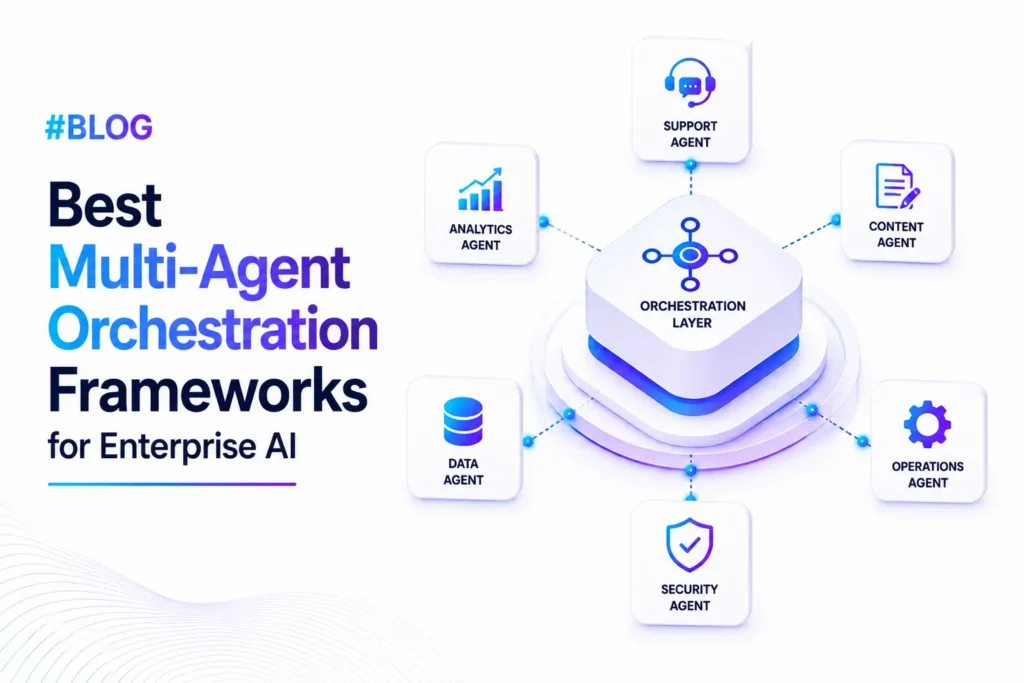
Multi-agent orchestration frameworks let several specialized AI agents work together on one business process, with clear rules about who does what and when. For enterprises, they are the difference between a clever demo and a system that can run finance, support, or IT operations reliably.
The stakes are rising fast. Gartner predicts 40% of enterprise applications will include task-specific AI agents by the end of 2026, up from less than 5% in early 2025. Once you have more than one agent, orchestration stops being optional.
This buyer’s guide compares the best multi-agent orchestration frameworks 2026 has to offer, using enterprise criteria rather than developer preferences. It doubles as a shortlist of the best multi-agent AI frameworks 2026 buyers are evaluating, and a read on multi-agent AI orchestration trends 2026. You will get criteria, a comparison table, real use cases, and a clear way to choose.
One thing to settle upfront: a framework gives engineers building blocks, not governance, integrations, or a production system. That gap is where most enterprise AI programs stall, and we cover it near the end.
What Are Multi-Agent Orchestration Frameworks?
Multi-agent orchestration frameworks are software toolkits that coordinate several AI agents working toward a shared goal. They handle how agents plan, share context, hand off tasks, recover from errors, and report results.
Think of it as the operating model for a team. Each agent is a specialist, and the framework is the manager deciding who picks up which task, in what order, and what happens when someone gets stuck.
So what is multi-agent orchestration in practice? A single agent might answer a customer question. An orchestrated group can read the ticket, verify the order in your ERP, check the refund policy, issue the refund, and update the customer, with each step handled by an agent suited to it.

Common multi-agent orchestration patterns
Most enterprise systems use one of a few recognizable multi-agent orchestration patterns:
- Supervisor pattern: A lead agent assigns work to specialists and reviews results, much like a team lead.
- Sequential pipeline: Agents pass work down a chain, each adding something before the next step.
- Parallel fan-out: Several agents work at once, then a coordinator merges their output.
- Hierarchical teams: Groups of agents report to sub-managers, useful for very complex processes.
- Event-driven: Agents react to events as they happen, which suits high-volume operations.
Frameworks are not the same as platforms. A multi-agent orchestration platform adds the runtime, governance, and integrations around the logic, which is why enterprise AI orchestration frameworks are usually paired with enterprise AI orchestration platforms in production. Choosing a pattern is a business decision as much as a technical one. Supervisor patterns give you a clear accountability point, which auditors like. Parallel fan-out is faster but harder to trace. Sequential pipelines are the easiest to explain to a risk committee, which is often why regulated teams start there.
A workable enterprise multi-agent orchestration architecture layers these patterns on top of shared services: a model layer with GPT-5, Claude, or Gemini, a retrieval layer using RAG and vector databases, an integration layer using the Model Context Protocol (MCP), and a governance layer that logs and controls everything.
If you want a deeper look at how these pieces fit together in practice, Wizr’s guide on building multi-agent applications walks through the architecture behind coordinated agents.
Key Criteria for Evaluating Multi-Agent Orchestration Frameworks
Enterprise buyers need different criteria than developers. GitHub stars and elegant syntax matter far less than whether the system survives audit, scale, and a bad Tuesday in production.
The best AI agent orchestration frameworks 2026 offers all score well here, so use these eight criteria to evaluate any option:
- Production readiness: Does it handle failures, retries, and long-running tasks without losing state?
- Scalability: Can it run hundreds of agents and high request volumes without cost or latency spiraling?
- Governance and control: Can you set permissions, approval gates, and boundaries for each agent?
- Security and compliance: Does it support access control, audit trails, and data residency for regulated work?
- Observability: Can you see what each agent decided, why, and where a process broke down?
- Enterprise integration: How easily does it connect to your CRM, ERP, ITSM, and data platforms?
- Deployment flexibility: Can you self-host for control, or use managed hosting for speed?
- Licensing and lock-in: Is the licence open and permissive, and can you switch models or clouds later?
Notice what is absent from this list. Benchmark scores, syntax elegance, and community size tell you little about whether a system will pass an audit or survive a Monday morning traffic spike. Enterprise AI adoption succeeds or fails on operational fit, not developer preference.
Weight these against your own risk. A bank will rank governance, audit trails, and self-hosting highest. A fast-moving product team may rank speed to first working agent above everything else. Write your weighting down before you evaluate anything, because it is far harder to stay objective once a vendor demo has impressed your team.
One warning worth taking seriously. Gartner predicts that over 40% of agentic AI projects will be canceled by the end of 2027, often due to unclear business value, rising costs, or weak risk controls. Choosing for production, not for demos, is how you stay out of that number.
Best Multi-Agent Orchestration Frameworks for Enterprise AI in 2026
Here are the top multi-agent AI frameworks 2026 enterprises are actually evaluating, and the multi-agent orchestration tools 2026 shortlists keep returning to.
Every framework below is reviewed against the same enterprise criteria: where it excels, its enterprise limitations, ideal use cases, and its suitability for production AI systems. That consistency lets you compare like for like instead of weighing one vendor’s marketing against another’s.
1. LangGraph
LangGraph, from the LangChain team, is the strongest choice for stateful, production-grade orchestration. It models a business process as an explicit graph, so every step, branch, and handoff is defined rather than left to chance.
- Where it excels: Durability and control. It saves progress at each step, resumes cleanly after a failure, and supports human approval pauses, which matters when a workflow runs for hours and touches real money. Governance and observability are among the strongest in this list.
- Enterprise limitations: More design effort upfront, and complex processes need experienced architects to model well. The learning curve is the steepest here.
- Ideal use cases: Claims processing, financial operations, compliance reviews, and any workflow where an auditor may later ask what happened at step seven.
- Production suitability: High. Teams at Uber, LinkedIn, and Klarna run it in production, and it is a common choice in regulated industries.
2. Microsoft Agent Framework
Microsoft Agent Framework reached general availability in April 2026, unifying the AutoGen research line with Semantic Kernel’s enterprise features into a single supported product for Python and .NET teams.
- Where it excels: Enterprise integration inside the Microsoft estate. It brings graph-based workflows, built-in observability through OpenTelemetry, and native support for the Model Context Protocol and Agent-to-Agent messaging, with deep Azure AI Foundry connectivity.
- Enterprise limitations: Value concentrates inside the Microsoft ecosystem, and the unified product is still young, so some patterns are less battle-tested than LangGraph’s.
- Ideal use cases: Employee-facing automation, internal operations, and any workflow already anchored in Microsoft 365, Dynamics, or Azure data services.
- Production suitability: High for Microsoft-centric enterprises, with Microsoft’s support and roadmap behind it.
3. CrewAI
CrewAI organizes agents into role-based teams, or crews, described largely in plain language. That makes it unusually fast to get a working multi-agent process in front of business stakeholders.
- Where it excels: Speed and clarity. Business teams can read a crew definition and understand who does what, which shortens the distance between process design and working software. It connects to enterprise tools through the Model Context Protocol.
- Enterprise limitations: Less granular control than graph-based frameworks once processes branch heavily, and governance features are lighter.
- Ideal use cases: Research and reporting, marketing operations, sales support, and well-defined processes that map naturally onto job roles.
- Production suitability: Medium to high. Strong for defined workflows, though complex or highly regulated processes often outgrow it.
4. Google Agent Development Kit (ADK)
Google’s ADK treats agent development with software engineering discipline, with solid support for multi-agent hierarchies and built-in evaluation. It is optimized for Gemini while remaining flexible about models.
- Where it excels: Managed deployment. Vertex AI Agent Engine removes weeks of infrastructure work, and native Agent-to-Agent support lets agents from different vendors cooperate. It supports several major enterprise programming languages.
- Enterprise limitations: Tightest integration is with Google Cloud, so the advantage narrows outside that stack.
- Ideal use cases: Multimodal workflows involving documents, images, or video, and hierarchical processes with clear sub-teams.
- Production suitability: High for Google Cloud enterprises, backed by managed runtime and Google’s operational tooling.
5. OpenAI Agents SDK
The OpenAI Agents SDK is deliberately minimal, built around a small set of ideas: agents, handoffs, guardrails, and tools. That simplicity gets teams to a working orchestration quickly.
- Where it excels: Clean handoffs. It is a natural fit for triage patterns where one agent classifies incoming work and routes it to the right specialist, with guardrails applied along the way.
- Enterprise limitations: Lighter on governance, long-running state, and audit depth than enterprise-grade alternatives. Its strongest features assume you stay within the OpenAI ecosystem.
- Ideal use cases: Customer request routing, internal helpdesk triage, and focused workflows with a handful of clear steps.
- Production suitability: Medium. Well suited to contained workflows, but most regulated enterprises will need to add governance around it.
6. LlamaIndex AgentWorkflow
LlamaIndex is the specialist when your agents work on top of enterprise knowledge. Its AgentWorkflow layer adds multi-agent coordination to an already strong retrieval foundation.
- Where it excels: Grounding. For document-heavy processes, connecting agents to trusted internal data through Retrieval-Augmented Generation reduces hallucinations and improves auditability, which matters when answers carry legal weight.
- Enterprise limitations: Orchestration is less mature than dedicated frameworks for very complex control flow and long-running state.
- Ideal use cases: Contract review, claims assessment, policy question answering, and research synthesis across large document sets.
- Production suitability: Medium to high for knowledge workflows, often paired with a stronger orchestration layer for complex processes.
7. AutoGen / AG2
AutoGen pioneered conversational multi-agent patterns such as group chat and reflection, and much of the field still builds on ideas it introduced. AG2 continues as a community-driven fork.
- Where it excels: Experimentation. Its conversational patterns remain an excellent way to explore how agents can debate, critique, and improve each other’s work before you commit to an architecture.
- Enterprise limitations: AutoGen is now in maintenance mode, with its innovations folded into Microsoft Agent Framework, so it is not the right target for new enterprise builds.
- Ideal use cases: Research, internal prototypes, and proof-of-concept work that will later migrate to a supported framework.
- Production suitability: Low to medium for new systems. Plan a migration path if you are already running it.
8. Agno
Agno, formerly Phidata, is engineered for speed and volume. It starts agents extremely quickly and is designed to run large teams of specialized agents efficiently.
- Where it excels: Performance economics. When you run thousands of agent invocations a day, startup time and memory footprint translate directly into infrastructure cost. It is model-agnostic with built-in memory and knowledge handling.
- Enterprise limitations: Less structured than graph or role-based frameworks, with a smaller ecosystem and lighter governance tooling.
- Ideal use cases: High-volume customer interactions, large-scale document processing, and workloads where cost per transaction is the deciding metric.
- Production suitability: Medium to high for throughput-driven workloads, with a control plane for managing deployments at scale.
9. Mastra
Mastra brings multi-agent orchestration to the TypeScript ecosystem, which matters more than it first appears. Many enterprise product teams already work in TypeScript and should not need a separate stack to ship agents.
- Where it excels: Developer continuity. Its workflow engine supports branching, parallel steps, and human-in-the-loop pauses, with agents, retrieval, memory, and evaluations included, so web-native teams stay in one language.
- Enterprise limitations: A younger ecosystem than the leading Python frameworks, with fewer large-scale enterprise references so far.
- Ideal use cases: Customer-facing agent experiences embedded in web and mobile products, and internal tools built by product engineering teams.
- Production suitability: Medium and improving, with managed hosting available for teams that prefer it.
For a wider view across the agent tooling landscape, our companion guide on the best AI agent frameworks for enterprise covers adjacent options and how they compare.
Multi-Agent Orchestration Framework Comparison Table
This AI agent orchestration frameworks comparison uses enterprise decision criteria rather than developer features. It covers the AI agent orchestration frameworks 2026 buyers shortlist most often, so leaders can narrow the field quickly.
| Framework | Deployment | Scalability | Governance | Security | Integrations | Observability | Production Readiness | Licence | Best Fit Use Case |
|---|---|---|---|---|---|---|---|---|---|
| LangGraph | Self-host or managed | High | Strong | Strong (self-host, audit trails) | Broad | Strong | High | Open source (MIT) | Long-running, auditable workflows |
| Microsoft Agent Framework | Azure or self-host | High | Strong | Strong (Azure-grade) | Deep Microsoft | Strong | High | Open source (MIT) | Azure and .NET operations |
| CrewAI | Self-host or managed | Medium to high | Moderate | Moderate | Good via MCP | Moderate | Medium to high | Open source | Role-based process automation |
| Google ADK | Vertex AI or self-host | High | Strong | Strong (Google Cloud) | Deep Google Cloud | Strong | High | Open source (Apache 2.0) | Multimodal, hierarchical workflows |
| OpenAI Agents SDK | Self-host or OpenAI | Medium | Moderate | Moderate | Growing | Moderate | Medium | Open source (MIT) | Triage and routing |
| LlamaIndex | Self-host or LlamaCloud | Medium to high | Moderate | Moderate | Strong data connectors | Moderate | Medium to high | Open source (MIT) | Document and knowledge work |
| AutoGen / AG2 | Self-host | Medium | Light | Light | Moderate | Light | Low to medium | Open source | Research and prototyping |
| Agno | Self-host or control plane | Very high | Moderate | Moderate | Moderate | Moderate | Medium to high | Open source | High-volume agent workloads |
| Mastra | Self-host or Mastra Cloud | Medium | Moderate | Moderate | Good | Moderate | Medium | Open source | TypeScript product teams |
Two things stand out. First, almost every serious option is open source, so the best open source multi-agent AI frameworks 2026 offers are also the enterprise leaders. Second, governance, security, and observability vary far more than raw capability, and that variance is usually what decides enterprise fit.
Read the table by column, not by row. If compliance is your binding constraint, scan the governance and security columns first and shortlist from there. If speed to value matters most, start with deployment and production readiness. Very few enterprises need the highest score in every column, and paying for capability you will not use is its own kind of waste.
Enterprise Use Cases for Multi-Agent Orchestration Frameworks
Multi-agent AI orchestration earns its keep on messy, multi-step work that a single agent cannot finish alone. Here is where enterprises are deploying it today.
- Customer support: A triage agent classifies a ticket, a retrieval agent pulls policy and order data, a resolution agent acts, and a quality agent checks the response. Wizr’s customer support AI agents follow this pattern to resolve issues end to end.
- IT operations: Agents detect an incident, diagnose the cause, apply a known fix, and escalate only when needed. This is a natural fit for IT support and management workloads with high ticket volume.
- Finance and accounting: Agents extract invoice data, match it against purchase orders, flag exceptions, and route approvals, as in finance and accounting automation.
- Software engineering: Agents review code, generate tests, triage bugs, and draft documentation, with a supervisor agent coordinating the work.
- Healthcare operations: Agents handle prior authorization, claims review, and clinical documentation, always with human approval at clinical decision points.
- Knowledge management: Research agents gather sources, synthesis agents summarize, and validation agents check claims against trusted internal data.
The common thread is that each process has several steps, needs different skills, and touches multiple systems. That is exactly the shape of work multi-agent orchestration software is built for.
A useful test before you build: if a single well-prompted agent can finish the job, orchestration is overhead you do not need. Multi-agent design earns its complexity when the work genuinely requires different specialisms, different data sources, or different permission levels at each step.
The business outcomes follow a similar pattern across these use cases. Enterprises typically report faster resolution times, fewer manual handoffs, and staff time redirected from routine processing to judgment work. Those are the numbers worth baselining before you start.
How to Choose the Right Multi-Agent Orchestration Framework for Enterprise AI
Choosing well is a business decision, not just a technical one. Work through these steps with both engineering and risk leaders in the room.
- Start with organizational goals, not the tool. Decide what business outcome you are buying, whether that is lower cost to serve, faster resolution, or reduced compliance risk. Then map one high-value workflow, its steps, and its failure points. The shape of that process will point to a pattern, and the pattern will narrow your framework choice.
- Match your existing stack. Azure and .NET shops should look hard at Microsoft Agent Framework. Google Cloud teams at ADK. TypeScript teams at Mastra. Fighting your stack costs more than any licence.
- Be honest about AI maturity. If this is your first multi-agent system, prioritize speed to a working pilot. If you already run agents in production, prioritize durability and governance.
- Set your compliance floor early. In regulated industries, audit trails, access control, and self-hosting are entry requirements, not upgrades.
- Plan for long-term scalability. Ask what happens to cost, latency, and complexity when you go from five agents to two hundred, since consumption-based spend climbs quickly. Choose a framework you will still be comfortable with in three years, not just for this quarter’s pilot.
- Be realistic about operational needs. Someone has to monitor these systems, respond when an agent misbehaves, and retrain as data shifts. Confirm you have that capacity in-house, or plan to source it, before you commit.
- Plan for the layers a framework will not give you. Governance, integrations, monitoring, and deployment are yours to build or buy.
- Pilot on one real workflow. Prove value on a single process with real data before committing to an enterprise-wide rollout, and agree the success metrics with business stakeholders in advance.
Multi-agent orchestration best practices 2026
A few multi-agent orchestration best practices 2026 keep showing up in successful programs:
- Start small. Two or three agents on one workflow beats a sprawling agent network you cannot debug.
- Give every agent a narrow role. Scoped permissions limit the blast radius when something goes wrong.
- Keep humans in the loop for high-risk actions. Automate the routine, approve the consequential.
- Instrument everything. If you cannot trace a decision, you cannot fix or defend it.
- Design for failure. Assume agents will fail, and make sure the system recovers cleanly.
Why do so many multi-agent projects stall?
Because building agents is the easy part. MIT research found that roughly 95% of enterprise generative AI pilots fail to deliver measurable business impact, usually because of integration, data, and governance gaps rather than weak models.
A framework solves coordination. It does not solve your data quality, your ERP integration, your audit requirements, or your deployment pipeline. Recognizing that early is what separates programs that ship from programs that quietly wind down. Wizr’s analysis of why enterprise AI pilots fail to reach production breaks this pattern down further.
How Wizr AI Helps Enterprises Build Production-Ready Multi-Agent AI Systems
Every framework above solves coordination. None of them solve the four things this guide keeps returning to: choosing the right framework, integrating with your business systems, governing what agents do, and getting to production. Wizr AI is an enterprise AI implementation partner that works on exactly those gaps.
It helps you choose, then designs the architecture. The evaluation criteria in this guide are the same ones Wizr applies during an assessment, weighing your stack, maturity, and compliance requirements before recommending a framework. Its Enterprise AI Services then translate that choice into an enterprise multi-agent orchestration architecture, covering models, retrieval, orchestration patterns, and integration. You skip the expensive detour of committing to the wrong framework first.
It builds the agents and connects them to your business. The use cases above only work when agents can act inside real systems. Wizr handles AI agent development end to end, building production agents with Agentic Workflows and connecting them to your CRM, ERP, and ITSM systems through tested integrations. Where you need something bespoke, its custom AI application development services cover the build rather than leaving your team to assemble it alone. That matters because integration work, not agent logic, is usually where timelines slip.
It supplies the governance layer frameworks leave out. This guide ranks governance and observability as the criteria that vary most between frameworks, and it is the layer teams most often postpone. Wizr’s AI Governance and AI agent governance services give each agent a scoped identity, least-privilege permissions, human-in-the-loop approval gates, and full audit trails, backed by SOC 2 Type II, ISO 27001, and GDPR compliance. Security sits in the same layer, with role-based access and encryption applied to every agent rather than configured case by case.
It gets systems into production and keeps them there. Given how many pilots stall, this is the part that matters most. As an Enterprise AI Services and AI-powered engineering partner, Wizr supports deployment, monitoring, and ongoing support. Across customers, 90% of Wizr pilots reach production, and pre-built agents for support, IT, and finance shorten the path further.
The practical result is that you keep the flexibility of an open framework while gaining the governance, integration, and delivery expertise an enterprise rollout requires. Companies including Chrysler, Project44, and Fragomen already work with Wizr, and you can see the outcomes in its case studies. Talk to the Wizr team to map your first multi-agent workflow.
Conclusion
Multi-agent orchestration frameworks have matured fast, and in 2026 the leading options are genuinely production-capable. LangGraph, Microsoft Agent Framework, CrewAI, Google ADK, and the rest each suit a different enterprise profile.
Choose by starting with a real process, matching your existing technology stack, setting your compliance requirements early, and piloting before you scale. And plan deliberately for governance, integration, and deployment, because no framework hands you those.
That is where an implementation partner earns its place. Explore how Wizr AI helps enterprises design, govern, and ship production-ready multi-agent AI systems, or browse the Wizr blog for more on building enterprise AI that lasts.
FAQs
1. What is multi-agent orchestration?
Multi-agent orchestration is the coordination of several AI agents working together on one goal. It defines how agents plan, divide tasks, share context, hand off work, and recover from errors.
A single agent handles one task. Orchestration lets a group complete a whole process, such as resolving a support ticket from first message to refund.
Wizr AI helps enterprises design and deploy these orchestrated systems, so coordination holds up under real production load.
2. What is the best multi-agent orchestration framework in 2026?
There is no single winner, because fit depends on your stack and goals. LangGraph leads for stateful, auditable workflows, Microsoft Agent Framework for Azure and .NET enterprises, CrewAI for fast role-based automation, and Google ADK for Google Cloud environments.
Choose based on your existing platform, your compliance needs, and how complex your processes are.
Wizr AI is framework-agnostic and helps enterprises evaluate the options, then build with whichever framework fits best.
3. What is the difference between an AI agent framework and an orchestration platform?
A framework is a toolkit your engineers use to build and coordinate agents. An orchestration platform adds the runtime, governance, monitoring, and integrations needed to run those agents in production.
Frameworks give control, while enterprise AI agent orchestration platforms give operational readiness. Many enterprises use a framework for logic and a platform for everything around it.
Wizr AI provides the surrounding implementation, governance, integration, and operational support as a service, so teams get production readiness without abandoning the framework they prefer.
4. Are multi-agent orchestration frameworks open source?
Most leading options are open source, including LangGraph, CrewAI, Microsoft Agent Framework, Google ADK, LlamaIndex, Agno, and Mastra. Licences are typically permissive, such as MIT or Apache 2.0.
Open source gives flexibility and avoids vendor lock-in, but you still own hosting, security, and governance.
Wizr AI helps enterprises run open-source frameworks safely by providing the governance, integration, and operational services around them.
5. How do enterprises govern multi-agent systems?
Treat every agent as an identity. Give it a scoped role, least-privilege access to only the tools and data it needs, approval gates for high-risk actions, and complete logging of what it did and why.
Then monitor continuously, since agent behavior drifts as data and systems change. Start supervised and expand autonomy as confidence grows.
Wizr AI applies this model through its AI Governance and AI agent governance services, helping multi-agent systems stay controlled as they scale.
6. How long does it take to build a production multi-agent system?
A focused pilot on one workflow typically takes a few weeks. A governed, fully integrated production system usually takes a few months, depending on data readiness and compliance requirements.
The slowest parts are rarely the agents themselves. Integration, data quality, and approvals usually set the pace.
Wizr AI shortens this with pre-built agents, tested integrations, and an established governance approach, which is why most of its pilots reach production.
About Wizr AI
Wizr AI helps enterprises build autonomous enterprises and accelerate product and software engineering with practical, production-ready AI. We help organizations automate business workflows, modernize legacy applications and digital platforms, and build intelligent AI solutions.
Our core services include Enterprise AI Services, AI-Powered Engineering & Legacy Modernization, AI Product Engineering, and AI Governance. We also leverage AI Assembly capabilities, including the Agentic AI Framework, Agentic Workflows, Security, and Integrations.
Through our AI solutions, including AI Agents, Pharma & Life Sciences AI, Oracle AI, and Salesforce AI, we help enterprises apply AI across business and technology needs.
See how we can help your enterprise move faster with AI. 👉 Talk to an AI Expert.


![Agentic AI vs AI Agents: Key Differences Every CIO Must Know [2025 Guide]](https://wizr.ai/wp-content/uploads/2025/07/Agentic-AI-vs-AI-Agents.webp)
![Agentic AI vs Traditional Automation: Why Enterprises Shift for Better CX [2025]](https://wizr.ai/wp-content/uploads/2025/06/Agentic-AI-vs-Traditional-Automation.webp)


![11 Real-World AI Agents Examples + Use Cases for Enterprises [2025]](https://wizr.ai/wp-content/uploads/2025/05/AI-Agents-Examples-Use-Cases.webp)