Behind every reliable enterprise AI system is something far less glamorous: a solid data pipeline. The model gets the attention, but the pipeline is what decides whether AI works in production or falls apart the moment it meets real data.
That is the hard lesson of 2026. Enterprises have learned that AI is only as good as the data feeding it, and bad data is now the number one reason AI projects fail. Gartner projects that through 2026, organizations will abandon 60% of AI projects that are not supported by AI-ready data.
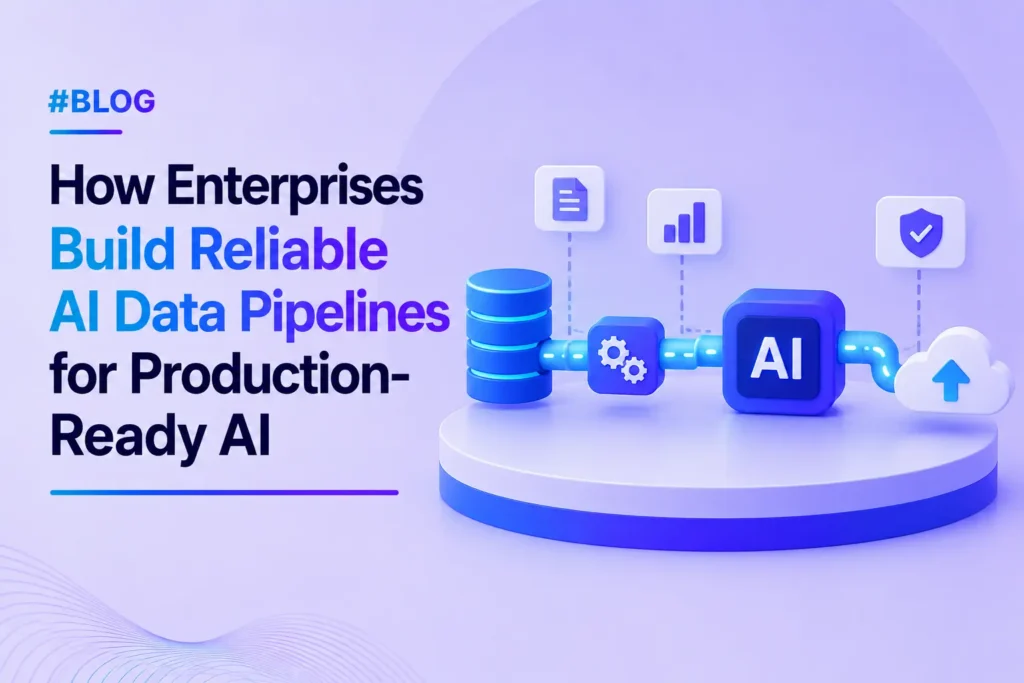
An AI data pipeline is what turns raw, scattered data into clean, reliable fuel for AI. Get it right, and your models are accurate and trusted. Get it wrong, and even the best model produces confident nonsense.
This is a shift in where the hard work of AI actually lives. For years, the race was to get the best model. In 2026, the frontier models are all strong, so the real differentiator has moved to data: whoever feeds their AI the cleanest, freshest, best-governed data wins. That is why data engineering has quietly become one of the most valuable skills in the enterprise, and why the pipeline deserves real investment rather than being treated as background plumbing.
This guide explains how enterprises build reliable AI data pipelines for production-ready AI. We cover what a pipeline is, its architecture, how to build one, best practices, how it supports real applications, and how Wizr AI helps.
Here is why the timing matters. As AI shifts from experiments to systems that run the business, the tolerance for bad data drops to zero. A dashboard with a stale number is an annoyance, but an agent that acts on stale data can trigger a wrong refund, a bad order, or a compliance breach. That change in stakes is exactly why the humble data pipeline has become a board-level concern in 2026. The good news is that the patterns for getting it right are now well understood, and this guide lays them out in plain terms.
What Is an AI Data Pipeline and Why Do Enterprises Need One?
An AI data pipeline is the automated system that collects, cleans, transforms, and delivers data to AI and machine learning models. It moves data from many sources to the place where models can actually use it, reliably and at scale.
The word “automated” is key. A pipeline is not a one-time data migration or a manual export, it is a repeatable, always-on flow that keeps data moving without someone pushing a button each time. That automation is what lets AI stay fed with current data, day and night, across every use case that depends on it.

Think of it like the plumbing behind AI. You do not see it, but nothing works without it. A machine learning AI data pipeline handles everything from raw ingestion to the clean, structured data a model needs to train and run.
If you are searching for a simple enterprise data pipeline AI search definition, here it is: an enterprise data pipeline is the governed, automated flow that moves data from source systems to the analytics and AI that use it, and an AI data pipeline is the version built specifically to feed models and agents. That distinction matters, because AI raises the bar on freshness, quality, and governance.
What makes an AI data pipeline different from a traditional one?
Traditional data pipelines were built for reports and dashboards. An AI data pipeline is different, because AI has tougher demands.
The core reason is that reports tolerate old, tidy data, while AI does not. A dashboard can happily show yesterday’s numbers from a clean table. An AI agent answering a customer or a model scoring a transaction needs current data, and it needs to handle the messy, unstructured content, like emails, contracts, and chat logs, that holds most of an enterprise’s real knowledge. That raises the bar on every stage of the pipeline.
Here is what sets a modern AI data pipeline apart:
- It handles all data types. Structured tables, plus unstructured text, images, and documents. Since most enterprise knowledge lives in unstructured form, a pipeline that ignores it leaves most of the value untapped.
- It supports real time. Many AI use cases need fresh data, not yesterday’s batch. An agent acting on stale data can make a wrong, costly decision in the moment.
- It feeds vectors and features. It prepares data for vector search and feature stores, not just SQL. This AI-ready layer is what lets models and RAG systems find and use the right context.
- It tracks lineage. It records where every piece of data came from, for trust and compliance. When an AI output is questioned, lineage is how you prove what data produced it.
- It never really stops. It monitors quality continuously, since stale or bad data breaks AI fast. Unlike a report you can rerun, a live AI system needs data that stays good around the clock.
Why enterprises need one now
The stakes have never been higher. AI agents and generative AI now make real decisions, so they need current, trustworthy data. A stale or messy pipeline leads straight to hallucinations and wrong answers.
There is also a scale problem. Enterprises are not building one AI use case, they are building dozens, and each one hits the same messy data. Without a shared, reliable pipeline, every new project rebuilds its own brittle data plumbing, which multiplies cost and risk. A solid pipeline turns that chaos into a reusable foundation, so each new AI project starts from clean, governed data instead of from scratch. This is why data leaders increasingly treat the pipeline as shared infrastructure, funded and owned centrally, rather than something each team reinvents.
Poor data quality is consistently named among the top reasons enterprise AI stalls. An MIT report found that around 95% of generative AI pilots deliver no measurable return, and weak data foundations are a recurring cause. Building a reliable AI data pipeline is how you avoid becoming one of those statistics. For a deeper look at why AI initiatives fail, Wizr’s guide on why enterprise AI apps fail and how to fix them is a useful companion.
AI Data Pipeline Architecture & Workflows for Scalable Enterprise AI
So what does a modern AI data pipeline architecture actually look like? At its heart, it is a set of stages that data flows through, from source to AI. Understanding these stages helps you design a pipeline that scales.
Here is a simple AI data pipeline architecture diagram, shown as the stages data moves through. You can read this AI data pipeline architecture diagram top to bottom, since data flows from raw sources down to the AI that consumes it:
| 1. Data Sources: Databases, apps, APIs, files, streams, sensors |
| 2. Ingestion Layer: Batch and real-time collection (ETL / ELT / CDC) |
| 3. Storage Layer: Data lake, warehouse, or lakehouse |
| 4. Processing Layer: Cleaning, transformation, feature engineering |
| 5. AI-Ready Layer: Vector stores, feature stores, RAG indexes |
| 6. Serving Layer: Data delivered to models, agents, and apps |
| 7. Governance & Monitoring: Security, lineage, quality across all stages |
Let me walk through the key layers of this enterprise data pipeline architecture. Real AI data pipeline architecture examples follow this same shape, whether they power a recommendation engine, a fraud detector, or a customer support agent. There is no single best design, so what is the best AI data pipeline architecture for you depends on your use cases, data volumes, and how fresh your data needs to be.
Here is a quick reference table of the layers, what each one does, and the tools you will often see at each stage:
| Layer | What It Does | Common Tools |
|---|---|---|
| Data sources | Where raw data originates | Databases, SaaS apps, APIs, files, IoT streams |
| Ingestion | Collects data in batch or real time | Kafka, CDC tools, Airbyte, Fivetran |
| Storage | Holds structured and unstructured data | Lakehouse, data lake, warehouse |
| Processing | Cleans, transforms, and engineers features | Spark, dbt, feature pipelines |
| AI-ready | Prepares data for models and retrieval | Vector stores, feature stores, RAG indexes |
| Serving | Delivers data to models, agents, and apps | APIs, model endpoints, agent runtimes |
| Governance | Secures and tracks data across all layers | Access controls, lineage, monitoring |
The specific tools matter less than the pattern. Whatever your stack, the same seven jobs have to happen, and a gap in any one of them shows up later as unreliable AI.
Data ingestion
This is where data enters the pipeline. A strong enterprise data ingestion pipeline architecture pulls from many sources: databases, SaaS apps, APIs, files, and event streams. It supports both batch loads and real-time streaming, so fresh data keeps flowing. A well-designed AI data ingestion pipeline architecture also validates and tags data as it arrives, so problems are caught at the door rather than deep in the pipeline.
Modern pipelines increasingly favor real-time ingestion using change data capture and event streaming. This is the backbone of any real-time AI data pipeline architecture. At enterprise volumes, this becomes an enterprise big AI data pipeline architecture problem, where the pipeline must handle huge, fast-moving data without buckling, which is where solid enterprise data engineering pipeline architecture really matters. Change data capture is especially powerful here, since it streams only what changed in a source system rather than reloading everything, which keeps data fresh without overwhelming the pipeline.
Storage
Once collected, data needs a home. Most enterprises now use a lakehouse, which combines the flexibility of a data lake with the structure of a warehouse. Gartner expects more than half of enterprises to run on lakehouse architecture in 2026, up from under 15% in 2022.
This layer stores structured and unstructured data side by side, which is exactly what AI needs. The lakehouse has become the default for AI work because it avoids the old trade-off between the cheap, flexible storage of a lake and the fast, governed queries of a warehouse. For AI, which needs both raw documents and clean tables, that combination is a natural fit.
Processing and transformation
Raw data is messy. This layer cleans it, removes duplicates, fixes errors, and transforms it into a usable shape. It also handles feature engineering, turning raw data into the signals models learn from. This is the core of any AI data engineering pipeline architecture.
Whether you use an AI ETL data pipeline architecture or a modern ELT approach, the goal is the same: clean, consistent, trustworthy data. The trend in 2026 is toward ELT, where raw data lands first and transformation happens in the powerful storage layer, which is more flexible for the many shapes of data that AI needs. Increasingly, AI itself helps here too, auto-detecting anomalies and suggesting transformations, so data engineers spend less time on manual cleanup. For generative AI, this layer also does the important work of chunking and enriching documents, splitting long text into meaningful pieces and adding metadata, so retrieval later returns the right context rather than a random fragment.
The AI-ready layer
This is what makes a pipeline truly AI-native. Here, processed data becomes vector embeddings for search, features for models, and indexes for retrieval-augmented generation. A generative AI data pipeline lives or dies on this layer, since it is what grounds models in real enterprise knowledge. This layer is the main thing that separates an AI data pipeline from a traditional one, and it is where many enterprises discover their existing data plumbing simply was not built for AI. Getting it right means keeping embeddings fresh, features consistent between training and serving, and indexes updated as the underlying data changes.
Serving, governance, and monitoring
Finally, the pipeline delivers data to models, agents, and applications, while governance and monitoring run across every stage. AI-native security data pipeline architectures build in access controls, encryption, and lineage from the start, not as an afterthought. Monitoring is what keeps the whole thing honest, since it watches for data quality drops, pipeline failures, and drift, and alerts you before a problem reaches your models. In a production pipeline, this cross-cutting layer is not optional, because it is the difference between catching a bad data feed in minutes and discovering it weeks later in a customer complaint.
How Enterprises Build Reliable AI Data Pipelines for Production-Ready AI
Knowing the architecture is one thing. Building a reliable pipeline is another. This section is a practical guide on how to build an AI data pipeline that holds up in production, and on how to design an enterprise data pipeline architecture that scales with you. The steps below apply whether you are feeding a single model or a whole AI data pipeline machine learning program across many teams.
A quick principle before the steps: reliability comes from discipline, not from any single tool. The enterprises that build pipelines they can trust treat data engineering as a first-class practice, with clear ownership, testing, and monitoring, the same way they treat application code. The six steps below turn that principle into a repeatable approach you can apply to every new use case.
Step 1: Start with the use case and data sources
Begin with the AI use case, then map the data it needs. Identify every source, its format, and how fresh the data must be. This tells you whether you need batch, real-time, or both, and shapes the whole design. Resist the urge to build a giant, do-everything pipeline up front. Start with the data one high-value use case actually needs, prove it, then extend, since a focused first pipeline is far easier to get right and becomes the template for the next.
Step 2: Choose batch, streaming, or both
Not every use case needs real-time data. Reporting can run in batches, while fraud detection or live agents need streaming. Many enterprises run a hybrid enterprise streaming data pipeline architecture, using each mode where it fits best. The cost difference is real, since streaming infrastructure is more expensive to run, so match the freshness to the actual business need rather than defaulting to real-time everywhere. A simple test helps: ask how stale the data can be before a decision goes wrong. If the answer is minutes, you need streaming; if it is hours or a day, batch is fine and far cheaper.
Step 3: Build in data quality from the start
Bad data is the top killer of AI projects, so quality cannot be an afterthought. Add validation, deduplication, and quality checks early in the pipeline. Catching bad data at ingestion is far cheaper than fixing a broken model later. Set clear quality rules, like accepted ranges, required fields, and freshness limits, and fail loudly when data breaks them. A pipeline that quietly passes bad data through is more dangerous than one that stops and alerts you, because the damage shows up later in a model’s output where it is much harder to trace.
Step 4: Design for AI-ready data
Prepare data specifically for AI, not just analytics. That means building vector stores, feature stores, and RAG indexes, and keeping rich metadata so agents can find and trust the right data. This is the difference between a pipeline that feeds dashboards and one that feeds production AI. Pay special attention to unstructured data here, since documents, emails, and PDFs hold much of an enterprise’s knowledge and are exactly what generative AI needs to reason over. A pipeline that only handles neat tables will leave most of your valuable context on the table. A feature store is worth calling out too, since it keeps the features used to train a model identical to the ones used when it runs, which quietly prevents a whole class of hard-to-debug accuracy problems.
Step 5: Automate and orchestrate
Manual pipelines break at scale. Use orchestration tools to schedule, run, and recover pipeline jobs automatically. AI-driven data pipeline scaling goes further, using AI to auto-tune resources and catch issues before they cause failures. Good orchestration also handles dependencies, so a downstream job only runs once its upstream data is ready and validated. This is what keeps a pipeline reliable when it grows from a handful of jobs to hundreds running around the clock.
Step 6: Bake in governance and security
Security and governance are not a final step, they run through everything. Build in access controls, encryption, lineage, and compliance from day one. Retrofitting governance later is painful and expensive, while building it in from the start makes audits routine and keeps sensitive data protected across every stage. For teams modernizing older systems first, Wizr’s guide on AI legacy application modernization services pairs well with this work.
Put these six steps together and you get a pipeline that is reliable by design, not by luck. The order matters, since each step builds on the last: a clear use case shapes the ingestion choice, quality checks protect everything downstream, AI-ready preparation makes the data usable, orchestration keeps it running, and governance keeps it safe. Skip a step and the weakness surfaces later, usually at the worst possible moment in production.
AI Data Pipeline Best Practices for Reliability, Security, and Scale
Beyond the build steps, a few AI data pipeline architecture best practices separate pipelines that scale from ones that constantly break. These habits keep data reliable, secure, and ready for AI. None of them is exotic, but together they are what separate a pipeline you can trust from one that quietly erodes confidence in your AI.
- Treat data as a product. Give each dataset an owner, quality standards, and documentation, so it is reusable and trusted across teams. This data-as-a-product mindset is what stops the same data being rebuilt badly for every new project.
- Monitor data quality continuously. Watch for drift, missing values, and anomalies in production, and alert before bad data reaches your models. Quality is not a one-time check at launch, since real data changes constantly and quietly.
- Build for observability. Track data lineage end to end, so you can always answer where a piece of data came from and when it changed. When something goes wrong, lineage turns a frantic investigation into a quick trace back to the source.
- Make pipelines idempotent and recoverable. Design jobs that can safely rerun and recover from failure without corrupting data. Failures are inevitable at scale, so a pipeline that recovers cleanly beats one that needs manual repair every time.
- Secure data everywhere. Encrypt data in transit and at rest, enforce least-privilege access, and mask sensitive fields. Security has to travel with the data through every stage, not sit only at the edges.
- Version your data and features. Keep versions of datasets, features, and indexes, so you can reproduce results and roll back safely. Without versioning, you cannot explain why a model behaved differently last week, which matters for both debugging and compliance.
- Design for scale from the start. Use cloud-native, elastic infrastructure so the pipeline grows with data volume without a rebuild. Building for ten times your current volume early is far cheaper than re-architecting under pressure later.
Follow these consistently, and your pipeline becomes an asset rather than a constant source of firefighting. For teams evaluating platforms and tooling, our CIO’s checklist for agentic AI workflow solutions helps you weigh options against enterprise needs.
How AI Data Pipelines Support Production Enterprise AI Applications
All of this matters because pipelines power real applications. A reliable AI data pipeline for machine learning is what turns a promising model into a system the business can trust. The pipeline is invisible to end users, but it is the difference between an AI they rely on and one they quietly stop trusting after a few wrong answers. Here is how pipelines support production enterprise AI. Across all of these use cases, one pattern holds: the pipeline is doing quiet, essential work in the background, and the quality of that work sets the ceiling on how good the AI can be.
They power retrieval-augmented generation
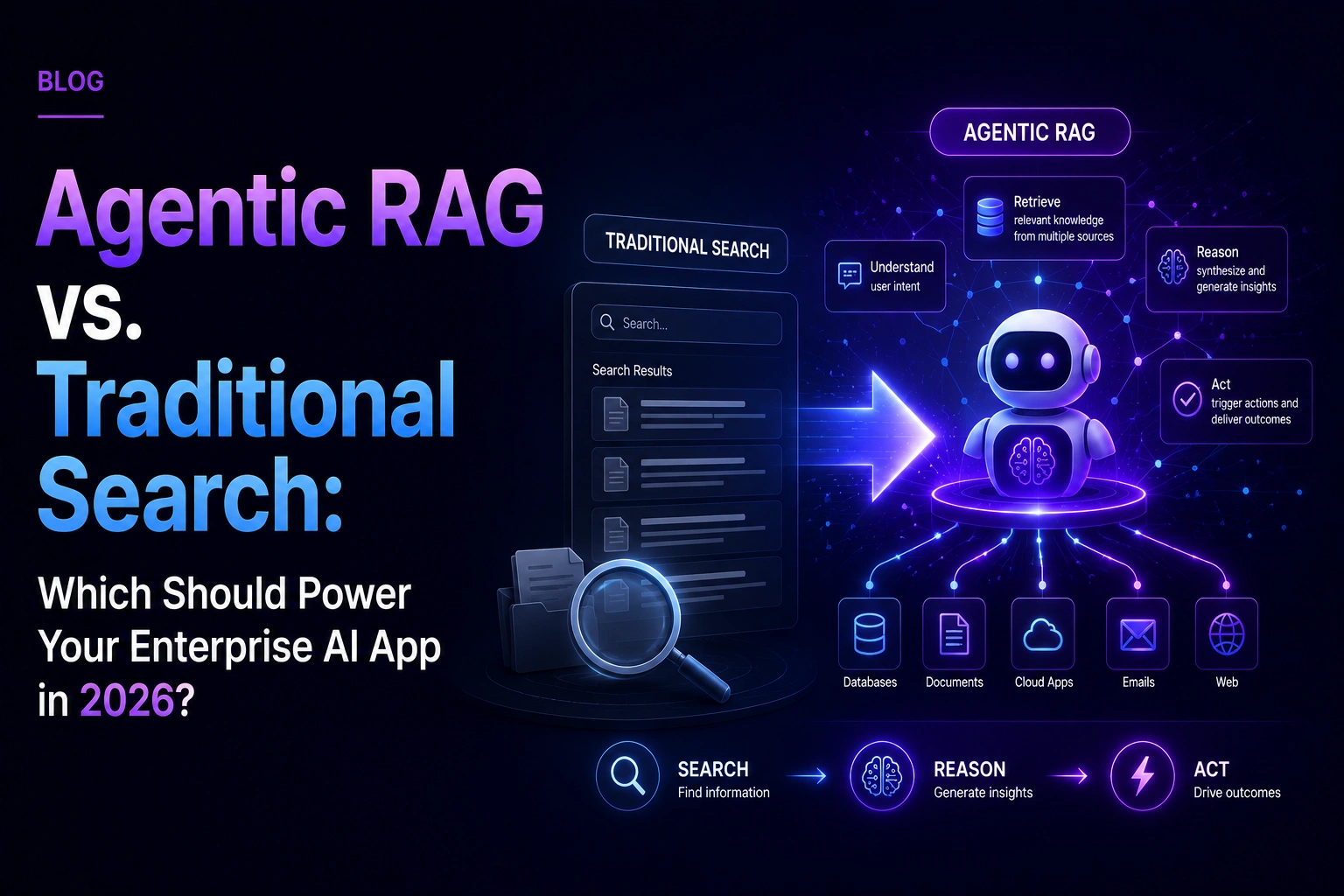
RAG is now table stakes for enterprise generative AI, and it depends entirely on the pipeline. The pipeline keeps the knowledge index fresh, so agents answer from current facts, not stale data. Most RAG failures trace back to retrieving the wrong or outdated context, which is a pipeline problem, not a model problem. This is a crucial insight, since teams often blame the model for hallucinations when the real fix is a better retrieval pipeline. Wizr’s guide on agentic RAG vs traditional search digs into why this grounding matters.
They feed AI agents real-time context
AI agents act on data, so they need current, reliable context. A real-time pipeline ensures an agent sees the latest order status, inventory level, or customer record before it acts. Stale data leads an agent to make confident but wrong decisions. This is why agentic AI raises the bar on pipelines, since an agent that takes action on bad data does real damage, not just a wrong answer on a screen. For a closer look at building these systems, Wizr’s guide on building multi-agent applications shows how data and agents fit together.
They keep models accurate over time
Models drift as the world changes. A good pipeline continuously feeds fresh, quality data for retraining and evaluation, so accuracy holds up. Without it, a model that worked at launch slowly degrades. The pipeline is also what makes retraining practical, since it can automatically gather, label, and prepare new data, turning model maintenance from a painful project into a routine, ongoing process.
They make AI auditable and compliant
For regulated industries, every AI decision must be traceable. The pipeline’s lineage and governance make it possible to show what data an AI used and where it came from. This is essential as rules like the EU AI Act raise the bar on transparency. Without pipeline-level lineage, proving why an AI made a given decision becomes nearly impossible, which is a serious problem when a regulator or a customer asks. A well-governed pipeline turns that from a fire drill into a simple lookup, since every input, version, and transformation is already recorded.
How Wizr AI Helps Enterprises Build Production-Ready AI Data Pipelines
Wizr AI helps enterprises build the data foundation that production AI depends on through Enterprise AI Services, AI-Powered Engineering & Legacy Modernization, and AI Governance. Founded in 2023, Wizr focuses on enterprise AI automation and AI-driven software engineering, which map directly to the pipeline work in this guide. Rather than a generic overview, here is how Wizr helps at each stage of building a reliable AI data pipeline, from ingestion to governed serving.
Data engineering and AI-ready pipelines. Wizr’s Enterprise AI Services and AI-Powered Engineering capabilities help build the ingestion, processing, and AI-ready layers that production AI needs. This includes vector stores, feature stores, and RAG indexes that ground agents in real enterprise data, which is the layer that most often separates a demo from a production system.
Integration and modernization. A lot of pipeline friction comes from scattered, legacy data sources. Wizr connects AI solutions to CRM, ERP, and ITSM systems through clean integrations and modernizes older systems so data flows cleanly instead of becoming a bottleneck. This directly tackles the ingestion and legacy-source challenges that stall so many pipelines.
Custom pipelines for complex data. When your data or use case needs something beyond standard tooling, Wizr’s custom AI application development services and its generative AI software development company services build the exact ingestion, processing, and retrieval components your stack requires, with quality and governance built in.
Agents grounded in trusted data. Wizr helps enterprises build AI Agents and intelligent workflows that operate on reliable, governed data. By connecting AI agents to well-structured enterprise data pipelines, the information they rely on can remain fresh and traceable, helping keep agentic AI accurate and reliable.
Governance and security built in. Wizr supports secure and governed AI implementation with SOC 2 Type II and ISO 27001 compliance, along with access controls, encryption, lineage, and human oversight. These capabilities make AI-native data pipeline architectures more practical in regulated environments, where every data flow needs to be secured and auditable.
The results speak for themselves. For a leading logistics SaaS firm, Wizr drove up to 50% faster response times and deflected around 43% of support tickets, and across customers 90% of pilots reached production. That production rate is the real test of a data foundation, since a pipeline only matters if the AI it feeds reaches users and stays reliable. Enterprises like Chrysler, Project44, and Fragomen build with Wizr. You can talk to the Wizr team to see how this fits your data stack.
Conclusion
The model gets the glory, but the pipeline does the work. In 2026, the enterprises winning with AI are the ones that treat their AI data pipeline as a first-class priority, not an afterthought.
The path is clear. Build a layered architecture, ingest from every source, clean and prepare AI-ready data, automate and orchestrate, and bake in governance and security from day one. Do this, and your AI runs on a foundation it can trust.
It also helps to reframe how you think about the work. A data pipeline is not a one-off project you finish and forget, it is living infrastructure that needs ownership, monitoring, and steady improvement, just like the applications it feeds. The enterprises that treat it that way are the ones whose AI keeps getting better instead of slowly drifting out of trust.
When you are ready to build reliable, production-ready AI data pipelines, Wizr AI can help with the right mix of data engineering, AI-powered engineering, modernization, and AI governance services.
FAQs
1. What is an AI data pipeline?
An AI data pipeline is the automated system that collects, cleans, transforms, and delivers data to AI and machine learning models. It moves data from many sources, like databases, apps, and streams, through processing and into an AI-ready form such as vectors, features, and RAG indexes. In short, it is the foundation that turns raw enterprise data into reliable fuel for AI.
Unlike a traditional pipeline built for reports, an AI data pipeline handles all data types, supports real time, and tracks lineage for trust and compliance. That is what makes it production-ready. It also feeds an AI-ready layer of vectors, features, and indexes that a reporting pipeline simply does not have.
Wizr AI helps enterprises build these pipelines through data engineering, AI-powered engineering, and governance services for production AI.
2. What is an AI data pipeline architecture?
An AI data pipeline architecture is the layered design that moves data from source to AI. It typically includes data sources, an ingestion layer, a storage layer like a lakehouse, a processing layer for cleaning and feature engineering, an AI-ready layer for vectors and features, and a serving layer, with governance and monitoring across all of them. Each layer has a clear job, so the pipeline stays reliable as it scales.
The best AI data pipeline architecture is the one that fits your use cases, whether that is batch, real-time streaming, or a hybrid of both.
Wizr AI helps enterprises design and implement these layered architectures through Enterprise AI Services and AI-Powered Engineering, so data reaches AI clean, fresh, and governed.
3. How do you build an AI data pipeline?
To build an AI data pipeline, start with the AI use case and map the data it needs. Then choose batch or streaming ingestion, build in data quality checks early, prepare AI-ready data with vectors and features, automate orchestration, and bake in governance and security from day one. The goal is a pipeline that delivers clean, current, trustworthy data to your models and agents.
The most common mistake is treating data quality as an afterthought, which is why so many AI projects fail. Building quality and governance in from the start saves painful rework later.
Wizr AI helps enterprises design and build these pipelines end to end, with engineering and AI governance support.
4. Why do enterprises need AI data pipelines?
Enterprises need AI data pipelines because AI is only as good as the data feeding it. Agents and generative AI make real decisions, so they need current, clean, trustworthy data, or they produce confident but wrong answers. A reliable pipeline is what turns scattered, messy enterprise data into a dependable foundation for production AI.
Without one, AI projects stall on poor data quality, which Gartner names as a leading cause of AI failure. The pipeline is the difference between a demo and a system the business can trust.
Wizr AI focuses on this foundation, helping enterprises build reliable data pipelines that support production AI and AI agents.
5. What is the difference between a data pipeline and an AI data pipeline?
A traditional data pipeline moves data mainly for reports, dashboards, and analytics. An AI data pipeline goes further, preparing data specifically for AI and machine learning, including unstructured data, vector embeddings, feature stores, and RAG indexes. It also demands fresher data, stronger lineage, and continuous quality monitoring, since AI breaks fast on stale or bad data.
In short, every AI data pipeline is a data pipeline, but not every data pipeline is ready for AI. The AI-ready layer is the key difference.
Wizr AI builds AI-ready data pipelines through data engineering and AI-powered engineering services, helping prepare enterprise data for real production AI, not just analytics.
6. How do AI data pipelines support RAG and AI agents?
AI data pipelines support RAG and AI agents by keeping the data they rely on fresh, clean, and governed. For RAG, the pipeline maintains the knowledge index so agents retrieve current, accurate context instead of stale data. For agents, it delivers real-time information, like order status or inventory, so they act on reality rather than an outdated snapshot.
Most RAG and agent failures come from bad retrieval or stale context, which is a pipeline issue, not a model one. That is why the pipeline deserves as much attention as the model.
Wizr AI helps build pipelines that ground AI agents in trusted enterprise data, supporting accurate and reliable AI solutions.
7. What is the best AI data pipeline architecture for enterprises?
There is no single best AI data pipeline architecture, since the right design depends on your use cases, data volumes, and freshness needs. That said, most modern enterprise pipelines share the same shape: multi-source ingestion with both batch and streaming, a lakehouse for storage, a processing layer for cleaning and features, an AI-ready layer for vectors and RAG indexes, and governance running across everything. The best architecture for you is the one that matches this pattern to your specific workloads.
For real-time use cases like fraud detection or live agents, lean toward streaming. For analytics-heavy workloads, a batch may be enough. Most enterprises end up with a hybrid.
Wizr AI helps enterprises design and implement the right architecture for their use cases, with governance incorporated throughout the engineering process.
8. How does AI-driven data pipeline scaling work?
AI-driven data pipeline scaling uses AI to manage the pipeline itself, not just the data flowing through it. This includes auto-tuning compute resources to match demand, detecting anomalies and quality issues automatically, and predicting failures before they happen. The result is a pipeline that scales up and down efficiently and needs far less manual firefighting.
As data volumes grow into enterprise big AI data pipeline architecture territory, this automation becomes essential, since no team can manually tune hundreds of jobs running around the clock.
Wizr AI builds intelligent automation into its AI-powered engineering services, helping pipelines scale reliably without constant manual effort.
About Wizr AI
Wizr AI helps enterprises build autonomous enterprises and accelerate product and software engineering with practical, production-ready AI. We help organizations automate business workflows, modernize legacy applications and digital platforms, and build intelligent AI solutions.
Our core services include Enterprise AI Services, AI-Powered Engineering & Legacy Modernization, AI Product Engineering, and AI Governance. We also leverage AI Assembly capabilities, including the Agentic AI Framework, Agentic Workflows, Security, and Integrations.
Through our AI solutions, including AI Agents, Pharma & Life Sciences AI, Oracle AI, and Salesforce AI, we help enterprises apply AI across business and technology needs.
See how we can help your enterprise move faster with AI. 👉 Talk to an AI Expert.


![Agentic AI vs AI Agents: Key Differences Every CIO Must Know [2025 Guide]](https://wizr.ai/wp-content/uploads/2025/07/Agentic-AI-vs-AI-Agents.webp)
![Agentic AI vs Traditional Automation: Why Enterprises Shift for Better CX [2025]](https://wizr.ai/wp-content/uploads/2025/06/Agentic-AI-vs-Traditional-Automation.webp)


![11 Real-World AI Agents Examples + Use Cases for Enterprises [2025]](https://wizr.ai/wp-content/uploads/2025/05/AI-Agents-Examples-Use-Cases.webp)