AI can write code fast. That part is settled. The harder question for an enterprise is whether all that fast code actually ships as reliable software, or just creates a bigger pile of things to review, test, and fix later.
This is the gap Dual Loop Engineering is built to close. Instead of treating AI as a faster typist, it organizes AI-driven development into two connected loops, one that plans the work and one that builds and checks it, so speed and quality move together rather than against each other.
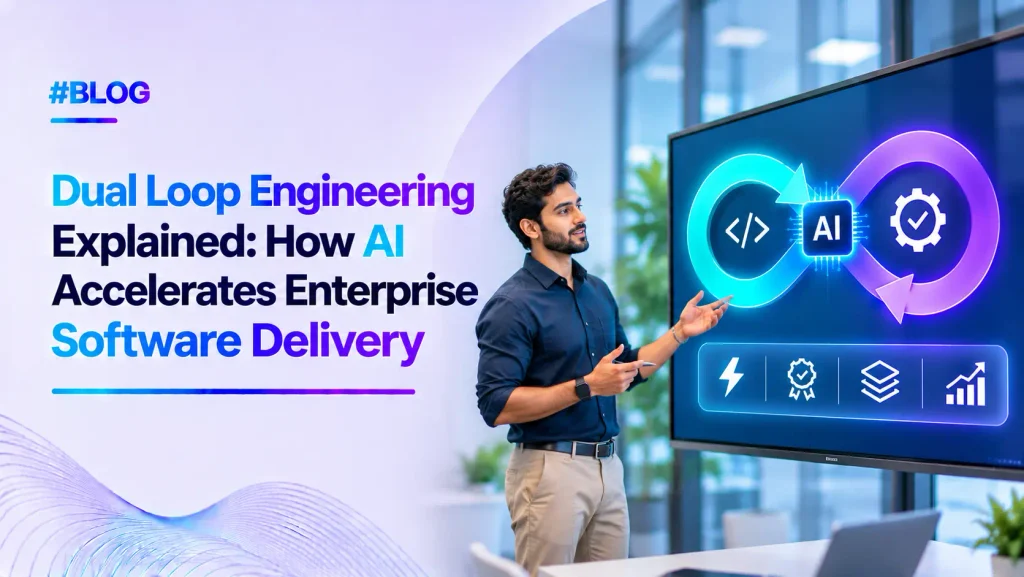
This is a practical guide for CTOs, VPs of Engineering, and software delivery leaders. We will explain what Dual Loop Engineering is, why it matters now, how the two loops actually work, the role of AI agents and human engineers, how it compares to prompt, harness, and graph engineering, and where it delivers real value in enterprise software delivery.
The goal here is understanding, not a sales pitch. By the end, you should be able to picture how this methodology fits your own teams and why the second loop, the one most AI coding setups skip, is the part that makes the difference.
What Is Dual Loop Engineering?
Dual Loop Engineering is an AI-driven software development methodology that splits work into two coordinated loops: a Define and Plan loop that turns requirements into clear goals, and a Build and Review loop that writes, verifies, and repairs the code. The two run together and feed each other, which is where the name comes from.
The simplest way to picture it is a maker and a checker. One side builds, using AI to write code quickly. The other side verifies that work independently, catching issues and sending them back for repair before anything moves forward. Neither loop is trusted to grade its own homework.

This maps onto an idea engineering teams already know: the inner loop and the outer loop. The Build and Review loop is the fast AI inner loop software development cycle, where code gets written, tested, and fixed in tight iterations. The Define and Plan loop is the AI outer loop software development cycle, where goals, scope, and acceptance criteria are set and checked. Together they form an AI closed loop software development process, where every output is measured against a clear intent.
As a concept, Dual Loop Engineering borrows from control theory, where a system stays stable by constantly comparing its output against a target and correcting the difference. Applied to software, that makes the Dual loop engineering concept less about any single tool and more about a software development methodology: a repeatable way to structure how AI and engineers plan, build, and verify work together. So what is Dual loop engineering in AI, specifically? It is that control-loop discipline applied to AI coding agents, so their speed is always checked against a clear, testable goal rather than trusted blindly. That makes the Dual Loop engineering software development methodology a matter of process first and tooling second, which is why it transfers across languages, stacks, and teams rather than locking you into one vendor’s product.
So what is Dual Loop Engineering in one line? It is a way to run AI coding as a disciplined, self-correcting process instead of a one-shot gamble. That distinction is the whole point, and the rest of this guide unpacks why it matters.
Why Dual Loop Engineering Matters in AI-Driven Software Development
Here is the uncomfortable truth behind the AI coding boom: writing code faster does not automatically ship software faster or better. In fact, without the right process, it can make delivery worse.
The data backs this up. Google’s 2024 DORA research found that as AI adoption rose, it was accompanied by an estimated 1.5% drop in delivery throughput and a 7.2% drop in delivery stability, even as more than a third of developers reported real productivity gains. The report’s own conclusion is blunt: improving the development process does not improve delivery on its own, not without the basics like small batches and robust testing.
That is exactly the problem Dual Loop Engineering addresses. AI makes the build step faster, but faster building without stronger verification just moves the bottleneck downstream, to code review, QA, and production incidents. The second loop is what keeps the speed from turning into instability.
This is why Dual Loop engineering AI 2026 has become a live conversation in engineering leadership. As AI coding agents move from experiment to everyday tool in 2026, the teams getting real value are the ones adding structure around them, not just writing more prompts. Dual loop engineering 2026, in that sense, is less a new technology than a maturing of how enterprises run AI development, with verification and cost control, including a realistic view of what AI agents cost to build and run, treated as first-class concerns rather than afterthoughts.
For an enterprise, the stakes are concrete. Unreviewed AI code can introduce subtle bugs, security gaps, and maintainability problems that surface weeks later as expensive rework. Enterprise Dual Loop engineering matters because it builds verification into the process rather than bolting it on at the end.
The payoff connects directly to the priorities engineering leaders care about.
- Software quality: independent verification catches issues before they ship.
- Development speed: AI accelerates building while the review loop keeps rework low.
- Cost efficiency: less rework and fewer production incidents mean lower total cost, a point worth weighing alongside the broader ROI of AI-powered engineering.
- Maintainability: code that is checked against clear goals stays cleaner over time.
- Predictable delivery: a disciplined loop produces steadier, more reliable releases.
These are not separate wins; they reinforce each other. Lower rework protects both speed and cost. Independent verification protects quality and maintainability. Predictable delivery is what lets product and business teams plan with confidence, and steadier releases mean fewer late nights spent firefighting avoidable incidents. For an engineering leader trying to adopt AI responsibly, that combination is the real argument: Dual Loop Engineering does not ask you to choose between moving fast and shipping safely. It is a structured way to do both at once, which is why so many teams are formalizing it in 2026 rather than leaving AI coding to run unchecked. The method, not the model, is what turns a promising pilot into dependable everyday practice.
In short, Dual Loop engineering AI is not about writing more code. It is about turning AI speed into dependable delivery, which is the difference enterprises actually need.
How Dual Loop Engineering Works in Enterprise Software Development
So how does the methodology actually run day to day? It helps to walk through each loop, then see how they connect. The flow is deliberately simple, because the discipline, not the complexity, is what makes it work. The same shape holds whether a single engineer is fixing one bug or a platform team is shipping a major release, which is part of why the approach scales so cleanly across an enterprise.
Think of it as intent, execution, and feedback, repeated until the work meets the goal. Here is how enterprise Dual Loop engineering software development plays out in practice.
Define & Plan Loop: Turning Requirements into Clear Development Goals
Everything starts with intent. The Define and Plan loop takes a request, a feature, a bug, a modernization task, and turns it into a clear, testable goal before any code is written.
In practice, this means analyzing requirements, writing user stories, sketching the architecture, and defining what done actually looks like. AI helps here too, drafting specifications and acceptance criteria from a plain-language request, which a human engineer then reviews and sharpens.
The output of this loop is a precise development goal: not just build a login feature, but build a login feature that supports these flows, meets these security rules, and passes these specific checks. That clarity is what the second loop measures against. Vague intent produces vague results, so this planning step is where quality really begins.
Picture a team asked to add multi-factor authentication. A weak brief just says add MFA. The Define and Plan loop instead produces user stories for each sign-in path, the security standards to meet, the edge cases to handle, and a set of acceptance tests that define success. Only with that in hand does building start. The extra ten minutes of planning saves hours of rework, because the build loop now has an unambiguous target to hit and to verify against.
Build & Review Loop: AI-Powered Development, Verification and Repair
With a clear goal set, the Build and Review loop does the hands-on work. An AI coding agent writes the code, and then the crucial step: an independent check verifies that code against the goal, finds issues, and sends them back for repair.
This build, verify, repair, review cycle runs iteratively. AI-assisted coding is fast here, and McKinsey has found generative AI can help developers complete many tasks up to twice as fast, but speed is only half of it. The verification step is what separates this from ordinary AI coding, because the checker is independent of the maker and does not simply trust the output.
When the check finds a problem, a failing test, a security issue, a deviation from the spec, the work goes back for repair and is checked again. Only code that passes moves on. This is the inner loop doing its job: catching problems in seconds, not in a production incident.
What makes this trustworthy is that the verification is more than a second opinion from the same model. It runs real checks: executing the test suite, scanning for security issues, confirming the code matches the agreed spec, and flagging anything that drifts. Each failed check is specific and actionable, so the repair step is targeted rather than a vague try again. Over several quick iterations, the code converges on something that genuinely meets the goal, which is what keeps AI speed from becoming AI debt.
Continuous Feedback: Connecting Both Loops for Better Results
The real power shows up when the two loops talk to each other. The Build and Review loop feeds results back to the Define and Plan loop, and the plan adjusts as reality comes in.
Say the build loop discovers that a requirement was ambiguous or technically unworkable. That signal flows back to the planning loop, the goal gets refined, and the build loop tries again against the clearer target. This continuous feedback is what makes the system self-correcting rather than just fast.
For an enterprise, this closed feedback cycle is what delivers steady improvement. Each iteration sharpens both the plan and the product, which is how Dual Loop engineering turns a messy, unpredictable AI coding process into something measurable and reliable.
It also produces a useful byproduct: a record of intent and verification for every change. Because each piece of work traces back to a defined goal and the checks it passed, teams get cleaner documentation, easier audits, and faster onboarding almost for free. In a large enterprise, that traceability is often as valuable as the speed itself, since it is what lets leaders trust AI-generated code at scale.
The Role of AI Agents in Enterprise Dual Loop Engineering
AI agents are the engine inside both loops, but they are not the whole story. Understanding how agents and humans share the work is key to using this methodology well.
An AI agent is software that can take a goal, make decisions, use tools, and complete multi-step tasks with limited human help. In enterprise Dual Loop engineering AI agents do the heavy lifting: drafting plans, writing code, running tests, and proposing repairs, often orchestrated as agentic workflows that coordinate those steps with checkpoints along the way.
Those agents rarely work alone. They call tools, read from repositories, run tests, and connect to enterprise systems, which is where decisions like when to connect through MCP or standard APIs shape how reliably they operate. In practice, Dual loop engineering AI agents 2026 setups put most of this activity inside the fast enterprise inner loop engineering cycle, where an agent builds and the system verifies in tight iterations before anything reaches a human reviewer.
The critical design choice is independence. In agentic Dual Loop engineering, the agent that builds and the agent or process that verifies are kept separate, so the check is genuinely independent. An agent grading its own work tends to miss the same things twice, which is exactly the failure mode the second loop is meant to prevent.
Humans stay firmly in the loop, and that is by design. Engineers set the goals, make the architectural calls, review what the agents produce at key points, and own the final decisions. The pattern is AI for speed and scale, humans for judgment and accountability, which is what keeps quality and reliability high. Enterprise agent Dual Loop engineering works precisely because it pairs autonomous execution with human oversight rather than replacing one with the other.
Dual Loop Engineering vs. Prompt Engineering, Harness Engineering and Graph Engineering
These terms get mixed up a lot, so it helps to place them side by side. They are not really competitors. They operate at different levels of the stack, and Dual Loop engineering often uses the others underneath it. Knowing which is which also helps leaders cut through vendor noise, since many AI coding tools market a single layer as if it were the whole answer to reliable software delivery.
Here is a simple way to see the differences.
| Approach | What it focuses on | Where it operates |
| Prompt engineering | Crafting the instruction given to the model | A single model request |
| Harness engineering | The runtime scaffolding around the model: the loop, tools, memory, guardrails | How an agent runs |
| Graph engineering | Modeling the workflow as explicit nodes and edges | How steps are orchestrated |
| Dual Loop engineering | The overall development process and feedback structure | How work is planned, built, and verified |
None of these approaches is a silver bullet, and treating them as rivals misses the point. A mature AI development setup usually blends several: thoughtful prompts, a solid harness to run agents, sometimes a graph to orchestrate complex flows, all organized by a Dual Loop methodology that decides what to plan, build, and verify. The value of naming Dual Loop engineering separately is that it keeps attention on the part teams most often neglect, the independent verification loop, rather than on the mechanics of any single layer.
A few plain-language distinctions help here. Dual Loop engineering vs prompt engineering is the biggest contrast: prompt engineering shapes one instruction to a model, while Dual Loop engineering governs the whole plan, build, and verify process around many such calls. A great prompt with no verification loop is still a one-shot gamble.
Dual Loop engineering vs harness engineering is more a matter of layer than rivalry. Harness engineering builds the machinery that runs an agent in a loop; Dual Loop engineering decides what those loops should be and how planning and verification connect. One is the engine, the other is the methodology driving it.
Dual Loop engineering vs graph engineering is similar. Graph engineering gives you precise, auditable control over how steps flow, often as a state machine, and a Dual Loop system can absolutely run on a graph underneath. The distinction is that graph engineering describes the orchestration, while Dual Loop describes the intent behind it: separate the making from the checking. Used well, these approaches complement each other rather than compete.
Enterprise Dual Loop Engineering: Practical Software Development Examples
Theory is useful, but leaders want to know where this pays off. Here are concrete Dual Loop engineering examples across common enterprise software work, showing how the two loops change the outcome.
Each example follows the same shape: a clear goal from the first loop, fast AI building and independent checking in the second, and feedback that keeps quality high. Notice how, in every case, the verification is not an optional extra bolted on at the end but a built-in part of each iteration, which is exactly what keeps AI-generated work honest under real enterprise pressure.
- Feature development. The plan loop turns a product request into a precise spec with acceptance tests. The build loop writes the feature, verifies it against those tests, and repairs failures before the code reaches human review, so engineers review working, checked code rather than a rough first draft.
- Legacy application modernization. For an aging system, the plan loop defines the target architecture and behavior to preserve. The build loop refactors or migrates code and continuously verifies that behavior has not changed, which is exactly the kind of risk control that makes AI-driven engineering and modernization safe to do at pace.
- Bug fixing. The plan loop captures the defect and the expected correct behavior as a test. The build loop generates a fix, confirms the test now passes and nothing else broke, and only then advances the change.
- Testing. Verification is native here. The build loop generates and runs tests as part of every iteration, so coverage grows alongside the code instead of lagging behind it.
- Complex, multi-step changes. For a large change spanning services, the plan loop breaks it into verifiable steps. The build loop executes and checks each one, and feedback keeps the overall plan honest as the work reveals new constraints.
Across all of these, the pattern of enterprise Dual Loop engineering AI coding is the same. AI supplies speed, independent verification supplies trust, and the feedback between loops keeps the whole effort aimed at the real goal. That is how to do Dual Loop engineering in a way that holds up under enterprise conditions, not just in a demo.
Scale changes the picture only in degree, not in kind. Across many teams and projects, the same two loops run in parallel, and the discipline of separating making from checking is what keeps quality consistent even as the number of AI-generated changes grows. That consistency is exactly what large engineering organizations struggle to maintain when AI coding spreads without a shared method behind it, which is why leaders increasingly treat the methodology, not the model, as the thing worth standardizing.
How Wizr AI Helps Enterprises Accelerate Software Delivery with Dual Loop Engineering
Understanding the methodology is one thing. Running it across real teams, projects, and legacy systems is where most enterprises need a partner, and that is where Wizr AI fits.
Wizr AI is a services-led AI-powered engineering partner. Rather than handing you a tool, Wizr’s engineers help enterprises adopt Dual Loop Engineering as a working practice, bringing the AI agents, the independent verification, and the human oversight together inside your existing delivery process. The focus is on outcomes: faster delivery, cleaner code, and fewer surprises in production.
In practice, that support shows up across the software lifecycle. Through AI product engineering, Wizr helps teams build and ship features faster with verification built in, and it extends the same disciplined approach to modernization, testing, and complex changes. The aim is to help your engineers do more, with more confidence, not to take them out of the loop.
Think of an engagement less as a product install and more as a hands-on Dual Loop engineering tutorial for your teams, where Wizr’s engineers embed the two loops into how you already work and then hand the practice back to your people. The methodology sticks because your engineers learn to run it, not because they depend on an outside tool.
For an engineering leader, the value is practical and measurable. Dual Loop Engineering helps turn AI speed into predictable delivery, and a partner like Wizr helps you apply it across larger teams and multiple projects without disrupting the work already in flight. It scales the same way a good process always does, one proven team and project at a time, extended with the right prioritization of where AI will create the most value.
Conclusion
AI has made writing code easy. Making that code ship as reliable, maintainable enterprise software is the real challenge, and it is the one Dual Loop Engineering is designed to solve.
The core idea is simple and powerful. Split the work into a loop that defines clear goals and a loop that builds and independently verifies against them, then let the two feed each other. That separation of making from checking is what turns raw AI speed into dependable delivery, and it is the step most AI coding setups skip.
For CTOs and engineering leaders, the takeaway is practical. The research is clear that AI speed alone can hurt delivery stability, so the organizations that win will be the ones that pair AI building with strong, independent verification. Dual Loop Engineering is a clear, repeatable way to do exactly that, connecting software quality, speed, cost efficiency, and predictable delivery in one process. It is less a tool to buy than a habit to build, and the enterprises that build it now will spend the next few years shipping AI-assisted software their customers can actually depend on.
If you want to put this methodology to work in your own engineering organization, Wizr AI can help you adopt it without disrupting ongoing delivery. You can talk to the Wizr team to explore how Dual Loop Engineering fits your software delivery.
FAQs
1. What Is Dual Loop Engineering in Simple Terms?
Dual Loop Engineering is an AI-driven software development methodology that organizes work into two connected loops: a Define and Plan loop that turns requirements into clear, testable goals, and a Build and Review loop that writes code, verifies it independently, and repairs issues before they move forward. The two loops feed each other in a continuous feedback cycle.
The simplest way to think about it is a maker and a checker that are kept separate, so AI speed never bypasses verification. Wizr AI helps enterprises put this methodology into practice as an AI-powered engineering partner, bringing the loops, agents, and human oversight together inside existing delivery workflows.
2. Why Does Dual Loop Engineering Matter for Enterprise Software Delivery?
It matters because faster AI coding does not automatically mean faster or better delivery. Research has shown that rising AI adoption can actually reduce delivery stability when verification and testing do not keep pace, which is where unreviewed AI code creates expensive rework and production risk.
Dual Loop Engineering addresses this by building independent verification into the process, so speed and quality move together. Wizr AI helps enterprises capture that benefit, turning AI acceleration into predictable, reliable delivery across their engineering teams.
3. How Is Dual Loop Engineering Different From Prompt Engineering?
Prompt engineering focuses on crafting a single instruction to get a good response from an AI model. Dual Loop Engineering operates at a higher level, governing the entire process of planning, building, and verifying software across many model calls, with independent checking built in.
In other words, a strong prompt still produces a one-shot result with no guarantee of correctness, while Dual Loop Engineering adds the verification and feedback that enterprise software needs. Wizr AI helps teams apply this process-level discipline rather than relying on prompts alone.
4. What Role Do AI Agents Play in Dual Loop Engineering?
AI agents do the multi-step work inside both loops: drafting plans, writing code, running tests, and proposing repairs. The key design choice is keeping the building agent and the verifying step independent, so the check is genuine rather than an agent grading its own work.
Human engineers stay in control, setting goals, making architectural decisions, and owning final approval. Wizr AI helps enterprises combine autonomous agents with this human oversight, so Dual Loop Engineering delivers both speed and accountability.
5. Where Does Dual Loop Engineering Deliver the Most Value?
It delivers the most value wherever quality and reliability matter as much as speed: feature development, legacy application modernization, bug fixing, testing, and complex multi-step changes. In each case, independent verification catches issues early and feedback keeps the work aligned to clear goals.
For large engineering organizations running many projects, that discipline compounds into steadier, more predictable delivery. Wizr AI helps enterprises apply Dual Loop Engineering across teams and projects, scaling the approach without disrupting delivery already underway.
About Wizr AI
Wizr AI helps enterprises build autonomous enterprises and accelerate product and software engineering with practical, production-ready AI. We help organizations automate business workflows, modernize legacy applications and digital platforms, and build intelligent AI solutions.
Our core services include Enterprise AI Services, AI-Powered Engineering & Legacy Modernization, AI Product Engineering, and AI Governance. We also leverage AI Assembly capabilities, including the Agentic AI Framework, Agentic Workflows, Security, and Integrations.
Through our AI solutions, including AI Agents, Pharma & Life Sciences AI, Oracle AI, and Salesforce AI, we help enterprises apply AI across business and technology needs.
See how we can help your enterprise move faster with AI. 👉 Talk to an AI Expert.