Every enterprise has a long list of AI ideas. Every department wants its own agent, its own automation, its own model. The hard part is not finding AI use cases. It is choosing the right ones.
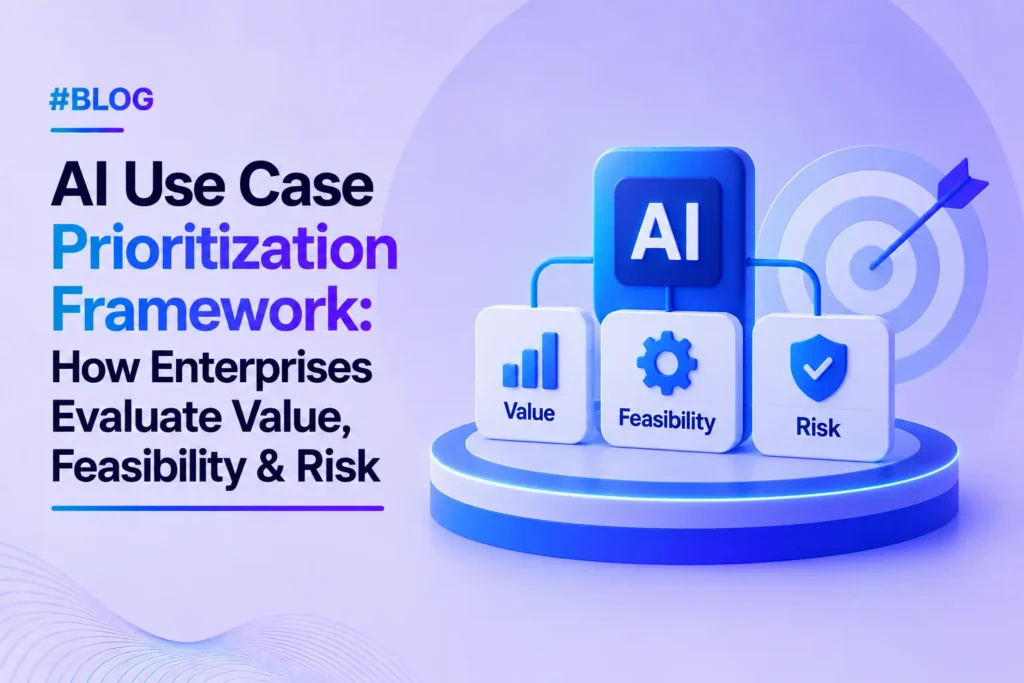
That is where AI use case prioritization comes in. Instead of chasing whatever has the loudest executive sponsor, you score each opportunity on value, feasibility, and risk, then fund the ones that will actually pay off.
The stakes are high. Deloitte’s State of AI research found that enterprises seeing strong AI returns focus on far fewer use cases, prioritizing around 3.5 on average, compared with 6.1 for companies not seeing returns. Focus wins.
The cost of getting this wrong is just as real. Gartner predicts that over 40% of agentic AI projects will be canceled by the end of 2027, often not because the ideas were bad, but because they were launched in the wrong order, before the organization had the data or capability to support them. A prioritization framework is how you avoid that trap.
This guide walks through a complete AI use case prioritization framework: what it is, why you need one, the criteria to evaluate, a scoring matrix, a step-by-step methodology, a ready-to-use template, and how Wizr AI helps you put it into practice. By the end, you will have a repeatable way to turn a long wish list into a short, fundable roadmap.
This is written for CIOs, CTOs, and the teams who advise them. If you are the person who has to defend an AI budget to the board, or the one deciding which of twenty proposals gets built next quarter, this framework is your tool. It replaces gut feel and internal politics with a clear, evidence-based way to choose, which is exactly what makes the decision easier to defend and faster to reach.
What Is AI Use Case Prioritization?
AI use case prioritization is the process of scoring and ranking potential AI projects so you invest in the ones with the best mix of value, feasibility, and manageable risk. It turns a messy wish list into a clear, funded roadmap.
Think of it like triage. You have limited money, talent, and attention, so you rank each opportunity by what it delivers and what it costs to build. The goal is to say a confident yes to a few things and a clear no to many others. The “no” list is just as important as the “yes” list, since every project you decline frees up people and budget for the ones that will actually move the business.

The “definition to application” path is short here. The definition is scoring use cases on value, feasibility, and risk. The application is a ranked, sequenced portfolio your leadership team can actually fund. In between sits the discipline of comparing ideas on the same criteria, so a loud sponsor’s pet project and a quiet team’s high-value idea get judged by the same yardstick. That single change, from opinion to evidence, is what makes the whole exercise worth the effort, because it turns a political fight into a shared, fact-based decision.
A quick real-world picture helps. Say a bank has forty AI ideas floating around, from a fraud-detection model to an HR chatbot to a document-summary tool. Without prioritization, the ones with the most senior champions get funded, whether or not they are the best bets. With prioritization, all forty get scored the same way, and the three or four that combine high value, real feasibility, and manageable risk rise to the top. That is the whole job: turning a crowded, political wish list into a short, defensible plan.
Why “prioritization” beats “more pilots”
Most enterprises do not fail because they lack ideas. They fail because they spread themselves too thin across dozens of half-funded experiments. An AI use case prioritization framework forces a disciplined choice, so scarce resources go where they matter most. The math is simple: ten projects at ten percent effort each rarely produce a single winner, while two projects at full effort often do.
The alternative is prioritizing by proxy: whoever shouts loudest, whatever a competitor announced, or the vendor who presented last. Each of those holds a little truth, but none gives you the structured comparison a real portfolio decision needs. For a deeper look at why disciplined execution matters, Wizr’s guide on why enterprise AI apps fail and how to fix them is a useful companion.
There is also a compounding effect worth understanding. Each well-chosen use case does more than deliver its own value. It teaches your team how to work with AI, surfaces data quality issues you can fix before the next project, and builds the business case for further investment. Start with the wrong use case, and you get the opposite: a stalled project that drains confidence and makes the next approval harder. Sequencing, not just selection, is what turns a series of projects into a compounding program.
This is why so many enterprises identify hundreds of AI ideas but deploy only a handful. The gap is rarely a shortage of ideas or even technology. It is the missing discipline to compare, choose, and sequence. A prioritization framework closes that gap, which is the whole reason it belongs at the front of your AI program rather than as an afterthought once budgets are already committed.
Why Enterprises Need an AI Use Case Prioritization Framework
Without a framework, AI investment gets decided by politics and hype. With one, it gets decided by evidence. That difference shows up directly in results.
It is worth naming what happens without one. Ideas get funded because a senior leader is passionate, or because a competitor made an announcement, or because a vendor gave a compelling demo last week. None of those is a bad signal on its own, but none is a substitute for a structured comparison. The result is a portfolio that looks busy but delivers little, with a budget spread so thin that nothing reaches the scale where it pays off.
Here is why a formal AI use case prioritization framework matters so much in 2026:
- Too many ideas, not enough focus. Large enterprises track dozens of AI initiatives at once, and only a small fraction reach production at scale. A framework cuts the list to what you can actually deliver, so effort concentrates instead of scattering.
- Wasted spend on the wrong bets. Gartner predicts that over 40% of agentic AI projects will be canceled by the end of 2027, often due to unclear value or weak risk controls. Most are good ideas launched in the wrong order, before the data and skills are ready.
- Rising risk and regulation. Agentic AI acts on real systems, and rules like the EU AI Act raise the stakes. A framework builds risk assessment into the decision from the start, so compliance is not a surprise at the end.
- Budget pressure. Boards want proof of ROI. A scored, sequenced portfolio is far easier to fund and defend than a loose list of experiments, because every choice comes with a clear rationale.
The payoff is real. Focused enterprises do not just waste less, they earn more, with high performers anticipating significantly greater ROI than peers who scatter their bets. A good enterprise AI use case prioritization framework is how you join that group. It also feeds directly into your wider enterprise AI implementation framework, since the use cases you pick shape everything downstream, from data work to governance.
Prioritization is really the front door to your whole AI implementation framework enterprise teams rely on. Get the front door right, and the rest of the program, including your AI governance framework enterprise implementation and your enterprise AI agent implementation framework, has a much stronger foundation to build on. Our CIO’s checklist for agentic AI workflow solutions pairs well with this step for evaluating the platforms behind each use case.
AI Use Case Prioritization Criteria: What Enterprises Should Evaluate
Good prioritization starts with the right criteria. Most enterprises weigh three big dimensions: value, feasibility, and risk. Here are the AI use case prioritization criteria to score under each.
The reason all three matter is that any one alone is misleading. A high-value idea with no feasible path is a fantasy. A highly feasible idea with no real value is busywork. And a valuable, feasible idea with unmanaged risk is a liability waiting to happen. Scoring all three together is what produces a decision you can defend to the board, to security, and to the teams who have to build it.
Before you score anything, it helps to know how ready your organization is to act on the results. Our guide on the enterprise AI readiness framework is a useful companion here, since data, skills, and governance gaps all show up as low feasibility scores. Treat these criteria as a shared language, so business and technical stakeholders judge every use case the same way instead of arguing past each other.
Value criteria
Value is the reward side of the equation. Score how much a use case moves the business, not just how interesting it is technically.
- Business impact. Does it drive revenue, cut costs, or reduce risk in a meaningful way? The bigger and clearer the financial effect, the higher this scores.
- Strategic fit. Does it advance a top company priority, or just a side project? A use case tied to a board-level goal is far easier to fund and defend.
- Scale of benefit. Does it help one team or many, once or continuously? A repeatable benefit across the business beats a one-time win in a single department.
- Time to value. How fast can it show a measurable result? Faster wins build momentum and free up the budget for bigger bets.
The most common value mistake is scoring a use case high because it is technically exciting. A model that optimizes warehouse layout may be brilliant engineering, but if your strategic priority is customer retention, it consumes resources without advancing the goal. Strategic fit is the guardrail against building something impressive that no one needs. The simplest fix is to make every use case name the specific company goal it serves, so a project with no clear link to a priority gets caught early. It also helps to quantify value in real terms, like dollars saved or hours returned, rather than vague promises of “efficiency,” since a number is far easier to compare and fund.
Feasibility criteria
Feasibility is how hard the use case is to actually build and run. This is where many exciting ideas quietly fall apart.
- Data readiness. Is clean, accessible data available? This is the most underestimated factor of all, and the one most likely to sink a promising project.
- Technical complexity. How hard is the build, integration, and maintenance? Simpler builds ships faster and break less often.
- Skills and resources. Do you have the people, or a partner, to deliver it? A capability gap here is a real cost, not a detail to wave away.
- Integration effort. How cleanly does it connect to your existing systems? A use case that plugs into your current stack is far more feasible than one that fights it.
Data readiness deserves special attention. In practice, it is the single most common reason AI projects stall, since even a brilliant model fails on fragmented, poor-quality data. Score it honestly, and be willing to fund data work as a prerequisite for high-value use cases that are not yet ready. A helpful habit is to ask, for each use case, exactly where the data lives, who owns it, and how clean it is, since vague answers to those questions are an early warning that feasibility is lower than it looks.
Risk criteria
Risk is the downside you have to manage. A high-value use case with unmanaged risk is not a good bet. This is the heart of any AI risk assessment framework, and it is where an enterprise AI risk assessment framework earns its keep.
- Regulatory and compliance risk. Does it touch regulated data or high-risk decisions under rules like the EU AI Act? Use cases in hiring, lending, or healthcare carry heavier obligations.
- Security and privacy risk. Could it expose sensitive data or create attack surface? An agent with broad system access needs tighter controls.
- Reputational risk. What happens if the AI gets it wrong in front of customers? A visible, customer-facing mistake costs more than an internal one.
- Operational risk. How much damage could a bad automated action cause? The more autonomy and reach an agent has, the higher this score should weigh.
A practical way to handle risk is to tier it. Many enterprises use an AI risk assessment framework low medium high model, scoring each use case into one of three bands and requiring more controls as risk rises. This maps neatly onto external standards: the EU AI Act risk assessment framework sorts systems into risk tiers, and the NIST AI Risk Management Framework offers a structured way to govern them. For generative and agentic systems, a generative AI risk assessment framework and an agentic AI risk assessment framework add checks specific to how those models can fail, from hallucinations to unintended actions. Tiering keeps the process proportionate, so a low-risk internal tool does not carry the same heavy review as a customer-facing agent that can make binding decisions.
The type of use case changes the risk picture too. An AI model risk assessment framework focuses on model behavior, bias, and drift, while an AI vendor risk assessment framework looks at the third-party tools and providers in the mix. Weaving these into your scoring, alongside an AI governance risk assessment framework for oversight, keeps risk from being an afterthought. For a broader view of how this fits into transformation, our guide on AI governance in digital transformation is a helpful reference.
Scoring all three dimensions together is what separates a durable program from a pile of experiments. For agentic use cases especially, an agentic AI risk assessment framework should weigh how much autonomy the agent has and what actions it can take. Wizr’s guide on AI agent guardrails for enterprise deployment shows how to keep that autonomy safe.
AI Use Case Prioritization Matrix: How to Score & Compare AI Opportunities
Once you have criteria, you need a way to compare use cases side by side. The AI use case prioritization matrix does exactly that, by plotting each opportunity on value against feasibility, with risk factored in. It is the single most useful visual in the whole process, since it turns a spreadsheet of scores into a picture a leadership team can act on in minutes.
The simplest version is a two-by-two matrix. Score each use case on value and feasibility using a 1 to 5 scale, then place it in one of four zones. The beauty of this view is that four zones map to four clear actions, so nobody leaves the room wondering what to do next.
| Zone | Value | Feasibility | What to Do |
|---|---|---|---|
| Quick Wins | High | High | Start here. Fast, provable value that builds momentum. |
| Strategic Bets | High | Low | Plan for these. High payoff, but need data and capability first. |
| Fill-Ins | Low | High | Do if spare capacity. Easy but low impact. |
| Money Pits | Low | Low | Avoid. High effort, low reward. |
Here is how to read it. Quick Wins are your starting point, since they prove value fast and build the data and skills you need for bigger moves. Strategic Bets are high-value but harder, so they belong on the roadmap from day one, even if they are not funded first. Fill-Ins are fine to slot in when a team has spare capacity, but they should never crowd out a Strategic Bet. Money Pits are the ones to walk away from, however appealing they sound in a meeting, because they burn effort without returning value.
The real power of the AI use case prioritization matrix is what it does to the conversation. Instead of the loudest voice winning, every idea has to earn its spot with a value and feasibility score everyone can see. That transparency is what makes the matrix so useful in a room full of competing priorities, since a low score is far easier to accept than a flat no from leadership.
Risk sits on top of this. A use case in the Quick Win zone with severe, unmanaged risk may still need to wait. Many enterprises use an AI risk assessment framework with low, medium, and high tiers, then require extra controls or sign-off before any high-risk use case proceeds. That way, value and risk are weighed together, not separately.
A quick example makes the matrix concrete. Imagine a logistics team with three candidates: predictive routing, automated claims processing, and a customer-facing chatbot. The chatbot might score lowest on business impact but highest on data readiness and speed to value, landing it firmly in Quick Wins. Predictive routing might be a high-value Strategic Bet that needs better data first. Automated claims could be high-value but high-risk, so it waits for stronger controls. The same three ideas, scored the same way, produce a clear and defensible order.
The matrix also helps with the build-versus-buy decision. A high-value Quick Win with a ready pre-built agent may be far faster to buy than to build, while a Strategic Bet unique to your business may justify custom work. Our guide on build versus buy for enterprise AI agents walks through that trade-off, which often changes where a use case lands on feasibility. Reading the matrix this way turns it from a static picture into a live planning tool.
AI Use Case Prioritization Methodology: A Step-by-Step Enterprise Approach
A matrix is only useful with a repeatable process behind it. Here is a practical AI use case prioritization methodology enterprises can follow, step by step. The point of a methodology is repeatability, so the same process gives you a defensible answer whether you run it once a year or every quarter, and whether a new CIO or a new business unit is driving it. Treat it as a lightweight governance ritual, not a heavyweight bureaucracy, since a process people dread is a process people skip.
Step 1: Gather and define use cases
Cast a wide net first. Run workshops with business and technical teams to surface candidate use cases, then write a clear one-line problem statement and success metric for each. A use case without clear boundaries cannot be scored fairly. The goal at this stage is coverage, not filtering, so capture every reasonable idea before you start judging them. A short, structured discovery workshop, with business and IT in the same room, usually surfaces more and better candidates than months of scattered emails. For inspiration on what is possible, our roundup of AI agent examples and enterprise use cases can help teams see beyond the obvious.
Step 2: Set your criteria and weights
Agree on your value, feasibility, and risk criteria before you score anything. Weight them to reflect your reality, so data readiness and clear ROI usually carry the heaviest weight, since those are the most common reasons projects fail. Getting agreement on weights up front is critical, because it stops people from arguing the scoring rules after they see results they do not like. Write the weights down and have leadership sign off before scoring begins. A simple rule of thumb is to give value and feasibility the largest shares, with risk acting as a brake that can hold back an otherwise attractive use case.
Step 3: Score each use case
Have business and technical stakeholders score every use case on each criterion, using a simple 1 to 5 scale. Scoring together, not in silos, is what closes the gap between what IT thinks is feasible and what the business actually needs. Where scores differ sharply, that disagreement is valuable information, since it usually points to a hidden assumption or an unknown that needs to be resolved before the project starts. Capture a short note explaining each score, so the reasoning survives past the meeting. Keep the scale simple, since an over-engineered ten-point scale adds false precision without improving the decision.
Step 4: Plot and compare
Place each scored use case on your prioritization matrix. This turns a spreadsheet of numbers into a clear picture of where your best opportunities sit, and which ones to avoid. Seeing the whole portfolio in one view also helps you spot dependencies, since some Quick Wins are worth doing first precisely because they build the data or infrastructure a Strategic Bet will need later. The visual also makes it obvious when your portfolio is unbalanced, for example if every funded project is a small Fill-In and no one is investing in the Strategic Bets that drive long-term value.
Step 5: Apply kill criteria and sequence
Set clear “kill criteria,” like a hard fail on data readiness or an unacceptable risk score, that remove a use case regardless of its other scores. Then sequence the survivors, starting with Quick Wins that build toward your Strategic Bets. Kill criteria are what give the framework teeth, since they let you say no to a politically popular idea on objective grounds. Without them, weak use cases tend to survive on enthusiasm alone. Common kill criteria include a data readiness score below a set threshold, a high unmitigated compliance risk, or no clear link to a strategic priority, and any one of them should be enough to pause a use case until the gap is closed.
Step 6: Review and re-prioritize
Prioritization is not a one-time event. Revisit your portfolio each quarter, since data improves, models change, and business priorities shift. A living process keeps your roadmap honest. A use case you killed six months ago for poor data may become a Quick Win once that data is cleaned up. This mirrors the discipline in our guide on the enterprise AI operating model, which covers how to scale AI beyond pilots.
AI Use Case Prioritization Framework Template: Example Scoring Model
Let us make this concrete. Here is a simple AI use case prioritization framework template you can adapt, using a weighted 1 to 5 score across the three dimensions. It is deliberately simple, since a template people actually use beats a sophisticated one that sits unopened in a shared drive.
Assign each criterion a weight that adds up to 100%, score each use case 1 to 5, then multiply and total. Higher totals rank higher, subject to your kill criteria. The example below scores a single use case; in practice you run the same model across every candidate and compare the totals.
| Dimension | Criterion | Weight | Score (1-5) | Weighted Score |
|---|---|---|---|---|
| Value | Business impact | 25% | 4 | 1.00 |
| Value | Strategic fit | 15% | 5 | 0.75 |
| Feasibility | Data readiness | 20% | 3 | 0.60 |
| Feasibility | Technical complexity | 15% | 3 | 0.45 |
| Risk | Compliance risk (5 = low risk) | 15% | 4 | 0.60 |
| Risk | Security risk (5 = low risk) | 10% | 4 | 0.40 |
| Total | 100% | 3.80 |
A few tips for using this AI use case prioritization framework template well:
- Score risk so that 5 means low risk. That way every dimension points the same direction, and higher totals are always better. Mixing directions is a common mistake that quietly corrupts the ranking.
- Set a minimum threshold. For example, no use case with data readiness below 3 moves forward, no matter its total. Thresholds stop a high average from hiding a fatal weakness.
- Keep it visible. Share the scores with leadership, so funding decisions are transparent and evidence-based. A visible score is much harder to override on a whim.
- Re-score over time. A use case that scored low on data readiness this quarter may clear the bar next quarter. Prioritization is a living process, not a one-time ranking.
This template gives CIOs a repeatable, defensible way to compare AI opportunities. It replaces gut feel and politics with a structured, evidence-based conversation everyone can see. It also becomes the backbone of your CIO AI use case prioritization strategies, since the same weighted model works whether you are ranking three use cases or thirty. Pair the scoring template with an AI risk assessment framework template for the risk dimension, and you have a complete, reusable toolkit for AI use case prioritization for enterprises of any size.
One last point on weights. The example weights above are a starting point, not a rule. A heavily regulated bank might push compliance risk to the top, while a fast-moving retailer might weigh time to value more. The framework works precisely because you tune it to your own strategy, then apply it consistently across every use case so the comparison stays fair.
Reading the worked example helps. The use case above scores a weighted total of 3.80 out of 5, which is a strong score, but the data readiness of 3 is worth watching. If your kill criterion is “no use case with data readiness below 3 proceeds,” this one just clears the bar. Run the same math across your whole backlog, and the totals give you a ranked list, while the individual scores tell you exactly what to fix to move a promising use case up the order. That combination of a single number and a clear diagnosis is what makes the template so practical for real portfolio decisions.
How Wizr AI Helps Enterprises Prioritize & Scale High-Value AI Use Cases
A framework tells you what to build. The harder part is turning that shortlist into governed, production-grade AI. That is where Wizr AI focuses, combining Enterprise AI Services, AI-powered engineering, and hands-on delivery to help enterprises move from prioritization to production. Here is how Wizr helps at each stage of prioritization and scaling.
Founded in 2023, Wizr concentrates on enterprise AI automation and AI-driven software engineering, the two capabilities that most often decide whether a prioritized use case reaches production. That focus matters here, because a prioritization exercise only pays off if the top-ranked use cases actually get built, governed, and scaled. A ranked list on a slide changes nothing on its own.
Strategy and prioritization. Wizr’s Enterprise AI Services team helps you identify, score, and sequence high-value use cases, so your roadmap targets real business outcomes. This pairs advisory work with hands-on delivery, so the priorities you set actually get built. For enterprises that want outside help with AI use case prioritization consulting, this is where a partner earns its keep, and it makes Wizr one of the best services for AI use case prioritization paired directly with delivery.
Build your top use cases. Wizr helps enterprises build AI agents, AI assistants, and agentic workflows using secure, modular architectures and proven AI capabilities. Pre-built agents for customer support, IT, and finance can help turn a prioritized Quick Win into a live system in weeks, not quarters. Starting from proven solutions rather than a blank page is a big part of how a top-ranked use case gets to production before the momentum fades. The modular approach also allows proven components and engineering practices to be reused across subsequent use cases, helping each new project move faster.
Manage risk and governance. Since risk is a core scoring dimension, Wizr incorporates governance into AI solutions with enterprise-grade security, access controls, audit trails, and human oversight. Wizr is SOC 2 Type II and ISO 27001 compliant, supporting the secure scaling of higher-risk use cases in regulated environments. This means a high-value use case that scores as higher risk does not necessarily have to be abandoned, as strong controls can help bring it within an organization’s approved risk parameters and enable ongoing monitoring.
Scale beyond the first win. For custom needs, custom AI application development services and its generative AI software development company services help build solutions around the requirements of your top-ranked use cases. This is how enterprises move from a scored shortlist to a portfolio of live systems. As each Quick Win proves out, Wizr’s services and engineering teams can support the transition to Strategic Bets that require more data, integration, and governance, helping the roadmap continue moving instead of stalling after the first success.
The results back it up. For a leading logistics SaaS firm, Wizr drove up to 50% faster response times and deflected around 43% of support tickets, and across customers, 90% of pilots reach production. That production rate is the real point of prioritization, since the goal is not a ranked list but live systems delivering value. Enterprises like Chrysler, Project44, and Fragomen build with Wizr. You can talk to the Wizr team to prioritize and scale your highest-value AI use cases.
Conclusion
The enterprises winning with AI in 2026 are not the ones with the most projects. They are the ones that pick the right few and execute them well. That discipline starts with a solid AI use case prioritization framework.
The path is clear. Score every opportunity on value, feasibility, and risk, plot them on a matrix, apply kill criteria, and sequence Quick Wins that build toward Strategic Bets. Then revisit the portfolio as your data and priorities change. None of these steps is complicated on its own, and together they replace months of circular debate with a decision your whole leadership team can stand behind.
Do this, and AI stops being a scattered set of experiments and becomes a focused, fundable program. The framework is not bureaucracy for its own sake. It is the fastest way to get the whole leadership team pointed at the same few high-value bets, and to say no to the rest without endless debate.
When you are ready to prioritize and scale your highest-value AI use cases, Wizr AI can help you move from strategy to execution with the right mix of AI solutions, engineering, and enterprise AI services.
FAQs
1. What is AI use case prioritization?
AI use case prioritization is the process of scoring and ranking potential AI projects so you invest in the ones with the best mix of value, feasibility, and manageable risk. Instead of chasing every idea at once, you compare them on the same criteria, then fund the few that will actually pay off. It turns a long, messy wish list into a short, sequenced, fundable roadmap.
The goal is focus. Research shows enterprises that concentrate on fewer, well-chosen use cases see far better returns than those that scatter their effort.
Wizr AI helps enterprises identify, score, and scale their highest-value use cases, pairing prioritization with Enterprise AI Services and engineering support to move them into production.
2. What criteria should enterprises use to prioritize AI use cases?
The main intelligent process automation use cases include customer support automation, IT ticket triage, finance and accounting document processing, intelligent document processing, regulated workflows in pharma and healthcare, legacy workflow automation, knowledge management, cross-system workflows, compliance and audit automation, and software delivery. Each one takes a slow, manual, error-prone process and makes it faster and more reliable.
Most enterprises start with one high-impact use case, prove the value, then expand. Support, IT, and finance are common starting points because the volume and payback are high. Document-heavy processes are also popular first choices, since intelligent document processing feeds so many other workflows.
Wizr AI offers AI agents for support, IT, and finance, helping enterprises move these use cases into production quickly.
3. What is an AI use case prioritization matrix?
An AI use case prioritization matrix is a simple two-by-two grid that plots each use case by value against feasibility, with risk factored in on top. It sorts opportunities into four zones: Quick Wins (high value, high feasibility), Strategic Bets (high value, low feasibility), Fill-Ins (low value, high feasibility), and Money Pits (low value, low feasibility). You start with Quick Wins, plan for Strategic Bets, and avoid Money Pits.
The matrix is powerful because it replaces the loudest-voice-wins dynamic with a clear, shared picture everyone can act on.
Wizr AI helps enterprises turn a prioritized matrix into production-ready AI solutions, starting with Quick Wins that build toward bigger bets.
4. How do you assess the risk of an AI use case?
You assess AI use case risk by scoring regulatory, security, reputational, and operational exposure, then tiering each use case as low, medium, or high risk. High-risk use cases, like those touching regulated decisions under the EU AI Act, need extra controls, guardrails, and sign-off before they proceed. Frameworks like the NIST AI Risk Management Framework offer a structured way to govern this, and agentic use cases need extra checks for how much autonomy an agent has.
The point is not to avoid risk entirely, but to weigh it against value and manage it deliberately.
Wizr AI incorporates governance, guardrails, security controls, and human oversight into its enterprise AI services and solutions, helping enterprises manage and scale higher-risk use cases responsibly.
5. How often should enterprises re-prioritize AI use cases?
Enterprises should revisit their AI use case portfolio at least quarterly. Data quality improves, models and costs change, regulations evolve, and business priorities shift, so a ranking that made sense six months ago can quickly go stale. A use case you killed for poor data may become a Quick Win once that data is cleaned up, while a former priority may drop as the market moves.
Treating prioritization as a living process, not a one-time event, is what keeps your AI roadmap honest and aligned with the business.
Wizr AI helps enterprises run prioritization as an ongoing practice, so their roadmap keeps pace with real conditions.
6. Should enterprises use a partner for AI use case prioritization?
Many enterprises benefit from outside help, especially early on. A partner brings a proven methodology, an objective view that cuts through internal politics, and the delivery capability to turn a prioritized shortlist into production systems. The best AI use case prioritization consulting pairs the scoring exercise directly with the engineering to build the winners, so strategy does not stall on the way to delivery.
In-house teams still play a key role, since they hold the business context, so a hybrid approach often works best.
Wizr AI works as this kind of partner, combining Enterprise AI Services, AI-powered engineering, and solution delivery to help take use cases from shortlist to scale.
About Wizr AI
Wizr AI helps enterprises build autonomous enterprises and accelerate product and software engineering with practical, production-ready AI. We help organizations automate business workflows, modernize legacy applications and digital platforms, and build intelligent AI solutions.
Our core services include Enterprise AI Services, AI-Powered Engineering & Legacy Modernization, AI Product Engineering, and AI Governance. We also leverage AI Assembly capabilities, including the Agentic AI Framework, Agentic Workflows, Security, and Integrations.
Through our AI solutions, including AI Agents, Pharma & Life Sciences AI, Oracle AI, and Salesforce AI, we help enterprises apply AI across business and technology needs.
See how we can help your enterprise move faster with AI. 👉 Talk to an AI Expert.


![Agentic AI vs AI Agents: Key Differences Every CIO Must Know [2025 Guide]](https://wizr.ai/wp-content/uploads/2025/07/Agentic-AI-vs-AI-Agents.webp)
![Agentic AI vs Traditional Automation: Why Enterprises Shift for Better CX [2025]](https://wizr.ai/wp-content/uploads/2025/06/Agentic-AI-vs-Traditional-Automation.webp)


![11 Real-World AI Agents Examples + Use Cases for Enterprises [2025]](https://wizr.ai/wp-content/uploads/2025/05/AI-Agents-Examples-Use-Cases.webp)