Enterprises are not short on AI ambition. In 2025, global organizations invested $684 billion in AI initiatives. Boards approved it. CIOs mandated it. Marketing decks are full of it.
Yet by year-end, over $547 billion of that investment produced no measurable business result. Not low returns. None. That is not a technology problem. The models work. The infrastructure scales. What keeps breaking is everything built around them.
According to RAND Corporation’s analysis of more than 2,400 enterprise AI initiatives, 80% of AI projects fail to deliver their intended value at roughly twice the failure rate of non-AI technology projects. MIT’s NANDA study (2025) is even more direct: 95% of enterprise generative AI pilots produced zero measurable return on P&L. Organizations investing in enterprise AI solutions are increasingly focusing on governance, workflow alignment, and operational scalability to improve AI implementation success and measurable business outcomes.
So what is actually going wrong? And more importantly what does fixing it look like?
“Enterprise AI failure is more often an implementation problem than a science problem.” Neuwark Research, 2026 The Failure Is Not Where Most People Think
The Failure Is Not Where Most People Think
The instinct when an AI project fails is to blame the model. In practice, that is rarely the cause. A Folio3 analysis of 140 enterprise AI implementations found that only 23% of failures were caused by model performance or integration complexity. The remaining 77% came down to strategy, governance, and change management.
RAND’s 2025 research breaks the failure modes into three distinct categories:
- 34% of AI projects are abandoned before reaching production
- 28% are completed but never deliver the expected business value
- 18% deliver some value but not enough to justify the cost
Only 19.7% of AI projects achieve or exceed their objectives. When enterprise AI apps fail, it is usually not the algorithm. It is the architecture of the program around it. Organizations are increasingly using structured AI software development services evaluation approaches to assess governance, scalability, operational readiness, and long-term implementation success.

The Four Root Causes
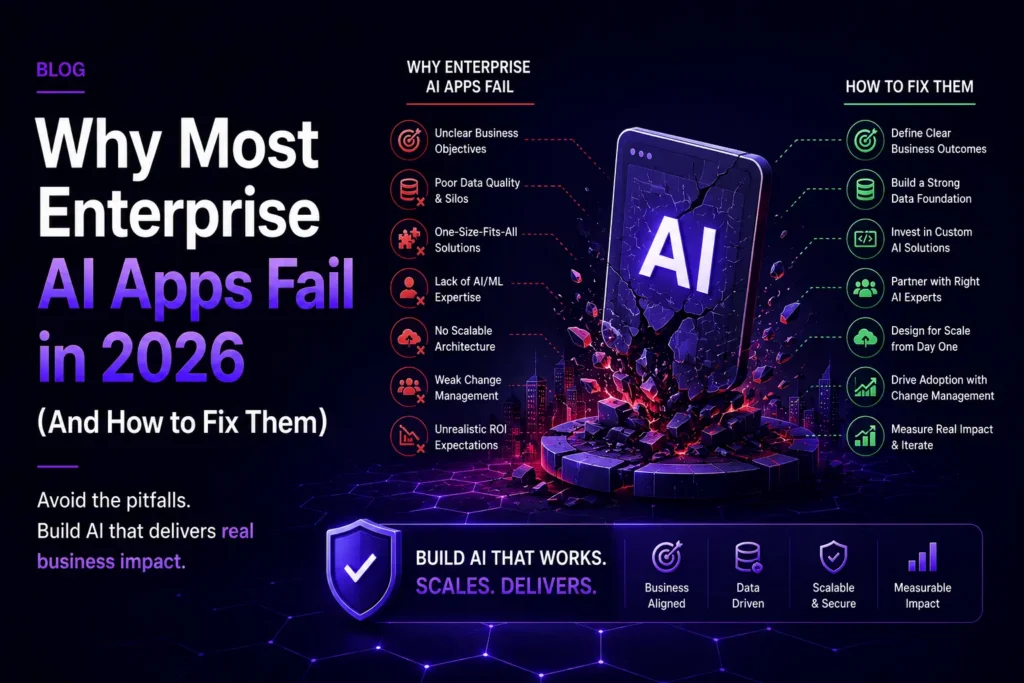
1. Data that is not ready for AI Gartner’s 2025 research found that only 12% of organizations have data of sufficient quality to support AI applications, and predicts 60% of AI projects lacking AI-ready data will be abandoned through 2026. Cloudera and HBR’s 2026 study confirmed only 7% of enterprises say their data is completely ready. The bar for AI-ready data is higher than most teams realize: it requires asset-level governance, automated quality pipelines, and quality signals updated in hours not quarterly audit cycles. Most enterprises are, as one researcher put it, building on sand.
2. No definition of success before the build starts
A 2025 MIT Sloan study found that 73% of failed AI projects had no agreed definition of success before the project began. Worse, 61% were approved on projected ROI that was never measured after launch. BCG adds that 60% of companies fail to define or monitor financial KPIs tied to AI value creation. When success is undefined, organizations cannot distinguish experimentation from achievement — and budget reviews become impossible to defend.
Organizations implementing enterprise AI agent platforms are increasingly prioritizing data governance, measurable KPIs, and operational accountability to improve AI adoption success and long-term business impact.
3. Generic tools applied to specific problems
MIT’s NANDA research makes a critical distinction: generic AI tools excel for individuals because of their flexibility, but they stall in enterprise use because they do not learn from or adapt to specific workflows. Companies that built AI through specialized engineering partnerships succeeded about 67% of the time. Internal builds from generic models succeeded only one-third as often. The gap is not the technology. It is the fit between the technology and the business process.
4. Governance treated as an afterthought Virtana’s March 2026 report found that while 59% of executives believe their organizations are prepared for AI-scale operations, 62% of practitioners report fragmented systems and persistent visibility gaps. Three in four enterprises now report AI job failure rates in double digits. Governance is consistently the last item on the AI project checklist — which means audit trails, access controls, and fallback systems are absent precisely when they are needed most. Organizations evaluating AI solutions for pharma companies and other enterprise AI deployments are increasingly prioritizing governance, compliance, and operational visibility to reduce risk and improve long-term AI reliability.
What the 20% Who Succeed Do Differently
McKinsey’s 2025 AI survey found that organizations reporting significant financial returns were twice as likely to have redesigned end-to-end workflows before selecting modeling techniques. The business process came first. The model came second.
WorkOS’s analysis of successful enterprise AI programs identifies four consistent behaviors:
- They invest 50–70% of project budget in data readiness before any model work begins
- They define a KPI ladder pre-build lead metrics within two weeks, P&L outcomes at 90 and 180 days
- They focus on fewer use cases with deeper engineering BCG found AI leaders expect 2.1x greater ROI by reducing scope, not expanding it
They treat AI as a cross-functional transformation program with defined stage gates not a technology workstream with a delivery date The common thread is not a better model. It is more rigorous engineering discipline applied to everything around the model.
One Counter-Intuitive Finding Worth Noting
MIT’s NANDA research found that more than half of generative AI budgets are directed toward sales and marketing tools — yet the biggest ROI consistently comes from back-office automation: eliminating business process outsourcing, reducing external agency costs, and streamlining internal operations.
The AI applications that stick are often internal, unglamorous, and deeply integrated into how work actually gets done. The highest-value AI is not usually the most visible. It is the most embedded. Organizations adopting AI-driven SDLC to accelerate delivery are increasingly focusing on deeply integrated automation that improves operational efficiency, engineering productivity, and long-term business outcomes.
The Fix Is an Engineering Problem
The research converges on a single conclusion: enterprises that succeed with AI approach it as a disciplined engineering program, not a technology procurement exercise. That means grounding models in real enterprise data, designing for workflow fit before feature set, engineering governance from the start, and measuring outcomes against pre-defined business KPIs not demo metrics.
The failure rate of enterprise AI is not a referendum on AI. It is a reflection of how it has been implemented. Change the implementation approach, and the outcomes change significantly. Organizations leveraging AI text analysis tools, techniques, and use cases are increasingly focusing on governance, workflow alignment, and measurable operational outcomes to improve enterprise AI adoption success.
References
1. RAND Corporation — AI Project Failure Analysis (2025), via Pertama Partners
https://www.pertamapartners.com/insights/ai-project-failure-statistics-2026
2. MIT NANDA — The GenAI Divide: State of AI in Business (2025), via Fortune
https://fortune.com/2025/08/18/mit-report-95-percent-generative-ai-pilots-at-companies-failing-cfo
3. Folio3 AI — AI Project Failure Rate in 2026
https://www.folio3.ai/blog/ai-project-failure-rate-stats
4. Gartner — AI-Ready Data Research (2025), via Talyx
https://talyx.ai/insights/enterprise-ai-implementation-failure
5. Cloudera & Harvard Business Review — Data Readiness for AI (March 2026)
6. BCG — The Widening AI Value Gap (September 2025)
https://talyx.ai/insights/enterprise-ai-implementation-failure
7. McKinsey — State of AI Survey (2025), via WorkOS
https://workos.com/blog/why-most-enterprise-ai-projects-fail-patterns-that-work
8. Virtana — AI Is Breaking Human Managed Operations (March 2026)
9. Neuwark — Enterprise AI Failure Rate Analysis (2026)
https://neuwark.com/blog/enterprise-ai-failure-rate-why-85-percent-of-ai-projects-fail
10. S&P Global Market Intelligence — Enterprise AI Initiatives Survey (2025)
https://workos.com/blog/why-most-enterprise-ai-projects-fail-patterns-that-work
Thinking through your AI program architecture?
Wizr AI is an AI product engineering company that helps enterprises build production-ready AI systems – grounded in real data, designed for real workflows, and governed for real compliance requirements. If you are working through what it takes to close the gap between AI investment and AI outcomes, we are happy to have that conversation.
About Wizr AI
Wizr AI helps enterprises build autonomous enterprises and accelerate product and software engineering with practical, production-ready AI. We help organizations automate business workflows, modernize legacy applications and digital platforms, and build intelligent AI solutions.
Our core services include Enterprise AI Services, AI-Powered Engineering & Legacy Modernization, AI Product Engineering, and AI Governance. We also leverage AI Assembly capabilities, including the Agentic AI Framework, Agentic Workflows, Security, and Integrations.
Through our AI solutions, including AI Agents, Pharma & Life Sciences AI, Oracle AI, and Salesforce AI, we help enterprises apply AI across business and technology needs.
See how we can help your enterprise move faster with AI. 👉 Talk to an AI Expert.



![Agentic AI vs AI Agents: Key Differences Every CIO Must Know [2025 Guide]](https://wizr.ai/wp-content/uploads/2025/07/Agentic-AI-vs-AI-Agents.webp)
![Agentic AI vs Traditional Automation: Why Enterprises Shift for Better CX [2025]](https://wizr.ai/wp-content/uploads/2025/06/Agentic-AI-vs-Traditional-Automation.webp)


![11 Real-World AI Agents Examples + Use Cases for Enterprises [2025]](https://wizr.ai/wp-content/uploads/2025/05/AI-Agents-Examples-Use-Cases.webp)