Two years ago, teams hired prompt engineers. Job boards filled with roles promising six figures for people who knew how to phrase a request well. Today those same roles carry different titles and different expectations.
The change was not marketing. It was architectural. Models grew from 4,000-token windows to 200,000 and beyond. Anthropic’s Claude and Google’s Gemini now handle context measured in hundreds of thousands of tokens. When a model can read an entire codebase, the bottleneck stops being how you ask and becomes what you feed it.
What Prompt Engineering Actually Solved
Prompt engineering emerged as a workaround for weak instruction-following. Early GPT-3 needed coaxing. Few-shot examples, chain-of-thought triggers, role assignments, and delimiter tricks all existed because models could not reliably infer intent.
Those techniques worked. Chain-of-thought prompting improved arithmetic reasoning on GSM8K benchmarks substantially in the original Wei et al. research from 2022. The gains were real.
But newer models are trained on instruction-following data at scale. Reasoning models like o3 and Claude’s extended thinking mode perform internal deliberation without being told to think step by step. Telling a 2026 frontier model to “take a deep breath” adds nothing. The prompt trick died because the underlying weakness disappeared.
As enterprises move beyond prompt optimization, many are investing in Enterprise Digital Engineering Services to build AI-native systems with robust context management, scalable architectures, and production-ready software engineering practices.
Defining Context Engineering
Context engineering treats the model’s input window as a managed resource, not a text box.
A context window contains far more than a user question. Production systems assemble system instructions, retrieved documents, tool schemas, conversation history, prior tool outputs, and structured state. Every token competes for attention. Every token costs money and latency.
Context engineering asks different questions:
- Which documents belong in the window for a given query?
- When does history get compacted, and what survives compaction?
- How are tool results formatted so the model parses them cleanly?
- What gets cached across calls to cut cost?
- Where does state live between turns?
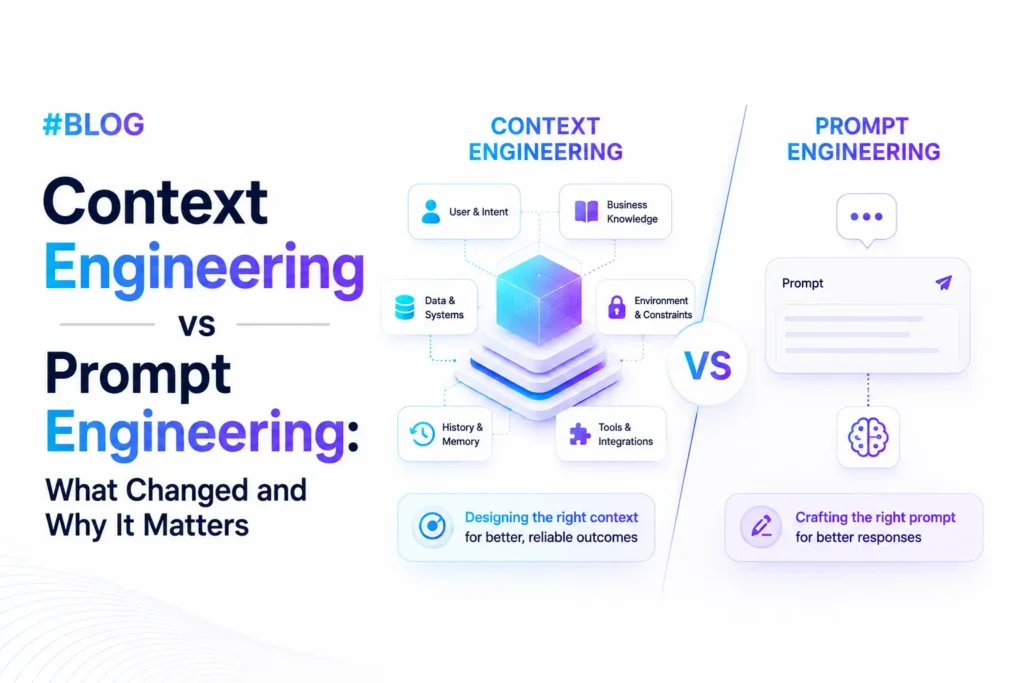
Prompt engineering optimized a string. Context engineering designs a pipeline.
Why Retrieval Changed the Math
Anyone who has shipped a RAG system knows the failure mode. The prompt reads beautifully. The retrieval returns three irrelevant chunks and one half-relevant chunk. Output quality collapses.
No rewording of the instruction fixes bad retrieval. The fix lives upstream: better chunking strategy, hybrid search combining BM25 with dense vectors, reranking with a cross-encoder, metadata filtering before the vector search runs.
Research on long-context behavior showed a further wrinkle. The “Lost in the Middle” paper from Liu and colleagues at Stanford found that model accuracy degrades when relevant information sits in the middle of a long input rather than at the beginning or end. Position matters. Ordering matters. Placement is now an engineering decision.
Context Rot and the Limits of Stuffing
Filling a 200,000-token window does not mean using it well. Practitioners describe context rot, where signal degrades as irrelevant tokens accumulate. Attention spreads thin. The model latches onto stale instructions from twenty turns ago.
Agentic systems make the problem acute. An agent running a fifty-step task accumulates tool outputs, error traces, and intermediate reasoning. Without active management, the window fills with noise before the task completes.
Working solutions look like software engineering, not writing:
Compaction. Summarize completed subtasks and drop raw logs.
Externalization. Store long-term state in files or a database. Load only what the current step needs.
Sub-agents. Delegate a bounded task to a fresh context, return the result, discard the scratch work.
Tool result trimming. Truncate a 40,000-token API response to the fields actually used.
What Stays Relevant
Prompt engineering did not vanish. It became a subset.
Clear instructions still beat vague ones. Structured output schemas still reduce parsing failures. Explicit constraints still prevent drift. Anthropic’s own documentation continues to recommend XML tags for delineating input sections, because delimiters help attention find boundaries.
The difference is scope. A well-written system prompt is one component in a context pipeline. Treating it as the entire discipline is like calling database administration “writing SELECT statements.”
Organizations building production-ready AI systems often work with a Generative AI Software Development Company to design end-to-end context pipelines that combine prompt engineering, retrieval, memory, and orchestration for reliable enterprise AI applications.
What Engineers Should Do Differently
Start measuring token composition. Instrument production calls and break down where tokens go: system instructions, retrieved chunks, history, tool schemas. Most teams discover that tool definitions consume more budget than expected.
Build evaluation before optimization. Context changes produce non-obvious effects. A retrieval tweak that improves one query class can degrade another. Golden datasets and regression suites catch regressions that vibes miss.
Treat prompt caching as infrastructure. Static prefixes cached across requests cut cost by a large margin on repeated calls. Structure your context so the stable parts sit first.
The Bottom Line
Prompt engineering was a bridge technology for an era when models needed help understanding requests. Context engineering is what remains once models understand fine and the hard problem becomes deciding what they should see.
The skill transfer is not from writer to better writer. It is from writer to systems engineer. Anyone who has designed a caching layer, tuned a search index, or managed application state already holds most of the relevant intuition.
The window is a resource. Engineer it accordingly. Organizations adopting this shift are increasingly investing in Custom AI Application Development Services to build AI applications with intelligent context management, scalable architectures, and production-ready agentic workflows.
About Wizr AI
Wizr AI helps enterprises build autonomous enterprises and accelerate product and software engineering with practical, production-ready AI. We help organizations automate business workflows, modernize legacy applications and digital platforms, and build intelligent AI solutions.
Our core services include Enterprise AI Services, AI-Powered Engineering & Legacy Modernization, AI Product Engineering, and AI Governance. We also leverage AI Assembly capabilities, including the Agentic AI Framework, Agentic Workflows, Security, and Integrations.
Through our AI solutions, including AI Agents, Pharma & Life Sciences AI, Oracle AI, and Salesforce AI, we help enterprises apply AI across business and technology needs.
See how we can help your enterprise move faster with AI. 👉 Talk to an AI Expert.


![Agentic AI vs AI Agents: Key Differences Every CIO Must Know [2025 Guide]](https://wizr.ai/wp-content/uploads/2025/07/Agentic-AI-vs-AI-Agents.webp)
![Agentic AI vs Traditional Automation: Why Enterprises Shift for Better CX [2025]](https://wizr.ai/wp-content/uploads/2025/06/Agentic-AI-vs-Traditional-Automation.webp)


![11 Real-World AI Agents Examples + Use Cases for Enterprises [2025]](https://wizr.ai/wp-content/uploads/2025/05/AI-Agents-Examples-Use-Cases.webp)