Most enterprises did not plan to end up here. One team spun up a support agent. Another switched on a copilot inside Salesforce. Finance built a reconciliation agent. A year later, dozens of AI agents are running across the business, and no one can say exactly how many, what they cost, or whether they are safe.
That gap is exactly what AI governance consulting is built to close. And in 2026, the fastest way to close it is not a year-long strategy project. It is a focused, 90-day managed service that gives you visibility, control, and optimization in weeks.
The stakes are real. Deloitte’s State of AI research found that only about one in five companies has a mature model for governing autonomous AI agents, even as agents scale fast. Most enterprises are deploying agents faster than they can govern them.
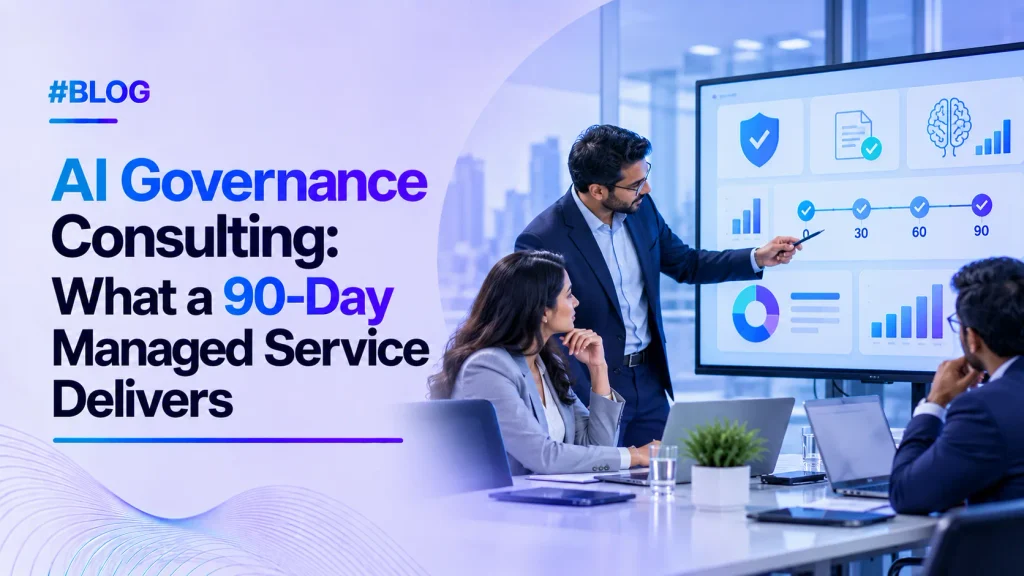
This guide explains what AI governance consulting delivers in a 90-day managed service. We cover what it is, the deliverables, the day-by-day roadmap, how to measure success, and how Wizr AI runs this as a service. The goal is a practical playbook for CIOs, CTOs, AI governance leaders, and risk and compliance teams.
A quick word on why speed matters here. Traditional governance programs can take a year of policy writing before anything changes on the ground, and by then you have even more agents running unseen. A managed service flips that order. It starts with what is actually running in your business, gives you control fast, and builds a deeper framework around real data instead of a blank page. For the stakeholders reading this, whether you own security, risk, or the AI budget, the promise is the same: in 90 days you go from guessing to knowing, and from exposure to control.
What Is AI Governance Consulting, and What Does It Help Enterprises Achieve?
AI governance consulting is a service that helps enterprises see, control, and improve the AI systems running across their business. It brings order to the sprawl of AI agents, models, and copilots that have appeared across departments, often without central oversight.
In plain terms, it answers four questions every enterprise now struggles with. What AI do we have running? How well is it performing? What is it costing us? And where is it putting us at risk? Good AI governance consulting services turn those unknowns into a clear, measured picture.
It is worth separating two things people often blur together. Enterprise AI governance is the ongoing discipline of controlling AI across the business. AI governance consulting is the outside expertise and managed service that helps you stand that discipline up quickly, without hiring a whole new team or building tooling from scratch. The consulting part matters because most enterprises simply do not have spare governance specialists sitting idle. A managed service brings the people, the method, and the monitoring, so your internal teams can focus on running the business while the agents get brought under control.
Why enterprises need it now
The problem is not that AI is bad. It is that AI is everywhere, and visibility has not kept up. Custom agents built by internal teams, point solutions stood up by departments, and vendor agents embedded inside platforms like Salesforce and Oracle, along with SAP, ServiceNow, and Microsoft, all run in parallel, with no single view.
The trouble is that each of these was switched on for a good local reason, but nobody is watching the whole picture. A department enables an agent to speed up its own work, IT never sees it, and finance never sees the bill. Multiply that across a large enterprise and you get real sprawl, which is exactly the condition AI governance consulting is built to untangle.
That creates three blind spots that enterprise AI governance is built to remove:
- No unified inventory. No one can list every agent in production, custom-built or vendor-embedded, let alone who owns each one.
- No performance or cost baseline. Accuracy, cost, and latency are rarely measured consistently, so quality quietly degrades until it becomes a customer complaint.
- No risk visibility. PII exposure, hallucination, drift, and unauthorized actions carry real regulatory and brand risk, and they stay invisible until something breaks.
That last blind spot is where the danger is greatest. IBM’s Cost of a Data Breach research found that among organizations that suffered an AI-related breach, 97% lacked proper AI access controls. Ungoverned agents are not just inefficient. They are a security exposure waiting to surface.
What it helps enterprises achieve
Done well, AI governance consulting delivers more than a compliance checkbox. It gives leaders a living picture of their AI estate and a clear path to make it safer and cheaper.
The outcomes enterprises care about include a complete agent inventory, consistent performance and cost baselines, early risk detection, executive-ready reporting, and real savings from optimization. This is the difference between hoping your AI is fine and knowing it is.
It matters most in regulated settings. In sectors like pharma, finance, and healthcare, an ungoverned agent is not just a cost problem, it is a compliance problem that can trigger audits and penalties. That is why Wizr builds governance into its regulated-industry work, such as its Pharma and Life Sciences AI solutions, where traceability and human oversight are non-negotiable. The same discipline that protects a drug submission protects any enterprise running AI at scale.
How it relates to frameworks and compliance
AI governance consulting does not replace recognized frameworks. It operationalizes them. An AI governance consulting framework gives you the structure, while the managed service does the hands-on work of applying it to your real agents. Think of the frameworks as the rulebook and the service as the team that puts the rules into practice.
Most engagements align with well-known references, so your controls map to standards auditors trust. These include the NIST AI governance framework, emerging rules for an agentic AI governance framework and generative AI governance framework, and your own responsible AI governance framework. Rather than a static AI governance framework template on a shelf, you get living inventory, metrics, and controls that reflect how your AI actually behaves. This is where AI governance framework implementation services and the broader AI governance framework development process turn policy into practice.
It is worth being clear about scope. This article focuses on the 90-day managed-service experience, the practical work of getting AI under control. Broader topics like a full AI governance strategy and framework, responsible AI consulting services, AI compliance consulting, and long-term compliance strategy are their own discipline, and we touch on them only where they intersect with the managed service. If you need AI compliance consulting services or a full AI governance consulting strategy and framework, those typically run alongside the managed service rather than inside its 90 days.
In practice, the managed service and the framework reinforce each other. The service gives you real data on how your agents behave, which makes your written policies sharper and more enforceable. And a clear framework tells the service what good looks like, so monitoring is measuring against the right standards. Enterprises that treat the two as one effort, hands-on control plus living policy, move much faster than those that write a framework first and hope it sticks.
What Does an AI Governance Consulting Service Deliver in 90 Days?
A good AI governance consulting service is not a slide deck. It is a set of concrete deliverables that give you visibility and control, starting in week one and maturing over 90 days. Reporting often begins almost immediately, with the deeper infrastructure growing only as fast as you need it.
Think of it as five moving parts delivered as a managed service: an agent inventory, baseline metrics, a weekly executive report, real-time analytics, and ongoing optimization. Together, these cover the full governance lifecycle without the heavy lift of building it all yourself.
AI Agent Inventory, Ownership, and Risk Classification
Everything starts with knowing what you have. The first deliverable is a complete, living register of every AI agent in your enterprise, custom-developed and third-party alike.
This inventory goes wider than most teams expect. It captures internal LLM and agent workflows built on tools like Azure, OpenAI, LangGraph, and Amazon Bedrock, as well as vendor-embedded agents such as Salesforce Agentforce, SAP Joule, ServiceNow Now Assist, and Microsoft Copilot. If an AI capability is turned on inside a licensed platform, whether IT approved it or not, it belongs in the register.
Each agent is then attributed to an owner, a department, a client, or a product, and classified by risk tier. This ownership and risk classification is the foundation of enterprise AI agent governance, since you cannot hold anyone accountable for an agent no one owns.
Risk tiering is what makes the inventory actionable rather than just a long list. A read-only agent that summarizes reports sits in a low tier and needs light oversight. An agent that can move money, change records, or touch customer data sits in a high tier and needs tight controls and human sign-off. By sorting every agent this way on day one, the service tells you exactly where to focus your attention first, so you are not spreading governance effort evenly across agents that carry wildly different risks. It mirrors how disciplined teams rank any AI initiative, weighing each one by value, feasibility, and risk before investing effort, only here the ranking is applied to agents already in production.
AI Performance, Cost, and Reliability Baselines
Once you know what you have, you need to know how it is doing. The second deliverable is a consistent baseline for every agent, measured the same way across the whole estate.
Strong AI governance consulting services measure each agent against the same six dimensions:
- Accuracy. Is the agent producing correct, on-policy output?
- Cost. What does each agent spend, and on which models?
- Latency. How fast does it respond under real conditions?
- Risk. Is it exposing PII, hallucinating, or taking unauthorized actions?
- Drift. Is its quality degrading over time as data and models change?
- Business outcome. Is it actually delivering the value it was built for?
Measuring every agent the same way makes performance and risk comparable across the enterprise for the first time. That is what turns a pile of disconnected agents into something you can actually manage, and it is central to any credible enterprise AI governance framework.
The baseline also gives you a before picture, which is what makes improvement provable later. Without it, you cannot show that accuracy rose, cost fell, or risk dropped, because you never measured the starting point. This is a common gap: teams deploy an agent, assume it works, and only discover months later that quality has quietly drifted. A consistent baseline closes that gap and turns vague confidence into hard numbers your leaders can trust.
Governance Metrics and Executive Reporting
Visibility only matters if it reaches the people who make decisions. The third deliverable is a recurring executive report that puts agent-level risk, cost, and accuracy in one view for leaders.
A typical weekly report might show 10 agents monitored, 92% average accuracy, around 29,000 dollars in weekly AI spend, and three agents flagged for review, each for a different reason. One might be flagged for hallucination, another for PII exposure, a third for an unauthorized action, with each routed to its owner before the next cycle.
This is the governance metrics layer that CEOs, CFOs, and CTOs actually read. It translates technical telemetry into risk exposure, performance, and recommended changes, which is exactly what executive reporting for enterprise AI governance should do.
The reason executive reporting matters so much is accountability. When a weekly report lands on the desk of the CFO and CTO, AI stops being an invisible experiment and becomes a managed part of the business, with owners, budgets, and clear next steps. It also closes the gap many boards worry about, where AI investments were approved but nobody set clear governance expectations. A simple, recurring report that names the risks, the spend, and the fixes is often the single most valuable deliverable of the whole engagement.
The 90-Day AI Governance Roadmap: From Visibility to Optimization
So what does the work actually look like week by week? A strong AI governance consulting service follows a clear 90-day roadmap that moves from visibility to control to optimization. The principle is simple: do not wait for perfect observability to start. Begin with the inventory and sampled reviews, then add automation where risk, spend, or volume justifies it.
Here is how the AI governance framework implementation unfolds over three phases, based on a proven managed-service rollout. These phases reflect enterprise AI governance best practices: start with visibility, build a steady assurance rhythm, then optimize. Following these AI governance framework best practices in order is what keeps the rollout low-risk and fast to value.
The order is deliberate, and skipping steps is where many programs go wrong. Teams that jump straight to optimization without an inventory end up tuning agents they do not fully understand. Teams that build elaborate dashboards before they know which agents matter waste months on tooling. The 90-day sequence below avoids both traps by always doing the cheapest high-value work first: see what you have, measure it, then fix it. Each phase builds on the last, so by day 90 you have a working governance capability, not just a report.
Days 1-30: Inventory AI Agents and Establish Performance Baselines
The first month is about seeing clearly. The goal is a complete agent register and a first baseline, so you finally know what is running and how it is doing.
In these first 30 days, the work focuses on:
- Identify agents and owners. Structured discovery across IT, procurement, and department leads, plus a license audit across vendor platforms in use.
- Build the agent register. A single living inventory of every agent, attributed to a department, client, or product.
- Sample key transactions. Early sampling of real agent activity to spot obvious issues fast.
- Define metrics and risk tiers. Agree how accuracy, cost, risk, and the other dimensions will be measured, and classify each agent by risk.
By the end of the first month, the fog lifts. You have a named inventory and a baseline, which is more visibility than most enterprises have ever had into their AI.
This phase almost always surprises people. Discovery turns up agents nobody remembered switching on, copilots quietly enabled inside licensed tools, and department-built automations that never crossed IT’s desk. Finding these is not about blame, it is about completeness, because an agent you do not know about is one you cannot govern. The license and system audit is key here, since much of the hidden risk and spend lives inside vendor platforms your teams already pay for.
Days 31-60: Review AI Performance, Cost, and Risk
The second month turns visibility into routine. The goal is a steady rhythm of assurance, where every agent is reviewed on the same schedule and issues get captured and owned.
The work in days 31 to 60 includes:
- Publish the weekly report. A recurring executive report on risk, cost, and performance goes live.
- Run accuracy, cost, and risk reviews. Each agent is reviewed consistently, with problems surfaced early.
- Create the remediation backlog. Every issue found becomes a tracked item with an owner, not a note that gets lost.
- Validate savings and value hypotheses. Early analysis identifies where money is being wasted and where value is real.
This phase is where governance becomes a habit rather than a one-time audit. The weekly cadence creates accountability, since every flagged agent is routed to someone before the next cycle.
The rhythm itself is the point. A one-time audit tells you where things stood on a single day, then goes stale. A weekly review keeps pace with a fast-moving AI estate, catching a new agent, a cost spike, or a drop in accuracy within days instead of months. Over these 30 days, the remediation backlog also starts to fill with real, prioritized work, so by the end of the second month you are not just watching problems, you are steadily clearing them. This is the difference between governance that reports and governance that actually improves things.
Days 61-90: Optimize AI Models, Workflows, and Governance Controls
The final month is where the savings and safety improvements land. The goal is to move from reporting on problems to fixing them, and to stand up the infrastructure for ongoing control.
In days 61 to 90, the focus shifts to:
- Connect high-priority data sources. Integrate the systems that matter most for live monitoring, so reporting moves from manual to automated.
- Create the data store and dashboards. The weekly document becomes a live console, refreshed daily and then hourly as maturity grows.
- Automate recurring metrics. Accuracy, cost, risk, and drift checks run continuously instead of by hand.
- Add alerts and budget guardrails. Real-time alerts and spend limits catch problems and cost spikes before they grow.
This third phase is where the business case closes. The first two months prove where money is being wasted and where risk sits, and this month turns those findings into action: a smaller model here, a cached workflow there, a tightened permission somewhere else. Each fix is measured against the baseline, so you can show the savings and the risk reduction in hard numbers. By day 90, governance has paid for itself and become a living system rather than a one-off project.
Beyond 90 days, the service matures into an analytics foundation, with drift and regression testing, model and vendor optimization, process redesign, and support for a standing governance committee. This is also where governing agentic workflows that span many systems becomes essential, since the more agents coordinate, the more oversight and control they need to stay safe.
Key Deliverables of Enterprise AI Governance Consulting
It helps to see the tangible outputs you walk away with. Enterprise AI agent governance consulting is not abstract advice. It produces specific, usable deliverables that your teams and leaders can act on. These are the practical artifacts behind credible enterprise AI governance solutions, not slideware.
The test of a good engagement is simple: at the end, can you hand a regulator, a board member, or a new CIO a clear picture of your AI estate and prove you are in control? The four deliverables below are what make that possible. Each one is something your teams keep and use long after the consultants step back, which is what separates a managed service from a one-time assessment.
Here are the four core deliverables that define a strong engagement.
AI Agent Register and Risk Documentation
The agent register is the backbone of the whole service. It is a single, living record of every AI agent in your enterprise, with its owner, its department or product, and its risk tier.
Alongside it sits the risk documentation: a clear record of which agents carry which risks, from PII exposure to hallucination to unauthorized actions. This is the artifact auditors, security teams, and the board actually want to see. It proves you know what AI you are running and that someone is accountable for each piece, which is the heart of enterprise AI agent governance.
Performance, Cost, and Risk Reports
The second deliverable is the reporting itself. These reports measure every agent against the same six dimensions and present the results in a way leaders can read in minutes.
A good report does three things. It shows how each agent is performing and where quality is slipping. It breaks down spend, often revealing that vendor-embedded agents quietly carry a large share of total cost. And it surfaces risk exceptions with clear owners. For example, a report might show that of 29,000 dollars in weekly AI spend, a meaningful slice runs on vendor-embedded platforms that nobody built in-house, which is the kind of insight that changes decisions. Reading these figures is far easier when you understand what AI agents actually cost to build and operate, from model usage to the engineering and infrastructure behind each one.
Remediation Backlog and Optimization Recommendations
Governance that only reports problems is not enough. The third deliverable is a prioritized remediation backlog, where every issue found becomes a tracked task with a clear fix and an owner.
The recommendations are specific and practical. A few common examples:
- Accuracy issue: update the prompt and knowledge source, add a golden test, and route low-confidence cases to human review.
- Cost anomaly: right-size the model, cache results, batch requests, and remove duplicated agent calls.
- Latency issue: simplify the workflow, reduce tool calls, and move heavy evaluation to run asynchronously.
- Risk exception: limit privileges, add approvals, mask PII, and enforce policy guardrails.
- Poor adoption: improve workflow fit, add UI triggers, and strengthen training and process ownership.
This backlog is where the real value shows up, since it turns insight into action and action into measurable savings. Each item carries a confidence level and an estimated impact, so leaders can prioritize the fixes that save the most money or close the biggest risk first. That makes governance a source of return, not just a cost of doing business, which is exactly the framing CFOs respond to.
Monitoring Alerts and Budget Guardrails
The final deliverable keeps you in control after the engagement. Monitoring alerts and budget guardrails make governance continuous rather than a point-in-time snapshot.
Alerts flag accuracy drops, cost spikes, drift, and risk exceptions as they happen, so you catch a failing agent before it reaches a customer or an auditor. Budget guardrails cap spend so an enthusiastic agent cannot quietly run up the bill. Together, these controls turn the weekly report into a live safety net.
This is also what makes governance sustainable. Without alerts and guardrails, control depends on someone remembering to check a dashboard, which never lasts. With them, the system watches itself and only pulls a human in when something actually needs attention. That shift from manual vigilance to automated guardrails is what lets a lean team govern a large and growing AI estate without being overwhelmed.
How to Measure AI Governance Success Across Performance, Risk, and Cost
How do you know the governance service is working? The answer is simple: by the numbers. Good AI governance consulting proves its value across three axes, performance, risk, and cost, with metrics you can track over time.
This is a point worth dwelling on, because governance has a reputation for being soft and hard to measure. It does not have to be. When every agent is scored on the same dimensions and tracked week over week, governance becomes as measurable as any other operational discipline. You can point to a chart and say accuracy is up, open risk exceptions are down, and weekly spend fell after right-sizing. That kind of evidence is what turns governance from a grudging compliance cost into a program leaders actively fund.
Here are the measures that matter most:
- Performance. Average accuracy across agents, the number of agents meeting their accuracy threshold, and latency against target. Rising accuracy and fewer flagged agents show the estate is getting healthier.
- Risk. The number of open risk exceptions, time to detect and resolve them, and reduction in PII exposure or unauthorized actions. Fewer and faster-closed exceptions mean lower exposure.
- Cost. Total AI spend, cost per 1,000 requests, and savings identified and realized. A governance service should pay for itself through right-sizing and waste removal.
- Business outcome. The value each agent delivers, from faster resolution to higher satisfaction, measured against its purpose.
The power of measuring consistently is that it makes AI a managed line item, not a mystery. Leaders can see spend, risk, and performance trending in one place, with an owner for every number.
A practical tip: pick two or three headline metrics your leadership actually cares about and report them every week without fail. For most enterprises that is total AI spend, the number of open risk exceptions, and average accuracy across agents. These three alone tell a clear story about whether your AI is getting safer, cheaper, and better, and they are simple enough to land on a single slide. The deeper metrics still get tracked underneath, but the headline numbers are what keep leadership engaged and the program funded.
A real example makes this concrete. Wizr benchmarked a client’s live contract review agent against nine alternative models under identical conditions, scoring each on accuracy, latency, and cost per document. The result was up to 80% lower cost per contract processed, a 26% faster median response time, and accuracy held at 100% with no quality tradeoff. That is governance paying for itself, and you can explore more in Wizr’s case studies.
What makes that example powerful is that it would have been invisible without measurement. The agent was already live and working, so nobody questioned it, yet it was running on a far more expensive model than the job needed. Only a consistent, side-by-side benchmark surfaced the waste and proved a cheaper model held the same accuracy. This is the quiet value of governance: it finds the money and the risks that are hiding in plain sight across agents everyone assumed were fine.
Gartner has warned that more than 40% of agentic AI projects will be canceled by the end of 2027, citing escalating costs, unclear business value, and inadequate risk controls. As Gartner’s Anushree Verma put it, many agentic projects “are mostly driven by hype and are often misapplied.” Measurable governance is how enterprises avoid becoming part of that statistic.
How Wizr AI Helps Enterprises Govern and Optimize AI Agents in 90 Days
Wizr AI is a services-led enterprise AI company that helps enterprises govern and optimize their AI agents through a managed service. Its AI Agent Governance service is built on a simple idea: AI powered, human driven. It gives you one place to see every agent, how each one is performing, and what to change next.
Rather than a generic offering, Wizr delivers governance as the 90-day managed service described in this guide, with reporting starting in week one and the infrastructure growing only as fast as you need it. The focus is on helping you get control, not selling you tooling you then have to run yourself. Here is how Wizr helps at each stage of governing and optimizing your AI agents.
Establish Visibility into AI Agents, Ownership, and Risk
Wizr starts by building a complete, living register of every AI agent in your enterprise, custom-developed and vendor-embedded. Through structured discovery across IT, procurement, and department leads, plus a system and license audit, Wizr finds the agents you know about and the ones you do not.
Each agent is attributed to a department, client, or product, classified by risk tier, and measured against the same six dimensions. This visibility is the foundation, since you cannot govern what you cannot see. Crucially, Wizr covers both the agents your teams built and the ones embedded inside vendor platforms, which is where a lot of hidden risk and spend lives. Wizr’s work securing and governing agents builds on enterprise-grade security, with SOC 2 Type II and ISO 27001 compliance and support for GDPR, so the inventory itself is handled to enterprise standards.
Monitor AI Performance, Costs, and Business Outcomes
Next, Wizr turns that baseline into a living picture. It publishes a weekly executive report on risk, cost, and performance, then matures it into live dashboards refreshed daily and hourly as more data sources connect.
This is where enterprises finally see AI as a managed line item. Spend is broken down by platform and agent, risk exceptions are routed to owners, and business outcomes are tracked against each agent’s purpose. The result is accountability, since every figure traces back to an agent with a named owner. Wizr’s Enterprise AI Services team brings the engineering depth to make this monitoring reliable across complex estates, connecting to the systems that hold the data without disrupting your core platforms, whether that calls for integrating through MCP or traditional APIs. As the engagement matures, the weekly report grows into a live console, so leaders can check the health of their AI estate at any time rather than waiting for the next review.
Optimize Models, Workflows, Guardrails, and AI Spend
Finally, Wizr moves from reporting problems to fixing them. It right-sizes models, caches and batches to cut cost, simplifies workflows to reduce latency, and adds guardrails and approvals to close risk gaps.
The impact is real and measurable. For a leading US automotive manufacturer, Wizr lifted dealer support resolution from around 25% to roughly 70%, cut response times by 60%, and delivered about 2.1 million dollars in annual savings, with monitoring and optimization running throughout. That result did not come from a bigger model, it came from measuring the agent against a baseline, finding what to fix, and tuning it under governance.
This optimization never stops once it starts. Models change, data drifts, and new agents appear, so Wizr keeps benchmarking, right-sizing, and tightening controls over time. Whether the agents run in customer support, finance, or IT, the governance service keeps them safe, performant, and cost-efficient as the estate grows. You can see the bigger picture at the Wizr AI website or by exploring the governance service directly.
Conclusion
AI has spread across the enterprise faster than anyone planned, and most organizations now run more agents than they can see, measure, or control. That is the real governance gap, and it is why AI governance consulting has moved from a nice-to-have to a priority for CIOs, CTOs, and risk leaders.
The encouraging part is that you do not need a year-long program to fix it. A focused, 90-day managed service delivers what matters most: a complete agent inventory, consistent performance and cost baselines, clear risk visibility, executive reporting, and real optimization. Visibility in month one, routine assurance in month two, and savings and safety improvements in month three.
Just as important, it does all of this without pulling your teams off their day jobs or asking them to build governance tooling from scratch. The expertise, the method, and the monitoring come as a service, and your people stay focused on the business. That is the practical appeal of AI governance consulting delivered this way: fast control, measurable value, and a foundation you keep.
The enterprises that win with AI in 2026 will be the ones that govern it as deliberately as they build it. When you are ready to see every agent, measure what matters, and optimize your AI estate in 90 days, Wizr AI can help you do it as a managed service built for exactly that. You can talk to the Wizr team to get started.
FAQs
1. What Do AI Governance Consulting Services Include?
AI governance consulting services include building a complete inventory of your AI agents, establishing performance and cost baselines, measuring risk, producing executive reports, and recommending optimizations. The best services run as a managed engagement, so you get visibility in week one and continuous monitoring over time, not just a one-off assessment.
In short, they cover the full lifecycle: see every agent, measure how it performs, surface the risks, and fix what is broken. Strong services also add alerts and budget guardrails so governance stays continuous. The best AI governance consulting services cover both custom-built agents and the vendor agents embedded in tools like Salesforce and SAP, since that is where much of your risk hides.
Wizr AI delivers all of this as a 90-day managed service, with a living agent register, consistent metrics, and ongoing optimization.
2. How Long Does AI Governance Implementation Take?
A focused AI governance implementation typically delivers meaningful results in 90 days. Reporting can start in the first week with an initial inventory and sampled reviews, while the deeper infrastructure, like live dashboards and automated metrics, grows over the three months. You do not have to wait for perfect observability to begin.
The point is to start light and mature as fast as the risk, spend, and volume justify. A staged rollout beats a year-long project that never ships. A broader enterprise AI governance framework and full compliance program can keep evolving after that, but you do not have to wait for them to gain control.
Wizr AI structures its managed service in exactly this way, moving from inventory and baselines to weekly assurance to optimization across 90 days.
3. How Much Do AI Governance Consulting Services Cost?
Cost varies by the size of your AI estate and the depth of monitoring you need, but a well-run governance service is designed to pay for itself. By right-sizing models, cutting waste, and removing duplicated agent calls, it often identifies savings that offset its cost, sometimes thousands of dollars a week in reduced AI spend.
The better question is the cost of not governing. Unmonitored agents waste money, degrade quietly, and carry regulatory and brand risk that can dwarf any consulting fee. A single compliance failure or data exposure can cost far more than a year of AI governance consulting services.
Wizr AI focuses on measurable value, surfacing cost savings and risk reductions that make the service a net gain, not just a line item.
4. What Should Enterprises Look for in an AI Governance Consulting Firm?
Look for a firm that can inventory both custom and vendor-embedded agents, measure them consistently, and actually fix what it finds, not just report on it. Strong candidates deliver governance as a managed service with clear deliverables, proven security and compliance, and real optimization results.
Also check that they cover the agents you already run inside platforms like Salesforce, SAP, and Microsoft, since much of your risk and spend hides there. Ask for evidence of savings and risk reductions, not just frameworks. Industry experience helps too, especially in regulated sectors, so a firm with proven work in areas like finance or pharma can map governance to real compliance needs.
Wizr AI fits this profile, combining a complete agent register, consistent metrics, enterprise-grade security, and proven optimization into one managed service.
5. What Happens After the First 90 Days?
After the first 90 days, governance matures from a project into an ongoing capability. The weekly report becomes a live analytics foundation, with drift and regression testing, model and vendor optimization, process redesign, and support for a standing governance committee.
The goal is continuous control, where new agents are added to the register automatically, metrics run in real time, and optimization is ongoing. Governance stops being a one-time clean-up and becomes how you run AI. This is also the point where many enterprises formalize a governance committee and align the running service with their broader responsible AI governance framework.
Wizr AI supports enterprises well beyond day 90, growing the service into a durable governance foundation that scales with your AI estate.
About Wizr AI
Wizr AI helps enterprises build autonomous enterprises and accelerate product and software engineering with practical, production-ready AI. We help organizations automate business workflows, modernize legacy applications and digital platforms, and build intelligent AI solutions.
Our core services include Enterprise AI Services, AI-Powered Engineering & Legacy Modernization, AI Product Engineering, and AI Governance. We also leverage AI Assembly capabilities, including the Agentic AI Framework, Agentic Workflows, Security, and Integrations.
Through our AI solutions, including AI Agents, Pharma & Life Sciences AI, Oracle AI, and Salesforce AI, we help enterprises apply AI across business and technology needs.
See how we can help your enterprise move faster with AI. 👉 Talk to an AI Expert.


![Agentic AI vs AI Agents: Key Differences Every CIO Must Know [2025 Guide]](https://wizr.ai/wp-content/uploads/2025/07/Agentic-AI-vs-AI-Agents.webp)
![Agentic AI vs Traditional Automation: Why Enterprises Shift for Better CX [2025]](https://wizr.ai/wp-content/uploads/2025/06/Agentic-AI-vs-Traditional-Automation.webp)


![11 Real-World AI Agents Examples + Use Cases for Enterprises [2025]](https://wizr.ai/wp-content/uploads/2025/05/AI-Agents-Examples-Use-Cases.webp)