Somewhere in your enterprise, decades-old COBOL code is quietly running the business. It processes payments, moves money, and handles records that millions of people depend on. It works, but almost no one left can read it.
That is the quiet crisis facing many large organizations in 2026. The systems are mission-critical, the original developers are retiring, and the risk of touching the code feels enormous. This is exactly where COBOL modernization with AI changes the picture.
AI has made it far cheaper and faster to read, document, translate, and test old COBOL estates. Used well, it turns a scary, multi-year rewrite into a structured, lower-risk migration. Used carelessly, it creates new problems.
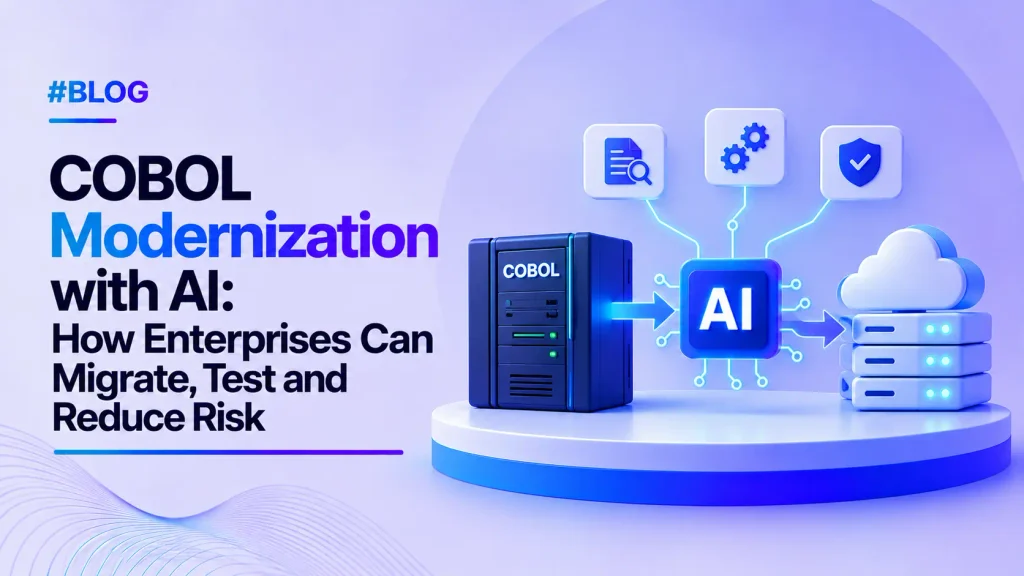
This guide walks through how enterprises can modernize COBOL with AI the right way. We cover what COBOL modernization is, how AI is transforming it, the main approaches, a step-by-step migration process, the real risks, and how to protect your business logic and data along the way.
For CIOs and enterprise architects, this is one of the defining technology decisions of the decade. The systems in question often sit at the center of the business, so the cost of a bad migration is measured in outages, compliance failures, and lost trust, not just overspend. The good news is that AI, used with discipline, has turned COBOL modernization from a feared, open-ended project into something you can plan, measure, and control. This guide is written to help you do exactly that.
What Is COBOL Modernization? Understanding Enterprise Mainframe Modernization
COBOL modernization is the process of updating old COBOL applications, usually running on mainframes, into modern languages, platforms, and architectures. The goal is to keep what the software does while changing how and where it runs.
So what is COBOL modernization in practice? It can mean moving a system to the cloud, rewriting it in Java, refactoring it into clean services, or simply re-hosting it on cheaper infrastructure. The right choice depends on your goals, risk tolerance, and budget.
This matters because COBOL still runs the world’s core systems. Reuters has reported that around 220 billion lines of COBOL remain in use, powering roughly 95% of ATM transactions and about 43% of banking systems. That is not legacy trivia. It is live, business-critical code.
Enterprise mainframe modernization is the broader effort these COBOL projects sit inside. Mainframes are reliable and secure, but they are also expensive to run and hard to staff. As skilled COBOL developers retire, the knowledge needed to maintain these systems is walking out the door, which makes legacy COBOL modernization an urgent priority rather than a someday project.
Why enterprises modernize COBOL now
A few pressures are pushing enterprises to act:
- The skills gap. Experienced COBOL developers are retiring faster than new ones are trained, so maintaining these systems gets riskier every year.
- Rising costs. Mainframe licensing and operations are costly, and modern cloud platforms often run the same workloads for less.
- Agility demands. Old systems are slow to change, which blocks new products, integrations, and customer experiences.
- Compliance and resilience. Regulators and boards expect systems that are documented, testable, and recoverable, which aging COBOL often is not.
Put simply, the question is no longer whether to modernize, but how to do it without breaking the systems your business runs on. That shift in mindset, from avoiding the problem to managing it carefully, is where every successful program begins.
It helps to be precise about what mainframe modernization is not. It is not a single product you buy, and it is not a one-time switch you flip. It is a portfolio decision that plays out over months or years, in which you decide, system by system, how much to change and how fast. Some COBOL applications are stable, low-change, and best left largely as they are until the business case is clear. Others are active, costly, and holding back new products, which makes them strong candidates to modernize first. Treating legacy COBOL modernization as this kind of prioritized, evidence-led program, rather than a blanket rip-and-replace, is what keeps cost, risk, and disruption under control, and it is the mindset every section of this guide builds on.
How AI Is Transforming Legacy COBOL Modernization
For decades, COBOL modernization meant armies of specialists reading code by hand, guessing at business logic, and rewriting line by line. It was slow, expensive, and risky. AI has changed the economics of every step.
COBOL modernization using AI works because large language models are good at exactly the tasks that used to be the bottleneck. They can read unfamiliar code, explain what it does, map how programs connect, draft translations into modern languages, and generate tests at scale.
Here is where AI helps most across a legacy COBOL modernization effort:
- Code comprehension. AI reads COBOL and explains its logic in plain language, recovering knowledge that left with retired developers.
- Documentation. It generates up-to-date documentation of business rules buried in the code, which often does not exist anywhere else.
- Code translation. AI drafts conversions from COBOL to Java or other modern languages, giving engineers a strong starting point instead of a blank page.
- Test generation. It creates test cases that capture current behavior, so teams can prove the new system matches the old one.
- Dependency mapping. AI traces how programs, data, and jobs connect, surfacing hidden risks before migration starts.
The important nuance is that AI accelerates the work, but does not replace judgment. As the research makes clear, AI has made reading, documenting, and testing a COBOL estate far cheaper, yet the hard decisions about architecture, data, and risk still need experienced engineers. This is why the strongest results come from AI-powered engineering paired with human oversight, an approach Wizr’s guide on AI legacy application modernization services explores in depth.
A caution on overestimating AI
AI is powerful, but it is not magic, and treating it that way is a common and expensive mistake. Gartner predicts that more than 70% of mainframe exit projects started in 2026 will fail to deliver their intended benefits, largely because buyers overestimate what generative AI can do on its own.
The lesson is clear. AI is a force multiplier for skilled teams, not a replacement for careful engineering. The enterprises that succeed treat AI as one powerful tool inside a disciplined, well-governed process.
It is worth being concrete about where the economics shift most. The traditional bottleneck in legacy COBOL modernization was never the typing, it was the understanding: working out what thousands of undocumented programs actually do, and proving that a new version behaves the same. This is exactly the work AI compresses. A task that once needed a specialist to spend weeks reading code can now produce a first-pass explanation in minutes, and test generation that used to be skipped for lack of time becomes practical at scale. The result is not just faster delivery but lower risk, because teams can afford to document and test far more of the estate than a manual budget ever allowed. The caution is the same throughout: AI gives you more coverage and speed, while your engineers still decide what is correct, what is safe, and what ships.
Enterprise COBOL Modernization Approaches: Rehosting, Refactoring, Rewriting and Replacing
There is no single way to modernize COBOL. The right path depends on your goals, risk appetite, and how much the system needs to change. Most enterprise COBOL modernization approaches fall into four categories, often called the “four Rs.”
Here is how each one works, with its trade-offs:
- Rehosting (lift and shift). Move the COBOL application to a new platform, like the cloud, with minimal code changes. It is the fastest and lowest-risk option, and it cuts infrastructure cost, but it does not fix the underlying code or improve agility much.
- Refactoring. Restructure and clean up the COBOL code, or convert it to a modern language, while keeping the same behavior. This improves maintainability and is a strong fit for AI-assisted work, balancing risk and reward.
- Rewriting. Rebuild the application from scratch in a modern language and architecture. It delivers the most modern result but carries the highest risk, cost, and time, since you are recreating decades of business logic.
- Replacing. Swap the custom COBOL system for a commercial or SaaS product. This works when a standard product fits your needs, but it rarely matches highly customized core systems.
A quick comparison helps:
| Approach | Risk | Cost & Time | Best For |
|---|---|---|---|
| Rehosting | Low | Low | Fast cost savings, minimal change |
| Refactoring | Medium | Medium | Better maintainability with controlled risk |
| Rewriting | High | High | A fully modern system, when justified |
| Replacing | Medium | Varies | Standard processes a product can cover |
Most enterprises do not pick just one. A large estate is usually modernized in waves, rehosting some systems quickly, refactoring others with AI, and rewriting only the few that truly need it. These enterprise COBOL modernization solutions work best when matched to each application rather than forced across the whole portfolio. For help weighing these trade-offs, our CIO’s checklist for agentic AI workflow solutions offers a useful evaluation lens.
How you choose between the four Rs comes down to a few honest questions about each system. How much business value does it still deliver, and how often does it change? How tangled are its dependencies, and how well is it documented? What is your tolerance for risk and your appetite for cost on this particular application? A high-value, fast-changing system that is blocking new products may justify refactoring or even a rewrite, because the payoff is real. A stable, rarely touched system may only warrant rehosting to cut infrastructure cost, with deeper work deferred. The mistake enterprises make is applying one answer across the whole estate, either rewriting everything in search of a clean slate or rehosting everything to avoid risk. The disciplined path is to assess each application on its own merits, sequence the work into waves, and let AI-powered analysis do the heavy lifting of surfacing the complexity and dependencies that should drive the decision.
How to Modernize COBOL Applications Using AI: A Step-by-Step Migration Process
This is the heart of a successful project. Knowing the approaches is useful, but execution is where enterprises win or lose. Here is a practical, step-by-step process for how to modernize COBOL applications using AI, with risk reduction built into every stage.
Think of it as a disciplined pipeline. Each step produces something you can review and trust before moving to the next, so you are never betting the business on a single leap.
This staged structure is what separates a safe migration from a risky one. It also lets you pause, measure, and adjust at every stage, which is exactly how enterprises keep large modernization programs from spiraling out of control. AI speeds up each step, but the gates between steps, where humans review and approve, are what keep the whole effort trustworthy.
Analyze Legacy COBOL Code and Document Business Logic
Everything starts with understanding what you have. You cannot safely modernize code you do not understand, and in many COBOL estates, the original documentation is long gone.
Use AI to read the COBOL and explain it. Modern tools can summarize what each program does, surface the business rules buried inside, and generate documentation that may never have existed. This recovers critical knowledge that retired developers took with them.
The output of this step is a clear, documented picture of your business logic. That documentation becomes the single source of truth for the rest of the migration, and it is valuable even before any code is moved, since it de-risks every future change.
In practice, start where the risk and value are highest. Point AI at your most critical, most frequently changed programs first, confirm its explanations with the few people who still know the system, and build a shared glossary of business terms as you go. This turns tribal knowledge into something the whole team can rely on, and it gives leadership an honest view of scope before any budget is committed. Many enterprises are surprised to learn that a large share of their COBOL estate is dormant or duplicated, which this analysis reveals early, so you modernize only what truly matters.
Map Mainframe Dependencies and Identify Migration Risks
COBOL applications rarely stand alone. They connect to databases, batch jobs, other programs, and external systems in ways that are easy to miss and dangerous to break.
AI helps by tracing these connections automatically. It maps how programs call each other, where data flows, and which jobs depend on which, building a dependency graph that would take humans weeks to assemble by hand.
With that map, you can spot the real migration risks early. You can see which systems are tightly coupled, where a change could ripple, and what must move together. Identifying these risks up front is how enterprises avoid nasty surprises halfway through a project.
Pay special attention to data lineage and batch schedules, since these are where COBOL estates hide their deepest dependencies. A single overnight batch job might update dozens of downstream systems, and missing one connection can quietly corrupt data for days before anyone notices. Use the dependency map to group applications into logical waves that can move together safely, and to decide the order of migration. Done well, this step turns a tangled, scary monolith into a set of bounded, manageable pieces, which is the single biggest factor in keeping a large legacy COBOL modernization program under control.
Use AI to Translate COBOL Code to Java or Modern Programming Languages
This is the step most people picture when they think of COBOL modernization with AI. AI models can draft a conversion from COBOL to Java, C#, or other modern languages, turning a blank-page rewrite into an editing job.
For COBOL to Java modernization, AI generates a working first draft that engineers then review, correct, and refine. This is a huge accelerator, since reviewing and fixing generated code is far faster than writing it all from scratch.
But this is also where discipline matters most. AI translations can be subtly wrong, carrying over logic incorrectly or missing edge cases. Every converted module needs expert review and testing before it is trusted. The goal is AI speed with human accuracy, not blind automation.
Watch the details that trip up machine translation. COBOL handles numbers, fixed-decimal arithmetic, and date formats in ways that do not map cleanly to modern languages, and a tiny rounding difference in a financial system can cause real harm. The strongest approach is to convert in small, reviewable modules rather than the whole program at once, test each one against the original, and keep a human expert in the loop for anything that touches money or compliance. This is why COBOL to Java modernization works best as an engineering discipline, not a one-click conversion, and why pairing AI tools with experienced engineers consistently beats tools alone.
Modernize COBOL Applications for Cloud Environments
Translating the code is only part of the job. To get the full benefit, applications usually need to be reshaped for modern, cloud-native environments rather than simply lifted as-is.
COBOL to cloud modernization means re-architecting applications to run as scalable, containerized services, use modern data stores, and fit into cloud operations. AI assists here too, suggesting how to break a monolith into services and optimize workloads for the cloud.
Done well, this is where the real payoff shows up: lower infrastructure cost, elastic scale, faster releases, and easier integration with the rest of your stack. Wizr’s AI-powered engineering and legacy modernization services focus on exactly this kind of cloud-native re-platforming, with automation and governance built in.
A useful pattern here is the strangler approach, where you wrap the old system and gradually route functions to new cloud-native services one at a time, rather than cutting over everything at once. This lets the old and new run side by side while you build confidence. Think carefully about data too, since moving from a mainframe data store to a modern database is often harder than moving the code itself. COBOL to cloud modernization delivers its full value only when the application, the data, and the operating model all move to a cloud-ready design, so plan all three together rather than treating the cloud as a simple hosting swap.
Test Migrated Applications and Validate Business Logic
Testing is where COBOL modernization succeeds or fails. The whole point is that the new system does exactly what the old one did, no more and no less, and the only way to know is to prove it.
AI transforms testing by generating test cases at scale, including the edge cases humans forget. A powerful technique is parallel testing: run the old COBOL system and the new one on the same inputs and compare the outputs. If they match across a broad set of real cases, you can trust the migration.
This validation of business logic is non-negotiable for core systems. AI-powered testing and quality assurance, a core part of Wizr’s AI product engineering services, is what lets enterprises modernize with confidence rather than crossed fingers.
Build your test strategy around real production data, not just hand-written cases. Capture a broad set of actual inputs and their correct outputs from the live system to form a golden dataset, then replay it through the new code and flag any difference for review. Add regression tests that run on every change, and performance tests to confirm the new system meets the speed and volume the business needs. The more of this you automate, the faster and safer each later wave of migration becomes, since you can prove equivalence in hours instead of weeks. For core financial or regulated systems, this evidence is also what satisfies auditors that the modernized system is trustworthy.
Deploy Modernized Applications and Monitor Performance
The final step is going live, carefully. A big-bang cutover of a core system is risky, so most enterprises roll out gradually and keep a fallback ready.
Use a phased deployment. Move one component or a slice of traffic at a time, watch it closely, and expand only once it proves stable. Keeping the old system available as a safety net during the transition reduces the risk of a costly outage.
After launch, monitor performance continuously. Track accuracy, speed, cost, and errors, and feed any issues back into improvement. Modernization is not finished at go-live, and good observability is what keeps the new system healthy as it takes over the real workload. Keep a clear rollback plan ready for each phase, so that if something does go wrong, you can revert quickly and calmly rather than scrambling under pressure.
Techniques like canary releases, where a small slice of traffic hits the new system first, and parallel runs, where both systems process the same work and you reconcile the results, give you an early warning before any issue reaches the whole business. Keep this discipline until the new system has proven itself over a full business cycle, including month-end and year-end peaks, which often stress COBOL systems in ways everyday traffic does not.
Taken together, these six steps turn COBOL modernization with AI from a single terrifying leap into a repeatable, measured program. Each step reduces risk and builds evidence, so by the time you deploy, you already know the new system behaves like the old one. That is the difference between the enterprises that modernize successfully and the majority that stall, and it is why execution, not just tool choice, decides the outcome.
COBOL Modernization Risks: How Enterprises Can Protect Business Logic and Data Integrity
COBOL modernization carries real risks, and the stakes are high because these systems run core operations. Understanding the risks is the first step to managing them. The biggest is losing or corrupting the business logic and data that the enterprise depends on.
Here are the main risks and how to protect against them:
- Lost or altered business logic. Decades of rules are embedded in COBOL, often undocumented. Protect against this by documenting logic with AI first, then validating the new system against the old through parallel testing.
- Data integrity problems. Migrating data between old and new systems can introduce errors. Reduce this risk with careful data mapping, validation checks, and reconciliation before, during, and after migration.
- Incorrect AI translations. AI-generated code can be subtly wrong. Guard against it with mandatory human review, strong test coverage, and staged rollouts rather than blind trust.
- Hidden dependencies. Missed connections can break systems you did not expect. Dependency mapping and phased deployment keep these surprises small and recoverable.
- Overestimating AI. Expecting AI to do the whole job leads to failure, as Gartner’s warning shows. Treat AI as an accelerator inside a disciplined, governed process.
The common thread is governance and oversight. Strong controls, audit trails, and human review at every critical step are what protect business logic and data integrity. Wizr’s guide on why enterprise AI apps fail and how to fix them reinforces why this discipline matters, and its guide on why enterprise AI pilots fail to reach production shows how careful execution bridges the gap from promising start to reliable system.
Across enterprise COBOL modernization case study after case study, in both the public and private sectors, the pattern holds: the projects that protect business logic through documentation, testing, and phased rollout succeed, while the ones that rush with unchecked automation stumble. The GAO found that of ten critical federal legacy systems flagged for modernization, only three had been modernized by 2025, a reminder that doing this well takes structure, not speed alone.
It helps to see these risks as connected rather than separate. Most failures trace back to the same root cause: a team moving faster than its evidence. Unchecked AI translations, missed dependencies, and silent data corruption are all symptoms of skipping the review and testing gates that slow you down on purpose. The enterprises that protect business logic and data integrity are the ones that refuse to treat any step as finished until it is proven, keeping a documented trail of what each program does, how each converted module was validated, and how the data was reconciled. That evidence is not bureaucracy. It is what lets you deploy a core financial or regulatory system with confidence, answer an auditor’s questions, and roll back cleanly if something slips through. In COBOL modernization, the discipline that feels slow in the moment is exactly what makes the overall program faster, because it prevents the expensive, reputation-damaging failures that force a restart.
How Wizr AI Supports Enterprise AI-Powered Engineering and Legacy Modernization
A COBOL migration succeeds or fails on the strength of the engineering and governance behind it, and that is exactly where Wizr AI helps. Rather than selling a conversion tool and leaving you to run the hard parts, Wizr brings AI-powered engineering, code refactoring, testing, and legacy modernization together as a service, so the steps this guide describes are carried out by experienced engineers using AI, not by automation alone. The focus below is practical: how Wizr’s confirmed capabilities map onto the specific challenges a COBOL estate presents, from recovering lost business logic to validating that a modernized system behaves exactly like the original.
A quick note on scope. Wizr’s strength is AI-powered engineering and legacy modernization applied to enterprise systems broadly. The capabilities below are what Wizr delivers for modernization work of this kind, and they align directly with the stages a COBOL migration requires, which is why they are relevant to any enterprise weighing how to approach its mainframe estate.
AI-powered engineering and legacy modernization
Through its AI-powered engineering and legacy modernization services, Wizr helps enterprises modernize and re-platform legacy applications into scalable, cloud-native, and containerized architectures. It accelerates code refactoring, workload optimization, and cloud migration with AI-powered automation, observability, and governance. These are exactly the COBOL modernization services capabilities a legacy estate needs to move safely to modern platforms. For a COBOL program specifically, this is the capability that carries the two hardest steps of the migration, reshaping a translated application into cloud-native services and moving it onto modern infrastructure, with the automation to do it faster and the governance to keep each change controlled and auditable.
Code refactoring and translation support
Wizr’s engineering teams use AI to accelerate software development and modernization, including AI-assisted refactoring and architecture modernization that reduce technical debt. For the translation-heavy stages of a migration, this means skilled engineers using AI to move faster while keeping quality high, rather than relying on automation alone. That human-in-the-loop model is precisely what COBOL translation demands, where a subtly wrong conversion of financial or date logic can cause real harm, and where every generated module needs expert review before it is trusted. It is the difference between AI as a reckless shortcut and AI as a disciplined accelerator inside a controlled engineering process.
AI-powered testing and quality assurance
Validation is central to any migration, and Wizr’s AI product engineering services include AI-powered code generation, testing, defect detection, and continuous quality monitoring. This supports the parallel testing and business-logic validation that COBOL modernization demands, helping teams prove the new system behaves exactly like the old one.
Enterprise AI services and governance
Beyond engineering, Wizr’s Enterprise AI Services team helps design and deliver AI solutions tailored to enterprise needs, and its AI governance capabilities help enterprises secure, monitor, and control AI across the lifecycle. Wizr is SOC 2 Type II and ISO 27001 compliant and supports GDPR, which matters for the regulated environments where COBOL systems usually live.
The thread through all of this is disciplined, AI-powered engineering with governance built in, which is precisely what the Gartner data suggests most failing projects lack. If you are planning a modernization effort, you can talk to the Wizr team to see how AI-powered engineering fits your systems.
Conclusion
COBOL modernization has long been one of the hardest problems in enterprise IT, and for good reason. The systems are critical, the code is old, and the risk of getting it wrong is severe. AI has genuinely changed what is possible, making it faster and cheaper to understand, translate, test, and modernize these estates.
But the lesson of 2026 is balance. AI is a powerful accelerator, not a replacement for careful engineering. The enterprises that succeed treat it as one tool inside a disciplined, well-governed process: document the logic, map the risks, translate with review, test rigorously, and roll out in phases.
Do this, and COBOL modernization with AI stops being a frightening leap and becomes a structured, lower-risk program that unlocks real value. When you are ready to modernize your legacy systems with AI-powered engineering and the governance to keep it safe, Wizr AI can help you plan and deliver the work.
If there is one idea to carry away, it is that modernization is a program to be managed, not a gamble to be taken. The organizations that win do not wait for a perfect moment or a tool that promises to do everything; they start with a scoped, well-understood piece of the estate, prove the process on it, and expand with confidence. They let AI compress the slow, expensive work of understanding and testing, and they keep experienced engineers in charge of the decisions that matter. Each wave de-risks the next, until a problem that once felt impossible becomes routine. The COBOL systems running your business do not have to be a liability you fear touching. With the right approach, they become the foundation you modernize deliberately, on your terms, and the sooner you begin that journey the more control you have over its cost, its pace, and its outcome.
FAQs
1. Can AI Modernize Legacy COBOL Applications?
Yes, AI can significantly help modernize legacy COBOL applications, though it works best alongside skilled engineers. AI reads and documents COBOL code, maps dependencies, drafts translations into modern languages, and generates tests, which dramatically speeds up the work. It recovers business logic that retired developers took with them and turns a slow manual process into a structured, faster one.
What AI cannot do is make the hard architecture and risk decisions on its own. The strongest results come from AI-powered engineering paired with human oversight.
Wizr supports this kind of AI-powered engineering and legacy modernization, combining AI acceleration with experienced engineering and governance.
2. Can AI Convert COBOL to Java?
Yes, AI can convert COBOL to Java, and this is one of its most valuable uses in modernization. AI models generate a working first draft of the Java code, giving engineers a strong starting point instead of a blank page. This makes COBOL to Java modernization far faster than a manual rewrite.
The key caveat is that AI translations need careful human review and testing. Generated code can carry over logic incorrectly or miss edge cases, so every module should be validated before it is trusted in production.
Wizr’s AI-powered engineering services help enterprises use AI for this kind of translation while keeping quality and accuracy high.
3. What Are the Biggest Risks of AI-Assisted COBOL Migration?
The biggest risks are losing or altering business logic, corrupting data during migration, trusting incorrect AI translations, missing hidden dependencies, and overestimating what AI can do on its own. Any of these can break a core system, which is why governance and testing are essential. Gartner has warned that most mainframe exit projects started in 2026 will miss their benefits largely because buyers overestimate generative AI.
The way to manage these risks is disciplined: document logic first, validate with parallel testing, review all AI output, and roll out in phases with a fallback ready.
Wizr builds this governance and quality assurance into its modernization work, so AI accelerates the effort without adding uncontrolled risk.
4. How Much Does Enterprise COBOL Modernization Cost?
Enterprise COBOL modernization costs vary widely, from the low hundreds of thousands of dollars for a small rehosting effort to many millions for a large, multi-system rewrite. The cost depends on the size of the estate, the approach chosen, and how much the systems need to change. A lift-and-shift is far cheaper than a full rewrite of decades-old business logic.
The good news is that AI is lowering these costs by making comprehension, translation, and testing faster and less labor-intensive. Starting with a scoped pilot helps you understand real costs before committing to a full program.
Wizr helps enterprises scope modernization efforts and apply AI to control cost while protecting quality.
5. What Factors Affect COBOL Modernization Costs and Migration Budgets?
Several factors drive COBOL modernization costs and shape your migration budget. The main ones include the size and complexity of your code estate, the modernization approach you choose, the quality of existing documentation, the number of system dependencies, data migration needs, testing and validation effort, and compliance requirements. Highly interconnected, poorly documented systems cost more to modernize safely.
Ongoing costs matter too, including cloud infrastructure, maintenance, and the effort to run old and new systems in parallel during transition. Factoring these in early prevents budget surprises later.
Wizr helps enterprises assess these factors up front, so modernization budgets reflect the real scope of the work.
6. How Can Enterprises Choose the Best AI COBOL Modernization Tools and Solutions?
To choose the best AI COBOL modernization tools and solutions, look beyond raw code translation. The strongest options combine deep code comprehension, dependency mapping, test generation, cloud re-platforming, and governance, not just a conversion engine. For enterprises, integration with your existing systems, security, and compliance matter as much as the AI itself.
A key point is that tools alone rarely deliver a successful migration. The best AI COBOL modernization solutions, and the best COBOL modernization solutions more broadly, pair AI tools with experienced engineering and a disciplined process, since Gartner’s data shows that overreliance on automation is the leading cause of failure. That is also why many enterprises prefer enterprise COBOL migration services, where AI tooling comes bundled with the engineering and governance to use it safely, over buying a tool and going it alone.
Wizr offers this combination, bringing AI-powered engineering, testing, and governance together as a service rather than a standalone tool.
7. How Can Enterprises Choose the Right COBOL Modernization Approach?
Choosing the right approach starts with your goals and risk tolerance for each system, not a one-size-fits-all decision. If your priority is fast cost savings with minimal change, rehosting fits. If you need better maintainability with controlled risk, refactoring is often the sweet spot. A full rewrite suits only the few systems that truly need a modern architecture and can justify the risk, while replacing works when a standard product can cover the process.
Most large enterprises blend approaches across their portfolio, matching each system to the right path. Assessing each application’s complexity, dependencies, and business value is how you decide.
Wizr helps enterprises evaluate their estate and choose the right modernization approach for each system, backed by AI-powered engineering to carry it out.
About Wizr AI
Wizr AI helps enterprises build autonomous enterprises and accelerate product and software engineering with practical, production-ready AI. We help organizations automate business workflows, modernize legacy applications and digital platforms, and build intelligent AI solutions.
Our core services include Enterprise AI Services, AI-Powered Engineering & Legacy Modernization, AI Product Engineering, and AI Governance. We also leverage AI Assembly capabilities, including the Agentic AI Framework, Agentic Workflows, Security, and Integrations.
Through our AI solutions, including AI Agents, Pharma & Life Sciences AI, Oracle AI, and Salesforce AI, we help enterprises apply AI across business and technology needs.
See how we can help your enterprise move faster with AI. 👉 Talk to an AI Expert.


![Agentic AI vs AI Agents: Key Differences Every CIO Must Know [2025 Guide]](https://wizr.ai/wp-content/uploads/2025/07/Agentic-AI-vs-AI-Agents.webp)
![Agentic AI vs Traditional Automation: Why Enterprises Shift for Better CX [2025]](https://wizr.ai/wp-content/uploads/2025/06/Agentic-AI-vs-Traditional-Automation.webp)

![11 Real-World AI Agents Examples + Use Cases for Enterprises [2025]](https://wizr.ai/wp-content/uploads/2025/05/AI-Agents-Examples-Use-Cases.webp)