Every enterprise codebase carries baggage. Years of quick fixes, old frameworks, and shortcuts pile up into technical debt that slows every new release. In 2026, that debt is growing faster than ever, and AI is a big reason why.
AI code refactoring flips the script. Instead of only generating new code, it cleans up what you already have, restructuring messy code so it is easier to read, safer to change, and cheaper to maintain.
The scale of the problem is real. McKinsey estimates that technical debt can equal 20 to 40 percent of the value of an entire technology estate, with a big share of new-product budgets diverted just to service it. For enterprises, refactoring is no longer optional.
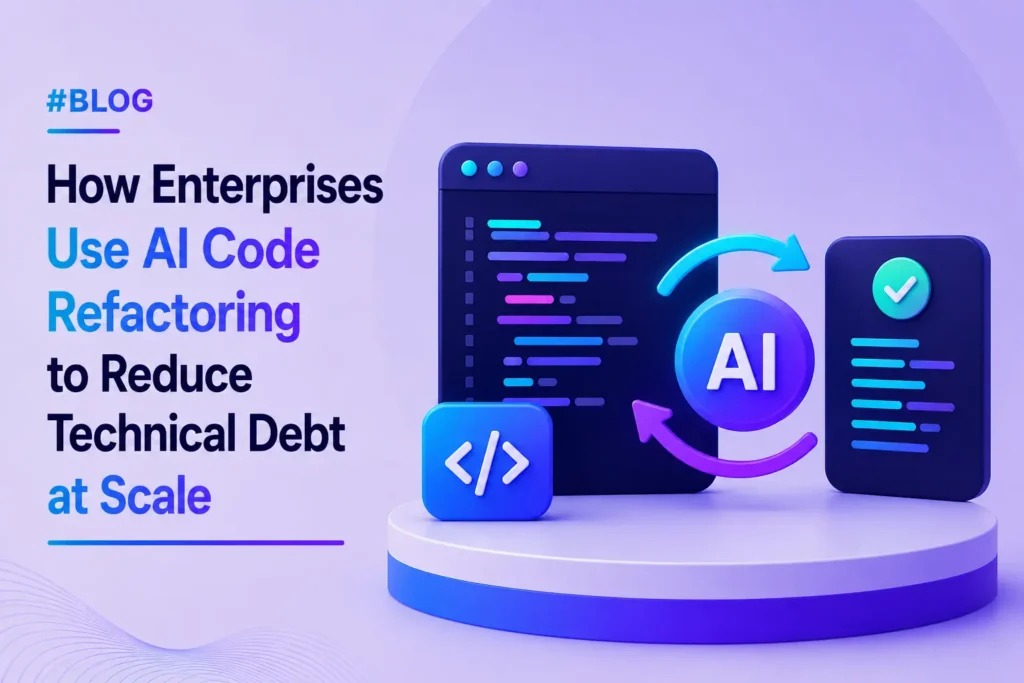
This guide explains how enterprises use AI code refactoring to reduce technical debt at scale. We cover what it is, how it works, best practices, how to refactor legacy code safely, how to validate the results, and how Wizr AI helps.
Here is why this matters now. AI coding tools have made writing code faster than ever, but they have also made it easier to pile up messy, duplicated code that no one fully understands. That means the very tools boosting output are also feeding technical debt. The enterprises that win in 2026 are the ones using AI on both sides of the equation, to write code faster and to clean it up continuously, so speed does not quietly turn into fragility.
For CIOs, this is a strategic issue, not just an engineering one. Technical debt slows down every product roadmap, raises the cost of every change, and eats into the budget for new features. Treating refactoring as a first-class, funded activity, powered by AI, is how forward-looking leaders protect both delivery speed and the bottom line. This guide is written with that leadership view in mind.
What Is AI Code Refactoring and How Does It Work?
AI code refactoring is the use of artificial intelligence to restructure existing code without changing what it does. The goal is to improve quality, readability, and maintainability, not to add features.
In practice, that means an AI reading a tangled 500-line function and proposing a clean set of smaller ones, or spotting the same logic copied across ten files and suggesting a single shared version. The behavior stays identical, but the code becomes easier and cheaper to work with, which is exactly what enterprises need across millions of lines.
The term comes from a simple idea: code, like a house, needs upkeep. Over time, quick fixes and workarounds make it harder to change, and refactoring is the cleanup that keeps it healthy. AI code refactoring simply brings modern models to that job, so the cleanup happens faster and across far more code than a team could handle by hand.

Traditional refactoring is slow and manual. A developer reads the code, spots problems, and rewrites them by hand. AI-powered code refactoring speeds this up by analyzing code, spotting issues, and suggesting or applying improvements automatically.
To be clear, refactoring is different from rewriting or adding features. Rewriting replaces code with something new, and feature work changes what the software does. Refactoring keeps the behavior identical and only improves the structure underneath, like tidying a messy room without changing what is in it. That distinction is what makes refactoring both safe and high-value, since you reduce risk and cost without touching the product’s behavior.
How does AI code refactoring work?
At a high level, AI automated code refactoring works in a few clear steps. It is less a single action than a loop, where the AI proposes, tests confirm, and a human approves, repeated across the codebase. Here is the typical flow:
- Analysis. The AI reads your codebase and builds an understanding of its structure, dependencies, and patterns. Modern models hold far more context than older tools, so they grasp how one file relates to the rest of the system.
- Detection. It finds code smells, duplication, dead code, security risks, and overly complex functions. It can rank these by severity, so you fix the riskiest issues first instead of chasing cosmetic ones.
- Suggestion. It proposes cleaner versions, from renaming variables to restructuring whole modules. Each suggestion comes as a reviewable diff, so an engineer can see exactly what would change before anything is applied.
- Validation. It runs or generates tests to confirm the behavior stays the same. If a test fails, the change is flagged rather than merged, so broken refactors never reach production.
- Review. A human engineer approves the change before it merges. This keeps accountability with people, which matters most for critical or regulated systems.
The key word is behavior. Good refactoring changes how code is written, never what it does. Modern AI tools understand context across files, which is why they can safely restructure code that older, rule-based tools could not. Knowing how to use AI for code refactoring well means treating the AI as a fast assistant, not an autopilot, since a human still reviews and approves each change. Some of the best AI tools for real-time code refactoring even work inside the editor, flagging issues and suggesting cleaner code as developers type, so debt gets caught the moment it appears. The real leap from older tools is context: because modern models read across your whole codebase, they can spot a duplicate buried in another module or a pattern that only makes sense given how the rest of the system works. For teams building on this foundation, Wizr’s guide on AI-powered product engineering shows how refactoring fits into a wider engineering practice.
How AI Code Refactoring Reduces Technical Debt in Enterprise Codebases
Technical debt is the hidden tax on every enterprise. It shows up as slower releases, more bugs, and rising maintenance costs. The Stripe Developer Coefficient found that developers lose around 42 percent of their week to technical debt and bad code.
AI code refactoring attacks that debt directly, and at a scale humans cannot match alone. The idea is simple: debt grows quietly, one shortcut at a time, until it drags down the whole delivery system. AI gives you a way to push back just as steadily, cleaning up code faster than it accumulates. Think of it like compound interest working in your favor for once, since small, consistent improvements add up to a much healthier codebase over time. Here is how it helps enterprise codebases.
It finds debt you cannot see
AI scans millions of lines and flags the risky, duplicated, and overly complex code that humans miss. This gives leaders a clear map of where debt lives and what it costs. You cannot fix what you cannot find. Just as important, it turns a vague worry into a prioritized list, so you can point engineering effort at the modules that change often and break often, instead of guessing where the pain is.
It cleans up AI-generated debt
Ironically, AI coding tools are a major source of new debt. Gartner reports that about 75 percent of enterprise software engineers will use AI coding assistants by 2026, up from less than 10 percent in 2023. That code is fast to write but often duplicated and inconsistent, since the model does not know your conventions or past design decisions. AI refactoring cleans it up before it compounds, catching the copy-paste patterns and near-duplicates that quietly erode a codebase’s coherence.
It reduces debt continuously
Instead of one big cleanup, AI-powered code refactoring can run continuously in your pipeline. Every commit gets checked and improved, so debt stops piling up. This shift from one-time projects to steady maintenance is what makes it work at enterprise scale. It also changes the economics: continuous, small cleanups cost far less than a giant remediation project later, and they keep delivery fast instead of grinding to a halt for a cleanup sprint. Wizr’s guide on why enterprise AI apps fail and how to fix them shows why this steady, governed approach matters.
It gives leaders a business case
Refactoring is easier to fund when you can show the payoff. AI turns code health into numbers, complexity scores, duplication rates, and change failure rates, that leaders can track over time. That makes it possible to treat technical debt like any other business risk, with a budget, an owner, and a measurable trend line, rather than a vague engineering complaint. It also helps you tie cleanup to outcomes leaders care about, like faster feature delivery and fewer production incidents, so the case for refactoring speaks the language of the business, not just the engineering team.
AI Code Refactoring Best Practices for Enterprise Codebases
Getting value from AI refactoring takes more than a tool. These AI code refactoring best practices help enterprises get real results without new risk. The theme running through all of them is control: you want the speed of AI with the safety of disciplined engineering, so cleanup never turns into a new source of bugs.
- Start small and prove value. Begin with one module or service, measure the impact, then expand. A contained win builds trust and a template you can reuse, and it gives you real numbers to justify a wider rollout.
- Always keep a human in the loop. AI suggests humans decide. Every AI-refactored change should get expert review before it merges, especially for critical systems, since a model can miss business rules and edge cases a person would catch.
- Refactor in small, safe steps. Many small changes beat one giant rewrite. Small diffs are easier to review, test, and roll back if something breaks, and they keep the codebase shippable the whole way through.
- Lean on tests as your safety net. Strong test coverage is what makes refactoring safe. Add characterization tests before refactoring code that lacks them, so you can prove behavior stayed the same rather than hoping it did.
- Target your worst debt first. Focus on the code that changes often and breaks often, since that is where cleanup pays back fastest. Use complexity and churn data to find these hotspots instead of relying on gut feel.
- Track the right metrics. Measure complexity, duplication, and change failure rate, not lines of code, so you can prove the debt is actually going down. Sharing that trend with leadership keeps refactoring funded and visible.
Follow these consistently, and refactoring becomes a steady habit rather than a risky event. For teams weighing tools and platforms, our CIO’s checklist for agentic AI workflow solutions helps you evaluate options against enterprise needs.
A quick word on tools, since this is where most buyers start. The market for AI code refactoring tools has grown fast, and no two are alike. When you run an AI code refactoring tools comparison, look past the demo and check how each one handles your languages, your scale, and your compliance rules. The best platforms for code refactoring in AI combine deep analysis, test generation, and safe, reviewable changes, while the top software for refactoring code with AI also plugs cleanly into your existing pipeline. Independent reviews of AI-driven code refactoring tools are useful, but the real test is a short pilot on your own code. Many teams also want AI tools for code review and refactoring in one place, so review and cleanup happen together rather than in separate steps.
How to Refactor Legacy Code With AI Safely at Enterprise Scale
Legacy code is where debt hurts most. It is old, poorly documented, and often has no tests, yet it runs critical business processes. Here are the best practices for AI refactoring legacy code safely. The stakes are high, since a single bad change to a core system can take down billing, orders, or payroll, so the whole approach is built around reducing risk at every step.
Step 1: Understand before you change
Use AI to map the legacy system first. Modern tools can read undocumented code and explain what it does, which is often the hardest part of legacy work. Never refactor code you do not understand. This is a genuine breakthrough, since the engineers who originally wrote the system have often moved on, and AI can rebuild that lost knowledge by tracing how data and logic actually flow through the code.
Step 2: Build a test safety net
Before changing anything, use AI to generate characterization tests that capture the current behavior. These tests are your safety net, since they catch any change that alters what the code does. This step is non-negotiable for legacy systems, because without tests you are refactoring blind, and even a small mistake can slip into production unnoticed. AI makes this practical by writing tests for code that never had any, turning an impossible task into an afternoon’s work.
Step 3: Refactor incrementally
Avoid the big-bang rewrite, which is where most modernization projects fail. Instead, use a pattern like Strangler Fig, replacing the old system in small slices while it keeps running. Companies like Netflix and Shopify used this incremental approach to modernize safely. Each slice is small enough to test, review, and roll back on its own, so the system stays live and stable the whole way through, and the business never has to bet everything on one risky cutover.
Step 4: Keep humans in control
AI does the heavy lifting, but engineers make the calls. Every change to a critical legacy system should be reviewed by someone who understands the business impact. This is how you move fast without breaking things. The AI handles the tedious, large-scale work of reading and restructuring code, while humans focus their judgment where it matters most, on edge cases, business rules, and the decisions a model cannot safely make alone.
For a deeper look at modernizing older systems, Wizr’s guide on AI legacy application modernization services walks through the full approach.
How Enterprises Validate AI-Refactored Code for Quality and Reliability
Refactoring is only safe if you can prove the code still works. Validation is what separates a smart refactoring program from a risky one. This matters even more with AI, since a change can look perfect and still behave differently in a subtle way. Here is how enterprises check AI-refactored code for quality and reliability.
- Automated testing. Run your full test suite on every change, including unit, integration, and regression tests, to confirm behavior is unchanged. This is the fastest, cheapest check and should gate every merge automatically.
- Behavioral comparison. Compare the output of the old and new code on real inputs. If they match, the refactoring is safe. Shopify built tooling that did exactly this, automatically catching differences before they reached customers.
- Static analysis. Use tools that scan for bugs, security flaws, and quality issues in the refactored code before it ships. This catches whole classes of problems, like injection risks or null-handling bugs, that tests might miss.
- Human code review. A senior engineer reviews the change, focusing on logic, edge cases, and business impact that tools might miss. Human judgment is the last line of defense, and it is where deep system knowledge earns its keep.
- Staged rollout. Release refactored code gradually, watching production metrics closely, so any issue is caught early and small. Canary releases and feature flags let you limit the blast radius if something slips through.
The goal is confidence. When automated tests, static analysis, and human review all agree, you can ship refactored code without fear. This layered check is essential, since AI-generated code can introduce subtle bugs that only show up under real conditions. Research has found that AI-generated code introduces security flaws in a meaningful share of cases, which is exactly why validation cannot be skipped. Think of it as defense in depth: each check catches a different kind of problem, so a flaw that slips past one layer gets caught by the next. Wizr’s guide on enterprise AI pilots failing to reach production covers why this rigor matters for any AI initiative.
How Wizr AI Helps Enterprises Reduce Technical Debt With AI Code Refactoring
Wizr AI is not only a platform. It is a platform plus the services that help enterprises modernize software and reduce technical debt at scale. Founded in 2023, Wizr focuses on enterprise AI automation and AI-driven software engineering, which map directly to the refactoring work in this guide. Rather than describe Wizr in the abstract, here is how it maps to the exact stages of reducing technical debt covered above, from finding debt to validating the fix.
Finding and refactoring debt (analysis and cleanup). Wizr’s Enterprise Digital Engineering services and the Glidepath AI SDLC accelerator bring AI into the full software lifecycle, from analyzing a codebase and spotting debt to refactoring, testing, and release. This helps teams find the debt they cannot see and pay it down while they ship, rather than in a separate cleanup project.
Refactoring legacy code safely (modernization). A lot of technical debt lives in older systems, which is the hardest debt to tackle. Wizr helps enterprises understand, refactor, and modernize legacy applications incrementally, so critical systems get faster and cheaper to maintain without a risky big-bang rewrite. This maps directly to the safe, step-by-step legacy approach in this guide.
Custom engineering for complex codebases. When refactoring needs go beyond off-the-shelf tools, Wizr’s custom AI application development services and its generative AI software development company services build the exact solutions your codebase needs, with quality and governance built in. This is where enterprises with unusual stacks or strict requirements get refactoring that fits their reality.
Validation and governance (proving the fix). Reducing debt only counts if the code still works. Wizr is SOC 2 Type II and ISO 27001 compliant, so refactoring runs with access controls, audit trails, and human oversight, and changes are validated before they ship. This is what makes AI-assisted change safe in regulated environments, and it mirrors the layered validation this guide recommends.
The results speak for themselves. For a leading logistics SaaS firm, Wizr drove up to 50% faster response times and deflected around 43% of support tickets, and across customers 90% of pilots reach production. That production rate matters here, since reducing technical debt is only valuable if the improved code actually reaches users safely. Enterprises like Chrysler, Project44, and Fragomen build with Wizr. You can talk to the Wizr team to see how this fits your codebase.
Conclusion
Technical debt is one of the biggest drags on enterprise software, and AI is making it grow faster. The good news is that AI code refactoring is also one of the most powerful tools to fight back.
The path is clear. Use AI to find and clean up debt, keep humans in the loop, refactor in small safe steps, validate everything, and make it a continuous habit rather than a one-time project. Do this, and your codebase gets faster, safer, and cheaper to maintain.
The enterprises that pull ahead in 2026 will treat technical debt as a managed risk, not an afterthought. They will use AI to keep their code healthy the same way they use it to ship features, steadily and with the right guardrails. That balance of speed and discipline is what turns AI from a source of debt into the cure for it.
When you are ready to reduce technical debt and modernize your codebase at scale, Wizr AI can help you do it with the right mix of AI-powered engineering and services.
FAQs
1. What is AI code refactoring?
AI code refactoring is the use of artificial intelligence to restructure existing code so it is cleaner, safer, and easier to maintain, without changing what it does. It analyzes your codebase, finds issues like duplication and complexity, and suggests or applies improvements. In short, it makes code better on the inside while keeping the same behavior on the outside.
Unlike traditional manual refactoring, AI can scan millions of lines quickly and understand context across files. That scale is what makes it useful for large enterprise codebases, where manual cleanup would take months of engineering time.
Wizr AI helps enterprises apply this at scale, pairing AI-powered engineering with the services to reduce technical debt safely.
2. How does AI code refactoring reduce technical debt?
AI code refactoring reduces technical debt by finding and cleaning up messy, duplicated, and overly complex code across your codebase. It surfaces debt humans miss, cleans up the debt that AI coding tools create, and can run continuously so debt stops piling up. The result is code that is cheaper to maintain and faster to change.
The biggest shift is from one-time cleanups to continuous improvement built into your pipeline. That is what keeps debt under control at enterprise scale, since it stops debt from accumulating faster than you can pay it down.
Wizr AI helps enterprises build this continuous, governed approach into their software delivery.
3. What are the best AI tools for code refactoring?
The best AI tools for code refactoring depend on your stack and goals, but strong options in 2026 combine deep code analysis, context awareness across files, test generation, and safe, reviewable changes. Enterprise buyers should look for tools with governance, security, and integration into existing pipelines, not just raw code suggestions. The right choice fits your languages, your systems, and your compliance needs.
When people ask which is the leading AI model for technical debt reduction, the honest answer is that the model matters less than the workflow around it. The most advanced AI code refactoring tools 2026 has produced all pair strong models with testing, review, and governance. For enterprises, a platform-plus-services approach often works better than a standalone tool, since complex legacy code needs both technology and expertise. That is also why recommendations for AI code refactoring services, not just tools, are worth seeking when your codebase is large or regulated.
Wizr AI offers this combination, helping enterprises refactor and modernize with engineering support built in.
4. Is AI code refactoring safe for enterprise systems?
Yes, when done with the right guardrails. Safe AI refactoring keeps a human in the loop, works in small reviewable steps, and validates every change with automated tests and static analysis before it ships. The risk comes from unreviewed, large-scale changes, not from AI assistance itself.
Strong test coverage and staged rollouts are what make it safe for critical systems. AI does the heavy lifting, but engineers keep control of the decisions. The teams that get burned are usually the ones that let AI apply large, unreviewed changes at once, which is exactly the practice to avoid.
Wizr AI builds these guardrails into its engineering services, so refactoring stays safe and auditable.
5. How do you refactor legacy code with AI?
To refactor legacy code with AI, start by using AI to understand and document the existing system, then generate characterization tests to capture its current behavior. Refactor incrementally, using a pattern like Strangler Fig to replace the old system in small slices while it keeps running. Keep engineers in control of every change to critical systems.
This incremental approach avoids the big-bang rewrite, which is where most legacy modernization projects fail. Slow and safe beats fast and broken, especially when the system runs core business processes that cannot go down.
Wizr AI specializes in safe legacy modernization, combining AI refactoring with services to reduce risk.
6. How do enterprises validate AI-refactored code?
Enterprises validate AI-refactored code with layered checks: automated tests to confirm behavior is unchanged, behavioral comparison of old and new outputs, static analysis for bugs and security flaws, human code review, and staged rollouts with close monitoring. When all these agree, teams can ship with confidence.
This rigor matters because AI-generated changes can introduce subtle bugs that only appear under real conditions. Validation is the safety net that makes refactoring trustworthy. The most effective teams automate as much of this as possible, gating every merge on tests and analysis, so validation happens on every change without slowing anyone down.
Wizr AI helps enterprises put these validation practices in place, so quality and reliability stay high.
7. What are the best AI code refactoring tools in 2026?
The best AI code refactoring tools 2026 offers share a few traits: they understand context across a whole codebase, generate tests to protect behavior, integrate with your CI/CD pipeline, and keep humans in control of every change. Some focus on batch cleanup of large legacy systems, while the best AI tools for real-time code refactoring 2026 has to offer work inside the editor as developers write. The right pick depends on whether your priority is cleaning up existing debt or preventing new debt at the keyboard.
For enterprises, the tool is only half the answer. Governance, security, and engineering expertise matter just as much, especially for regulated or mission-critical systems. The tool finds and drafts the change, but people and process decide whether it is safe to ship.
Wizr AI brings the platform and the services together, so enterprises get refactoring that is safe, governed, and built for scale.
About Wizr AI
Wizr AI helps enterprises build autonomous operations and accelerate software delivery with practical, production-ready AI. Our secure, modular platform enables teams to build, govern, and scale AI agents and intelligent workflows across Customer Support, IT Support Management, and Finance & Accounting. Through AI-powered engineering services, Wizr also helps organizations accelerate software development and modernization. With pre-built and configurable AI agents, along with enterprise-grade security and integrations, Wizr makes it easy to move from pilot to production with real business impact.
See how Wizr AI can help your teams move faster. 👉 Get in touch.


![Agentic AI vs AI Agents: Key Differences Every CIO Must Know [2025 Guide]](https://wizr.ai/wp-content/uploads/2025/07/Agentic-AI-vs-AI-Agents.webp)
![Agentic AI vs Traditional Automation: Why Enterprises Shift for Better CX [2025]](https://wizr.ai/wp-content/uploads/2025/06/Agentic-AI-vs-Traditional-Automation.webp)

![11 Real-World AI Agents Examples + Use Cases for Enterprises [2025]](https://wizr.ai/wp-content/uploads/2025/05/AI-Agents-Examples-Use-Cases.webp)