AI agents are moving from demos to real work. They plan, decide, and act across your systems, not just answer questions. But an agent that dazzles in a demo often falls apart in production, and the reason is almost always the architecture behind it.
That is the heart of this guide. Enterprise Agentic AI Architecture is the blueprint that lets agents run reliably, securely, and at scale. Get it right, and agents become a trusted digital workforce. Get it wrong, and you get sprawl, risk, and runaway cost.
The shift is happening fast. Gartner expects 40% of enterprise applications to include task-specific AI agents by the end of 2026, up from less than 5% in 2025. The question for CIOs is no longer whether to build agents, but how to architect them properly.
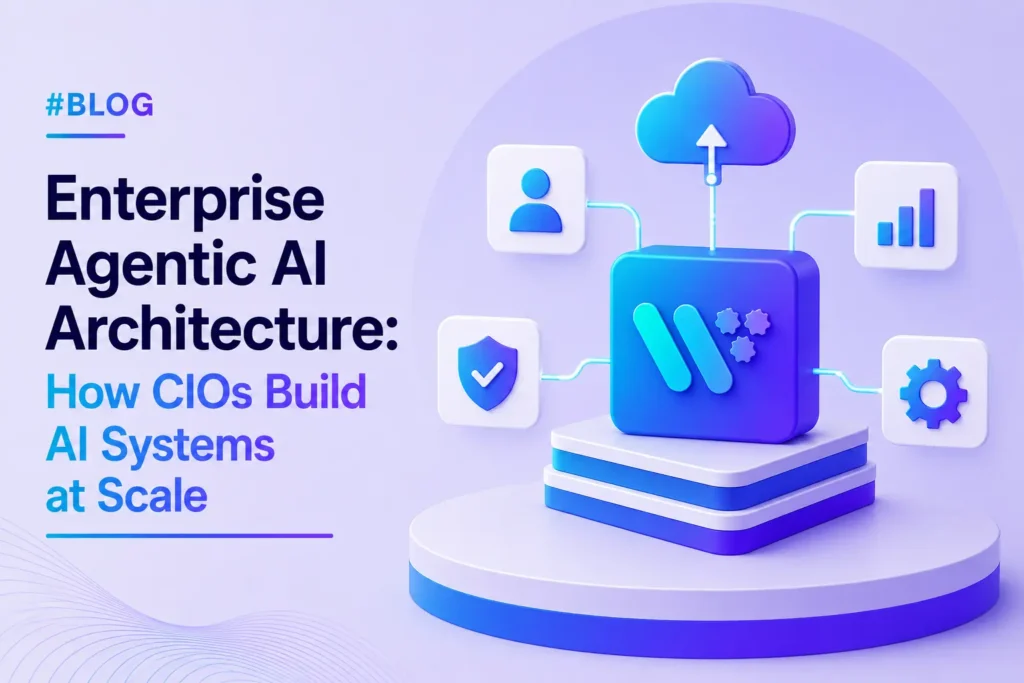
This guide breaks down what enterprise agentic AI architecture is, its key components and layers, and how to design a secure, scalable system. Think of it as a practical architecture blueprint for CIOs and enterprise architects.
The shift matters because agents change what architecture has to do. A chatbot only had to return an answer. An agent has to decide, act on real systems, and be accountable for what it does. That raises the bar on data, security, and coordination, and it is exactly why so many teams that nailed the pilot struggle to reach production. Getting the architecture right is what closes that gap.
This is a CIO-level concern, not just an engineering one. Every architectural choice, how much autonomy an agent gets, which systems it can touch, who signs off on risky actions, is also a decision about accountability and control. That is why the strongest agentic programs treat architecture as a leadership topic, with the CIO setting the guardrails and the engineering team building within them. Read this guide with both hats on.
What Is Enterprise Agentic AI Architecture?
Enterprise agentic AI architecture is the structural design that lets AI agents perceive, reason, plan, and act across enterprise systems in a governed, reliable way. It defines how agents think, how they use tools and data, how they coordinate, and how you keep them safe.
Here is the simplest way to see it. Traditional AI pipelines follow fixed, predefined steps. Agentic architecture is different, since agents reason toward a goal, choose their own actions, and adapt as conditions change. Where older automation encodes exactly how a task is done, agentic systems are told what to achieve and left to work out the how, which is powerful but also why they need firm boundaries around them.

So what is agentic AI architecture in practice? It is the difference between a chatbot that looks up an order and a system that spots a problem across thousands of orders, coordinates with inventory and logistics agents, proposes a fix, logs every action, and escalates to a human when needed. That second system does not happen by accident. It is architected.
This matters because agents take real actions. As Kore.ai CEO Raj Koneru puts it, building everything from scratch is “expensive,” and most open-source frameworks lack enterprise-grade reliability and support. A strong architecture is what turns raw AI power into dependable business outcomes. For a closer look at building these systems, Wizr’s guide on building multi-agent applications is a useful companion.
It also helps to be clear about what this architecture is not. It is not a single model or a clever prompt, and it is not a workflow automation tool with a chat box bolted on. It is a coordinated system of reasoning, memory, tools, data, and governance that together let agents act with autonomy inside firm boundaries. Getting that distinction right early saves a lot of pain later, since teams that treat an agent as just a smarter chatbot tend to skip the layers that make it safe at scale.
Key Components of Agentic AI Architecture for Enterprise Systems
Every agentic system is built from the same core building blocks. Understanding these agentic AI architecture and components is the first step to designing one that works. Together they form an agentic AI architecture framework you can reuse across every use case, from a single agent to a full agentic AI workflow architecture spanning many departments. Here are the six that matter most.
1. Reasoning engine
This is the brain of the agent, usually a large language model. It interprets goals, weighs options, and decides what to do next. In enterprise systems, teams often route tasks across two or three models, using smaller ones for simple work and larger ones for hard reasoning. This model routing is a real cost lever, since sending every request to a top-tier model gets expensive fast, while a well-tuned mix keeps quality high and spending under control.
2. Planning
Planning breaks a big goal into small, executable steps. Instead of answering in one shot, the agent maps out a sequence of actions, then adjusts as it learns. Patterns like ReAct, where the agent reasons and acts in a loop, live here. Good planning also knows its limits, so the agent can recognize when a task is too ambiguous or risky and hand it back to a human rather than guessing its way forward.
3. Memory
Memory is what makes agents smart over time. Short-term memory holds the current task and context, while long-term memory stores past interactions, facts, and learned patterns. Without memory, an agent forgets everything the moment a task ends. In practice, long-term memory often lives in a vector database, and it is an engineered part of the system rather than something the model provides on its own, so how you design and govern it directly shapes how reliable the agent feels.
4. Tools and integrations
Tools are how agents act in the real world. Through APIs and connectors, agents read and write to your CRM, ERP, ITSM, and databases. Open standards like the Model Context Protocol are quickly becoming the common way to connect agents to tools and data. Each tool should expose clear inputs, outputs, and error handling, so the agent uses it predictably, and each connection should be scoped to only what the agent truly needs, since every new tool is also a new way for things to go wrong.
5. Orchestration
Orchestration is the coordination layer that ties everything together. It manages multi-agent collaboration, hands off tasks between specialized agents, tracks workflow state, and enforces human-in-the-loop checkpoints. This is where a multi-agentic AI architecture becomes a coordinated team instead of a crowd. The most common failure point in multi-agent systems is context loss at handoffs, where one agent passes a task to another but the full reasoning context does not transfer, so strong orchestration treats every handoff as a complete transfer of what was seen, decided, and done.
6. Governance and security
Governance runs across every component, not just one. It covers identity, access controls, guardrails, audit trails, and observability. Every action an agent takes should be traceable, permitted, and within clear limits. This is what makes agents safe to run in production, especially in regulated industries where an unlogged action can become a compliance problem. Wizr’s guide on why enterprise AI apps fail and how to fix them shows what happens when these controls are missing.
Together, these six components turn a single model into a coordinated system. The reasoning engine thinks, planning sequences of the work, memory keeps context, tools take action, orchestration coordinates, and governance keeps it all safe. Remove any one, and the system either breaks or becomes a risk. The art of good architecture is not just having these parts, but wiring them together so context, permissions, and accountability flow cleanly between them.
Enterprise Agentic AI Architecture Layers: How the Pieces Work Together
Components are the parts. Layers are how they stack into a working system. A clear agentic AI layered architecture is what keeps large deployments reliable, and most agentic AI reference architecture models in 2026 converge on the same six layers, with governance running through all of them. This shared enterprise agentic AI architecture framework is now the common language architects use to design agentic systems.
Here is a simple enterprise agentic AI architecture diagram, shown as a stack from the user down to your data. You can read it as an agentic AI system architecture diagram, where each box is a layer and requests flow top to bottom and back:
| Interaction Layer (apps, chat, interfaces) |
| Orchestration Layer (coordination, planning) |
| Agent Layer (specialized agents, reasoning) |
| Model Layer (LLMs, multi-model routing) |
| Tool & Integration Layer (APIs, MCP, systems) |
| Data & Memory Layer (RAG, vector DB, stores) |
| Governance, Security & Observability span all layers |
Here is what each layer does:
- Interaction layer. The user-facing apps, chat interfaces, and no-code tools where people work with agents.
- Orchestration layer. The control plane that coordinates agents, manages state, routes tasks, and enforces approvals. This is where most governance is applied.
- Agent layer. The specialized agents themselves, each with a domain focus like IT, finance, or customer support, plus their own reasoning and memory.
- Model layer. The foundation models that power reasoning, often with a gateway that routes across several models for cost and reliability.
- Tool and integration layer. The connectors and APIs that let agents act on your real systems, increasingly through open standards.
- Data and memory layer. The retrieval pipelines, vector databases, and knowledge bases that ground agents in real enterprise data.
- Governance and security (cross-cutting). The access controls, guardrails, audit logs, and observability that run through every layer, so no matter where an action happens, it is permitted, logged, and monitored.
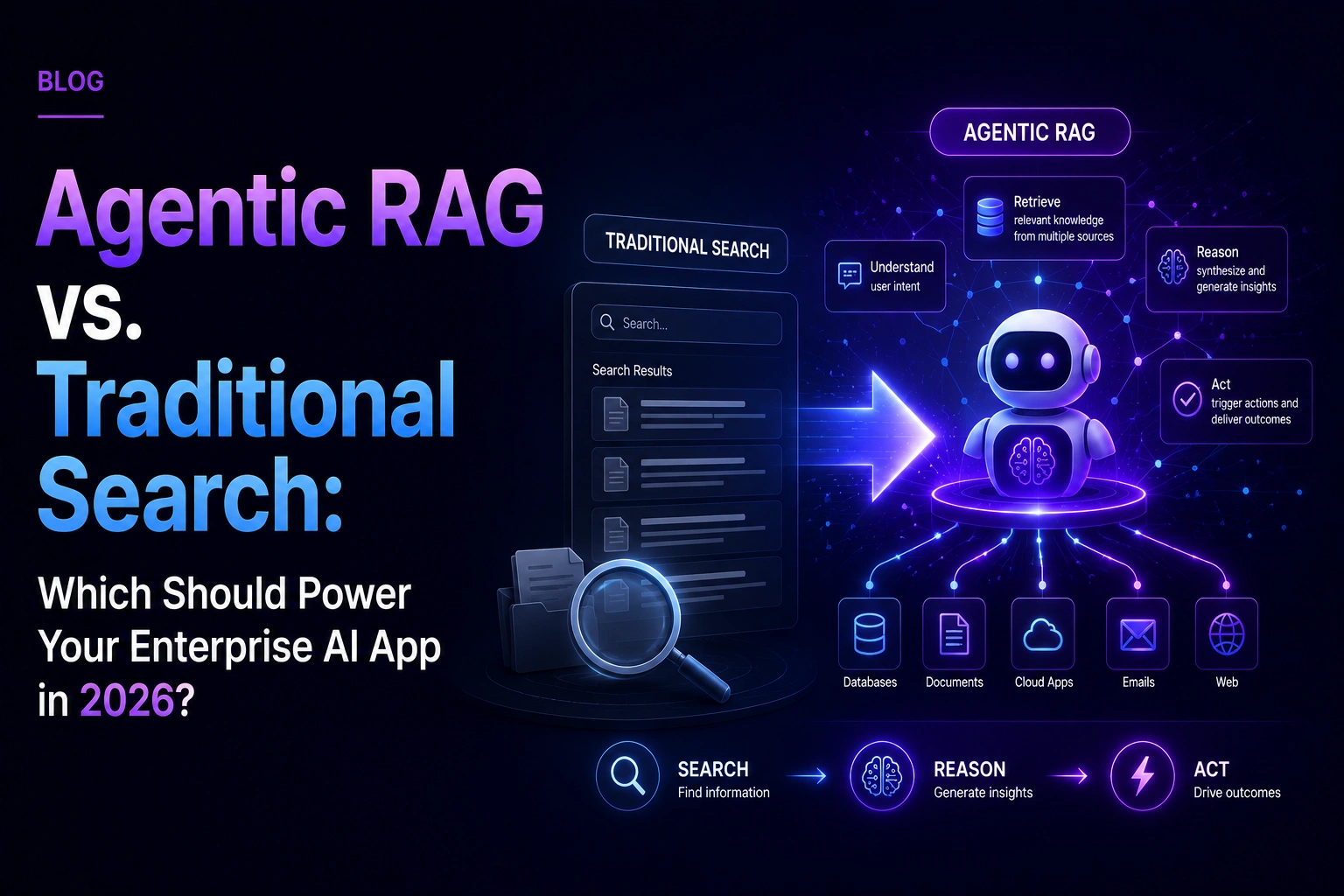
The layers matter because they separate concerns. When reasoning, coordination, execution, and data are cleanly divided, the agentic AI system architecture is easier to secure, debug, and scale. When they are tangled together, it becomes fragile fast. Common agentic AI architecture examples follow this same layered shape, from autonomous customer support to finance and IT operations. Wizr’s take on agentic RAG versus traditional search digs into how the data layer grounds agents and cuts hallucinations.
To make it concrete, follow a support request through the stack. A customer message enters at the interaction layer. The orchestration layer decides which agents to involve and in what order. A support agent reasons using the model layer, pulls the order history from the data layer, and issues a refund through the tools layer, all while the governance plane checks permissions and logs each step. If anything looks risky, it escalates to a human. That clean flow, layer by layer, is what makes the difference between a reliable system and an unpredictable one.
How to Design a Secure and Scalable Agentic AI Architecture
Knowing the parts is one thing. Designing them into a system that is safe and scales is another. Here are the design principles that separate a reliable agentic AI deployment architecture from a fragile one. Think of these as the agentic AI technical architecture decisions that make an enterprise agentic AI platform architecture production-ready rather than just demo-ready. Each one is a lever a CIO can pull, and together they turn a fragile prototype into a system the business can depend on.
Separate reasoning, orchestration, and execution
Keep the thinking, the coordinating, and the doing in distinct layers. When these are mixed, systems become hard to debug and govern. Clean boundaries are the single most important design choice for reliability. A practical rule is that orchestration manages workflow state while agents focus on reasoning and task execution, and tools handle the actual actions. When something goes wrong, this separation lets you pinpoint whether the failure was in the plan, the coordination, or the action, instead of untangling one giant loop.
Constrain agent autonomy
Give each agent only the tools, data, and permissions it truly needs. Least-privilege access limits the damage if an agent misbehaves or is compromised. Define clear scope and safety policies for every agent, and treat each new tool you connect as a decision, not a default. Match the level of autonomy to the level of risk: a read-only agent that summarizes reports needs far lighter controls than one that can issue refunds or change records. Route those high-stakes actions through human approval until the agent has earned trust in production.
Ground agents in enterprise data
Agents that reason without real data make confident but wrong decisions. Use retrieval and clean data pipelines to ground every agent in a verified enterprise context. This is what prevents hallucinations from compounding at scale. The data engineering work here is the same work that powers reliable analytics, so it pays off twice. Add semantic caching and clear data ownership so agents pull from a trusted, current source rather than a stale copy, since context contamination is one of the most common causes of wrong outputs.
Build governance and observability into every layer
Do not bolt governance on later. Log every action, tool call, and decision, and make the whole system auditable. Standards like the NIST AI RMF, and rules like the EU AI Act with major obligations in August 2026, expect this level of oversight. Treat governance as a control plane that spans reasoning, retrieval, memory, and execution, not a checklist you run once. Real-time observability, with alerts for drift, cost spikes, and unusual behavior, is what lets you catch a failing agent before it reaches a customer or an auditor.
Design for failure and human oversight
Agents will fail, so design for it. Build in retries, fallback logic, recoverable state, and human-in-the-loop checkpoints for high-risk actions. A workflow that recovers gracefully beats one that breaks silently. It helps to sketch an agentic AI workflow architecture diagram for each process, mapping every handoff, retry, and escalation point before you build. For bespoke processes that off-the-shelf agents cannot cover, custom AI application development services can build the exact resilience and control your workflow needs.
Stay modular and avoid lock-in
Use open standards and a modular, model-agnostic design, so you can swap models and tools as they evolve. Single-vendor architectures impose heavy costs right when you need flexibility most. The models you rely on today may be outmatched in a year, so the freedom to change them without a rebuild is worth protecting. Open protocols like MCP for tool access make this far easier, since agents and tools become portable across frameworks. Our CIO’s checklist for agentic AI workflow solutions helps you evaluate platforms on exactly these points, and our roundup of the best AI agent frameworks for enterprise covers the tools behind these patterns.
The stakes are real. Gartner predicts that over 40% of agentic AI projects will be canceled by the end of 2027, often because architecture and governance were an afterthought. Designing well from the start is how you stay in the winning minority. None of these principles is exotic, and none requires a research breakthrough. They are engineering disciplines applied to a new kind of system, and the enterprises that treat them as non-negotiable are the ones whose agents actually make it to production and stay there.
How Wizr AI Helps Enterprises Build Scalable Agentic AI Systems
Building all of this from scratch can take a year or more of engineering. Wizr AI helps enterprises design, build, and deploy scalable agentic AI systems through Enterprise AI Services and AI-powered engineering expertise. Founded in 2023, Wizr focuses on enterprise AI automation and AI-driven software engineering, which map directly to the architecture in this guide. In practice, Wizr designs agentic AI architectures around your real systems and data, combining governed architecture with hands-on delivery so the design actually reaches production. Rather than describe Wizr in the abstract, here is how its capabilities map to each architectural layer you have just read about.
Agentic AI foundation (agent, model, and memory layers). Wizr’s Agentic AI Framework provides the foundation for building AI agents, AI assistants, and agentic workflows as part of its Enterprise AI Services. Instead of stitching together disconnected open-source components, enterprises can work with Wizr to establish a governed architecture across orchestration, agents, models, and memory. This reduces months of undifferentiated engineering while keeping the architecture aligned with enterprise requirements.
Orchestration and multi-agent workflows (orchestration layer). Wizr’s Agentic Workflows support coordination, task hand-offs, and state management so specialized agents can work together with clean context transfer. Pre-built agents for customer support, IT, and finance provide a fast starting point based on proven patterns rather than requiring enterprises to begin with a blank canvas.
Data, tools, and integration (tools and data layers). Clean integrations connect agents to your CRM, ERP, and ITSM within clear boundaries and ground them in real enterprise data. Wizr’s integration capabilities address the tool and data layers that make or break reliability, helping keep agents grounded in facts rather than guesses.
Governance and security (the cross-cutting plane). Governance is built into the architecture through enterprise-grade security, access controls, audit trails, and human oversight. Wizr is SOC 2 Type II and ISO 27001 compliant, so oversight spans the architecture rather than being limited to a single layer, which is particularly important for regulated industries that need to scale AI safely.
Custom engineering for bespoke architectures. When your architecture needs something beyond standard capabilities, Wizr’s AI-Powered Engineering and Enterprise AI Services can design and build custom agents, integrations, and controls around your existing technology environment. This allows enterprises to extend the reference architecture to fit their exact workflows without compromising governance.
Modular, model-agnostic design. Wizr takes a modular, model-agnostic approach, helping enterprises avoid unnecessary lock-in and adopt new models as they emerge. This protects the architecture as AI technology evolves, so a model upgrade does not automatically require a complete rebuild.
The results back it up
For a leading logistics SaaS firm, Wizr drove up to 50% faster response times and deflected around 43% of support tickets, and across customers, 90% of pilots reach production. That production rate is the real test of an architecture, since a design only matters if it survives contact with real systems and users. Enterprises like Chrysler, Project44, and Fragomen build with Wizr. You can talk to the Wizr team to see how a scalable agentic architecture fits your systems.
Conclusion
Agentic AI is one of the biggest shifts in enterprise technology, but power without structure is a liability. The enterprises that win in 2026 are not the ones with the biggest models. They are the ones that master the architecture, from clean layers and strong components to governance in every layer.
The path is clear. Separate your concerns, ground agents in real data, constrain their autonomy, build governance from the start, and stay modular so you can adapt. Do this, and agents become a dependable part of how your business runs.
If you remember one thing, make it this: with agents, architecture is not a technical detail you sort out later. It is the foundation that decides whether your AI stays a demo or becomes a trusted part of the business. The reasoning power is already here in today’s models. What separates the leaders is the discipline to wrap that power in clean layers, real data, and strong governance.
You do not have to build it all alone. When you are ready to design a secure, scalable agentic AI architecture, Wizr AI can provide the Enterprise AI Services, AI-powered engineering expertise, and agentic AI capabilities to help you get there faster.
FAQs
1. What is enterprise agentic AI architecture?
Enterprise agentic AI architecture is the structural design that lets AI agents perceive, reason, plan, and act across enterprise systems in a secure, governed way. It defines how agents think, use tools and data, coordinate with each other, and stay within safe limits. In short, it is the blueprint that turns autonomous agents into reliable, production-grade systems.
Unlike traditional AI pipelines that follow fixed steps, agentic architecture supports goal-driven, adaptive behavior. That flexibility is powerful, which is exactly why strong structure and governance matter so much.
Wizr AI helps enterprises design and implement governed agentic AI architectures through Enterprise AI Services, AI-powered engineering, and its Agentic AI Framework.
2. What are the main components of agentic AI architecture?
The main components are a reasoning engine, planning, memory, tools and integrations, orchestration, and governance. The reasoning engine decides what to do, planning breaks goals into steps, memory holds context over time, tools let agents act on real systems, orchestration coordinates multiple agents, and governance keeps everything safe and auditable. Together, these components let an agent work reliably in a complex environment.
Each part depends on the others, so a weakness in any one, especially memory or governance, can undermine the whole system.
Wizr AI helps enterprises bring these components together through Enterprise AI Services, Agentic AI Framework capabilities, Agentic Workflows, integrations, security, and governance.
3. What are the layers of an agentic AI architecture?
A typical enterprise agentic AI architecture has six layers: interaction, orchestration, agent, model, tool and integration, and data and memory. Governance, security, and observability run across all of them. This layered design separates reasoning, coordination, execution, and data, which makes the system easier to secure, debug, and scale.
The clean separation is the point. When layers are tangled together, multi-agent systems quickly become fragile and expensive to run.
Wizr AI helps enterprises design and implement these layers through its Enterprise AI Services, AI Assembly capabilities, and AI-powered engineering expertise, creating a coherent architecture rather than a patchwork of disconnected components.
4. How is agentic AI architecture different from traditional AI architecture?
Traditional AI architecture automates predefined steps using fixed rules or workflows. Agentic AI architecture enables adaptive intelligence, where agents reason, decide, and collaborate dynamically to reach a goal. The big shift is from executing a script to pursuing an objective, which requires new layers like orchestration, memory, and tool registries that traditional stacks do not have.
This is why you cannot just bolt agents onto an old architecture. Agentic systems need infrastructure built for autonomy and coordination.
Wizr AI helps enterprises adopt this new paradigm through Enterprise AI Services, Agentic AI Framework capabilities, and AI-powered engineering that bring agentic layers into real enterprise environments.
5. What are common agentic AI architecture patterns?
Common agentic AI architecture patterns include the single-agent tool loop, where one agent uses many tools in a ReAct-style cycle, and the supervisor pattern, where an orchestrator agent delegates to specialized agents. Other patterns include plan-and-execute, where the agent plans first then acts, and multi-agent collaboration for complex, cross-domain workflows. The right pattern depends on how complex the work is and how the agents need to coordinate.
Most enterprise systems combine patterns, using a supervisor to coordinate several specialized agents.
Wizr AI supports these patterns through its Agentic AI Framework and Agentic Workflows, helping enterprises align the architecture with the specific job and workflow requirements.
6. How do you make an agentic AI architecture secure and scalable?
You make it secure and scalable by separating reasoning, orchestration, and execution, constraining each agent to least-privilege access, grounding agents in real data, and building governance and observability into every layer. Designing for failure with retries and human-in-the-loop checks, and staying modular to avoid lock-in, keeps the system reliable as it grows. Security and scale are design choices made early, not features added later.
The enterprises that scale agents successfully treat architecture as a risk and reliability discipline, not just a developer task.
Wizr AI applies these principles through AI Governance, security, integrations, Enterprise AI Services, and AI-powered engineering, helping enterprises build agentic systems with security and scalability considered from the beginning.
7. What does an enterprise agentic AI architecture diagram look like?
An enterprise agentic AI architecture diagram is usually drawn as a layered stack. From the top, it shows the interaction layer, the orchestration layer, the agent layer, the model layer, the tool and integration layer, and the data and memory layer, with governance and security running down the side across all of them. Arrows show how a request flows from the user down to the data and back, with each layer doing its specific job.
The value of the diagram is shared understanding. It gives architects, security teams, and business leaders one picture of how agents reason, act, and stay governed.
Wizr AI helps enterprises implement this layered architecture through Enterprise AI Services, AI Assembly capabilities, and AI-powered engineering, translating the architectural design into working enterprise systems.
8. What are some examples of enterprise agentic AI architecture?
Common examples include autonomous customer support, where agents read tickets, check systems, and resolve issues end to end; IT operations, where agents triage and fix routine incidents; and finance, where agents handle invoice processing and reconciliation. In each case, the same layered architecture applies: agents reason, use tools, pull grounded data, coordinate, and stay under governance. The use case changes, but the architecture pattern stays consistent.
This consistency is what makes the architecture reusable. Once you have the layers in place, adding a new use case means deploying new agents, not rebuilding the stack.
Wizr AI offers AI Agents for customer support, IT support management, and finance and accounting use cases, helping enterprises apply agentic AI architecture to real business workflows.
9. Should enterprises build or buy their agentic AI architecture?
It depends on your skills and timeline, but many enterprises reach production faster by buying a platform than by building the whole architecture themselves. Open-source frameworks are powerful but often lack enterprise-grade reliability, security, and support, which takes years to build in-house. A platform gives you the layers ready to use, so your team focuses on real business capability instead of infrastructure.
In-house teams still matter for domain knowledge and long-term ownership, so a hybrid approach is common, where a platform accelerates delivery while your team builds lasting capability.
Wizr AI works as an Enterprise AI Services and AI-powered engineering partner, helping enterprises design, build, integrate, govern, and scale agentic AI systems while maintaining control over their technology environment.
About Wizr AI
Wizr AI helps enterprises build autonomous enterprises and accelerate product and software engineering with practical, production-ready AI. We help organizations automate business workflows, modernize legacy applications and digital platforms, and build intelligent AI solutions.
Our core services include Enterprise AI Services, AI-Powered Engineering & Legacy Modernization, AI Product Engineering, and AI Governance. We also leverage AI Assembly capabilities, including the Agentic AI Framework, Agentic Workflows, Security, and Integrations.
Through our AI solutions, including AI Agents, Pharma & Life Sciences AI, Oracle AI, and Salesforce AI, we help enterprises apply AI across business and technology needs.
See how we can help your enterprise move faster with AI. 👉 Talk to an AI Expert.


![Agentic AI vs AI Agents: Key Differences Every CIO Must Know [2025 Guide]](https://wizr.ai/wp-content/uploads/2025/07/Agentic-AI-vs-AI-Agents.webp)
![Agentic AI vs Traditional Automation: Why Enterprises Shift for Better CX [2025]](https://wizr.ai/wp-content/uploads/2025/06/Agentic-AI-vs-Traditional-Automation.webp)


![11 Real-World AI Agents Examples + Use Cases for Enterprises [2025]](https://wizr.ai/wp-content/uploads/2025/05/AI-Agents-Examples-Use-Cases.webp)