Generative AI is changing how businesses operate, make decisions, and serve customers. It is no longer just a tool for technical teams. According to McKinsey, more than a quarter of C-suite executives are now using GenAI for their own work. Around 40% of organizations plan to increase their investment in AI, driven by the rapid advancements in generative technology, highlighting the growing need to understand the difference between Generative AI and Large Language Models.
As adoption grows, so does the need for accuracy. Large language models often generate answers that sound right but are based on incomplete or outdated information. This becomes a serious issue when you rely on AI for customer service, compliance, or business insights.

LLM grounding for enterprises helps solve this problem. It connects your AI to accurate, real-time data so that responses reflect what is true and relevant to your business. In this blog, you will learn what LLM grounding for enterprises means, how it works, and which LLM grounding techniques for enterprises can help you get better, more reliable results, including the importance of grounding large language models for enterprises and understanding LLM grounding vs Agentic RAG.
Struggling with AI outputs that sound smart but miss the mark? LLM Grounding connects your large language model to real-time, business-specific data – boosting response accuracy and reducing hallucinations.
This blog breaks down key grounding techniques like RAG, embeddings, and fine-tuning that help your AI deliver reliable, context – aware results across enterprise use cases.
If accuracy, compliance, and trust matter in your AI strategy, this is where you start. Read the full post to explore how Wizr enables grounded, enterprise-grade AI.
What is LLM Grounding?
LLM Grounding is the process of connecting a large language model (LLM) to accurate, domain-specific data so it can generate factually correct and context-aware responses. This ensures that the model doesn’t rely solely on its general training data, but instead references enterprise-specific sources for relevance and accuracy. LLM grounding is gaining momentum as enterprises demand AI that reduces hallucinations and aligns with business knowledge.
By grounding the model in your data, such as product catalogs, customer support logs, HR documentation, or policy manuals, you help it provide relevant and accurate answers. This approach ensures grounded language models for enterprises and supports LLM factual grounding for enterprises by reducing the chances of hallucinations or incorrect outputs. Instead of guessing, the model refers to real information that reflects your business, incorporating data grounding for AI models for enterprises.
In short, grounding LLM for enterprises helps align the model’s responses with your context, language, and workflows. This method also enhances knowledge grounding in LLM, creating a knowledge-enhanced LLM better suited for enterprise needs through LLM and real-world grounding for enterprises.
A Forrester study highlighted that over 60% of enterprises investing in generative AI plan to implement grounding techniques by 2025 to ensure trustworthy outputs. This practice supports compliance, consistency, and productivity across sectors such as customer support, HR, and legal operations.
How LLM Grounding Works for Enterprises?
Grounding large language models for enterprises is not the same as retraining the model. Instead, you are enhancing its ability to answer questions by giving it access to your data during the response process. This happens through techniques like document indexing, vector search, and API calls.
There are several stages involved in grounding LLM for enterprises. Each stage adds a layer of understanding that improves how the model performs in real-world enterprise settings, ensuring LLM and real-world grounding for enterprises, as seen in how large language models transform enterprise workflows.
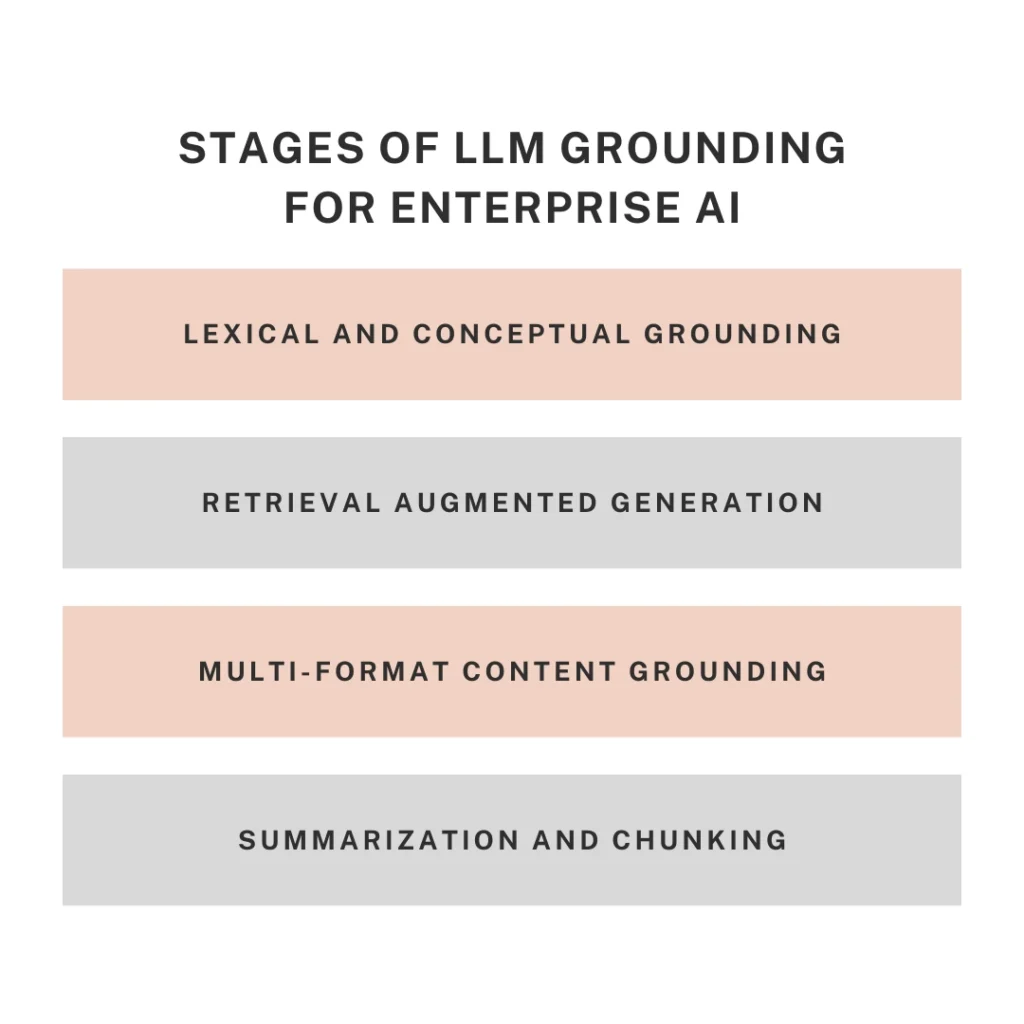
Stages of LLM Grounding for Enterprise AI
| Stage | What It Does | Examples of Data Sources |
| Lexical and Conceptual Grounding | Helps the model understand your company’s terminology and processes. This gives it a better grasp of how your teams communicate and solve problems, supporting knowledge grounding in LLM. | Internal glossaries, knowledge bases, service tickets, chat logs |
| Retrieval Augmented Generation | Allows the model to retrieve relevant content from connected sources before answering. This ensures the output is based on real-time information, incorporating data grounding for AI models for enterprises. | Document indexes, APIs, vector databases |
| Multi-Format Content Grounding | Enables the model to process information in various formats, including structured data and multimedia content, strengthening LLM context grounding for enterprises. | Spreadsheets, PDFs, charts, presentations |
| Summarization and Chunking | Breaks down large or unstructured content into digestible parts. This makes it easier for the model to identify and use important details, enhancing LLM factual grounding for enterprises. | Long-form articles, training materials, and support documentation |
These LLM grounding techniques for enterprises improve the model’s ability to generate precise and meaningful responses. When combined, they form a structured approach that aligns your AI with how your business communicates and operates, resulting in grounded language models for enterprises.
Why LLM Grounding Is Essential for Accurate AI Responses?
Large language model grounding for enterprises is critical because LLMs are built for language, but not for real-world reasoning. They generate responses based on probabilities, not understanding. That works well for general tasks, but not when accuracy, compliance, or customer trust is at stake.
Without grounding, you might run into:
- Stale knowledge: Models are trained on data that may be months or years old. They don’t automatically reflect new regulations, product changes, or policy updates.
- No enterprise context: LLMs don’t know your workflows, tone, or customer relationships unless you provide that information. They can’t see behind your firewall, highlighting the need for knowledge-enhanced LLM.
- Overconfidence in errors: The model may confidently return answers that sound plausible but are entirely incorrect.
These risks increase when you apply AI across departments such as legal, HR, customer service, or finance, areas where the cost of an inaccurate response can be high.
Grounding LLM for enterprises addresses these gaps by giving the model a reliable foundation to work from. Instead of relying on guesswork, it refers to current, relevant data that reflects how your business operates, emphasizing data grounding for AI models for enterprises.
It also gives you more control over what the AI says. You can ensure the tone fits your brand, the facts come from approved sources, and the response is consistent with your internal processes through effective LLM context grounding for enterprises.
For enterprise teams that need AI to support real users, not just generate creative content, grounding isn’t optional. It’s what makes your AI accurate, reliable, and usable on a large scale, validating the importance of LLM grounding for enterprises.
Also, Read: Generative AI vs Large Language Models (LLMs): What’s the Difference? [2025]
Key Techniques for Grounding LLMs in Enterprise AI Systems
Below are the most effective LLM grounding techniques for enterprises you can apply based on your systems, use cases, and data infrastructure, supporting better grounding large language models for enterprises.
- Retrieval-Augmented Generation (RAG)
This is often the starting point for effective LLM grounding for enterprises. Retrieval-Augmented Generation (RAG) works by retrieving relevant documents or data from your enterprise sources before the model generates a response. Instead of relying only on what the LLM was trained on, it pulls live, contextual information from knowledge bases, wikis, product manuals, or support tickets, ensuring strong LLM and real-world grounding for enterprises. This keeps responses accurate and aligned with your organization’s most up-to-date content, especially when powered by Agentic RAG for enterprise environments.
For example, if a customer asks about a product feature update, the system can retrieve the latest documentation to respond accurately, even if the update occurred after the model was trained. This showcases the role of LLM factual grounding for enterprises.
- Fine-Tuning with Domain-Specific Data
To increase accuracy in specialized fields like finance, healthcare, or legal, fine-tune your LLM using vetted, high-quality, domain-specific datasets, enhancing knowledge grounding in LLM. This trains the model to understand terminology, compliance standards, and common industry scenarios, supporting grounded language models for enterprises. Learn more about how this is managed through LLMOps for enterprise use.
Fine-tuning also helps reduce hallucinations by aligning the model with language patterns and knowledge from real, relevant business use cases. It’s beneficial when serving regulated sectors, where even minor mistakes can cause serious issues, ensuring robust LLM grounding for enterprises.
- Embeddings and Semantic Search
When you convert your data into vector embeddings, the model can use semantic search to understand user intent, not just exact keyword matches. This technique strengthens data grounding for AI models for enterprises. It allows the model to surface content that’s conceptually relevant, even if it’s phrased differently across your documents or systems, enhancing LLM context grounding for enterprises.
For large enterprises with tons of unstructured data, this technique greatly improves discovery and response quality. It enables AI to act more like a subject matter expert than a keyword bot, contributing to stronger grounding LLM for enterprises, especially when powered by advanced LLM embeddings and their AI capabilities.
Additional Techniques to Ground LLMs Effectively:
- Real-Time Data Integration via APIs
Connect your AI to real-time data sources using APIs. Whether it’s your CRM, inventory management system, or service desk logs, live data ensures your AI always answers with the latest and most accurate information, reinforcing large language model grounding for enterprises.
- Metadata Logging and Source Attribution
Track the origin of every answer your AI generates. By tagging responses with metadata (like source file, timestamp, or author), your teams can trace back any claim to its original source, building a knowledge-enhanced LLM. This adds transparency and builds trust in high-stakes environments like ITSM, healthcare, or legal services, supporting LLM factual grounding for enterprises.
- Multi-Step Self-Verification
Some models are trained to evaluate their own responses by generating multiple drafts and cross-checking them for consistency, which improves LLM grounding techniques for enterprises. This reduces the chance of flawed or incomplete outputs reaching users.
- Human-in-the-Loop (HITL) Feedback
No AI model is perfect without human input. Involving your subject matter experts in reviewing and correcting AI-generated responses helps train better future outputs. Over time, the loop makes your model more aligned with real-world expectations and internal policies, enhancing grounded language models for enterprises.
Together, these techniques build a reliable foundation for enterprise-grade AI. Use a mix of automation, human oversight, and live data connections to ensure your LLM doesn’t just sound smart, but actually knows what it’s talking about.
How LLM Grounding Improves AI Response Accuracy in Enterprises?
When an LLM isn’t grounded, it draws on general training data, often outdated or too broad for your use case. LLM grounding for enterprises changes that by connecting the model directly to your business data. That way, responses are accurate, reliable, and reflect your real-time information, as demonstrated in how large language models transform enterprise workflows.
Here’s what grounded language models for enterprises deliver:
- Factual accuracy: The model pulls from current policies, documents, and databases.
- Reduced hallucinations: It doesn’t make up answers because it refers to live sources.
- Aligned responses: Your AI reflects your actual business, no assumptions.
Say a customer has a billing question. A grounded model pulls the exact refund policy from your knowledge base. In contrast, an ungrounded one may guess or reference an outdated term, leading to frustration and more support tickets.
In internal tools, LLM grounding techniques for enterprises also play a role:
- HR chatbots can respond with up-to-date leave policies.
- IT bots can give steps tailored to your tech stack.
As a result:
- Teams get consistent answers across the board.
- Changes in data are automatically reflected in AI responses.
- Employees and customers trust the system more.
LLM grounding for enterprises turns your AI into a reliable source, not just a smart one. And in enterprise environments, that difference matters.
LLM Grounding in Action: Enterprise Use Cases
LLM grounding for enterprises is already transforming enterprise teams by connecting AI to relevant data, ensuring accurate, context-aware responses.
- Support and Customer Experience (CX): Coveo grounds AI by linking it to support documentation and tickets, ensuring accurate, consistent answers across all communication channels.
- Internal IT Helpdesks: Aisera grounds its AI with live and historical ticket data, enabling quicker, more relevant IT support by recognizing recurring issues.
- E-commerce Operations: Grounded AI in retail connects to live product feeds and inventory databases, providing real-time, accurate answers on product availability and pricing.
- Finance and Banking: In finance, LLM grounding for enterprises aligns AI with the latest regulatory updates and compliance policies, preventing errors and ensuring reliable responses.
- Healthcare Administrative Support: In healthcare, grounded AI streamlines administrative tasks like scheduling and insurance verification, improving efficiency while ensuring data security.
- Sales and Account Management: Grounding AI in CRM systems and client data helps sales teams by providing tailored, context-specific insights and identifying opportunities.
These examples show how LLM grounding for enterprises enhances AI’s ability to deliver accurate, reliable responses. As demand for AI grows, so does the need for grounded language models for enterprises to ensure trustworthy outputs at scale.
As enterprise interest grows, so does the demand for grounded systems. According to Grand View Research, the global large language model market reached 10.5 billion US dollars in 2023. It is expected to grow at a compound annual growth rate of 34.7 percent from 2024 to 2030. In this environment, grounding LLM for enterprises is not just an enhancement; it is becoming a requirement for delivering trustworthy outputs at scale.
Overcoming LLM Grounding Challenges in Enterprise AI
Grounding LLMs in enterprise settings isn’t plug-and-play. You’ll run into challenges like data quality, latency, cost, and compliance. Here’s how to handle them.
- Scattered and Unstructured Data
Enterprise data often lives in silos and inconsistent formats. Clean, tag, and centralize high-impact content. Use metadata to improve search accuracy and reduce irrelevant answers. This is vital for grounding large language models for enterprises, ensuring more reliable and relevant results.
- Latency and Performance
Real-time grounding can slow responses. Use tiered caching to keep frequent content readily available. Chunk documents and apply staged retrieval – filter broadly first, then run focused semantic search. This ensures LLM factual grounding for enterprises remains effective without compromising speed.
- Balancing Accuracy and Flexibility
Some use cases need strict accuracy; others need creativity. Use confidence thresholds to control how tightly the model stays grounded – strict for factual content, flexible for idea generation. This is key for achieving knowledge-enhanced LLM performance in different scenarios within an enterprise.
- Cost and Scalability
Large-scale retrieval can be expensive. Optimize your RAG pipeline with vector compression, early filtering, and usage tracking. Prioritize grounding for high-impact queries. This will help you balance the cost and scalability of LLM grounding techniques for enterprises effectively.
- Security and Compliance
Sensitive data needs guardrails. Use secure connectors, log sources, and enable audit trails. Add human review for high-risk responses when necessary. This is essential for ensuring LLM context grounding for enterprises is compliant and secure.
LLM grounding isn’t optional, it makes your AI reliable. With clean data, smart retrieval, safety checks, and performance tuning, you can scale grounded AI that works for your business.
Also Read: What Are LLM Embeddings and How Do They Revolutionize AI?
Conclusion
Enterprises adopting LLMs often face the challenge of inaccurate or incomplete AI responses. This usually stems from models working without access to the right business context. Issues like siloed data, real-time performance, regulatory concerns, and scale make grounding large language models for enterprises even more important. By applying practical LLM grounding techniques for enterprises, you can reduce hallucinations, improve response reliability, and make your AI systems more useful across functions like support, sales, IT, and compliance.
Wizr helps enterprises solve these challenges through a combination of Enterprise AI Services, AI-powered automation, and agentic workflows that support structured grounding in real business environments. Our AI services help integrate AI systems with enterprise data while supporting security, performance, and governance requirements. Whether you’re improving response accuracy or building scalable workflows, Wizr AI helps enterprises implement grounded, trustworthy AI across business processes.
If accuracy matters in your AI strategy, LLM grounding is the first step. Explore how Wizr can help you do it right.
FAQs
1. What is LLM Grounding for Enterprises?
LLM Grounding for enterprises connects a large language model (LLM) to real-time, business-specific data, ensuring AI responses are accurate and contextually relevant. It ties the model to structured knowledge like internal databases, documents, and policies instead of relying solely on general training data.
Wizr AI helps enterprises implement LLM grounding through Enterprise AI Services, agentic workflows, and AI-powered automation, making AI-driven processes precise, reliable, and aligned with current business data.
2. How Does Grounding Improve Accuracy in AI Responses?
Grounding improves AI accuracy by linking LLMs to relevant enterprise data, such as HR policies, product inventories, or financial regulations. This reduces “hallucinations” where AI generates incorrect information and ensures responses are fact-based and trustworthy.
With Wizr AI, businesses can implement effective LLM grounding using enterprise data integration, AI-powered automation, and workflow engineering, delivering consistent, context-aware answers for enterprise operations.
3. What Are Some Challenges of Grounding LLMs in Enterprises?
Challenges include managing unstructured, scattered data, ensuring low-latency responses, and scaling effectively across departments. Real-time grounding can slow AI responses if not optimized.
Wizr AI helps overcome these challenges through integrated data pipelines, agentic workflows, and AI governance services, ensuring performance, scalability, and compliance while grounding LLMs efficiently.
4. How Can LLM Grounding Benefit Customer Support in Enterprises?
LLM grounding enhances customer support by connecting AI agents to up-to-date documentation, policies, and customer interaction data. This ensures accurate answers, reduces errors, and improves response times.
Wizr AI enables AI agents to access live enterprise data through integrated AI workflows and enterprise AI services, delivering consistent, context-aware responses that improve efficiency and user experience.
5. What is the Difference Between LLM Grounding and RAG (Retrieval-Augmented Generation)?
LLM grounding links AI directly to trusted, structured enterprise data, ensuring consistent accuracy. RAG retrieves relevant documents or external sources before generating a response, which can introduce variability. Both improve AI outputs, but grounding prioritizes alignment with verified business knowledge.
Wizr AI enables enterprises to leverage both grounding techniques and retrieval-based approaches through AI-powered workflows and enterprise AI solutions, ensuring accurate and contextually relevant outputs across enterprise use cases.
6. How Can Enterprises Enhance LLM Accuracy with Their Own Data?
Enterprises can enhance LLM accuracy by grounding models to internal knowledge bases, CRM systems, product catalogs, and compliance documents. Using structured, verified data ensures AI outputs are contextually relevant and reduces errors in automated responses.
Wizr AI helps businesses implement data-driven AI solutions, AI-powered workflows, and grounding strategies, ensuring AI agents consistently provide precise, enterprise-aligned responses.
7. What Are Best Practices for Grounding LLMs in Customer Support?
Best practices for grounding LLMs in customer support include:
- Integrating live support documentation and knowledge bases
- Continuously updating policies and FAQs for AI reference
- Monitoring AI responses to prevent outdated or incorrect answers
Wizr AI enables intelligent grounding through agentic workflows and Enterprise AI Services, ensuring responses remain accurate, up-to-date, and aligned with enterprise-specific scenarios.
8. Can LLM Grounding Improve Enterprise Compliance and Risk Management?
Yes, Grounding LLMs to enterprise policies, regulations, and audit data ensures AI responses follow legal and compliance guidelines. This minimizes operational risks and strengthens governance.
Wizr AI enables compliant AI automation through AI Governance services and data controls, supporting accurate and policy-aligned outputs across functions like HR, finance, legal, and support.
About Wizr AI
Wizr AI helps enterprises build autonomous enterprises and accelerate product and software engineering with practical, production-ready AI. We help organizations automate business workflows, modernize legacy applications and digital platforms, and build intelligent AI solutions.
Our core services include Enterprise AI Services, AI-Powered Engineering & Legacy Modernization, AI Product Engineering, and AI Governance. We also leverage AI Assembly capabilities, including the Agentic AI Framework, Agentic Workflows, Security, and Integrations.
Through our AI solutions, including AI Agents, Pharma & Life Sciences AI, Oracle AI, and Salesforce AI, we help enterprises apply AI across business and technology needs.
See how we can help your enterprise move faster with AI. 👉 Talk to an AI Expert.


![Agentic AI vs AI Agents: Key Differences Every CIO Must Know [2025 Guide]](https://wizr.ai/wp-content/uploads/2025/07/Agentic-AI-vs-AI-Agents.webp)
![Agentic AI vs Traditional Automation: Why Enterprises Shift for Better CX [2025]](https://wizr.ai/wp-content/uploads/2025/06/Agentic-AI-vs-Traditional-Automation.webp)


![11 Real-World AI Agents Examples + Use Cases for Enterprises [2025]](https://wizr.ai/wp-content/uploads/2025/05/AI-Agents-Examples-Use-Cases.webp)