Here is the paradox every CIO is living in 2026. The price of a single AI token keeps falling, yet the AI bill keeps climbing. Usage grows faster than prices drop, and invoices arrive long before the returns do.
That is why enterprise AI cost optimization has moved from a finance footnote to a boardroom priority. Gartner forecasts worldwide AI spending will reach 2.59 trillion dollars in 2026, up 47% year over year, with budgets now under real scrutiny.
The good news is that runaway AI cost is a solvable problem. It is an engineering and governance challenge, not an inevitable tax on AI. With the right strategies, you can scale AI in production while keeping spend under control.

This guide breaks down where enterprise AI costs come from and gives you 10 practical strategies to scale AI cost-effectively. We also cover how to measure and manage AI costs, and how Wizr AI helps you reduce spend while scaling production workloads.
Think of it as a field guide for the finance-meets-engineering problem that AI has become. The strategies here range from quick wins you can ship this week, like caching and routing, to deeper practices like FinOps governance that take a quarter to build. You do not need all of them at once. Start with the ones that hit your biggest cost driver, prove the savings, then expand.
What Is Enterprise AI Cost Optimization and Why Does It Matter?
Enterprise AI cost optimization is the practice of systematically reducing what you spend on AI, across models, inference, data, and infrastructure, without hurting quality or business outcomes. It blends classic cloud FinOps with AI-specific levers like model selection, caching, and token efficiency.
In plain terms, it means getting the most value from every dollar you spend on AI. The goal is not to spend less for its own sake, but to spend smart, so AI stays affordable as you scale.

Think of it like fuel efficiency for a car. You are not trying to drive less, you are trying to go further on the same tank. Applied to AI, that means serving more requests, running more agents, and shipping more features without the bill growing at the same rate. Done well, cost optimization is what makes ambitious AI programs financially sustainable rather than a runaway expense.
Why does AI cost optimization matter now?
It matters because AI economics changed in 2026. Costs that were tiny in a pilot explode in production, and the shift to agentic AI makes it worse. According to EY, a simple linear AI workflow from 2023 cost about 4 cents per interaction, while a modern agentic system with tool calls and reasoning loops costs roughly 1.20 dollars, around 30 times more.
Without cost discipline, three things happen:
- Pilots stall. A business case that worked at a small scale falls apart when usage grows.
- Budgets blow up. Costs run well over projections, and finance loses trust in AI.
- Scaling stops. Teams freeze new AI projects because they cannot predict the bill.
This is exactly why AI cost optimization for enterprises is now a core discipline. Getting it right is what lets you scale AI with confidence instead of fear. For a related view on why projects stall, our guide on why enterprise AI pilots fail to reach production is a useful companion.
There is also a strategic upside here. When you control AI costs, you can afford to do more AI, not less. Every dollar you save on wasted inference is a dollar you can put toward a new use case, so cost discipline is really about funding growth. The enterprises that master this early get to scale further on the same budget than competitors who let their bills run wild.
Where Enterprise AI Costs Come From: Models, Inference, Data, and Infrastructure
Before you can cut costs, you need to know where they come from. Many teams only see the model API bill, but that is just the visible tip. Real enterprise AI cost hides across several layers, and the ones you cannot see are usually the ones that grow fastest.
The biggest shift in 2026 is that inference, the cost of running a model in production, now dwarfs training. Gartner projects that in 2026, global spending on inference will reach 23.3 billion dollars and surpass training at 19 billion dollars for AI-optimized infrastructure. For most enterprises, inference is now the line item to watch. This is a real change from a few years ago, when training a model was the scary number and running it felt cheap by comparison.
Here is where enterprise AI costs actually come from:
| Cost driver | What it covers | Why it grows |
|---|---|---|
| Inference | Running models on live requests, token by token | Usage and agentic workflows multiply calls per task |
| Model training and tuning | Building or fine-tuning custom models | Large training runs and frequent retraining add up |
| Data and vector storage | Embeddings, vector databases, and RAG pipelines | Retrieval corpora scale fast as documents grow |
| Infrastructure and GPUs | Compute, servers, and cloud services | Idle GPUs and over-provisioning waste money |
| Orchestration and agents | Multi-step agent calls and tool use | Agents can trigger many model calls per task |
| Operations and monitoring | FinOps, observability, and governance tooling | More AI workloads mean more to track and manage |
The key insight is that agentic AI is the big cost multiplier. Agentic workflows can burn 5 to 30 times more tokens per task than a simple chatbot query, because they reason in loops, call tools, and pull in extra context. That is why enterprise AI infrastructure cost optimization has to focus on how agents consume tokens, not just the sticker price per token. Gartner even predicts that AI inference costs per agentic workflow will increase more than fivefold through 2028, a dynamic it calls the “inference paradox,” where better unit prices still drive higher total bills.
The two costs to watch most closely are inference and training. Enterprise AI inference cost optimization targets the ongoing cost of running models on live traffic, which is now the largest line item for most production systems. AI model training cost optimization targets the cost of building and fine-tuning models, which matters most for teams running frequent custom training. Knowing which of the two dominates your bill tells you where to focus first. For most enterprises past the pilot stage, inference wins that contest by a wide margin, since a model is trained once but runs millions of times.
10 Enterprise AI Cost Optimization Strategies to Scale AI Cost-Effectively
Now the practical part. These are the 10 AI cost optimization strategies that leading enterprises use to scale AI without the bill spiraling. Treat them as a toolkit, and start with the ones that fit your biggest cost driver.
These AI cost optimization strategies 2026 leaders rely on span both architecture and governance. Some are quick AI infrastructure cost optimization strategies you can ship this week, like caching and routing. Others, like a full FinOps practice, take a quarter to stand up properly. The right AI cost optimization tools make each one easier, but the strategy matters more than any single tool.
1. Route tasks to the right-sized model
Not every task needs your most expensive model. Model routing sends simple requests to smaller, cheaper models and saves the frontier models for hard reasoning. This one change often cuts inference cost by half or more, with no drop in quality where it matters.
A support agent might route a routine FAQ to a small model and only escalate a complex case to a large one. This tiered approach is one of the highest-impact AI inference cost optimization moves you can make. Real deployments show the effect clearly: analyses of production systems have found cost per answer dropping by 80 percent or more once routing, caching, and right-sizing are in place. The trick is to build routing on a clear rule set, so each request lands on the cheapest model that can do the job well.
Impact: High savings, low effort. Often cuts inference cost 40 to 60 percent, and you can pilot it in days.
2. Cache prompts and responses
Enterprises ask the same things over and over. Prompt caching and response caching store results so you do not pay to compute the same answer twice. Prompt compression and output caching alone can cut LLM API costs by 30 to 50 percent without changing provider or quality.
For a document assistant that answers common policy questions, caching turns repeat queries into near-free lookups. This is one of the simplest, fastest wins in LLM cost optimization in AI deployment. The savings are real: Anthropic reports up to 90 percent cost reduction on long, cached prompts, and independent research confirms 41 to 80 percent real-world savings on agentic workloads. Semantic caching goes further, matching questions that mean the same thing even when the wording differs, which lifts hit rates in real support and knowledge-base workloads. Check your current cache hit rate first, since the gap between where you are and where you could be is often pure savings.
Impact: High savings, low effort. Cuts LLM API costs 30 to 50 percent on repetitive workloads.
3. Compress and trim your prompts
Every token you send and receive costs money. Long system prompts, bloated context, and verbose outputs quietly inflate the bill. Trimming prompts, limiting output length, and pruning retrieved context all reduce token count directly.
RAG systems are a common culprit, since retrieval can inflate context windows three to five times. Tight context management is a core AI cost optimization in deployment technique that pays off on every single call. A practical example: a knowledge assistant that retrieves ten documents per query might work just as well with the top three, cutting input tokens sharply while improving answer focus. Small per-call savings add up fast when you multiply them across millions of requests.
Impact: Medium savings, low effort. Reduces token count on every call, so gains compound at scale.
4. Batch and schedule non-urgent work
Not all AI work is real-time. Batching requests and scheduling non-urgent jobs for off-peak windows lets you use cheaper capacity and discounted rates. Many providers offer large discounts for batch processing.
Nightly report generation or bulk data enrichment does not need instant answers, so it is perfect for batching. This is a classic AI infrastructure cost optimization strategy borrowed from mature cloud FinOps. The mindset shift is to separate work that truly needs a real-time answer from work that only feels urgent. Once you sort your workloads that way, a surprising share can move to cheaper batch lanes without anyone noticing a difference.
Impact: Medium savings, low effort. Unlocks large batch discounts for non-real-time jobs.
5. Right-size and optimize your infrastructure
Idle and over-provisioned GPUs are a silent budget killer. Right-sizing compute, improving GPU utilization, and using autoscaling make sure you pay for what you use, not for capacity sitting idle. Average GPU utilization across enterprise teams is often far lower than it should be.
Techniques like quantization and better batching squeeze more work out of the same hardware. These AI tools for cloud cost optimization turn wasted capacity into real savings. Committed-use discounts and reserved capacity can cut rates further for predictable workloads, while autoscaling handles the spiky ones. The goal is simple: never pay for a GPU that is sitting idle when a smarter setup could keep it busy or release it.
Impact: High savings, medium effort. Turns idle GPU capacity into real budget back.
6. Choose self-hosting or APIs deliberately
The build-versus-buy math matters at scale. For stable, high-volume, predictable workloads, self-hosted or on-premise inference can cut costs 70 to 90 percent with full data control. For bursty or experimental work, cloud APIs stay more cost-effective.
The trick is to match the deployment model to the workload, not to pick one for everything. Getting this right is central to enterprise AI cloud cost optimization. Many enterprises land on a hybrid setup: self-host the steady, high-volume workloads where the savings are huge, and use APIs for burst capacity and access to the newest frontier models. Run the math on your real volumes before you decide, since the break-even point depends entirely on how predictable your traffic is. Our guide on build versus buy for enterprise AI agents walks through this decision in more depth.
Impact: Very high savings, high effort. Self-hosting can cut cost 70 to 90 percent for stable, high-volume workloads.
7. Set token budgets and agent spend controls
Agents left ungoverned can run up huge bills fast. Setting a hard token budget per agent, per user, or per workflow puts a ceiling on spend before it happens. Add automatic cutoffs so a runaway agent cannot burn the budget in an afternoon.
These AI agent cost optimization strategies 2026 leaders rely on turn agent spend from a mystery into a managed number. Our CIO’s checklist for agentic AI workflow solutions covers how to govern agents at scale. The danger with agents is that a single misconfigured loop can call a model hundreds of times before anyone notices, so a hard ceiling per agent is essential. Pair budgets with alerts, so finance and engineering both see spend in real time rather than in next month’s invoice.
Impact: High savings, medium effort. Prevents the runaway agent bills that wreck AI business cases.
8. Optimize your data and RAG pipelines
Data is a hidden cost center. Bloated vector databases, oversized embeddings, and inefficient retrieval quietly drive up storage and query costs. Pruning stale data, right-sizing embeddings, and tuning retrieval cut both storage and inference spend.
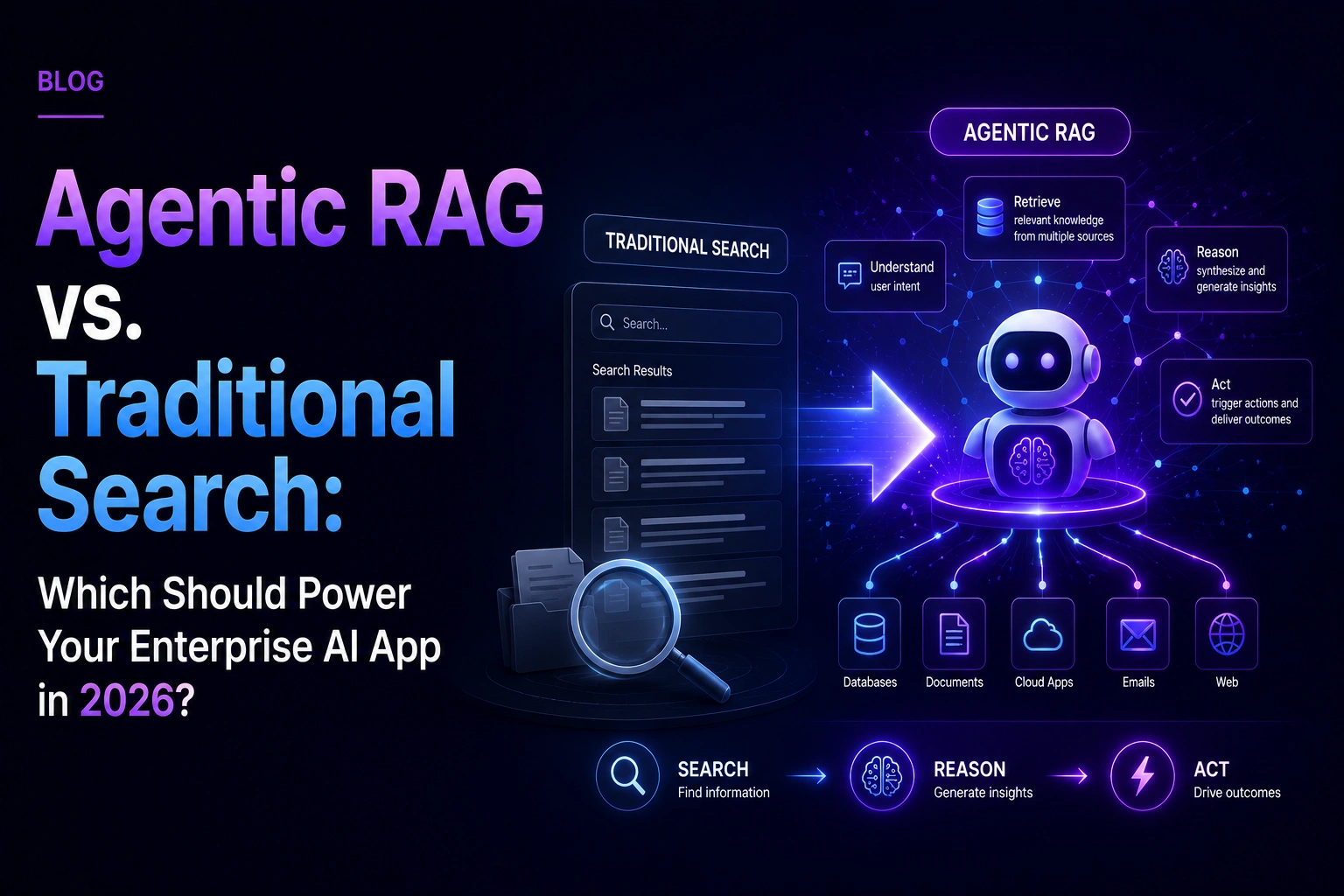
A leaner RAG pipeline returns fewer, more relevant chunks, which means fewer tokens per query. Our guide on agentic RAG versus traditional search explains how smarter retrieval improves both cost and quality. Embedding corpora tend to grow silently as teams add documents, so a periodic cleanup of stale and duplicate content keeps storage and query costs from creeping up. Better retrieval is a rare win-win, since fewer, sharper chunks cut cost and improve answers at the same time.
Impact: Medium savings, medium effort. Cuts both storage and per-query token costs at once.
9. Standardize on one governed platform
Scattered AI tools across teams create duplicate spend and no visibility. Standardizing on one governed platform gives you shared infrastructure, central controls, and a single view of cost. It also stops every team from solving the same problem twice.
A shared platform is where many of these AI-powered enterprise cost optimization solutions come together. It turns one-off savings into a repeatable, enterprise-wide discipline. It also gives AI cost optimization for enterprise developers a common set of guardrails and defaults, so efficient patterns like caching and routing are built in rather than left to each team. These cost-effective AI workflow solutions make the cheap path the default path. The alternative, a dozen teams each buying their own tools and models, guarantees duplicate spend and zero visibility. Our guide on enterprise AI integration strategies shows how to consolidate without a disruptive rip-and-replace.
Impact: High savings, high effort. Removes duplicate spend and makes efficiency the default across teams.
10. Build a continuous AI FinOps practice
Cost optimization is not a one-time cleanup. A continuous AI FinOps practice pairs real-time cost visibility with automated policies and clear ownership, so unit economics stay healthy as you scale. This is what separates controlled programs from runaway ones.
The FinOps Foundation found that 98% of FinOps teams now manage AI spend, and 73% of organizations reported AI costs exceeded their original projections. Building this discipline early is the single best defense against surprise bills. The goal is to make cost a shared responsibility between finance and engineering, reviewed on a regular cadence, so it never drifts back into a once-a-year surprise.
Impact: Compounding savings, ongoing effort. Keeps every other strategy working as you scale.
How Enterprises Measure and Manage AI Costs for Sustainable AI Scaling
You cannot optimize what you cannot see. Sustainable AI scaling depends on measuring the right things, so you know where money goes and whether it is worth it. Here is how enterprises measure and manage AI costs. The work splits cleanly into three stages: get visibility, attribute costs to owners, then optimize and govern continuously.
Get cost visibility first
Start by making AI spend visible in real time, not at month-end. Modern AI cost tracking and optimization tools break spend down by model, feature, and workload, so you can see what is actually driving the bill. Without this, optimization is guesswork.
Look for AI-specific cost optimization platforms that understand tokens, not just cloud instances. Standards like the FinOps FOCUS spec now make per-token billing easier to normalize across providers. The practical goal is a single dashboard where finance and engineering see the same numbers, so cost conversations start from shared facts instead of finger-pointing.
Attribute costs to teams and features
Once you can see the spend, tie it to who is causing it. Cost attribution assigns each dollar to a team, product, or business unit, which drives accountability. When a team owns its AI bill, it optimizes on its own.
This chargeback model is a core part of AI-enabled IT cost optimization. It turns AI cost from a shared mystery into a set of owned, managed budgets. It also surfaces the quiet problem of agent sprawl, where teams spin up agents without central oversight, so attribution is often the first step to reining in spend nobody was tracking.
Track the metrics that matter
Raw spend is not the whole story. The metrics that matter most are:
- Cost per outcome. What you pay per resolved ticket, generated report, or completed task, not per token. This is the metric that ties AI spend to business value, and it is the one to show leadership.
- Cost per user or request. How spend scales with usage, so you can forecast the bill before it arrives.
- Token usage per task. A leading indicator that catches agentic workflows burning tokens before the invoice does.
- GPU and infrastructure utilization. Whether you are paying for capacity you actually use, or for idle hardware.
- Quality against cost. Making sure savings do not quietly degrade output, since cheap answers that are wrong cost more in the end.
Make it a continuous loop
The best programs treat cost as a living metric, reviewed on a regular cadence. Set alerts for spikes, watch trends, and feed issues back into optimization. This continuous loop is what keeps cost-effective AI solutions cost-effective as they scale.
Sharing these metrics with leadership also keeps AI funded. When executives can see cost per outcome improving, they back the next phase with confidence. This is also where cost optimization connects to broader operating discipline, much like the ROI practices in our guide on AI workflow orchestration. Treat cost, quality, and governance as three views of the same system, and you get AI that scales sustainably instead of stalling under its own weight.
How Wizr AI Helps Enterprises Reduce AI Costs While Scaling Production Workloads
Most cost tools solve one slice of the problem. Wizr AI focuses on the bigger picture: helping enterprises scale AI in production efficiently through Enterprise AI Services, AI-powered engineering, and practical AI solutions. Founded in 2023, Wizr focuses on enterprise AI automation and AI-driven software engineering, which map directly to the cost drivers in this guide. Beyond tooling, its services support enterprise AI cost optimization, helping teams design efficient systems and governance from the start. Here is how Wizr helps.
Efficient agents on one governed platform. Wizr helps enterprises build AI agents, AI assistants, and agentic workflows using modular, model-agnostic approaches. Because solutions can be designed around the right model for each task, enterprises can route workloads to appropriately sized models instead of overpaying for a single frontier model everywhere. This directly addresses inference costs, one of the biggest drivers of enterprise AI spend.
Governance and spend controls built in. Wizr incorporates governance, access controls, and observability into AI solutions, helping enterprises keep agent usage visible and controlled rather than treating AI spend as a black box. This addresses agent-spend and token-budget challenges that can make agentic AI expensive when left unmanaged, turning cost governance into an ongoing part of AI implementation.
Efficient engineering and modernization. Wizr’s AI-powered product engineering and custom AI application development services help enterprises build efficient AI systems from the start, with considerations such as caching, right-sized models, and clean integration. Building with cost efficiency in mind from day one is far more effective than optimizing a wasteful system later, while also supporting the caching and prompt-efficiency strategies outlined in this guide.
Integration without rip-and-replace. Wizr connects AI solutions with existing cloud, data, and CI/CD environments, helping enterprises optimize what they already have instead of duplicating spend. Its generative AI software development services can build custom, efficient solutions around existing workflows when off-the-shelf tools fall short, helping organizations reduce fragmented and overlapping technology investments.
Proven at production scale. The payoff is efficiency that holds up in production. For a leading logistics SaaS firm, Wizr drove up to 50% faster response times and deflected around 43% of support tickets, and across customers, 90% of pilots reach production. That production rate matters for cost too, since the cheapest AI is the kind that actually works and reaches users instead of remaining an expensive pilot.
Enterprises like Chrysler, Project44, and Fragomen build with Wizr. You can talk to the Wizr team to see how this approach fits your workloads. You can talk to the Wizr team to see how this fits your workloads.
Conclusion
AI in 2026 is powerful, but it is not free, and costs grow fast when you scale. The enterprises that win are the ones that treat cost as a first-class engineering and governance discipline, not an afterthought.
The path is clear. Understand where your costs come from, apply the right strategies, from model routing and caching to agent spend controls, and build a continuous FinOps practice to keep it all in check. Do this, and you can scale AI in production without the bill spiraling.
Remember that cost optimization is not a one-time project. As your AI grows and shifts toward agents, new cost drivers appear, so the discipline has to be continuous. The enterprises that treat cost, quality, and governance as one connected practice are the ones that keep scaling while others stall under runaway bills.
When you are ready to reduce AI costs while scaling production workloads, Wizr AI can help with the right mix of efficient AI solutions, governance, and AI-powered engineering services.
FAQs
1. What is enterprise AI cost optimization?
Enterprise AI cost optimization is the practice of reducing what an organization spends on AI, across models, inference, data, and infrastructure, without hurting quality or business outcomes. It combines cloud FinOps discipline with AI-specific levers like model routing, caching, prompt compression, and token budgets. The goal is to get the most business value from every dollar spent on AI.
It matters because AI costs that are small in a pilot can explode in production, especially with agentic AI. Cost optimization is what lets enterprises scale AI affordably.
Wizr AI helps enterprises build cost-efficient AI solutions, combining governed AI services with engineering expertise to keep spend under control as workloads grow.
2. Why are enterprise AI costs rising in 2026?
Enterprise AI costs are rising because usage is growing faster than prices are falling. Even though per-token prices keep dropping, enterprises are running far more AI, and the shift to agentic AI multiplies token use per task. Agentic workflows can burn 5 to 30 times more tokens than a simple query, since they reason in loops and call tools.
Inference has also overtaken training as the biggest AI cost line item in production. This is why cost discipline is now essential, not optional.
Wizr AI helps enterprises control these costs with efficient, governed AI agents and model-agnostic approaches.
3. What is the biggest driver of enterprise AI cost?
For most enterprises in production, inference is the biggest cost driver, the ongoing cost of running models on live requests. It has surpassed training as the top AI cost line item in 2026. Inference cost scales with usage and token count, which is why agentic AI, with its many calls per task, drives spend up so fast.
Data and vector storage for RAG, plus idle GPU capacity, are common hidden drivers too. Seeing all of these clearly is the first step to controlling them. A single agentic task can trigger ten to twenty model calls, each re-sending the accumulated context, so costs grow with task complexity rather than staying flat.
Wizr AI helps enterprises address inference costs through right-sized model routing and efficient AI agent design.
4. How can enterprises reduce AI inference costs?
Enterprises reduce AI inference costs with a few high-impact moves: route tasks to the right-sized model, cache prompts and responses, compress prompts and trim context, batch non-urgent work, and set token budgets for agents. Together these can cut inference spend by 40 to 60 percent or more without hurting quality. The key is to treat cost as an architecture problem, not something to wait out.
Right-sizing models and caching are usually the fastest wins. Agent spend controls prevent the worst surprises.
Wizr AI incorporates these efficiency considerations into AI engineering and agent development services, helping enterprises run AI workloads cost-effectively at scale.
5. What are the best AI cost tracking and optimization tools?
The best AI cost tracking and optimization tools give real-time visibility into AI spend, broken down by model, feature, team, and workload, not just monthly cloud totals. Strong options understand token-level billing and support cost attribution and chargebacks, so each team owns its spend. Enterprise buyers should look for AI-specific cost optimization platforms with governance and alerting built in.
The tool is only half the answer, though. A continuous FinOps practice, with clear ownership and regular review, is what makes the tooling pay off.
Wizr AI combines AI engineering and governance services to help enterprises establish cost visibility and control as they build and run AI solutions.
6. Does AI cost optimization hurt performance or quality?
No, when done well it protects both. Good cost optimization targets waste, like idle GPUs, duplicate calls, and oversized models, rather than cutting corners on quality. Techniques like model routing actually match each task to the right model, so quality stays high where it matters and cost drops where it does not.
The key is to track quality against cost, so savings never quietly degrade output. Optimization and quality go together when you measure both.
Wizr AI focuses on building efficient and reliable AI solutions, helping enterprises scale without unnecessarily trading quality for cost.
7. What are the top AI cost optimization strategies for 2026?
The top AI cost optimization strategies for 2026 are model routing to the right-sized model, prompt and response caching, prompt compression, batching non-urgent work, right-sizing infrastructure, choosing self-hosting or APIs deliberately, setting agent token budgets, optimizing data and RAG pipelines, standardizing on one governed platform, and building a continuous FinOps practice. Used together, these can cut enterprise AI spend by 40 to 60 percent or more without hurting quality.
Start with routing and caching, since they deliver the biggest savings for the least effort. Then add governance and FinOps to keep the gains as you scale.
Wizr AI helps enterprises apply these strategies through Enterprise AI Services, AI-powered engineering, AI agents, and AI governance.
8. How much can enterprises save with AI cost optimization?
Enterprises can typically save 30 to 60 percent on AI spend with a disciplined cost optimization program, and some workloads save far more. Prompt compression and caching alone can cut LLM API costs by 30 to 50 percent, while self-hosting stable, high-volume workloads can cut costs 70 to 90 percent. Real production analyses have shown cost per answer dropping by more than 80 percent once routing, caching, and right-sizing are in place.
The exact savings depend on your workloads and how much waste exists today. The bigger and more agentic your AI, the more there is to save.
Wizr AI helps enterprises pursue these efficiencies by combining cost-conscious AI engineering, governed AI agents, and services that help keep AI spend under control.
About Wizr AI
Wizr AI helps enterprises build autonomous enterprises and accelerate product and software engineering with practical, production-ready AI. We help organizations automate business workflows, modernize legacy applications and digital platforms, and build intelligent AI solutions.
Our core services include Enterprise AI Services, AI-Powered Engineering & Legacy Modernization, AI Product Engineering, and AI Governance. We also leverage AI Assembly capabilities, including the Agentic AI Framework, Agentic Workflows, Security, and Integrations.
Through our AI solutions, including AI Agents, Pharma & Life Sciences AI, Oracle AI, and Salesforce AI, we help enterprises apply AI across business and technology needs.
See how we can help your enterprise move faster with AI. 👉 Talk to an AI Expert.



![Agentic AI vs AI Agents: Key Differences Every CIO Must Know [2025 Guide]](https://wizr.ai/wp-content/uploads/2025/07/Agentic-AI-vs-AI-Agents.webp)
![Agentic AI vs Traditional Automation: Why Enterprises Shift for Better CX [2025]](https://wizr.ai/wp-content/uploads/2025/06/Agentic-AI-vs-Traditional-Automation.webp)


![11 Real-World AI Agents Examples + Use Cases for Enterprises [2025]](https://wizr.ai/wp-content/uploads/2025/05/AI-Agents-Examples-Use-Cases.webp)