Enterprise AI is no longer something you test on the side. It is slowly becoming part of how your teams work every day. As a CIO or CTO, you are now expected to make AI work across customer support, IT, finance, and product teams without breaking existing systems through effective Enterprise AI integration.
The pace of change is hard to ignore. According to Grand View Research, the global enterprise artificial intelligence market was valued at $23.95 billion in 2024 and is expected to reach $155.21 billion by 2030, growing at a CAGR of 37.6%.
But here is the real question. Is your AI actually working across your organization or stuck in isolated pilots?
Many enterprises see early success with AI tools but struggle to scale them. Data sits in different systems. Teams use disconnected tools. AI models lack the context they need to deliver reliable outputs. This is why businesses are increasingly investing in enterprise AI solutions that unify workflows, integrate data sources, and support scalable AI adoption across departments.
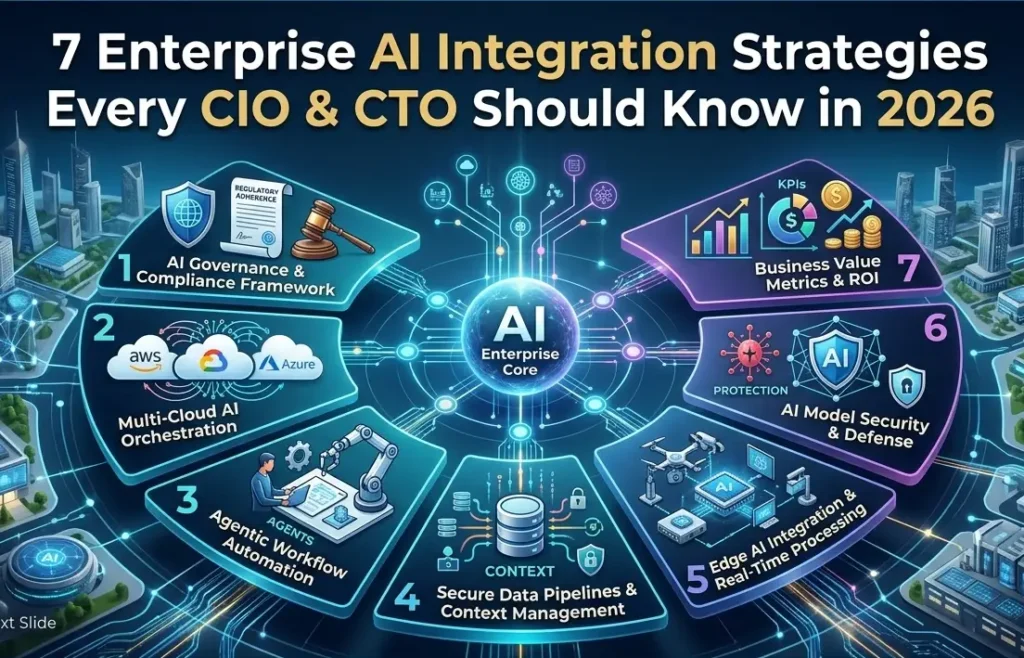
This is where your strategy matters. Strong Enterprise AI Integration Strategies help you connect models, data, and workflows so AI can work as part of your core systems.
In this blog, you will learn seven practical strategies that help you move from small AI experiments to scalable, enterprise-wide adoption in 2026.
Why Enterprise AI Integration Strategies Matter for CIOs and CTOs in 2026
AI adoption is growing across enterprises. But the main challenge is not building models. It is connecting AI to the systems your business depends on.
Most enterprises run multiple platforms:
- CRM systems
- ERP platforms
- IT service management tools
- data warehouses
- document repositories
These systems store valuable data. But they are often disconnected. Without integration, AI cannot access the right information at the right time, limiting Enterprise AI data integration.
This creates clear issues:
- AI responses lack business context
- Employees do not trust outputs
- workflows stay manual
- AI initiatives fail to scale
You also face governance gaps. When teams adopt AI tools independently, data usage becomes inconsistent. Visibility reduces. Security risks increase.
Strong Enterprise AI Integration Strategies address these gaps.
They help you:
- connect AI models with enterprise systems
- build reusable infrastructure
- scale AI across teams
- Apply consistent security and compliance controls
For CIOs and CTOs, integration is now a leadership focus. It decides whether AI becomes part of daily operations or stays limited to isolated use cases.
Also Read: How Generative AI Enhances Enterprise Search & Instant Insights
7 Enterprise AI Integration Strategies for CIOs and CTOs in 2026
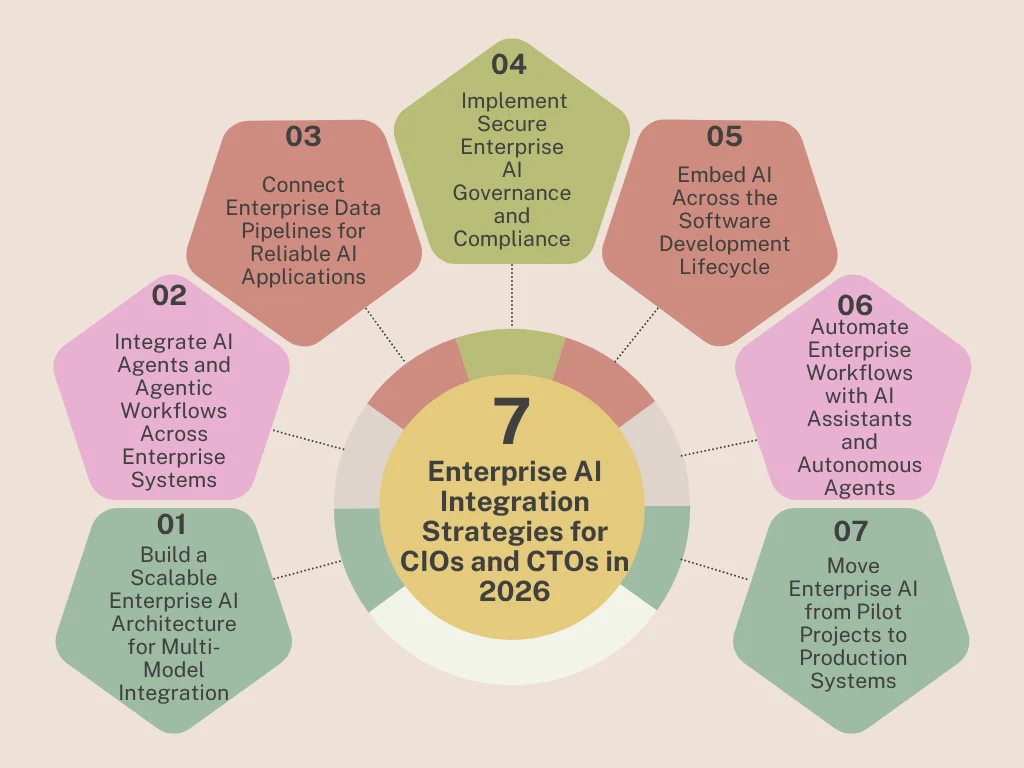
As you move from AI pilots to real adoption, the focus shifts from tools to integration. You need a clear approach that connects models, data, and workflows across your enterprise systems.
The following Enterprise AI Integration Strategies help you build scalable AI systems that work across teams and deliver consistent results.
Strategy 1: Build a Scalable Enterprise AI Architecture for Multi-Model Integration
Enterprises rarely depend on a single AI model. Different teams use different tools based on their needs.
- Customer support uses conversational AI
- IT teams use automation assistants
- Developers use coding copilots
- Finance teams use document processing models
Your architecture must support this setup as part of an effective AI integration strategy for large enterprises 2026.
A scalable AI architecture allows you to integrate multiple models without rebuilding systems each time. It gives you flexibility as new models and use cases emerge. Many organizations are adopting AI solutions for enterprise to support multi-model integration, workflow orchestration, and scalable AI deployment across business functions.
Key components include:
Model orchestration layer: Routes tasks to the right model based on the use case.
API gateways: Connect enterprise applications with AI models through secure endpoints.
Vector databases: Store indexed enterprise knowledge for retrieval-based use cases.
Monitoring systems: Track usage, performance, and errors.
With this structure, you can adopt new models without disrupting existing workflows.
Strategy 2: Integrate AI Agents and Agentic Workflows Across Enterprise Systems
AI is moving from assistants to agents. Instead of only responding to queries, agents can complete tasks.
For example, an IT agent can:
- understand a request
- search internal documentation
- create or update a ticket
- resolve the issue
To work effectively, agents must connect with enterprise systems as part of AI integration strategies for enterprises.
They interact with:
- ticketing platforms
- CRM systems
- HR portals
- knowledge bases
- collaboration tools
Without integration, these workflows break.
Your goal is to build agentic workflows that connect systems across teams using AI-powered integration solutions for enterprise IT teams.
Examples include:
IT support automation: Agents handle common requests like password resets.
Customer service automation: Agents fetch customer data and respond across channels.
HR assistants: Employees receive accurate answers from internal policies.
These workflows reduce manual effort and improve response time.
Strategy 3: Connect Enterprise Data Pipelines for Reliable AI Applications
AI systems depend on data. But enterprise data is often scattered across systems.
Common sources include:
- CRM databases
- ERP systems
- knowledge repositories
- data lakes
- support tickets
- communication tools
When data is disconnected, AI outputs remain incomplete, limiting Enterprise AI data integration.
You need unified data pipelines that make enterprise data accessible and usable.
Key elements include:
Real-time data ingestion: Ensures AI systems use current information.
Centralized indexing: Makes data searchable across systems.
Retrieval systems: Enable AI to fetch relevant data using vector search.
Access controls: Protect sensitive data with role-based permissions.
Connected data pipelines improve accuracy and build trust in AI outputs.
At the same time, many organizations still struggle to realize value at scale. A recent BCG-backed insight highlights that only about 5% of companies achieve measurable value from AI deployments, even though adoption is widespread.
This gap shows that data readiness and integration, not model capability, often determine success.
Strategy 4: Implement Secure Enterprise AI Governance and Compliance
AI systems often handle sensitive data, including:
- customer information
- financial records
- internal communication
- legal documents
Without governance, risks increase.
A strong framework should include:
Access control policies: Define who can use AI tools and what data they can access.
Audit logs: Track how systems access and use data.
Model monitoring: Identify errors and unusual behavior.
Compliance alignment: Ensure adherence to industry regulations.
For example:
- Financial firms must meet reporting standards
- Healthcare providers must protect patient data
- Retail companies must follow privacy laws
When governance is built early, AI systems remain secure and easier to scale, often supported by AI firms for enterprise security integration.
Strategy 5: Embed AI Across the Software Development Lifecycle
AI is now part of how software is built and maintained.
Teams use AI tools to write code, review changes, and detect issues faster.
AI supports multiple stages:
Code generation: Creates boilerplate code and templates.
Documentation: Generates technical content from codebases.
Automated testing: Finds issues earlier in development.
Incident analysis: Helps identify root causes quickly.
For CIOs and CTOs, this improves developer productivity and speeds up delivery as part of broader AI integration knowledge and business strategies 2026.
It also allows teams to integrate AI features directly into enterprise applications.
Strategy 6: Automate Enterprise Workflows with AI Assistants and Autonomous Agents
Many enterprise processes still rely on manual work. Employees spend time searching for data, processing requests, and updating systems.
AI assistants reduce this effort.
Common use cases include:
- HR assistants answering policy questions
- finance assistants processing invoices
- sales assistants summarizing insights
- IT assistants resolving tickets
AI agents can take this further by handling complete workflows, including finance workflow automation.
Examples include:
Employee onboarding: Collects documents, sets up accounts, and guides new hires.
Contract review: Analyzes documents and flags risks.
Customer request resolution: Retrieves data and completes follow-up actions.
Strategy 7: Move Enterprise AI from Pilot Projects to Production Systems
Many enterprises remain in the pilot stage. AI tools are tested but not scaled across the organization.
To move to production, focus on a structured approach aligned with enterprise AI integration strategies for 2026.
Define clear use cases
Start with problems that deliver measurable outcomes.
Examples:
- ticket classification
- enterprise search
- document processing
Build shared infrastructure
Create reusable platforms instead of isolated solutions.
Include:
- model orchestration
- data integration
- monitoring systems
Enable cross-team collaboration
Align engineering, data, and business teams.
Track business metrics
Measure:
- resolution time
- cost reduction
- productivity
With these steps, AI becomes part of daily operations and reflects how CIOs and CTOs implement AI integration strategies.
These strategies work best when applied together. When your architecture, data, workflows, and governance are aligned, AI can operate across your enterprise systems at scale.
Also Read: Top Enterprise AI Solutions in 2026 (+ 15 Tools Built for Scale)
How Wizr AI Helps Enterprises Implement Scalable AI Integration and Autonomous Workflows
Enterprise AI works best when your models, data, and workflows are connected through effective Enterprise AI integration. This is where a structured platform and platform-enabled services make a clear difference.
Wizr AI provides Enterprise AI Services and AI-powered solutions that help enterprises design, build, integrate, and deploy AI systems across their organizations. It focuses on integrating AI into existing infrastructure, so teams can use it in daily operations as part of AI integration strategies for enterprises.
With Wizr AI, you can:
- Connect enterprise data sources, including internal documents, systems, and knowledge bases using AI-powered data integration for enterprises
- Build and deploy AI Agents, AI Assistants, and Agentic Workflows for functions like IT, customer support, finance, and other enterprise operations
- integrate AI into existing enterprise applications and workflows
- Support multiple AI models across enterprise AI solutions and workflows
- Apply governance, access control, and monitoring across AI systems through enterprise AI services and governance practices
Wizr AI also supports use cases such as AI-powered workflow automation, intelligent support systems, and agent-driven enterprise operations. This helps you move beyond isolated tools and build AI that works across departments with AI-powered integration solutions for enterprise IT teams.
For CIOs and CTOs, this means you can standardize how AI is implemented across teams. You avoid fragmented deployments and create a consistent approach to scaling AI aligned with Enterprise AI strategy 2026.
Instead of running disconnected pilots, you can deploy production-ready AI agents and workflows that interact with real business processes. This improves adoption and ensures AI delivers measurable outcomes.
As AI adoption grows, having the right integration approach becomes essential. With Wizr AI, you can move from experimentation to production-grade, enterprise-wide AI deployment aligned with enterprise AI integration strategies for 2026, with better control, reliability, and scalability.
Also Read: Top 10 Enterprise AI Platforms Transforming Workflows in 2026
Conclusion
Enterprise AI success in 2026 depends on how well you connect it to your core business systems through strong Enterprise AI Integration Strategies. Running pilots or adopting standalone tools is no longer enough. As a CIO or CTO, your focus should be on building an integrated foundation where AI works across teams, systems, and workflows using the right AI integration strategy for CIOs and CTOs.
This means creating a scalable architecture that supports multiple models, integrating AI agents into real business processes, and ensuring your data pipelines provide accurate and timely information through Enterprise AI data integration. At the same time, you need strong governance to protect sensitive data, supported by enterprise AI services and security-focused implementation, while embedding AI into development workflows and automating everyday tasks across departments, including finance workflow automation. Most importantly, you must move beyond isolated experiments and bring AI into production with clear use cases and measurable outcomes as part of an AI integration strategy for large enterprises 2026.
When these Enterprise AI Integration Strategies come together, AI becomes a reliable part of how your enterprise operates. It supports decision-making, reduces manual work, and improves efficiency across functions.
If you are planning your next step, focus on building a connected AI ecosystem rather than adding more tools. Explore how Wizr AI can help you implement scalable AI integration, automate enterprise workflows, and deploy intelligent AI solutions that deliver real business impact.
FAQs
1. What are Enterprise AI Integration Strategies, and why do they matter in 2026?
Enterprise AI Integration Strategies focus on connecting AI models, enterprise data, and workflows so AI can operate across systems not just in isolated tools. In 2026, success depends less on building models and more on Enterprise AI integration across business functions.
For example, AI that connects CRM, ERP, and support systems can deliver more accurate insights than standalone tools.
Wizr AI helps enterprises implement these strategies through Enterprise AI Services and AI-powered solutions that support end-to-end AI integration across IT, finance, customer operations, and product engineering.
2. How do CIOs and CTOs implement AI integration strategies at scale?
Understanding how CIOs and CTOs implement AI integration strategies starts with building a strong foundation across systems, data, and workflows.
Most leaders follow a structured approach:
- Start with high-impact use cases (e.g., IT support, finance workflow automation)
- Build shared infrastructure for Enterprise AI data integration
- Integrate AI agents into existing enterprise systems
- Apply governance and security controls
This approach aligns with a strong AI integration strategy for CIOs and CTOs and ensures AI moves beyond pilots.
Wizr AI supports this through Enterprise AI Services that help organizations design, deploy, integrate, and scale AI agents, assistants, and agentic workflows with governance, integrations, and continuous optimization.
3. What are the biggest challenges in Enterprise AI integration?
The biggest challenge in Enterprise AI integration is not the technology it is connecting fragmented systems and data.
Common challenges include:
- Disconnected data across ERP, CRM, and internal tools
- Lack of AI-powered data integration for enterprises
- Security and compliance risks
- Difficulty scaling beyond pilot projects
According to industry reports, only a small percentage of companies achieve measurable ROI from AI due to these gaps.
Wizr AI addresses these challenges through Enterprise AI Services, data engineering, integration services, and AI Ops, enabling seamless, secure, and scalable AI adoption across enterprise environments.
4. What are real-world use cases of AI integration in enterprises?
There are several practical AI integration strategies for enterprises already delivering value:
- IT support automation (ticket resolution, knowledge retrieval)
- Customer service automation (AI agents across channels)
- Finance workflow automation (invoice processing, reconciliation)
- Enterprise search and knowledge assistants
These are real AI solutions for enterprise data integration where AI connects systems and workflows to improve efficiency.
Wizr AI enables these use cases by deploying AI Agents and Agentic Workflows integrated with enterprise systems and tailored through Enterprise AI Services to accelerate time-to-value.
5. What should an Enterprise AI strategy for 2026 include?
A strong Enterprise AI strategy 2026 should focus on integration, scalability, and governance not just tools.
Key elements include:
- Unified Enterprise AI data integration across systems
- Scalable architecture supporting multiple AI models
- Secure governance frameworks for enterprise AI security and compliance
- Clear path from pilots to production
This ensures your enterprise AI integration strategies for 2026 deliver measurable business outcomes.
Wizr AI supports this through Enterprise AI Services and AI-powered engineering capabilities, combining AI Agents, Agentic Workflows, integrations, governance, and AI implementation expertise to help enterprises move from experimentation to production-ready AI at scale.
About Wizr AI
Wizr AI helps enterprises build autonomous enterprises and accelerate product and software engineering with practical, production-ready AI. We help organizations automate business workflows, modernize legacy applications and digital platforms, and build intelligent AI solutions.
Our core services include Enterprise AI Services, AI-Powered Engineering & Legacy Modernization, AI Product Engineering, and AI Governance. We also leverage AI Assembly capabilities, including the Agentic AI Framework, Agentic Workflows, Security, and Integrations.
Through our AI solutions, including AI Agents, Pharma & Life Sciences AI, Oracle AI, and Salesforce AI, we help enterprises apply AI across business and technology needs.
See how we can help your enterprise move faster with AI. 👉 Talk to an AI Expert.


![Agentic AI vs AI Agents: Key Differences Every CIO Must Know [2025 Guide]](https://wizr.ai/wp-content/uploads/2025/07/Agentic-AI-vs-AI-Agents.webp)
![Agentic AI vs Traditional Automation: Why Enterprises Shift for Better CX [2025]](https://wizr.ai/wp-content/uploads/2025/06/Agentic-AI-vs-Traditional-Automation.webp)

![11 Real-World AI Agents Examples + Use Cases for Enterprises [2025]](https://wizr.ai/wp-content/uploads/2025/05/AI-Agents-Examples-Use-Cases.webp)