Every enterprise AI project eventually hits the same wall: how do you connect your AI to the systems, data, and tools it needs to be useful? For years, the answer was simple. You used APIs. In 2026, there is a second answer gaining ground fast, the Model Context Protocol, or MCP.
This has created a real question for CIOs and architects. When you plan an AI integration, should you reach for a traditional API, an MCP server, or both? The MCP vs API decision is quietly shaping how enterprises build AI that actually works in production.
The shift is not hype. Gartner expects 40% of enterprise applications to include task-specific AI agents by the end of 2026, up from less than 5% in 2025. As agents multiply, the way they connect to the world matters more than ever.
This guide breaks down MCP vs API integration in plain terms. We cover what each one is, how they differ, when to use each, how to combine them, and real enterprise examples. The goal is to help you choose the right integration approach with confidence.
For enterprise leaders, this is not just a developer debate. The choice between MCP and APIs affects how fast you can ship AI, how securely it runs, and how much it costs to maintain. Enterprise AI MCP model context protocol adoption is accelerating because agents need a cleaner way to reach tools, but APIs are not going away. Understanding where each fits is now a core part of any AI strategy, which is why we wrote this as a practical guide rather than a technical deep dive.
What Is MCP vs API? Understanding the Key Differences for Enterprise AI
Let us start with clear definitions, since MCP vs API is easy to confuse. Both connect software, but they solve different problems. If you have been asking what is model context protocol MCP and how it differs from a normal API, this section is for you.
What is an API?
An API, or application programming interface, is a set of rules that lets two pieces of software talk to each other. When your CRM sends data to your billing system, that is an API at work. APIs have powered enterprise software integration for decades, and they are precise, reliable, and well understood.
The catch is that APIs are built for developers, not AI. Each API has its own structure, authentication, and documentation. A developer has to read that documentation and write custom code to connect to each one. That works fine for fixed, predictable integrations, but it does not scale well when an AI agent needs to reach dozens of systems and decide which to use at the moment. Writing and maintaining a custom connector for every tool an agent might need quickly becomes a bottleneck, which is the exact problem MCP was created to solve.
What is the Model Context Protocol (MCP)?
The Model Context Protocol (MCP) is an open standard that gives AI models and agents a universal way to discover and use external tools, data, and services. Think of it as a common language that lets an AI agent connect to any MCP-enabled system without custom code for each one. That is the simplest MCP model context protocol definition: one standard interface between AI and the tools it needs.
Anthropic introduced MCP in November 2024, and it spread fast. By 2026 it had become the de facto standard for AI integration, adopted by OpenAI, Google, Microsoft, and AWS, and is now governed under the Linux Foundation. In fact, one 2026 roadmap reports MCP has surpassed 97 million monthly SDK downloads in about 18 months. People often call it the “USB-C of AI,” since it standardizes how agents plug into tools the same way USB-C standardized device connections.
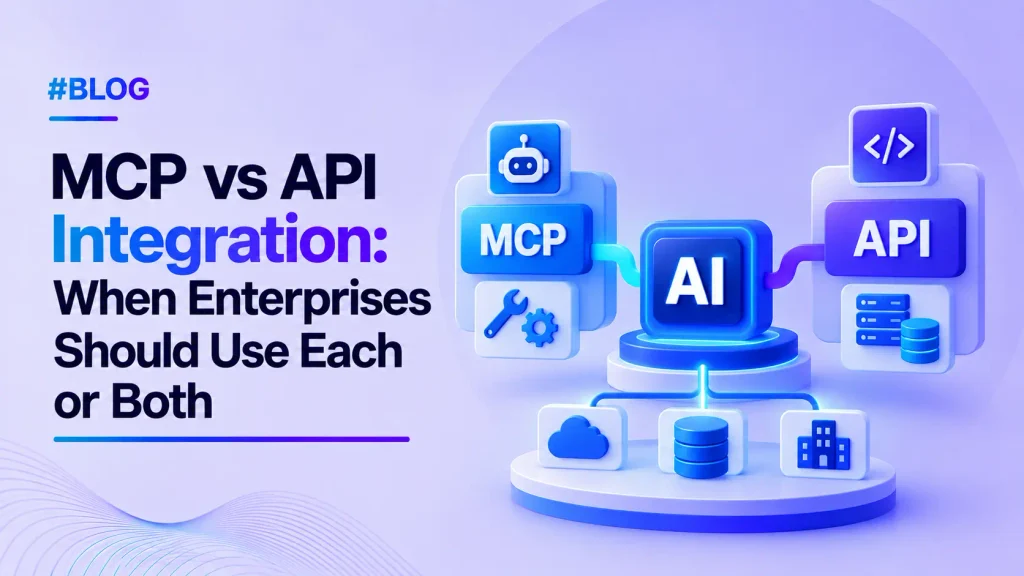
So what is the MCP protocol made of? A quick model context protocol MCP overview helps. MCP has three parts: an MCP host (the AI app), an MCP client inside it, and an MCP server that exposes tools. The model never talks to the server directly. Instead, the client discovers available tools, passes them to the model, and sends a tools call to the MCP server when the model wants to act. A simple model context protocol MCP architecture diagram shows this as host to client to server, with the server calling real APIs underneath.
An MCP server, then, is just a standard wrapper around your tools and data. When people say “an MCP server for our API,” they usually mean a set of tools that call API endpoints through this common protocol. That is the heart of what is an AI MCP model context protocol: a shared way for any AI agent to reach any connected system.
MCP vs API: the core difference
Here is the simplest way to understand the MCP protocol versus an API. An API is how two systems connect. MCP is how an AI agent discovers and uses those systems on its own.
In fact, MCP usually sits on top of APIs. When an agent calls an MCP tool, the MCP server often turns around and calls a regular API to do the work. So this is rarely API vs MCP as enemies. It is more about which layer you expose to your AI. For enterprises building agents, our guide on building multi-agent applications shows where this connection layer fits in a wider architecture.
MCP vs API Integration: How Do They Differ for Enterprise AI and System Connectivity?
The clearest way to see the enterprise MCP vs API integration difference is side by side. Each shines in a different context, and seeing them in one view makes the trade-offs obvious. Before the table, it helps to hold one idea in mind: an API is a connection between systems, while MCP is a standard way for an AI agent to find and use those connections. That single distinction explains almost every row below.
| Factor | API | MCP (Model Context Protocol) |
|---|---|---|
| Primary user | Developers writing code | AI agents acting on their own |
| Integration style | Custom code per API | One standard protocol for many tools |
| Discovery | Manual, read the docs | Dynamic, agent discovers tools at runtime |
| Best for | Fixed, predictable system-to-system flows | Flexible, agent-driven tasks across many tools |
| Setup effort | High per integration, low to run | Lower per tool once MCP is in place |
| Control | Very precise and predictable | Flexible, needs guardrails |
| Security model | Mature, per-API keys and OAuth | OAuth 2.1 with PKCE, centralized authorization |
| Maturity | Decades of tooling and standards | Newer, maturing fast in 2026 |
The pattern is clear. APIs give you tight, predictable control for defined flows. MCP gives your AI agents the flexibility to use many tools through one standard, which is why MCP server vs API is becoming a real design choice rather than a technical footnote.
Neither is “better.” They answer different questions. APIs answer “how do these two systems connect?” MCP answers “how does my AI agent reach everything it needs?” Most enterprises in 2026 will use both.
One more point on the enterprise MCP vs API integration question. The two approaches also differ in how they age. A custom API integration is fixed once you build it, so every change means more code. An MCP server, by contrast, is a reusable interface: build it once, and any agent, on any model, can use it. As your number of agents and use cases grows, that reusability is what keeps a model context protocol MCP server approach from turning into a maintenance burden. For predictable, unchanging flows, though, the simplicity of a direct API still wins.
It also helps to think about who maintains each layer. APIs are usually owned by the teams that run the underlying systems, with their own release cycles and versioning. MCP adds a thin, shared layer that your AI team can own and evolve without touching those systems. That separation of concerns is part of why MCP scales well across a large enterprise: the people building agents do not have to wait on every system owner to ship a new integration, they just add or update an MCP server. Keep that ownership model in mind as you read the next sections on when to use each.
When Should Enterprises Use MCP for AI Agents, Tools, and Data Access?
MCP shines when AI agents need flexible, dynamic access to many tools and data sources. If you are building agents that reason and act, model context protocol MCP AI agents is often the right layer. The AI MCP protocol was designed for exactly this: giving autonomous agents a safe, standard way to reach the tools they need.
Here is when enterprise MCP integration makes the most sense:
- You are building AI agents. When agents need to pick and use tools on their own, MCP lets them discover and call tools at runtime without custom code for each.
- You have many tools to connect. Instead of writing a new integration for every system, you expose each as an MCP server once, and any agent can use it. This model context protocol integration approach scales far better than one-off connectors.
- You want model and vendor flexibility. Because MCP is an open standard, agents built on different models can use the same MCP tools, which avoids lock-in.
- Your needs change often. MCP makes it easy to add or swap tools as your use cases evolve, without rebuilding integrations.
- You want consistent governance. MCP gives you one place to enforce authentication, authorization, and audit trails across all agent tool use.
Why MCP fits the age of AI agents
The real driver is autonomy. An agent that can only call hardcoded functions is limited. An agent that can discover and use any MCP tool can handle far more, safely, inside clear limits. This is why MCP server integration has taken off alongside the rise of agentic AI.
There is also a growing ecosystem. Public and private MCP registries, sometimes called an MCP model context protocol tools marketplace, now let teams find and share ready-made MCP servers for common systems. A rising number of data integration providers that support MCP are publishing official servers, so connecting your AI to a popular tool can be as simple as pointing it at that server.
A practical example: a support agent connected through MCP can check an order in your ERP, look up a policy in your knowledge base, and issue a refund, all by discovering those tools at runtime. For teams exploring this, our roundup of the best AI agent frameworks for enterprise covers the tools that pair with MCP, and shows how agents reach grounded enterprise data.
There is a governance upside too, which is easy to miss. Because every agent reaches its tools through the same MCP layer, you get one consistent place to apply authentication, permissions, and logging. Compare that to a sprawl of custom connectors, each with its own auth and its own audit trail, or none at all. For a CISO, model context protocol MCP AI agents are often easier to secure than a pile of hand-built integrations, precisely because the access path is standardized. That is a big part of why enterprise MCP integration has moved from experiment to production so quickly in 2026.
When Should Enterprises Use APIs for Reliable and Controlled AI Integration?
APIs remain the backbone of enterprise integration, and for good reason. When you need precise, predictable, high-control connections, a direct API is still the right call.
Here is when APIs are the better choice:
- Fixed, predictable workflows. When the integration always does the same thing, like syncing orders between two systems, a direct API is simpler and more reliable.
- High-volume, performance-critical flows. For millions of transactions where every millisecond counts, a direct API avoids the extra layer MCP adds.
- Tight control and compliance. When you need to control exactly what happens, step by step, APIs give you that precision, which matters in regulated environments.
- System-to-system, no AI involved. If no agent is making decisions, you do not need MCP. A classic API integration is the clean choice.
- Mature, stable integrations. Where you already have reliable API connections that work, there is no need to change them.
Why APIs are not going anywhere
APIs are decades old, battle-tested, and supported by vast tooling. They are precise and dependable, which is exactly what core enterprise flows need. Even in an MCP world, APIs do the real work underneath, since most MCP servers call APIs to get things done.
It is worth stressing this point, because the rise of MCP sometimes gets read as “APIs are obsolete.” They are not. One 2026 industry analysis found that a large majority of enterprise AI teams are already using MCP in production, yet every one of those deployments still runs on APIs underneath. MCP changed how agents reach your systems, not what those systems are built on. Your API investment keeps paying off.
The point is not to replace your APIs. It is to add MCP where AI agents need flexible access, while keeping direct APIs for the predictable, high-control flows that already serve you well. Wizr’s AI-powered engineering and legacy modernization services include API and integration work that keeps these core connections reliable, from designing versioned APIs to streamlining integrations across ERP, CRM, and payment systems.
There is also a reliability argument worth making. For the flows that keep your business running, like billing, order processing, or inventory sync, predictability matters more than flexibility. A direct API does exactly one thing, the same way, every time, which is what you want when an error would cost real money. Adding an agent and an MCP layer to a flow like that introduces decision-making where you do not want any. The mature move is to reserve APIs for these deterministic paths and bring in MCP only where judgment and flexibility genuinely add value. Knowing which is which is the core skill behind a good MCP vs API integration strategy.
MCP vs API for AI Agents: Which Integration Approach Fits Your Enterprise Use Case?
So how do you decide? For AI agents specifically, the choice comes down to how much flexibility versus control you need. Here is a simple way to think it through. The good news is that this is rarely an all-or-nothing call: you can use MCP for one agent and direct APIs for the rest, and change your mind as you learn what works.
Choose MCP when
- Your AI agent needs to use many tools and decide which to use.
- You expect to add or change tools often.
- You want one standard and consistent governance across agent tool use.
- You value model and vendor flexibility to avoid lock-in.
Choose a direct API when
- The task is fixed and always runs the same way.
- Performance and volume are critical.
- You need step-by-step control for compliance.
- No agent is making decisions, it is pure system-to-system.
A quick decision rule
Ask one question: is an AI agent making decisions about what to do? If yes, lean toward MCP for flexible, governed tool access. If not, a direct API is usually simpler and tighter.
Most real enterprises land in the middle, using MCP for the agent-facing layer and APIs underneath. For help weighing these trade-offs against your needs, our CIO’s checklist for agentic AI workflow solutions is a practical companion.
Do not forget cost, latency, and maturity
Three practical factors round out the decision. Cost: MCP adds a small layer, so for massive, simple, high-volume flows, a direct API can be cheaper to run. Latency: for the fastest paths, fewer hops win, which favors direct APIs. Maturity: APIs have decades of tooling, while MCP, though maturing fast in 2026, is still newer, so teams should plan for evolving specs. None of these rule MCP out, but they are worth weighing, especially for performance-critical or deeply regulated systems where predictability is everything.
Can Enterprises Use MCP and APIs Together? Enterprise MCP Integration Patterns Explained
Yes, and in fact most enterprises should. MCP and APIs are not rivals. They are layers that work best together, and the smartest enterprise MCP integration patterns use both. Think of APIs as the plumbing and MCP as the standard faucet your agents turn on. You still need the pipes, but the faucet makes them easy and safe to use. Here are the patterns enterprises rely on in 2026.
Pattern 1: MCP on top of APIs
This is the most common pattern. You keep your existing APIs and wrap the ones your agents need in MCP servers. The agent uses MCP to discover and call tools, and each MCP tool calls your API underneath.
This gives you the best of both worlds. Agents get flexible, standardized access, while your proven APIs keep doing the real work. You expose only what agents should touch, which keeps control tight. It is also low-risk, since you are not rebuilding anything, you are adding a thin, governed layer on top of integrations you already trust. Many enterprises start here precisely because it protects existing investments while opening the door to agentic AI.
Pattern 2: Direct APIs for core flows, MCP for agents
Here you keep direct API integrations for your high-volume, system-to-system flows, like syncing data between core systems. You add MCP only where AI agents need access. This keeps performance-critical paths lean while giving agents the flexibility they need. In practice, this means drawing a clear line between your deterministic backbone and your agent-facing layer, so each gets the right tool. The backbone stays fast and predictable on direct APIs, while agents get a flexible, governed MCP layer on top of the subset of systems they are allowed to touch.
Pattern 3: MCP gateway with centralized governance
As agents multiply, many enterprises add an MCP gateway that sits between agents and tools. It centralizes authentication, authorization, logging, and rate limits for all MCP traffic. This is where MCP security model secure integration patterns really pay off, giving you one control point for every agent action. Gartner projects that 75% of API gateway vendors will ship MCP features by the end of 2026, so this gateway pattern is quickly becoming standard.
MCP security and authorization for the enterprise
Security is often the first question a CISO asks about MCP, and the answer has matured fast. Strong MCP model context protocol authorization security is now built on OAuth 2.1 with PKCE, where MCP servers act as OAuth resource servers that validate tokens issued by your existing identity provider. In plain terms, your AI agents authenticate the same way your people do, and you control exactly which agent can reach which tool.
This is what makes the MCP security model secure integration patterns enterprise-ready in 2026. Every agent action can be authenticated, scoped with least-privilege permissions, and logged for audit. Centralized authorization through your identity provider means access is governed in one place, not scattered across dozens of connectors. For regulated industries, that single, consistent control layer is a major advantage over hand-built integrations.
The role of governance
Combining MCP and APIs raises an obvious question: how do you keep it all secure? This is where governance matters most. Strong authorization, built on OAuth 2.1, lets you control who can access what, log every action, and enforce policy. Wizr’s AI governance service helps enterprises keep visibility and control as agent integrations grow, with a single register of every agent and consistent monitoring of cost, accuracy, and risk.
MCP vs API Examples: Practical Enterprise AI Integration Use Cases
Theory is useful, but examples make it real. Here are practical MCP vs API examples that show how enterprises use each, or both, in the real world. As you read them, notice the deciding question each time: is an agent making decisions, or is the flow fixed?
Example 1: Customer support agent
A support agent needs to check orders, look up policies, and issue refunds. These tasks change case by case, and the agent decides what to do. This is a strong MCP fit, since the agent discovers and uses tools at runtime. Underneath, each MCP tool calls the APIs of your CRM, ERP, and knowledge base. The agent handles the variety, while the APIs handle the transactions, and governance on the MCP layer keeps every action authenticated and logged. Wizr’s customer support AI agents use exactly this kind of governed, integrated approach.
Example 2: Nightly data sync
Every night, your system moves sales data from one database to another. It always does the same thing, at high volume, with no AI involved. This is a clear direct API job. Adding MCP here would only add overhead for no benefit.
Example 3: Finance automation
A finance agent reconciles invoices, matches payments, and flags exceptions across your ERP. The agent reasons over each case, so MCP gives it flexible, governed access to the tools it needs, while APIs to SAP or Oracle do the transactions. Each exception can look different, which is exactly why the agent needs to choose its tools at runtime rather than follow a fixed script. Wizr’s finance and accounting AI agents show how this works in practice, automating reconciliation and invoice matching while keeping humans in control of the decisions that matter.
Example 4: Real-time payment processing
Processing a payment is fixed, fast, and compliance-heavy. Every step must be exact and auditable. This is a direct API use case, where tight control beats flexibility. No agent decision-making is involved, so MCP is not needed.
Example 5: IT support agent across many systems
An IT support agent handles password resets, software provisioning, and ticket updates across tools like ServiceNow, Active Directory, and your HR system. The tasks vary, and the agent decides which system to act on. This is a strong MCP fit, since the agent discovers and calls the right tool for each request, while APIs to each system do the work. Governance sits on top, so every action is authenticated and logged. Wizr’s IT support management AI agents use this kind of connected, governed design.
The thread through all of these is simple. Where an agent decides and the task varies, MCP fits. Where the flow is fixed, fast, and controlled, a direct API fits. Many enterprises run both side by side, and the best architectures make the choice deliberately for each use case rather than defaulting to one approach everywhere.
How Wizr AI Helps Enterprises Build Scalable, AI-Ready Integrations
Choosing between MCP and APIs is one thing. Building secure, scalable integrations that actually work in production is another. This is where Wizr AI helps, as a services-led enterprise AI company focused on AI services and AI-powered engineering. Rather than a generic overview, here is how Wizr maps to the exact integration challenges in this guide, from reliable APIs to governed, agent-ready connections.
Founded in 2023, Wizr helps enterprises apply AI to real business processes and software, from strategy through to production. The reason that matters for this topic is simple: AI-ready integration is not just a protocol choice, it is engineering plus governance. You need reliable APIs, a clean agent-facing layer, and the controls to keep it all safe, and Wizr brings all three together as a service.
API and integration engineering. Through its AI-powered engineering and legacy modernization services, Wizr designs reliable, versioned APIs and streamlines integrations across ERP, CRM, payment, and other enterprise systems. It uses generative AI to accelerate schema mapping, automate documentation, and monitor reliability, so your core connections stay solid.
AI agents and agentic workflows. Wizr’s Enterprise AI Services team builds AI agents, assistants, and agentic workflows that connect to your systems. Its AI Assembly capability equips agents with tools to securely interact with enterprise applications and data, which is exactly the layer MCP standardizes. In other words, Wizr builds the agent-facing connection layer, whether through MCP, direct tools, or both, so your agents can reach what they need safely.
Connected enterprise systems. Wizr helps integrate AI across your enterprise ecosystem, connecting agents and workflows to the apps your teams already use, from Salesforce and ServiceNow to Oracle and Slack, using APIs, SDKs, and reusable components. This is the practical work of making integrations real, mapping to each system, handling auth, and keeping connections reliable as they scale.
Governance and security built in. Wizr is SOC 2 Type II and ISO 27001 compliant and supports GDPR. Its AI governance service gives enterprises one place to see every agent, measure performance and risk, and enforce secure, compliant access as integration scale. As your agent and tool count grows, this single control point is what keeps a sprawling integration layer safe and auditable.
The results are real. For a leading US automotive manufacturer, Wizr lifted dealer support resolution from around 25% to roughly 70%, cut response times by 60%, and delivered about 2.1 million dollars in annual savings. Enterprises like Project44, Chrysler, and FES Study Abroad build with Wizr. You can talk to the Wizr team to see how this fits your integration strategy.
Conclusion: How to Choose the Right MCP vs API Integration Approach
The MCP vs API question does not have a single answer, and that is the point. They solve different problems, and the best enterprises use both.
Here is the simple way to choose. Use direct APIs for fixed, high-volume, system-to-system flows where control and performance matter most. Use MCP where AI agents need flexible, governed access to many tools and data sources. And in most real deployments, layer them, with MCP on top of APIs, so agents get flexibility while your proven integrations do the heavy lifting.
As AI agents become part of everyday operations, the integration layer is no longer a back-office detail. It is a strategic choice that shapes how fast, safe, and scalable your AI can be. Get it right, and your AI connects to everything it needs without becoming a security or maintenance headache.
If you are just starting, a simple path works well. Keep your existing APIs for the flows that already run reliably. Pick one agent use case, wrap the tools it needs in MCP servers, and put governance on top from day one. Prove the value there, then expand the pattern as more agents come online. This staged approach lets you adopt MCP without disrupting the integrations your business already depends on, and it keeps security and cost under control the whole way.
When you are ready to build secure, scalable, AI-ready integrations, Wizr AI can help you design the right mix of MCP and APIs with the engineering and governance to make it last.
FAQs
1. What is the difference between MCP and API?
An API is a set of rules that lets two software systems connect and exchange data, built for developers who write custom code for each integration. MCP, the Model Context Protocol, is an open standard that lets AI agents discover and use tools on their own, without custom code for each one. In short, an API is how two systems connect, while MCP is how an AI agent reaches and uses many systems through one standard. MCP usually sits on top of APIs, so it is rarely a question of API vs MCP as rivals.
The simplest test is whether an AI agent is making decisions. If yes, MCP fits. If it is pure system-to-system work, a direct API is cleaner.
Wizr AI helps enterprises build both layers, with reliable APIs and governed, agent-ready MCP connections.
2. What is the Model Context Protocol (MCP)?
The Model Context Protocol (MCP) is an open standard, introduced by Anthropic in November 2024, that gives AI models and agents a universal way to connect to external tools, data, and services. It has three parts: an MCP host, an MCP client, and an MCP server that exposes tools. By 2026 it had become the de facto standard for AI integration, adopted by OpenAI, Google, Microsoft, and AWS, and is now governed under the Linux Foundation.
People often call it the “USB-C of AI,” since it standardizes how agents plug into tools. An MCP server is essentially a standard wrapper around your existing APIs and data.
Wizr AI builds the agent-and-tool layer that MCP standardizes, so enterprises can connect AI to their systems safely.
3. When should enterprises use MCP vs API?
Use a direct API for fixed, high-volume, system-to-system flows where control and performance matter most, like billing or data sync. Use MCP where AI agents need flexible, governed access to many tools and data sources and must decide which to use at runtime. Most enterprises use both, layering MCP on top of APIs so agents get flexibility while proven integrations do the real work.
The deciding question is simple: is an AI agent making decisions about what to do? If yes, lean MCP. If not, learn API.
Wizr AI helps enterprises make this call for each use case and build the right mix.
4. Is MCP secure enough for enterprise use?
Yes, MCP security has matured quickly. In 2026, enterprise MCP authorization is built on OAuth 2.1 with PKCE, where MCP servers act as resource servers that validate tokens from your existing identity provider. This means AI agents authenticate the same way your people do, with least-privilege permissions and full audit logging. Centralized authorization through your identity provider governs access in one place rather than across scattered connectors.
For regulated industries, that single, consistent control layer is a real advantage. Strong governance on top keeps every agent action visible and compliant.
Wizr AI builds this governance and security into every integration, so AI scales safely.
5. Can MCP replace APIs?
No, and it is not meant to. MCP sits on top of APIs rather than replacing them. When an AI agent calls an MCP tool, that tool usually calls a regular API underneath to do the work. APIs remain the backbone of enterprise integration, decades proven and supported by vast tooling. MCP simply gives AI agents a cleaner, standardized way to reach those APIs.
So the future is not MCP instead of APIs. It is MCP and APIs working together, each doing what it does best.
Wizr AI helps enterprises combine both into secure, scalable, AI-ready integrations.
6. Which systems and providers support MCP?
By 2026, MCP is supported by every major AI vendor, including Anthropic, OpenAI, Google, Microsoft, and AWS, and by a growing list of enterprise software like Salesforce, Atlassian, Slack, and Notion. A rising number of data integration providers that support MCP now publish official servers, and public and private registries act as a tools marketplace for ready-made MCP servers. Gartner projects most API gateway vendors will ship MCP features by the end of 2026.
This broad, vendor-neutral support, now under the Linux Foundation, is a big reason enterprises feel safe betting on MCP.
Wizr AI helps enterprises connect to these systems through both MCP and direct integrations, with governance built in.
About Wizr AI
Wizr AI helps enterprises build autonomous enterprises and accelerate product and software engineering with practical, production-ready AI. We help organizations automate business workflows, modernize legacy applications and digital platforms, and build intelligent AI solutions.
Our core services include Enterprise AI Services, AI-Powered Engineering & Legacy Modernization, AI Product Engineering, and AI Governance. We also leverage AI Assembly capabilities, including the Agentic AI Framework, Agentic Workflows, Security, and Integrations.
Through our AI solutions, including AI Agents, Pharma & Life Sciences AI, Oracle AI, and Salesforce AI, we help enterprises apply AI across business and technology needs.
See how we can help your enterprise move faster with AI. 👉 Talk to an AI Expert.


![Agentic AI vs AI Agents: Key Differences Every CIO Must Know [2025 Guide]](https://wizr.ai/wp-content/uploads/2025/07/Agentic-AI-vs-AI-Agents.webp)
![Agentic AI vs Traditional Automation: Why Enterprises Shift for Better CX [2025]](https://wizr.ai/wp-content/uploads/2025/06/Agentic-AI-vs-Traditional-Automation.webp)


![11 Real-World AI Agents Examples + Use Cases for Enterprises [2025]](https://wizr.ai/wp-content/uploads/2025/05/AI-Agents-Examples-Use-Cases.webp)