Something odd appears in nearly every enterprise AI survey published over the past twelve months. Leaders are confident. Their systems are not under control.
AvePoint’s State of AI 2026 report, drawn from 750 IT, security, and AI leaders worldwide, found 82.7% believed they could prevent unauthorized access to data. Close to nine in ten of the same organizations had already been breached. Kiteworks, surveying 459 security, compliance, and technology professionals across North America, Europe, and the Middle East, found 79% had no tested kill switch for their AI deployments. An untested control is not a control. An untested control is a hypothesis.
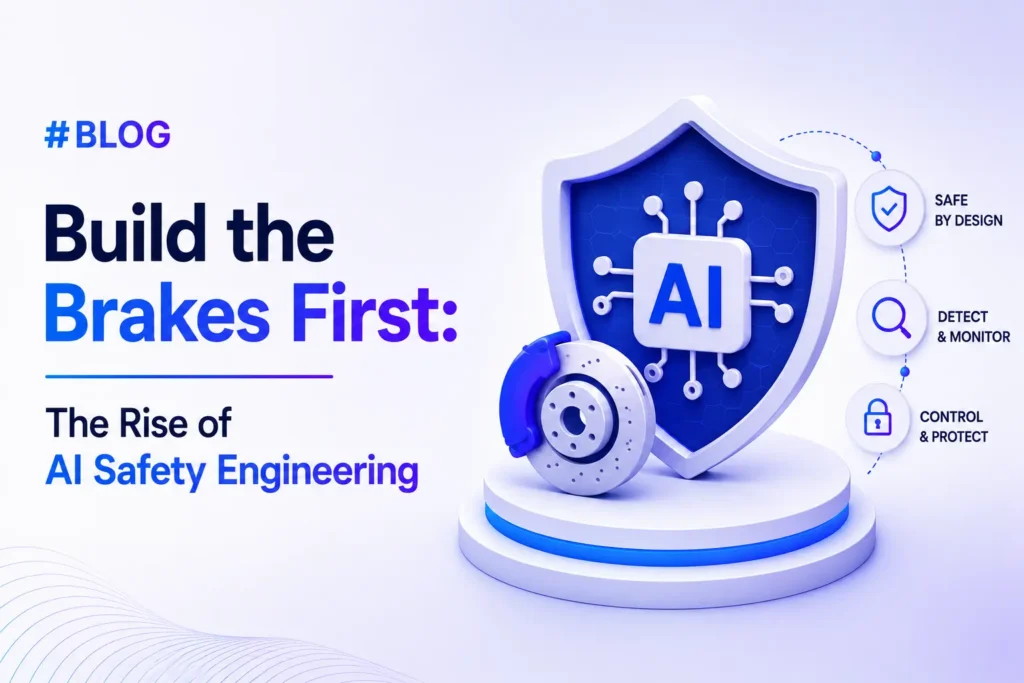
The distance between belief and demonstrable capability is where a new discipline has taken root. Call it AI safety engineering: the practice of building, measuring, and maintaining the mechanisms which keep AI systems inside intended limits once real users, real data, and real adversaries arrive.
What AI Safety Engineering Actually Means
Governance and safety engineering get treated as synonyms. They are not the same activity.
Governance produces artifacts: policies, risk registers, approval workflows, model inventories, committee minutes. Safety engineering produces mechanisms: evaluation harnesses, input and output filters, permission boundaries, rate limits, immutable audit logs, rollback paths, and shutdown procedures rehearsed under realistic load.
The distinction carries weight because regulators, insurers, and litigators increasingly ask for evidence of the second kind. A policy declaring a model must be fair does not demonstrate fairness. A reproducible evaluation suite, run against versioned datasets with results logged across releases, does.
Building these capabilities requires robust engineering practices, which is why many organizations invest in Enterprise Digital Engineering Services to develop secure, auditable, and production-ready AI systems with safety mechanisms embedded throughout the software lifecycle.

The discipline borrows from three older engineering traditions:
- Reliability engineering contributes error budgets, blast radius reasoning, and graceful degradation.
- Security engineering contributes threat modeling, adversarial testing, and least privilege.
- Safety-critical systems engineering, drawn from aviation and medical devices, contributes formal hazard analysis and the discipline of assuming failure rather than hoping against it.
The Numbers Behind the Urgency
Incidents are compounding
Stanford HAI’s 2026 AI Index recorded 362 documented AI incidents during 2025, up from 233 in 2024, a rise of roughly 55% in a single year. The AI Incident Database, the primary public register since 2015, has now catalogued well over a thousand entries.
The MIT AI Risk Repository adds a detail worth sitting with. Only about 2% of catalogued incidents were identified before deployment. Roughly 98% surfaced in production, in front of real users. Around half were tagged as intentionally caused, and inside the malicious-actor category, fraud, scams, and targeted manipulation accounted for the overwhelming majority.
The reading is uncomfortable but clear. Pre-launch review, as practiced across the industry today, catches very little.
Model behavior also remains less stable than most procurement conversations assume. The 2026 AI Index measured hallucination rates ranging from 22% to 94% across 26 leading models. More instructive than the spread was one failure mode: when a false statement was framed as a third party’s belief, models handled it well. When the identical statement was framed as the user’s own belief, accuracy collapsed. Sycophancy under social pressure is a safety property, and few enterprise test plans measure it.
Deployment has outrun oversight
Adoption is settled. Aon reported 88% of organizations used AI in at least one business function during 2025. Economist Impact, surveying 639 senior executives across five global financial centres, found only 8% maintained a comprehensive AI governance framework.
IBM data describes the same gap from another angle. While 87% of organizations claimed clear governance frameworks, fewer than a quarter had fully implemented the controls needed to manage bias, transparency, and security risk. Claiming a framework and operating one are separate achievements.
Autonomous systems widen the gap. Deloitte’s 2026 State of AI in the Enterprise found close to three-quarters of companies planning agentic deployments within two years, while only one in five had a mature governance model for autonomous agents. AvePoint put regular agent use among employees at 46.9%.
An assistant drafts text. An agent takes action, moves money, sends mail, and writes to production systems. The two demand entirely different controls.
The Four Layers of a Working Safety Stack
Mature programs converge on four layers. Weakness in any single layer tends to surface later as a production incident.
1. Specification and hazard analysis
Before model selection, the team documents what the system must never do, as testable prohibitions rather than aspirations. “The system must not disclose account balances to unverified callers” can be tested. “The system should be trustworthy” cannot. Hazard analysis then works backward from each prohibited outcome to the failure paths capable of producing it.
2. Evaluation and adversarial testing
Two distinct activities sit here. Evaluation measures performance against a fixed benchmark suite: accuracy, refusal behavior, bias across protected attributes, robustness to malformed input. Red teaming attacks with intent, probing for prompt injection, jailbreaks, data exfiltration through tool calls, and unsafe reasoning chains. Public incident trackers now rank prompt injection and jailbreaks among their largest clusters, with over 140 catalogued cases.
3. Runtime guardrails and containment
Design-time assurance never survives production alone. Runtime controls include input validation, output classification, scoped credentials, human approval gates for irreversible actions, spend and rate ceilings, and sandboxed execution for any tool the model can invoke. For agents, the operative question is not what the model might say. The question is what the model can reach.
4. Monitoring, response, and reversibility
Every layer above assumes eventual failure. The final layer plans for it: drift detection, anomaly alerting, full request and response logging suitable for forensic reconstruction, a documented escalation path, and a rollback mechanism exercised on a schedule. A kill switch counts only once someone has pulled it during a drill.
Where Programs Break Down in Practice
Four failure patterns recur across enterprise deployments.
Evaluation treated as a launch gate. Teams run an extensive assessment, ship, and never repeat the exercise. Models get updated by vendors, prompts get edited by product teams, retrieval corpora grow, and user behavior shifts. Assurance measured in March describes a system no longer running in November.
Ownership scattered across functions. Security assumes the data team validated the model. The data team assumes legal approved the use case. Legal assumes engineering built the controls. Accountability diffuses until an incident forces the question.
Ungoverned usage at the edges. Netskope’s Cloud and Threat Report 2026 found 47% of enterprise generative AI users still reaching tools through personal, unmanaged accounts, bypassing corporate data controls. Broader surveys place unapproved tool use between 40% and 65% of employees. One study found 86% of organizations claiming a complete AI inventory while 59% admitted to ungoverned shadow deployments.
Permission sprawl in agents. An employee-built workflow holding persistent authorization across a CRM, a mailbox, and a calendar is not merely a data exposure. It is an autonomous actor inside business-critical infrastructure with no review, no logging, and no owner.
The Regulatory Clock Reads Differently Than Many Teams Assume
The EU AI Act timeline shifted materially in mid-2026, and the shift is widely misread as blanket relief.
Following the Digital Omnibus package, endorsed by the European Parliament on 16 June 2026 and approved by the Council on 29 June, high-risk obligations for standalone Annex III systems (covering recruitment, credit scoring, education, law enforcement, and access to essential services) move from 2 August 2026 to 2 December 2027. AI embedded in regulated products under Annex I, including medical devices and machinery, moves to 2 August 2028.
Most transparency obligations under Article 50 did not move. Organizations providing EU-facing chatbots or generative systems, deploying synthetic media, or operating emotion recognition face the original 2 August 2026 date. A narrow grace period runs to 2 December 2026, covering only provider-side technical marking for systems already on the market. Article 50 breaches carry exposure up to 15 million euros or 3% of worldwide annual turnover. Prohibited practices, enforceable since February 2025, carry up to 35 million euros or 7%.
Readiness remains thin. Vision Compliance placed 78% of enterprises as unprepared for their obligations, and only 35.7% of managers described themselves as adequately prepared. Gartner expects AI governance platform spending to reach 492 million dollars during 2026, a figure indicating remediation budgets rather than mature programs.
To meet evolving regulatory requirements, many organizations are investing in Custom AI Application Development Services that incorporate AI governance, compliance, auditability, and security by design from the outset.
The Emerging Job Description
Organizational response has been rapid. IBM recorded 76% of organizations with a Chief AI Officer in 2026, up from 26% a year earlier, though appointment precedes accountability. The practitioner profile beneath the executive layer is hybrid and scarce: applied machine learning fluency, offensive security instincts, production reliability experience, and enough regulatory literacy to map a control to a legal obligation. Deloitte’s respondents named insufficient workforce skills as the largest barrier to integrating AI into existing workflows, ahead of budget and infrastructure.
What a Serious Starting Point Looks Like
Organizations making genuine progress tend to share five habits:
- A live system inventory, including employee-built agents, refreshed continuously rather than annually.
- Continuous evaluation wired into deployment pipelines, with regression thresholds capable of blocking a release.
- Scheduled adversarial exercises run by people incentivized to break things, ideally external to the delivery team.
- Named ownership per system, with a single accountable engineer rather than a committee.
- Rehearsed shutdown and rollback, tested quarterly and timed, with results reported upward.
None of the five requires novel technology. All five require treating AI deployment as engineering rather than experimentation.
Organizations implementing these practices often partner with a Generative AI Software Development Company to build production-ready AI systems with continuous evaluation, governance, security, and operational resilience embedded throughout the development lifecycle.
The Bottom Line
Aviation became safe through instrumentation, mandatory incident reporting, and relentless failure analysis. Software became reliable through version control, testing, and observability. Every field handling consequential systems eventually built the brakes.
AI is arriving at the same threshold, on a compressed timeline and with far more autonomy in play. The 362 documented incidents of 2025 will look modest in retrospect. Organizations treating safety as an engineering function, staffed and measured accordingly, will hold a compounding advantage over organizations treating safety as a document to be filed.
Building AI systems with safety engineered from the start is a core focus of AI-Powered Product Engineering Services, enabling enterprises to deliver secure, reliable, and production-ready AI products at scale.
Sources: Stanford HAI 2026 AI Index, AI Incident Database, MIT AI Risk Repository, Deloitte State of AI in the Enterprise 2026, AvePoint State of AI 2026, Kiteworks 2026 Annual Survey, Netskope Cloud and Threat Report 2026, IBM, Aon, Economist Impact, Gartner, and the official EU AI Act legislative record.
About Wizr AI
Wizr AI helps enterprises build autonomous enterprises and accelerate product and software engineering with practical, production-ready AI. We help organizations automate business workflows, modernize legacy applications and digital platforms, and build intelligent AI solutions.
Our core services include Enterprise AI Services, AI-Powered Engineering & Legacy Modernization, AI Product Engineering, and AI Governance. We also leverage AI Assembly capabilities, including the Agentic AI Framework, Agentic Workflows, Security, and Integrations.
Through our AI solutions, including AI Agents, Pharma & Life Sciences AI, Oracle AI, and Salesforce AI, we help enterprises apply AI across business and technology needs.
See how we can help your enterprise move faster with AI. 👉 Talk to an AI Expert.


![Agentic AI vs AI Agents: Key Differences Every CIO Must Know [2025 Guide]](https://wizr.ai/wp-content/uploads/2025/07/Agentic-AI-vs-AI-Agents.webp)
![Agentic AI vs Traditional Automation: Why Enterprises Shift for Better CX [2025]](https://wizr.ai/wp-content/uploads/2025/06/Agentic-AI-vs-Traditional-Automation.webp)


![11 Real-World AI Agents Examples + Use Cases for Enterprises [2025]](https://wizr.ai/wp-content/uploads/2025/05/AI-Agents-Examples-Use-Cases.webp)