You roll out an AI model, and instead of solving problems, it gives you answers that are incomplete or flat-out wrong. Suddenly, the “game-changer” becomes a liability. It happens more often than you’d think. The enterprise agentic AI market is expected to cross USD 1.2 trillion by 2032, but not every project will make it that far. Many will stall because no one checked if the model was actually ready for the job.
LLMs are powerful. They can draft reports, process data, and speed up decisions. But they can also produce biased insights or irrelevant responses if left unchecked. And that’s the real risk, scaling AI without knowing if it can deliver what you need.
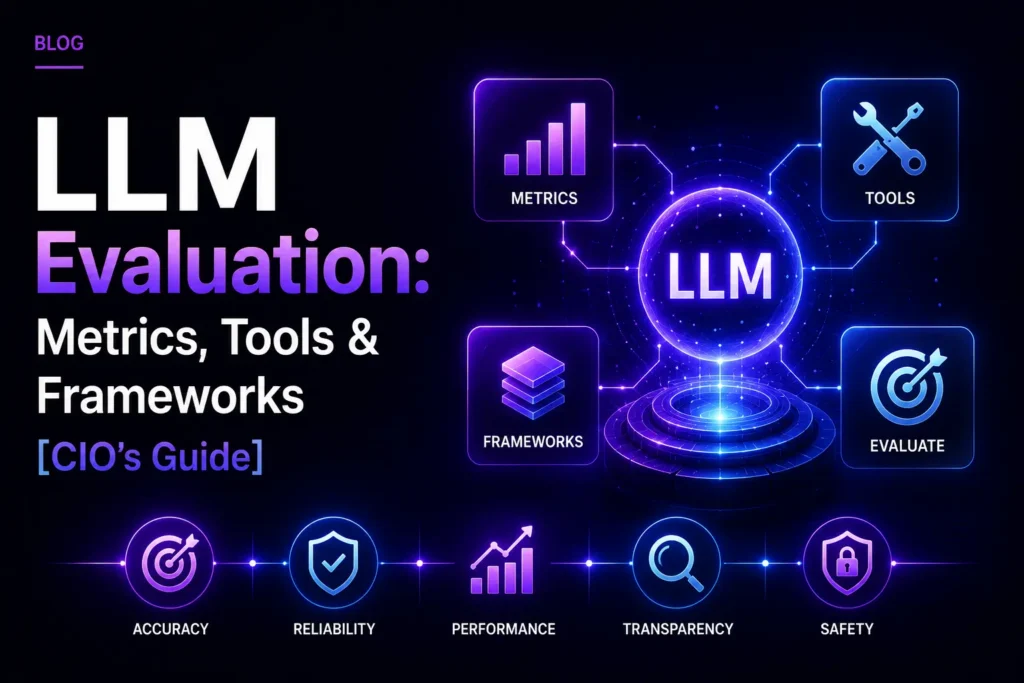
That’s why LLM Evaluation matters. It’s not just a technical step; it’s how you figure out whether your AI is trustworthy, safe, and worth the investment using LLM evaluation tools for enterprise AI, which leverage innovations like LLM embeddings to improve context understanding and model performance.
LLM evaluation isn’t just about testing outputs – it’s how CIOs ensure AI models are accurate, compliant, and enterprise-ready. Without it, projects risk wasted investment, compliance failures, and eroded trust.
This guide breaks down key metrics, tools, and frameworks that help leaders validate performance, align AI with business goals, and scale responsibly.
Read the full post to see how structured LLM evaluation sets the foundation for trustworthy enterprise AI in 2026.
What Is LLM Evaluation?
LLM Evaluation is the process of checking how well a large language model performs across your business use cases. It goes beyond simply asking if the model can generate text, it looks at whether the outputs are accurate, safe, and relevant to your enterprise.
To do this, you need to test the model on two levels:
- Model Evaluation – measuring the core capabilities of the LLM using LLM evaluation metrics 2026.
- System Evaluation – testing how the LLM works when integrated into your LLM evaluation platform for enterprises.
Both are essential for understanding real performance and for enterprise LLM benchmarking.
The Fundamentals
At its simplest, LLM model evaluation for CIOs helps you answer:
- Does the model generate clear and correct outputs?
- Can it handle tasks like summarization, classification, or domain-specific queries?
- Does it remain consistent when tested with different inputs?
These checks highlight where the model is strong and where it may need tuning, providing insights for LLM evaluation methods for enterprise deployment and LLM evaluation techniques for enterprise models.
Model Evaluation
This level focuses on the model itself, without external systems. It typically includes:
- Intrinsic metrics such as BLEU, ROUGE, or F1 scores for text quality, forming part of LLM evaluation benchmarks for enterprise AI.
- Fine-tuning tests to confirm adaptability on your business data using LLM evaluation harness for AI systems.
- Task-based checks like summarization, translation, or sentiment analysis.
In short, LLM evaluation tools for enterprise AI at this stage shows you the raw capability of the LLM.
System Evaluation
System evaluation measures how the LLM performs once deployed in your enterprise setup. Here, the focus is on practical value. You assess:
- Extrinsic metrics such as accuracy in handling real end-to-end tasks.
- User experience, including responsiveness and ease of interaction.
- Reliability, especially when dealing with edge cases or unexpected queries.
This ensures the model not only works in theory but also fits into your day-to-day operations, a key consideration for LLM agent evaluation in enterprise workflows.
Why Both Matter
Strong lab results don’t always translate to business impact. That’s why you need both perspectives. Model evaluation checks technical strength, while system evaluation confirms real-world effectiveness. Together, they ensure that your best LLM evaluation tools for 2026 provide actionable insights for deployment and ongoing monitoring, as explained in LLMOps for enterprise, which helps maintain performance and reliability at scale.
Why LLM Evaluation Matters for CIOs and Enterprise AI Success
As a CIO, you’re tasked with more than adopting AI, you’re expected to show real business impact. The pressure is high to prove that AI projects improve productivity, reduce costs, and deliver consistent results. But without proper LLM evaluation for enterprises, LLMs can produce biased, inaccurate, or unstable outputs. When left unchecked, these risks can lead to compliance failures, erode customer trust, and waste valuable resources.
A Gartner report predicts that over 40 agentic AI projects will be scrapped by 2027 because they failed to deliver business value. The takeaway is clear: investment alone is not enough. Without structured LM evaluation frameworks in 2026, AI initiatives risk stalling before they achieve scale.
This is where LLM Evaluation becomes essential. It ensures models are tested not only for technical strength but also for enterprise alignment. In practice, it helps you:
- Validate enterprise fit: Compare models to see which one works best for your data, industry, and compliance needs.
- Protect against compliance risks: Confirm outputs meet privacy, security, and regulatory requirements.
- Ensure performance stability: Track accuracy, reliability, and latency as models scale across departments.
- Tie AI to business goals: Measure results against KPIs like customer satisfaction, IT ticket resolution time, HR fairness, or financial accuracy.
- Build organizational trust: Show stakeholders clear benchmarks and evaluation results to back AI decisions.
To see how large language models are transforming enterprise workflows through better evaluation, automation, and governance, explore the full insights in this guide on enterprise LLM adoption.
A CIO Scenario in Practice
Imagine you’re rolling out two AI projects at the same time:
- A CX chatbot designed to handle 70% of customer queries.
- A financial audit model built to analyze expense reports.
Without LLM agent evaluation in enterprise workflows, the chatbot might sound fluent but fail to resolve queries accurately, frustrating customers. Meanwhile, the audit model could overlook key anomalies, raising compliance risks. Through LLM Evaluation, you can stress-test both models, measure accuracy and reliability, and ensure they meet business objectives before full deployment.
Evaluation acts as your quality assurance framework for AI. It gives you the confidence that models are not only delivering outputs but are also safe, dependable, and aligned with your enterprise strategy, leveraging LLM evaluation techniques for enterprise models and LLM evaluation harness for AI systems.
Also Read: Top 10 Benefits of AI Virtual Assistants for Customer Service
Key Metrics to Assess Enterprise Large Language Models (LLMs)
When evaluating an LLM for enterprise use, you need a combination of technical assessments, business-focused indicators, and human-centered review. Each perspective offers unique insights, and together they provide a clear picture of whether a model is ready for deployment through LLM evaluation for enterprises and LLM evaluation frameworks in 2026.

1. Technical Assessments
These are quantitative measures that assess how well a model processes and generates language, forming part of LLM evaluation benchmarks for enterprise AI.
- Output Accuracy – Measures how closely the model’s responses match the expected results. Accuracy ensures that generated answers are factually correct and reliable.
- Prediction Confidence – Evaluates how well the model anticipates the next word or action in a sequence. Higher confidence indicates smoother, more coherent output.
- Content Overlap – Checks whether the model captures the essential elements of a reference response or source material. This ensures critical information is preserved in summaries, reports, or translations.
- Semantic Alignment – Measures whether the meaning of the model’s output aligns with the intended context, even if the wording differs. This is important for generating understandable and contextually relevant information.
- Response Time – Tracks how quickly the model delivers outputs. Fast response is essential for customer-facing applications or real-time operational tasks.
- Resource Efficiency – Evaluates the quality of output relative to computational cost. Efficient models reduce operational expenses while maintaining accuracy.
These technical checks provide an objective baseline for LLM model evaluation for CIOs performance across different tasks.
2. Business-Focused Indicators
Technical performance alone doesn’t guarantee business value. You also need to measure outcomes that matter to your organization, aligning with LLM evaluation methods for enterprise deployment.
- Context Relevance – Determines whether the model’s output is meaningful within your specific enterprise setting. For instance, does a report or recommendation follow internal guidelines and business rules?
- Consistency Across Scenarios – Ensures the model provides stable and repeatable outputs across different departments or use cases. This is vital when deploying AI at scale.
- Fairness and Risk Mitigation – Monitors outputs for bias or unintended discriminatory effects. Fair AI supports ethical practices, especially in HR, legal, or financial workflows.
- Compliance Alignment – Verifies that outputs adhere to regulations and company policies. This is critical in regulated industries like finance, healthcare, and legal services.
- User Satisfaction – Measures how end-users perceive and interact with AI outputs. High satisfaction indicates that the model is effectively supporting employees or customers.
These indicators link model performance directly to tangible business results.
3. Human-Centered Review
Even with thorough automated assessments, human evaluation adds depth and context, a critical component in LLM evaluation harness for AI systems.
- Clarity and Readability – Evaluators check if outputs are easy to understand and logically structured.
- Practical Usefulness – Determines whether outputs are actionable in real-world enterprise tasks.
- Alignment with Brand or Organizational Standards – Ensures tone, style, and messaging are consistent with company values.
Human review complements automated metrics by capturing qualitative nuances that machines may miss.
Balancing Assessments and Reviews
The most effective approach blends technical checks, business indicators, and human review. Automated assessments provide scale and objectivity, while human evaluation ensures depth, relevance, and contextual alignment. Together, they deliver a complete picture of LLM performance, readiness, and enterprise value.
By combining technical assessments, business-focused indicators, and human review, you gain a holistic view of your LLM’s performance. This balanced approach ensures the model is not only accurate but also reliable, fair, and effective for real-world enterprise use, compatible with top LLM evaluation platforms for CIOs and best LLM evaluation tools for 2026.
Also Read: Top 21 Customer Service Metrics & How to Measure Them[Tips + Examples]
Top Tools and Frameworks for Enterprise LLM Evaluation in 2026
Enterprises will have a growing set of tools and frameworks to make LLM Evaluation systematic, reliable, and actionable. These platforms address different layers of evaluation, technical performance, risk management, and domain-specific accuracy helping CIOs make informed decisions through enterprise LLM benchmarking and LLM evaluation frameworks in 2026.
- OpenAI Evals – Ideal for flexible benchmarking, OpenAI Evals allows enterprises to test models across multiple tasks and datasets. It is particularly useful for comparing performance across different LLMs and measuring accuracy, relevance, and robustness in scenarios that reflect real LLM agent evaluation in enterprise workflows.
- Wizr AI – An Enterprise AI Services and solutions partner that supports AI agent deployment, workflow automation, and enterprise-grade LLM application management. Wizr helps organizations build, evaluate, and manage AI agents and workflows using real enterprise data while maintaining compliance and governance. With prompt chaining, vector memory, and multi-model integration, Wizr helps CIOs monitor AI agent performance and ensure consistent results across customer support, IT, HR, and finance workflows. Many enterprises adopt a layered evaluation approach, using a combination of these tools to cover technical accuracy, risk assessment, and domain-specific requirements. While this approach works, some organizations prefer a unified solution that simplifies evaluation across departments and use cases, creating an opportunity to work with Enterprise AI Services providers like Wizr AI.
- LangSmith by LangChain – Focused on operational monitoring, LangSmith tracks prompts, outputs, and model behaviors over time. Enterprises can use it to identify recurring errors, ensure consistent responses in customer support chatbots, or monitor IT automation outputs across thousands of queries daily. It supports LLM evaluation techniques for enterprise models and continuous improvement.
- Confident AI – Designed for automated evaluation pipelines, Confident AI scores outputs against defined metrics while flagging potential risks like hallucinations or biased results. Its seamless integration into enterprise workflows reduces manual oversight, enabling teams to maintain quality at scale using LLM evaluation methods for enterprise deployment.
- Giskard – Built for safety and reliability, Giskard goes beyond accuracy by testing fairness, detecting bias, and simulating edge-case scenarios. This makes it highly valuable for regulated industries such as finance, healthcare, and legal, where compliance and risk mitigation are critical, supporting LLM evaluation updates for 2026 enterprise AI.
- SuperAnnotate – While primarily a data labeling platform, SuperAnnotate strengthens LLM evaluation by providing high-quality, domain-specific datasets. This ensures that models are trained and tested on data reflective of your enterprise needs, minimizing the risk of poor performance in specialized tasks, part of LLM evaluation frameworks for CIOs.
Many enterprises adopt a layered evaluation approach, using a combination of these tools to cover technical accuracy, risk assessment, and domain-specific requirements. While this approach works, some organizations prefer a unified solution that simplifies evaluation across departments and use cases, paving the way to explore platforms like Wizr AI.
Also Read: 9 Best Enterprise Generative AI Tools for 2025 [CIO’s Guide]
How Wizr AI Simplifies LLM Evaluation for Enterprises
While various tools provide strong capabilities, many enterprises face challenges in coordinating AI adoption across departments, workflows, and business processes. This is where Wizr AI stands out by providing Enterprise AI Services that help organizations deploy, govern, and scale AI automation across business processes.
Wizr AI helps CIOs and enterprise teams move from isolated pilots to production-grade automation. Through its Enterprise AI Services and AI Governance capabilities, Wizr connects AI performance, governance, and business outcomes within operational workflows, supporting a practical LLM evaluation approach for CIOs:
- Deploy AI on Enterprise Data: Build and run AI agents and workflows using enterprise knowledge, historical interactions, and operational processes.
- Monitor Operational Performance: Track how AI agents perform within business processes to identify gaps, improve workflows, and maintain reliability.
- Maintain Governance and Reliability: Apply enterprise-grade controls to reduce inaccurate responses and ensure consistent outputs aligned with business rules.
- Align AI With Business Outcomes: Measure automation impact through operational metrics such as resolution speed, ticket reduction, and productivity improvements.
By combining pre-built agents with governed workflows, Wizr AI enables enterprises to reduce manual effort and scale automation confidently across supported functions. Rather than focusing only on model testing, Wizr emphasizes real-world deployment helping organizations adopt AI beyond pilots and achieve measurable ROI.
Enterprise LLM Evaluation Use Cases Across CX, IT, HR, Finance, and Legal
LLM evaluation for enterprises impacts different departments in distinct ways. Understanding how to measure performance and reliability for each function ensures your AI deployments deliver real value and align with enterprise LLM benchmarking practices.
- Customer Experience (CX): LLMs are often used in chatbots or virtual assistants. LLM agent evaluation in enterprise workflows ensures responses are accurate, relevant, and aligned with your brand voice, while maintaining consistent tone and compliance.
- IT and Operations: AI models assist in incident classification, workflow automation, and system monitoring. LLM evaluation metrics measures speed, reliability, and correctness of automated decisions, identifying edge cases before they disrupt operations.
- Human Resources (HR): LLMs support resume screening, internal employee queries, and knowledge management. LLM evaluation methods for enterprise deployment ensures fairness, prevents bias, and validates outputs against organizational policies.
- Finance: Risk analysis, fraud detection, and report generation rely on LLM outputs. LLM evaluation benchmarks for enterprise AI checks for accuracy, regulatory compliance, and consistency, reducing financial and operational risks.
- Legal: Contract review, policy analysis, and compliance monitoring are increasingly AI-assisted. LLM evaluation tools for enterprise AI confirms outputs are correct, consistent, and free from bias or misinterpretation of legal language.
When applied across functions, LLM evaluation frameworks in 2025 gives you a full picture of AI’s reliability and impact. Since managing this across multiple departments can be complex, unified platforms simplify monitoring and benchmarking, keeping models aligned and enterprise-ready.
Future Trends in LLM Evaluation for Enterprise AI in 2026
LLM evaluation frameworks for CIOs are shifting from one-time testing to ongoing governance. Four trends are shaping this change:
1. Agentic AI Evaluation: Enterprises now use agentic models that reason and act across steps. LLM evaluation techniques for enterprise models must measure task completion, context retention, and decision quality not just single responses.
2. Regulatory Compliance Testing: With stricter AI regulations worldwide, LLM evaluation updates for 2026enterprise AI include automated checks for data privacy, financial standards, and audit-ready records.
3. Human-in-the-Loop Feedback: Enterprises are blending automated metrics with employee input. This keeps models aligned with business values, whether in CX, HR, or finance.
4. Continuous Evaluation Pipelines: Models evolve over time. Real-time monitoring and feedback loops ensure accuracy, safety, and fairness as LLMs are retrained or scaled.
Evaluation is no longer about “Does the model work today?” but “Is it meeting enterprise standards every day?”
Conclusion
For enterprises, adopting LLMs is no longer just about deploying a model. It’s about ensuring every output meets business standards, complies with regulations, and builds trust with employees and customers. That’s why LLM evaluation for enterprises has become a cornerstone of enterprise AI strategy, it transforms AI from a one-off experiment into a dependable, scalable asset.
The future of evaluation will demand continuous oversight, human feedback, and compliance-ready checks. Enterprises that treat evaluation as an ongoing process will gain a clear advantage, while those that overlook it risk costly setbacks.
This is where Wizr AI’s Enterprise AI Services and AI Governance capabilities support LLM evaluation for enterprises. Rather than positioning evaluation as a standalone platform, Wizr helps CIOs and business leaders benchmark accuracy, monitor performance, and keep AI aligned with organizational goals as part of a broader enterprise AI strategy.
If your enterprise is ready to move beyond AI experimentation, it’s time to make governed AI adoption part of your foundation. Partner with Wizr AI to scale AI from pilots to production with confidence.
FAQs
1. What is LLM Evaluation and why is it important for enterprises?
LLM Evaluation is the process of assessing large language models (LLMs) to ensure their outputs are accurate, relevant, and safe for real-world enterprise use. It goes beyond generating text LLM evaluation verifies that AI delivers value across business functions.
Key benefits include:
- Identifying strengths and weaknesses of AI models
- Ensuring compliance with enterprise regulations
- Improving decision-making in CX, IT, HR, and finance
For CIOs, structured LLM evaluation frameworks in 2026 provide confidence that AI models deliver measurable business outcomes. Wizr AI’s Enterprise AI Services and AI Governance capabilities support enterprises in monitoring performance, detecting risks, and aligning AI with organizational goals.
2. What metrics should CIOs track for LLM evaluation in enterprises?
CIOs should focus on metrics that combine technical performance with business impact:
- Accuracy & consistency: Ensures outputs meet expected results and remain stable across departments
- Response time & efficiency: Supports real-time decisions while optimizing resources
- Fairness & compliance: Detects bias and meets regulatory requirements
These LLM evaluation metrics for 2026 enable enterprise benchmarking and smarter model selection. Wizr AI helps enterprises apply these evaluation considerations across teams and workflows as part of its Enterprise AI Services and AI Governance approach.
3. How does LLM evaluation support multiple enterprise departments?
LLM agent evaluation in enterprise workflows ensures AI models add value across functions:
- Customer Experience (CX): Validates chatbots and virtual assistants for relevance and brand alignment
- IT & Operations: Measures automation accuracy and workflow reliability
- HR & Finance: Checks fairness in recruitment or financial reporting
- Legal: Ensures contracts and policies are interpreted correctly
Wizr AI supports continuous evaluation across enterprise workflows through its AI services and governance capabilities, helping CIOs maintain visibility and control across departments while reducing operational risk.
4. What are the latest trends in LLM evaluation for enterprise AI in 2026?
CIOs should consider these LLM evaluation frameworks trends in 2026:
- Agentic AI evaluation: Assesses multi-step decision-making capabilities
- Continuous evaluation pipelines: Real-time monitoring with automated feedback loops
- Human-in-the-loop feedback: Combines AI metrics with expert review for contextual accuracy
- Regulatory compliance testing: Ensures outputs meet global privacy and audit standards
Wizr AI’s Enterprise AI Services and AI Governance capabilities support enterprises in applying these practices to build continuous, secure, and scalable LLM evaluation processes.
5. Which tools and platforms are best for enterprise LLM evaluation?
Top LLM evaluation tools for enterprise AI include:
- OpenAI Evals: Flexible benchmarking across multiple tasks
- LangSmith: Tracks model performance and behavior over time
- Confident AI: Automated evaluation pipelines for risk detection
- SuperAnnotate & Giskard: Ensure data quality, detect bias, and test fairness
For a unified approach, Wizr AI brings technical assessment, business alignment, and compliance considerations together through its Enterprise AI Services and AI Governance capabilities, helping CIOs benchmark, monitor, and continuously improve AI models across departments with minimal manual effort.
About Wizr AI
Wizr AI helps enterprises build autonomous enterprises and accelerate product and software engineering with practical, production-ready AI. We help organizations automate business workflows, modernize legacy applications and digital platforms, and build intelligent AI solutions.
Our core services include Enterprise AI Services, AI-Powered Engineering & Legacy Modernization, AI Product Engineering, and AI Governance. We also leverage AI Assembly capabilities, including the Agentic AI Framework, Agentic Workflows, Security, and Integrations.
Through our AI solutions, including AI Agents, Pharma & Life Sciences AI, Oracle AI, and Salesforce AI, we help enterprises apply AI across business and technology needs.
See how we can help your enterprise move faster with AI. 👉 Talk to an AI Expert.


![Agentic AI vs AI Agents: Key Differences Every CIO Must Know [2025 Guide]](https://wizr.ai/wp-content/uploads/2025/07/Agentic-AI-vs-AI-Agents.webp)
![Agentic AI vs Traditional Automation: Why Enterprises Shift for Better CX [2025]](https://wizr.ai/wp-content/uploads/2025/06/Agentic-AI-vs-Traditional-Automation.webp)


![11 Real-World AI Agents Examples + Use Cases for Enterprises [2025]](https://wizr.ai/wp-content/uploads/2025/05/AI-Agents-Examples-Use-Cases.webp)