Ask any CTO in 2026 what their biggest AI challenge is, and very few will say, “We haven’t found the right model yet.” Most of them have GPT-4o, Claude, Gemini, or a fine-tuned open-source variant already running somewhere in their stack. The models are good. In many cases, they are spectacular.
The problem is everything else.
The problem is that a capable model sitting inside a poorly architected system delivers mediocre outcomes slowly, expensively, and unreliably. The real competitive differentiator in 2026 is not which foundation model you picked. It is how well your engineering layer is built around it. Organizations investing in Custom AI Application Development are increasingly focusing on building scalable architectures, workflow integration, governance, and operational reliability around enterprise AI systems.
The Model Selection Trap
The industry has an alluring narrative: choose the best AI model, plug it in, and watch productivity soar. Vendors support this with multimodal capabilities, token speeds, and benchmark scores. It is a strong pitch, but it is also a distraction.
Model performance benchmarks seldom survive encounters with enterprise reality, as CTOs are discovering often the hard way. Inconsistent API contracts, multi-system dependencies, confusing legacy data, compliance restrictions, and user operations that do not match any benchmark dataset are characteristics of real enterprise environments. If the underlying architecture is fragile, even a model that ranks highly on leaderboards may not be able to provide value. Organizations implementing enterprise AI solutions are increasingly prioritizing workflow integration, governance, and scalable system architecture over benchmark-driven model selection alone.
Many enterprises address these challenges through AI-driven legacy application modernization initiatives that improve system interoperability, modernize aging infrastructure, and create a stronger foundation for scalable AI adoption.
Key data points that highlight this gap:
- 67% of enterprise AI pilots never reach production
- Enterprises with proper AI workflow orchestration report 40–60% faster outcomes
- AI-driven orchestration delivers 30–50% improvement in operational efficiency
These numbers tell the same story: the bottleneck is almost never the model. It is the engineering layer around it.
What “Engineering Around AI” Actually Means
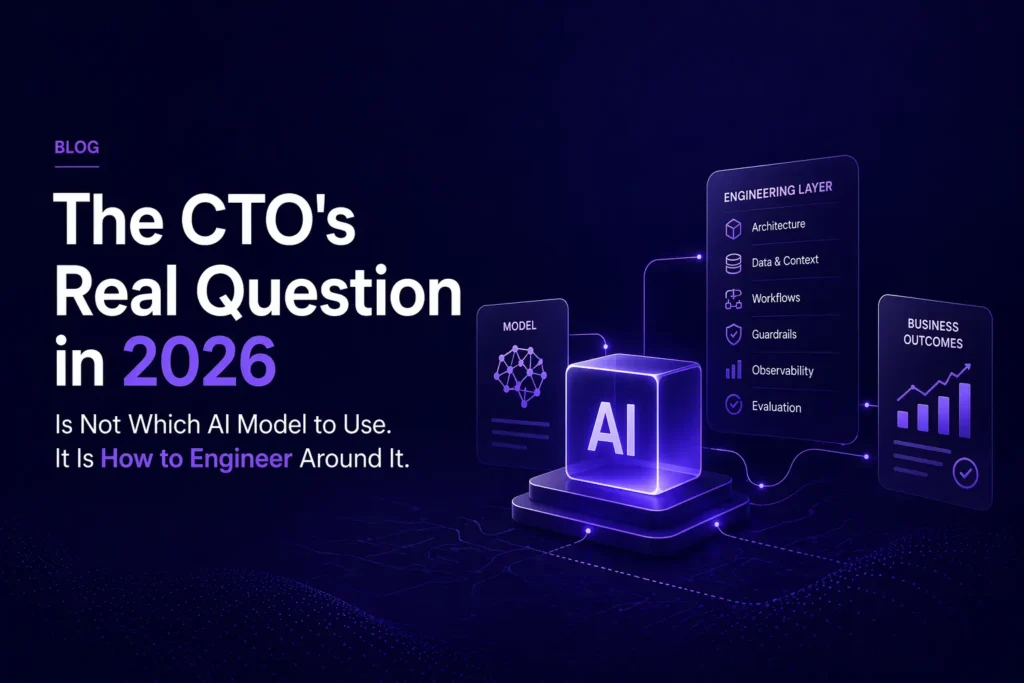
When we discuss engineering related to AI, we are referring to a series of intentional architectural choices that decide whether your investment in AI yields business results or merely dazzling demonstrations. Organizations that are achieving actual ROI can be distinguished from those that are in permanent pilot mode in four areas:
1. Workflow Orchestration
AI agents that operate within governed, auditable, multi-step processes not isolated completions. Orchestration ensures every agent decision has a clear path, a fallback, and an audit trail. Organizations implementing AI text analysis tools, techniques, and use cases are increasingly integrating workflow orchestration, governance, and enterprise automation to improve reliability and measurable AI outcomes.
2. Context and Data Grounding
Models connected to live enterprise data via Retrieval-Augmented Generation (RAG), not hallucinating from stale training knowledge. Grounded AI gives accurate, current, context-aware responses.
3. System Integration
Deep, bidirectional connections to CRM, ITSM, ERP, and HRMS not demo-layer API wrappers. True integration means AI can read from and write to the systems your business actually runs on.
4. Governance and Observability
Audit logs, policy enforcement, fallback paths, and real-time monitoring at every decision point. When your compliance team asks for a full audit trail of every automated decision made last quarter, you need to be ready.
None of these is glamorous. None of them generates a press release. But all of them are what determine whether your AI system works at 9 AM on a Monday when the ticket volume spikes, or when an edge case arrives that the model has never seen before. Organizations implementing AI-driven SDLC to accelerate delivery are increasingly prioritizing governance, observability, and operational resilience to ensure enterprise AI systems remain reliable, auditable, and scalable in production environments.
The Model-Agnostic Architecture Advantage
Here is the strategic insight that the most forward-thinking engineering leaders have internalized: if your AI architecture is tightly coupled to a single model, you are one product announcement away from technical debt. The foundation model landscape moves fast. What is state-of-the-art today may be mid-tier in eighteen months.
The organizations building a durable AI advantage are doing so on top of model-agnostic orchestration layers. They swap models as the ecosystem evolves. Their competitive moat is not the model — it is the enterprise context, the integrated workflows, the fine-tuned prompting strategy, and the proprietary data pipelines they have built around it. Enterprises adopting enterprise AI agent platforms are increasingly prioritizing orchestration, workflow integration, and model flexibility to build scalable and future-ready AI systems.
How Wizr AI Closes the Engineering Gap
Wizr AI is built specifically for this challenge. Rather than being another model provider or AI platform, Wizr helps enterprises engineer, integrate, and operationalize AI across their existing systems and workflows making AI work reliably at scale.
Here is what Wizr AI brings to your AI program:
- Modular AI agents: Pre-built for IT, Customer Support, Finance, and HR – deploy in days, not months
- Workflow orchestration: Multi-agent coordination with audit trails, policy enforcement, and fallback paths
- Enterprise integrations: Deep connectors to CRM, ERP, ITSM, and HRMS out of the box
- AI engineering services: SDLC acceleration, software modernization, and production delivery support
- Governance and security: Policy enforcement, access control, and enterprise-grade compliance built in
- Model-agnostic architecture: Swap foundation models without rebuilding your integration layer
Enterprises using Wizr AI report 40–60% faster outcomes not because they found a better model, but because they engineered the systems, workflows, and integrations around it properly. From Chrysler’s dealer support transformation to accelerating enterprise software delivery, Wizr AI has a track record of moving organizations from pilot to production with real business impact.
The Question to Ask Your Team This Quarter
If you are a CTO evaluating your AI strategy right now, the most important question is not “Are we using the best model?” It is: “Do we have the engineering capabilities, workflows, integrations, and governance to get consistent, governed, scalable value out of any capable model?”
If the answer is no or “we’re still figuring that out” – then the model you chose is the least of your concerns. The organizations pulling ahead in 2026 are not doing so because they found a secret model. They are doing so because they invested in the engineering, automation, integration, and governance needed to make models work effectively in real enterprise environments.
That investment is available to you today. The question is whether you make it deliberately or spend another year discovering its absence. Organizations exploring AI solutions for pharma companies and other enterprise AI initiatives are increasingly prioritizing scalable engineering services, governance, and workflow orchestration to achieve reliable long-term AI outcomes.
Ready to engineer your AI for production?
See how Wizr AI helps enterprises move from pilot to production – with AI agents, enterprise integrations, AI-powered engineering, and enterprise-grade governance.
About Wizr AI
Wizr AI helps enterprises build autonomous enterprises and accelerate product and software engineering with practical, production-ready AI. We help organizations automate business workflows, modernize legacy applications and digital platforms, and build intelligent AI solutions.
Our core services include Enterprise AI Services, AI-Powered Engineering & Legacy Modernization, AI Product Engineering, and AI Governance. We also leverage AI Assembly capabilities, including the Agentic AI Framework, Agentic Workflows, Security, and Integrations.
Through our AI solutions, including AI Agents, Pharma & Life Sciences AI, Oracle AI, and Salesforce AI, we help enterprises apply AI across business and technology needs.
See how we can help your enterprise move faster with AI. 👉 Talk to an AI Expert.


![Agentic AI vs AI Agents: Key Differences Every CIO Must Know [2025 Guide]](https://wizr.ai/wp-content/uploads/2025/07/Agentic-AI-vs-AI-Agents.webp)
![Agentic AI vs Traditional Automation: Why Enterprises Shift for Better CX [2025]](https://wizr.ai/wp-content/uploads/2025/06/Agentic-AI-vs-Traditional-Automation.webp)

![11 Real-World AI Agents Examples + Use Cases for Enterprises [2025]](https://wizr.ai/wp-content/uploads/2025/05/AI-Agents-Examples-Use-Cases.webp)