For nearly three years, Retrieval-Augmented Generation has followed a single blueprint: chunk a document, embed the chunks, store the vectors, and retrieve by similarity. Enterprises around the world adopted the pattern quickly, and it worked well enough to become the default. But a growing body of production evidence now shows the pattern buckling under long, structured, high-stakes documents, and a new architecture called vectorless RAG is stepping in to fix what similarity search cannot.
For tech leaders, evaluating where to invest AI budgets in 2026, the shift matters. It touches infrastructure cost, retrieval accuracy, compliance readiness, and how defensible an AI answer is when a regulator or auditor asks “why.”
The Cracks in Vector-Based Retrieval
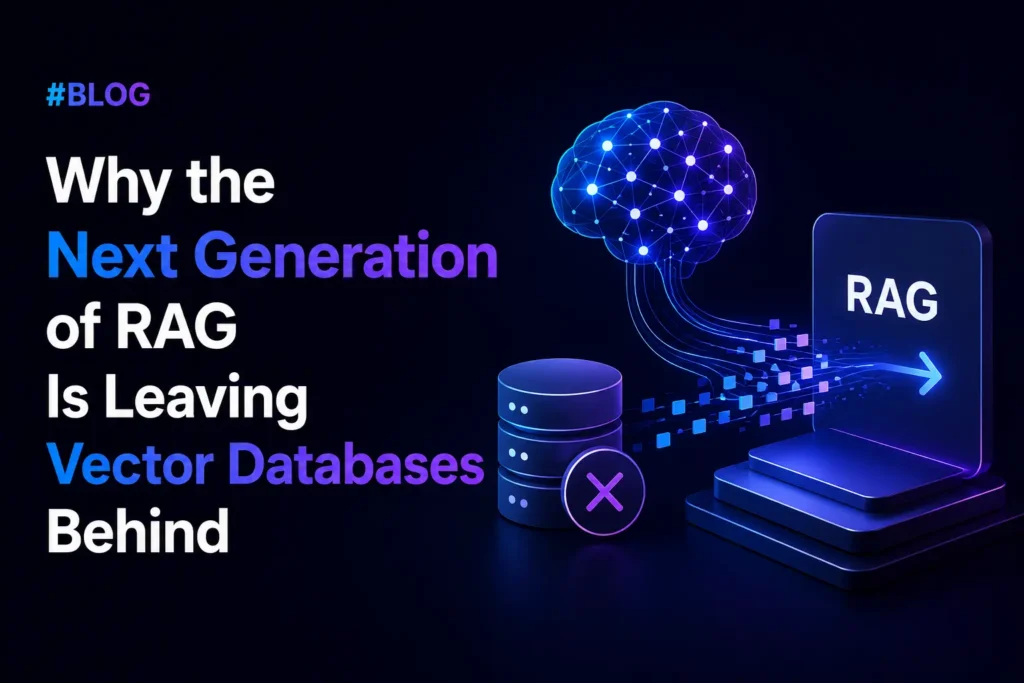
Traditional RAG pipelines convert text into high-dimensional embeddings and rank chunks by mathematical closeness to a query. Closeness in vector space, however, does not guarantee logical relevance. A financial analyst querying a 200-page SEC filing may receive a vaguely related paragraph instead of the exact clause needed, because the embedding model matched on keyword proximity rather than document logic , and practitioners describe this failure pattern as “vibe retrieval,” where mathematical closeness substitutes for genuine understanding.
Organizations building advanced RAG systems often rely on Custom AI Application Development Services to design retrieval architectures that combine semantic search, enterprise context, and agentic reasoning for more accurate and reliable AI applications.

Public benchmarking data reinforces the concern. Developers working with long professional documents report that even after tuning chunking strategy, embedding models, and vector store configuration, retrieval accuracy on complex documents commonly plateaus below 60% . Cross-referencing compounds the problem: when a filing directs a reader to an appendix dozens of pages away, standard vector search has no mechanism to follow that structural link .
What Vectorless RAG Changes
Vectorless RAG removes embeddings and vector databases from the pipeline entirely. Instead of scoring chunks by similarity, an LLM reasons over a hierarchical index of the document, essentially the way a human analyst would use a table of contents to locate a section. Microsoft’s own developer community describes the approach as retrieving text that is “logically relevant” by reasoning over document structure, rather than text that is merely semantically similar .
PageIndex, the open-source framework that popularized the technique, builds a tree index from a document’s natural sections and lets an LLM navigate that tree during retrieval, skipping chunking and vector similarity calculations altogether . On FinanceBench, a benchmark built specifically around financial document question answering, the approach reached 98.7% accuracy, a result researchers describe as vastly outperforming vector RAG on professional document analysis . The project has drawn substantial developer attention as well, with its GitHub repository surpassing 23,000 stars within roughly six months of release .
Cost and Explainability, Not Just Accuracy
Accuracy is only part of the business case. Vector databases carry ongoing infrastructure cost: RAM-intensive storage for high-dimensional vectors, per-query charges from managed vector services, and per-token charges from embedding APIs that compound quickly at enterprise query volumes. Vectorless alternatives built on structured indexes or existing systems like SQL can reduce end-to-end retrieval latency by an order of magnitude when retrieval itself is the bottleneck .
Explainability carries equal weight for regulated industries. A vector-based system can only explain a retrieval decision as geometric closeness in high-dimensional space, an answer that satisfies no compliance officer or auditor. Reasoning-based retrieval, by contrast, produces a traceable path: which section of the tree was selected and why, in language a human reviewer can verify.
Organizations looking to implement explainable, cost-efficient retrieval systems can leverage Generative AI Software Development Company expertise to build enterprise-grade RAG solutions with transparent reasoning, optimized infrastructure, and production-ready governance.
Where the Two Approaches Still Coexist
None of the evidence suggests vector search is obsolete. Vector-based retrieval remains well suited to large collections of loosely related, unstructured documents where semantic similarity alone is sufficient to surface relevant material quickly . Vectorless retrieval performs best on long, structured documents such as financial reports, contracts, and regulatory filings, where the logical organization of content carries meaning that pure similarity search cannot capture . Independent analysis of vectorless retrieval also notes a genuine scaling constraint: building a tree index across millions of documents is slower and costlier than building a vector index, since it depends on LLM summarization rather than lightweight embedding generation . Industry analysts increasingly expect hybrid systems, blending vector search for broad coverage with reasoning-based navigation for precision, to define the next stage of enterprise RAG architecture.
This hybrid approach is becoming a key capability of modern enterprise AI solutions, enabling organizations to balance semantic search, reasoning, scalability, and governance across enterprise knowledge systems.
The Decision-Maker Takeaway
The broader RAG market itself is expanding fast enough to justify close attention regardless of architecture choice, with independent market research firms projecting growth from roughly 2 billion dollars in 2025 to well past 60 billion dollars within the next decade . Against that backdrop, the vectorless shift is not a rejection of RAG. It is a maturing of it. IT leaders auditing existing pipelines for cost overrun, accuracy shortfalls, or compliance risk on long-document workloads have a credible, benchmarked alternative worth piloting before committing to another round of embedding infrastructure.
References
- Microsoft Tech Community, “Vectorless Reasoning-Based RAG: A New Approach to Retrieval-Augmented Generation,” March 2026 — https://techcommunity.microsoft.com/blog/azuredevcommunityblog/vectorless-reasoning-based-rag-a-new-approach-to-retrieval-augmented-generation/4502238
- Nemorize, “Vectorless RAG — 2026 Modern AI Search & RAG Roadmap,” April 2026 — https://nemorize.com/roadmaps/2026-modern-ai-search-rag-roadmap/lessons/vectorless-rag
- VectifyAI, “PageIndex: Document Index for Vectorless, Reasoning-based RAG,” GitHub, 2026 — https://github.com/VectifyAI/PageIndex
- Plaban Nayak, “Vectorless RAG — Reasoning RAG Framework,” The AI Forum, Medium, March 2026 — https://medium.com/the-ai-forum/vectorless-rag-reasoning-rag-framework-0c053add971e
- BuildFastWithAI, “Vectorless RAG: How PageIndex Works (2026 Guide)” — https://www.buildfastwithai.com/blogs/vectorless-rag-pageindex-guide
- Partha Sarkar, “Proxy-Pointer RAG: Achieving Vectorless Accuracy at Vector RAG Scale and Cost,” Towards Data Science, April 2026 — https://towardsdatascience.com/proxy-pointer-rag-achieving-vectorless-accuracy-at-vector-rag-scale-and-cost/
- Precedence Research, “Retrieval Augmented Generation Market Size to Hit USD 67.42 Billion by 2034,” December 2025 — https://www.precedenceresearch.com/retrieval-augmented-generation-market
- Towards AI, “PageIndex: The RAG Framework That Threw Out Vector Databases and Still Hit 98.7% Accuracy,” April 2026 — https://pub.towardsai.net/pageindex-the-rag-framework-that-threw-out-vector-databases-and-still-hit-98-7-accuracy-d194e0549478
About Wizr AI
Wizr AI helps enterprises build autonomous operations and accelerate software delivery with practical, production-ready AI. Our secure, modular platform enables teams to build, govern, and scale AI agents and intelligent workflows across Customer Support, IT Support Management, and Finance & Accounting. Through AI-powered engineering services, Wizr also helps organizations accelerate software development and modernization. With pre-built and configurable AI agents, along with enterprise-grade security and integrations, Wizr makes it easy to move from pilot to production with real business impact.
See how Wizr AI can help your teams move faster. 👉 Get in touch.




![Agentic AI vs AI Agents: Key Differences Every CIO Must Know [2025 Guide]](https://wizr.ai/wp-content/uploads/2025/07/Agentic-AI-vs-AI-Agents.webp)
![Agentic AI vs Traditional Automation: Why Enterprises Shift for Better CX [2025]](https://wizr.ai/wp-content/uploads/2025/06/Agentic-AI-vs-Traditional-Automation.webp)


![11 Real-World AI Agents Examples + Use Cases for Enterprises [2025]](https://wizr.ai/wp-content/uploads/2025/05/AI-Agents-Examples-Use-Cases.webp)