


Regulatory work in pharma is becoming more demanding every year. If you are part of a regulatory or compliance team, you already see how often things change. New global guidelines, submission deadlines, safety updates, labeling changes, and audits all move at the same time, often across multiple regions.
Managing this manually slows your teams down and increases the risk of missing important updates. Even a small delay or oversight can create compliance gaps, especially when you are working across different regulatory bodies and complex product pipelines.
That is why many pharma enterprises are shifting toward AI-powered compliance systems. According to Grand View Research, the global AI in drug discovery market was valued at USD 2.35 billion in 2025 and is expected to reach USD 13.77 billion by 2033. This growth shows how quickly AI is becoming part of everyday pharma operations, not just in research but also in AI pharmaceutical regulatory compliance and regulatory intelligence initiatives.
Pharma AI regulatory intelligence tools help you keep track of regulatory changes, reduce manual effort in documentation, improve pharmacovigilance processes, and bring more structure to compliance operations across teams and markets. As a result, many organizations are investing in an AI pharma regulatory intelligence platform and AI pharmaceutical regulatory compliance software to strengthen governance and regulatory readiness. Enterprises looking to build and scale these capabilities often leverage Custom AI Application Development Services to create secure, compliant, and domain-specific AI solutions tailored to pharmaceutical workflows and regulatory requirements.
What Is AI Regulatory Intelligence in Pharma?
AI regulatory intelligence is a way for your teams to use artificial intelligence to track, organize, and understand regulatory information across the pharma lifecycle. Instead of manually checking updates, AI helps you stay on top of changes in real time. This is one of the key pharmaceutical regulatory compliance trends 2026, as companies increasingly adopt AI platforms for regulatory compliance in pharma to manage growing regulatory complexity.
Earlier, regulatory teams had to review information from multiple sources every day, including:
- Health authority updates
- Submission requirements
- Drug safety reports
- Labeling changes
- Compliance documents
- Pharmacovigilance data
This becomes difficult as your operations expand across regions. Each market has its own rules, timelines, and frequent updates, which makes manual tracking slow and error-prone. These challenges are driving demand for AI pharma regulatory compliance automation and AI regulatory compliance automation for pharma 2026 solutions.

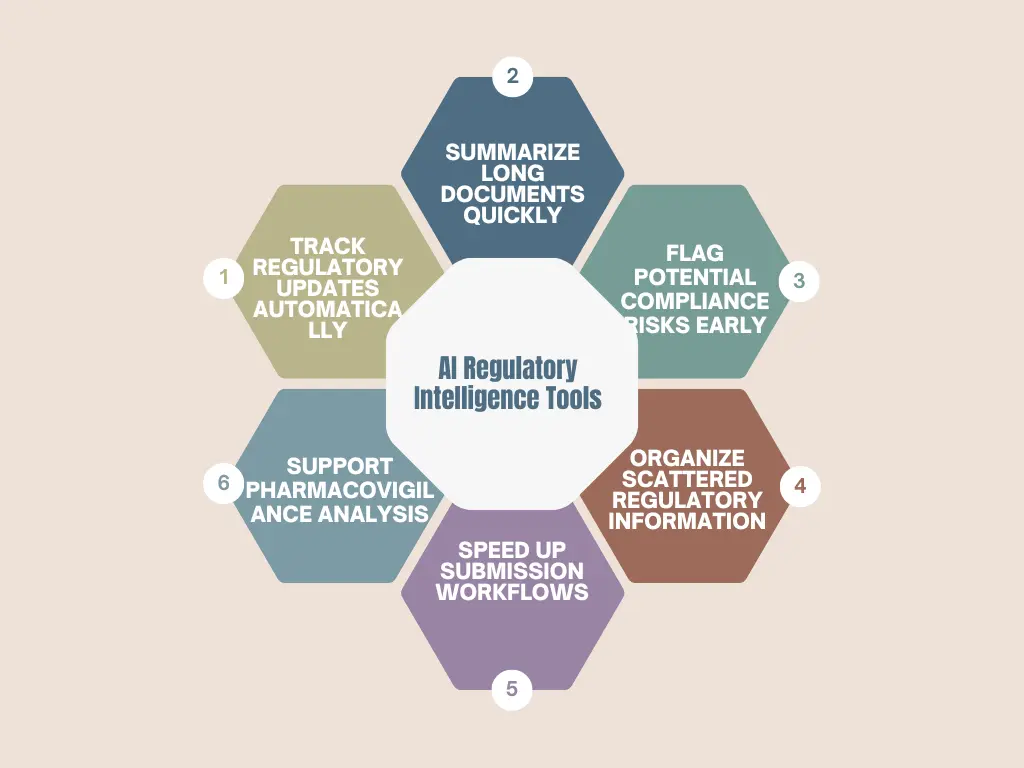
AI Regulatory Intelligence Tools help reduce this effort by automating key tasks. They allow your teams to:
- Track regulatory updates automatically
- Summarize long documents quickly
- Flag potential compliance risks early
- Organize scattered regulatory information
- Speed up submission workflows
- Support pharmacovigilance analysis
For example, AI can scan updates from the U.S. Food and Drug Administration and the European Medicines Agency within minutes and surface only what matters to your teams. Advanced AI tools for pharma compliance and regulatory reporting can also help teams improve visibility into evolving requirements while supporting AI pharma regulatory compliance monitoring 2026 initiatives.
As regulatory volume grows, AI-driven pharma regulatory compliance is becoming a core part of how pharma enterprises manage compliance day-to-day. Many organizations are also exploring Generative AI for pharma regulatory compliance, AI agents for pharma regulatory compliance, and other innovations focused on automating pharma regulatory compliance with AI to improve efficiency, reduce compliance risks, and accelerate decision-making.
Also Read: 11 Best AI Solutions for Pharma Companies in 2026 [CIO & CTO Guide]
11 Best AI Regulatory Intelligence Tools for Pharma Enterprises in 2026
Choosing the right platform is not always simple. Each solution among today’s AI Regulatory Intelligence Tools focuses on different parts of the pharmaceutical value chain, including regulatory submissions, pharmacovigilance, document control, compliance management, and enterprise knowledge management. As Pharmaceutical regulatory compliance trends 2026 continue to evolve, the goal is to align the right platform with your regulatory priorities, operational goals, and compliance requirements.
1. WIZR AI
WIZR AI helps pharma enterprises automate compliance, regulatory intelligence, pharmacovigilance, and operational workflows using AI-native solutions built on a secure enterprise platform and supported by expert AI services. Rather than treating regulatory intelligence as a standalone function, WIZR AI enables organizations to connect regulatory, quality, safety, and business operations through intelligent workflows, helping teams improve decision-making, reduce manual effort, and maintain AI pharmaceutical regulatory compliance at scale.
What Makes WIZR AI Stand Out
WIZR AI combines AI-powered automation, agentic workflows, and enterprise AI services to help pharma organizations streamline regulatory and compliance processes. As our advanced AI pharma regulatory intelligence platform, it enables AI agents for pharma regulatory compliance and workflows to operate across enterprise systems while maintaining governance, traceability, audit readiness, and optional human verification for critical regulatory activities. This makes it one of the emerging Pharma AI regulatory intelligence tools supporting modern compliance operations.
Core Features
- AI-powered regulatory intelligence and compliance workflows
- Agentic AI workflows for process automation
- AI agents for regulatory, quality, and operational processes
- Retrieval-augmented generation (RAG) for grounded responses
- Secure role-based access controls and governance
- Enterprise integrations across business systems and data sources
- Human-in-the-loop verification for compliance-sensitive workflows
- Audit-ready traceability and monitoring
Why It Matters for You
If your organization is looking to modernize regulatory intelligence, compliance, or pharmacovigilance operations, WIZR AI helps automate complex workflows while maintaining governance and regulatory confidence. By combining AI-powered automation with enterprise AI services, it supports AI-driven pharma regulatory compliance, improves access to critical information, and enables scalable AI pharma regulatory compliance automation across regulatory, quality, and safety teams while helping address common AI pharma regulatory compliance challenges.
2. Veeva Vault RIM
Veeva Vault RIM is widely used in pharma enterprises for managing regulatory information across global markets. It helps teams handle submissions, registrations, and regulatory documentation in a centralized system. This reduces fragmentation and improves visibility across regulatory operations in different regions, making it one of the most established AI regulatory compliance tools for pharma and Pharma regulatory compliance software 2026 solutions.
What Makes Veeva Vault RIM Stand Out
The platform brings all regulatory processes into one structured environment. It helps teams track submissions, manage approvals, and maintain compliance records without relying on disconnected systems or manual tracking methods across departments.
Core Features
- Regulatory submissions management
- Product registration tracking
- Health authority correspondence tracking
- Global compliance monitoring
- Regulatory content management
Why It Matters for You
If your enterprise manages complex multi-country regulatory submissions, Veeva helps improve consistency, reduce duplication, and increase coordination between global regulatory teams working on shared products and approvals.
3. IQVIA Regulatory Affairs Solutions
IQVIA combines healthcare analytics with regulatory intelligence to help pharma enterprises manage both compliance and market-related insights. It supports decision-making by integrating regulatory data with real-world healthcare trends and clinical information. These capabilities position it among the leading AI tools for pharma regulatory compliance and AI tools for pharma compliance and regulatory reporting available to global pharmaceutical organizations.
What Makes IQVIA Stand Out
IQVIA connects regulatory intelligence with broader healthcare datasets, helping you understand compliance requirements in context. This allows teams to make more informed decisions when dealing with complex regulatory environments across global markets.
Core Features
- Regulatory monitoring and tracking
- Safety analytics and insights
- Market intelligence support
- Clinical data integration
- Submission planning assistance
Why It Matters for You
If your organization operates in multiple regulated regions, IQVIA helps you align compliance decisions with broader healthcare and market data, improving both regulatory accuracy and strategic planning.
4. ArisGlobal LifeSphere
ArisGlobal LifeSphere is focused on pharmacovigilance and regulatory operations where large volumes of safety data need to be processed efficiently. It helps pharma enterprises automate case processing and improve compliance accuracy across global safety workflows. The platform supports organizations implementing AI pharma regulatory compliance monitoring 2026 initiatives and modern pharmacovigilance programs.
What Makes ArisGlobal LifeSphere Stand Out
The platform is built to handle complex pharmacovigilance operations at scale. It helps reduce manual work in safety reporting and improves consistency in how adverse events and regulatory cases are processed across teams.
Core Features
- Adverse event processing
- Signal detection and tracking
- Regulatory reporting automation
- Safety case management
- Compliance workflow automation
Why It Matters for You
If your pharmacovigilance teams are struggling with high data volume and manual processes, this platform helps improve speed, reduce workload, and enhance regulatory accuracy across safety operations. Its automation capabilities support organizations pursuing AI regulatory compliance automation for pharma 2026 and broader digital transformation initiatives focused on automating pharma regulatory compliance with AI.
5. Oracle Argus Safety
Oracle Argus Safety is a widely used pharmacovigilance system that helps enterprises manage global safety reporting and case processing. It is designed for large-scale operations where consistency and accuracy in adverse event handling are essential. As one of the leading AI pharmaceutical regulatory compliance software solutions, it supports global safety and compliance requirements across regulated markets.
What Makes Oracle Argus Safety Stand Out
The system standardizes pharmacovigilance workflows across global teams. It ensures that safety data is processed consistently while reducing manual intervention in case handling and regulatory reporting processes. This helps organizations strengthen Pharma AI regulatory compliance and improve reporting accuracy.
Core Features
- Safety case processing
- Signal management and detection
- Global reporting automation
- Risk monitoring systems
- Pharmacovigilance workflow support
Why It Matters for You
If your enterprise handles large volumes of safety cases across regions, Oracle Argus helps reduce processing delays and improve accuracy in regulatory reporting workflows. Its automation capabilities support AI pharma regulatory compliance monitoring 2026 initiatives and enterprise-wide compliance programs.
6. MasterControl
MasterControl is focused on quality and compliance management for life sciences companies. It helps organizations manage documents, audits, training, and change control processes in a structured and compliant environment. The platform is widely recognized among Pharma regulatory compliance software 2026 solutions for managing regulated quality processes.
What Makes MasterControl Stand Out
The platform brings quality management and compliance processes into one system. This helps reduce documentation gaps and improves audit readiness across departments by standardizing workflows. It also supports organizations addressing common AI pharma regulatory compliance challenges related to documentation and governance.
Core Features
- Document control systems
- Audit management tools
- Training compliance tracking
- Change control workflows
- Quality event management
Why It Matters for You
If your organization deals with heavy compliance documentation requirements, MasterControl helps you maintain structure, reduce manual errors, and improve regulatory readiness while supporting broader AI-driven pharma regulatory compliance initiatives.
7. Ennov Regulatory Affairs
Ennov provides regulatory and quality management solutions designed for pharma enterprises that need structured compliance workflows. It helps organizations manage submissions, registrations, and regulatory tracking in one system. These capabilities make it one of the most valuable AI tools for pharma compliance and regulatory reporting available to regulated organizations.
What Makes Ennov Stand Out
Ennov centralizes regulatory operations so teams can collaborate more effectively. It reduces fragmentation and improves visibility across submission processes and compliance activities across global teams. This supports the growing adoption of Pharma AI regulatory intelligence tools and modern compliance management practices.
Core Features
- Submission management workflows
- Product registration tracking
- Regulatory monitoring tools
- Document collaboration systems
- Compliance workflow automation
Why It Matters for You
If your enterprise needs centralized regulatory operations, Ennov helps improve coordination between teams working across multiple markets and regulatory environments while supporting AI regulatory compliance automation for pharma 2026 strategies.
8. Phlexglobal
Phlexglobal specializes in regulatory document and content management, especially for inspection readiness and trial master file management. It helps enterprises manage large volumes of compliance documents efficiently. Its document-centric capabilities align with the growing demand for AI platforms for regulatory compliance in pharma.
What Makes Phlexglobal Stand Out
The platform focuses on structuring and organizing regulatory documents to support audits and inspections. It reduces the complexity of managing large-scale documentation across clinical and regulatory teams.
Core Features
- Regulatory document management
- Trial master file systems
- Inspection readiness support
- Submission preparation tools
- Compliance documentation workflows
Why It Matters for You
If your teams deal with document-heavy regulatory processes, Phlexglobal helps improve organization, reduce delays, and ensure audit readiness across operations. This is increasingly important as pharmaceutical regulatory compliance trends 2026 continue to emphasize documentation accuracy and inspection preparedness.
9. Parexel Regulatory Consulting
Parexel provides regulatory consulting services combined with operational support for pharmaceutical enterprises. It helps organizations manage regulatory strategy, submissions, and compliance planning with expert guidance. Its services complement many AI regulatory compliance tools for pharma used by global life sciences companies.
What Makes Parexel Stand Out
The platform combines consulting expertise with operational support, helping enterprises navigate complex regulatory environments more effectively. It supports both strategy and execution across regulatory functions.
Core Features
- Regulatory strategy planning
- Submission support services
- Clinical development guidance
- Compliance operations support
- Regulatory consulting expertise
Why It Matters for You
If your organization needs expert regulatory guidance along with execution support, Parexel helps reduce complexity in compliance decision-making and planning while supporting broader AI pharmaceutical regulatory compliance objectives.
10. Saama Technologies
Saama Technologies focuses on AI-driven analytics for clinical and regulatory operations. It helps enterprises analyze large datasets and improve visibility across compliance and clinical workflows. These capabilities position it among the emerging AI tools for pharma regulatory compliance and Best AI tools for pharma regulatory compliance 2026.
What Makes Saama Stand Out
Saama integrates AI analytics into life sciences operations, helping teams process complex data faster and generate insights that support regulatory and clinical decisions. Its approach aligns with the industry’s shift toward AI pharma regulatory compliance automation and data-driven compliance management.
Core Features
- Clinical data analytics
- Compliance monitoring systems
- Data quality management
- Operational reporting tools
- AI-driven insights
Why It Matters for You
If your enterprise depends on large-scale clinical and regulatory datasets, Saama helps improve decision-making speed and operational efficiency while supporting AI tools for pharma compliance and regulatory reporting initiatives.
11. Corti
Corti is an AI platform focused on clinical communication analysis. It helps healthcare and pharma organizations process real-time conversations and identify safety-related insights that may be important for regulatory workflows. Its capabilities reflect the growing adoption of Generative AI for pharma regulatory compliance and Generative AI pharma regulatory compliance 2026 use cases.
What Makes Corti Stand Out
Corti analyzes clinical interactions in real time to detect potential risks and support documentation. This improves response time and helps teams act faster on critical safety signals while supporting AI agents for pharma regulatory compliance and workflow automation initiatives.
Core Features
- Real-time clinical analysis
- AI-assisted documentation
- Safety signal detection
- Workflow automation
- Medical communication processing
Why It Matters for You
If your organization handles large volumes of clinical communication data, Corti helps improve processing efficiency and ensures faster identification of regulatory and safety insights. These capabilities support organizations focused on automating pharma regulatory compliance with AI and advancing AI-driven pharma regulatory compliance across clinical and regulatory functions.
Also Read: How AI Solutions Help Pharma Companies Automate Regulated Workflows
How AI Regulatory Intelligence Tools Improve Compliance and Pharmacovigilance
As regulatory workloads grow, enterprises need faster and more accurate ways to manage compliance operations. This is where AI Regulatory Intelligence Tools provide measurable value.
- Faster Regulatory Monitoring
Regulatory teams must constantly track updates from multiple global agencies.
AI-powered platforms can automatically monitor:
- FDA updates
- EMA guidelines
- Drug safety alerts
- Policy changes
- Submission requirements
Instead of manually reviewing multiple sources, your teams receive alerts and summaries automatically.
According to Grand View Research, the global AI in drug discovery market could grow from USD 1.49 billion in 2023 to USD 9.17 billion by 2030. This growth reflects how quickly pharma enterprises are investing in AI-driven operations.
- Better Pharmacovigilance Operations
Pharmacovigilance teams process large amounts of safety data every day.
AI helps your teams:
- Detect adverse event patterns earlier
- Process safety cases faster
- Improve signal detection
- Reduce repetitive manual reviews
This improves operational efficiency while supporting patient safety initiatives.
- Improved Document Management
Regulatory documentation often becomes difficult to manage across departments and regions.
AI systems help you:
- Organize documents automatically
- Extract key information
- Summarize lengthy reports
- Reduce duplicate work
This improves audit readiness and reduces operational delays.
- Faster Decision-Making
AI systems can analyze large datasets quickly and provide actionable insights to compliance teams.
This helps you:
- Prioritize high-risk issues
- Respond to regulatory changes faster
- Improve coordination across departments
- Reduced Operational Costs
Manual compliance operations require significant administrative effort.
AI automation helps reduce:
- Processing delays
- Manual documentation work
- Repetitive compliance reviews
- Operational inefficiencies
According to Gartner research covered by Reuters, more than 40% of agentic AI projects could be canceled by 2027 due to unclear business value and governance issues. This highlights why enterprises need AI systems with strong governance, compliance controls, and enterprise knowledge management.
Also Read: AI in Pharma and Biotech: How Enterprises Scale AI Beyond Pilots to Production
How WIZR AI Helps Pharma Enterprises Automate Regulatory Intelligence and Compliance
Pharma enterprises often struggle with disconnected systems, growing regulatory workloads, and slow access to enterprise knowledge.
WIZR AI helps address these challenges through AI-native solutions, AI agents, agentic workflows, and platform-enabled AI services designed for regulated environments. By automating complex compliance and regulatory processes, organizations can improve operational efficiency while maintaining governance, traceability, and regulatory confidence.
With WIZR AI, your teams can:
- Search enterprise knowledge instantly
- Automate compliance workflows
- Improve pharmacovigilance support
- Reduce manual query handling
- Connect siloed systems
- Access approved regulatory documents faster
Our platform also supports Retrieval-Augmented Generation (RAG), enabling AI agents and assistants to generate grounded responses using approved enterprise data, regulatory content, and organizational knowledge.
This is especially useful for:
- Regulatory affairs teams
- Pharmacovigilance operations
- Legal and compliance departments
- Quality assurance teams
- Enterprise support functions
As AI adoption continues to expand across the pharmaceutical industry, organizations need solutions that combine automation, governance, security, and human oversight. WIZR AI helps pharma enterprises build scalable AI-driven compliance, regulatory intelligence, and operational workflows while maintaining enterprise-grade control through a combination of our platform and expert AI services.
Also Read: 15 Best Enterprise AI Solutions in 2026 (+Tools Built for Scale)
Final Thoughts
Regulatory complexity will continue to grow across the pharmaceutical industry in 2026 and beyond.
AI Regulatory Intelligence Tools help your enterprise improve compliance visibility, automate repetitive workflows, and support faster regulatory operations. From pharmacovigilance to regulatory submissions, AI is becoming part of modern enterprise compliance strategies.
The right platform depends on your operational priorities, regulatory workload, and enterprise AI goals.
If your organization wants to automate regulatory intelligence workflows while improving governance and enterprise knowledge access, WIZR AI provides a scalable combination of AI-powered automation, agentic workflows, and platform-enabled AI services designed for regulated enterprise environments.
FAQs
1. What are AI Regulatory Intelligence Tools in pharma, and why are they important in 2026?
AI Regulatory Intelligence Tools help pharmaceutical companies monitor regulatory updates, manage compliance requirements, automate documentation, and improve pharmacovigilance operations. Instead of manually tracking guidance from multiple regulatory agencies, these tools use AI to identify relevant updates, flag risks, and streamline regulatory workflows.
As regulatory complexity continues to increase, Pharma regulatory intelligence tools 2026 are becoming essential for maintaining compliance, improving operational efficiency, and reducing the risk of missed regulatory changes across global markets.
WIZR AI helps pharmaceutical enterprises strengthen regulatory intelligence through AI-powered automation, AI agents, agentic workflows, and platform-enabled AI services that help automate compliance processes while maintaining governance, traceability, and regulatory controls.
2. How do AI regulatory compliance tools for pharma improve pharmacovigilance operations?
Pharmacovigilance teams manage large volumes of safety data, adverse event reports, and regulatory submissions every day. AI regulatory compliance tools for pharma help automate many of these tasks, allowing teams to focus on higher-value activities.
Key benefits include:
- Faster adverse event detection
- Improved signal identification
- Automated safety case processing
- Reduced manual reviews
- Better regulatory reporting accuracy
According to industry research, AI adoption continues to accelerate across life sciences as organizations seek faster and more scalable compliance operations.
WIZR AI supports pharmacovigilance teams through AI-powered workflows, Retrieval-Augmented Generation (RAG), AI agents, and platform-enabled AI services that help accelerate access to approved safety information, regulatory content, and operational knowledge.
3. What should pharma companies look for when evaluating the best AI regulatory intelligence tools in 2026?
When evaluating the Best pharma regulatory intelligence tools 2026, organizations should focus on capabilities that improve compliance while supporting governance and scalability.
Important evaluation criteria include:
- Regulatory monitoring and intelligence
- AI-powered compliance automation
- Pharmacovigilance support
- Audit-ready traceability
- Enterprise integrations
- Data security and governance
- AI agents and workflow automation
Many pharmaceutical companies are also prioritizing solutions that can integrate regulatory, quality, safety, and operational processes into a unified environment.
WIZR AI provides a secure enterprise platform combined with expert AI services, enabling organizations to deploy AI agents, automate workflows, integrate enterprise systems, and maintain governance across regulatory and compliance operations.
4. How is Generative AI transforming pharmaceutical regulatory compliance?
Generative AI for pharma regulatory compliance is helping organizations process large volumes of regulatory content more efficiently. It can summarize lengthy regulatory documents, support compliance research, generate draft responses, and improve access to enterprise knowledge.
As Generative AI pharma regulatory compliance 2026 adoption grows, organizations are using AI to:
- Summarize regulatory guidance
- Improve document review processes
- Accelerate compliance research
- Enhance regulatory reporting workflows
- Support faster decision-making
However, governance remains critical. AI-generated outputs should always be validated using approved enterprise data and regulatory controls.
WIZR AI addresses this challenge through Retrieval-Augmented Generation (RAG), allowing AI agents and assistants to generate grounded responses using approved enterprise knowledge, regulatory content, and organizational data while maintaining enterprise governance and oversight.
5. How can pharma enterprises automate regulatory compliance while maintaining governance?
Successful automating pharma regulatory compliance with AI requires balancing efficiency with governance, transparency, and human oversight. Many organizations face AI pharma regulatory compliance challenges related to auditability, security, compliance validation, and data governance.
The most effective AI pharma regulatory compliance automation strategies typically include:
- AI-powered workflow automation
- Human-in-the-loop verification
- Regulatory monitoring and reporting
- Secure access controls
- Audit-ready traceability
- Enterprise knowledge management
This approach helps organizations implement AI-driven pharma regulatory compliance while reducing operational risk and maintaining regulatory confidence.
WIZR AI enables pharmaceutical enterprises to automate regulatory intelligence, compliance workflows, pharmacovigilance processes, and related operational workflows through AI agents, agentic workflows, governance controls, Retrieval-Augmented Generation (RAG), and platform-enabled AI services designed for regulated environments.
About Wizr AI
Wizr AI helps enterprises build autonomous operations and accelerate software delivery with practical, production-ready AI. Our secure, modular platform enables teams to build, govern, and scale AI agents and intelligent workflows across Customer Support, IT Support Management, and Finance & Accounting. Through AI-powered engineering services, Wizr also helps organizations accelerate software development and modernization. With pre-built and configurable AI agents, along with enterprise-grade security and integrations, Wizr makes it easy to move from pilot to production with real business impact.
See how Wizr AI can help your teams move faster. 👉 Get in touch.



![Agentic AI vs AI Agents: Key Differences Every CIO Must Know [2025 Guide]](https://wizr.ai/wp-content/uploads/2025/07/Agentic-AI-vs-AI-Agents.webp)
![Agentic AI vs Traditional Automation: Why Enterprises Shift for Better CX [2025]](https://wizr.ai/wp-content/uploads/2025/06/Agentic-AI-vs-Traditional-Automation.webp)


![11 Real-World AI Agents Examples + Use Cases for Enterprises [2025]](https://wizr.ai/wp-content/uploads/2025/05/AI-Agents-Examples-Use-Cases.webp)


