There is a particular kind of boardroom frustration that has become almost universal in
2026. The enterprise has spent. It has experimented. It has stood up steering committees,
brought in consultants, signed enterprise agreements with three different model providers,
and sat through more proof-of-concept demos than anyone cares to count. And yet, when a
VP of IT is asked to point to AI that is genuinely running in production changing
outcomes, moving metrics, showing up in the P&L the silence is uncomfortable.
This is not a technology problem. The models work. The demos were impressive. So what is
actually happening?
The Numbers Are Damning and Consistent
The data arriving from multiple independent sources tells the same story with startling
uniformity.
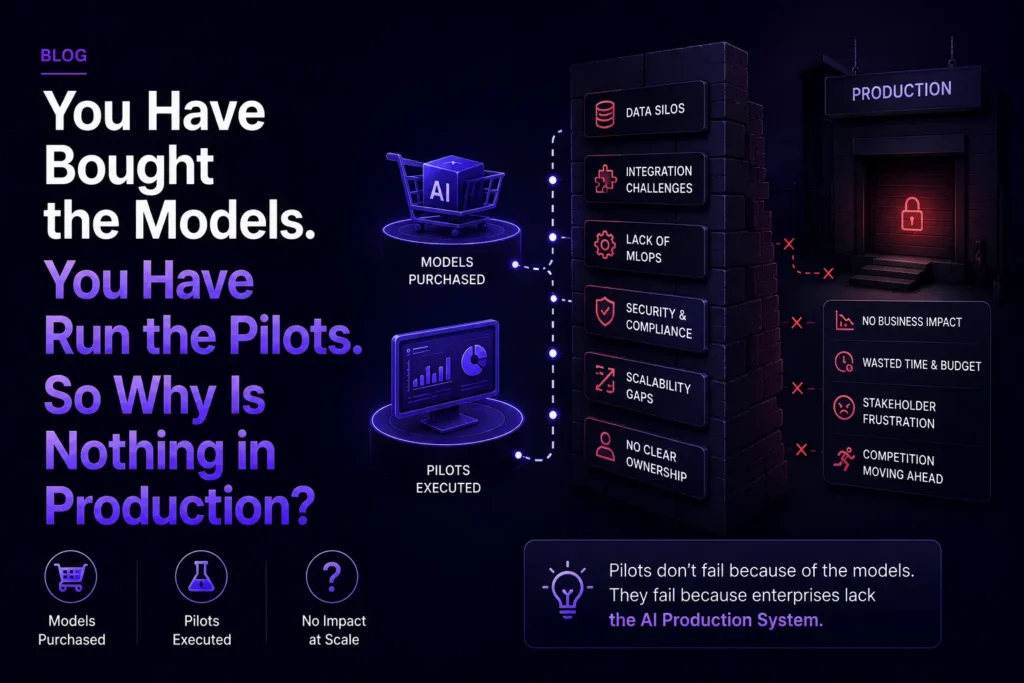
MIT’s NANDA initiative reviewed over 300 publicly disclosed AI deployments and found that
95% of enterprise generative AI pilots delivered zero measurable return not low return,
zero. IDC research found that for every 33 AI proofs of concept an enterprise starts, only
four ever reach production. According to S&P Global, large enterprises with over 10,000
employees abandoned an average of 2.3 AI initiatives in 2025 alone, with each abandoned
initiative carrying an average sunk cost of $7.2 million.

Meanwhile, 88% of organizations report using AI in at least one business function. Yet only
39% report any EBIT impact. The gap between deployment and value is not marginal it is
the defining condition of enterprise AI right now.
This is what the industry has started calling pilot purgatory: the organizational state in
which AI initiatives are neither cancelled nor scaled, consuming resources and credibility
while delivering neither transformation nor clarity. Organizations looking to move beyond pilot-stage AI initiatives often invest in Custom AI Application Development Services to build production-ready AI systems with enterprise integration, governance, scalability, and measurable business outcomes.
Why Pilots Don’t Cross the Line
The failure is rarely the model. It is almost never the data science team. The breakdown
happens in the translation layer between a controlled experiment and a live operational
environment and it follows recognizable patterns.
The pilot was designed to succeed in isolation. Most proofs of concept are scoped to
demonstrate capability, not to stress-test integration. They run on curated data, bypass
legacy systems, and operate outside the authentication, compliance, and workflow
dependencies that govern real enterprise operations. When the pilot moves toward
production, it encounters the actual environment and quietly collapses.
There was no defined outcome before build started. The most common root cause
identified across multiple research bodies is the absence of a measurable business objective
tied to the initiative from day one. Without a production success metric, there is no forcing
function to complete the journey from experiment to deployment.
The integration layer was underestimated by an order of magnitude. Internal AI builds fail
at twice the rate of vendor-led solutions, according to MIT’s findings. The gap is not
engineering talent it is the compounding complexity of connecting AI to the actual
systems of record, ticketing platforms, ERP layers, and knowledge bases that the pilot
deliberately avoided.
Pilot fatigue sets in before scale does. Deloitte’s 2026 State of AI in the Enterprise report
names this specifically: organizations that have cycled through multiple stalled pilots
progressively lose the institutional appetite and cultural momentum needed to complete a
production transition. By the third failed pilot, executives stop attending reviews.
Champions disengage. The fourth pilot launches into an organization that has already
decided, implicitly, that AI does not work here.
The Cost of Staying in the Middle
Pilot purgatory is not a neutral state. Every month spent cycling through inconclusive
experiments carries real cost — the $7.2 million in sunk costs per abandoned initiative, yes,
but also the opportunity cost of competitors who are scaling, the reputational cost with the
board as AI ROI targets go unmet, and the human cost of teams that invested belief in a
transformation that never arrived.
Gartner projects that 60% of AI projects lacking production-ready infrastructure will be
abandoned through 2026. That abandonment rate is already accelerating. The organizations
that are not scaling now are not simply behind — they are accumulating a compounding
deficit that gets harder to close each quarter.
What Production-Ready Actually Means
The enterprises that are closing the pilot-to-production gap share a specific characteristic:
they stopped treating AI as a series of standalone experiments and started building with
deployment as the starting assumption, not the destination.
Production-ready AI means governance and security are architectural choices made at the
beginning, not retrofitted at the end. It means integration with existing enterprise systems
ITSM platforms, CRM, ERP, knowledge bases is a design requirement, not a post-pilot
engineering sprint. It means pre-built, configurable components that carry 80% of the
functionality needed to go live, so teams are customizing for context rather than
engineering from first principles. And it means the path from pilot to measurable ROI is
measured in weeks, not the nine-month average that large enterprises currently endure.
The Inflection Point Is Now
The enterprises that will look back on 2026 as the year AI started delivering are not those
that ran more pilots. They are those that changed the question from can this work in a
demo? to what does it take to run this in production by Q3?
That shift in framing changes everything: the vendor selection criteria, the integration
architecture, the governance model, the success metrics, and the organizational
accountability structure around the initiative.
At Wizr.ai, we built the Enterprise AI Platform specifically for this gap not to help
enterprises experiment, but to help them ship. Our pre-built AI agents for Customer
Support, ITSM, Finance, and more are designed to deploy in weeks, integrate with your
existing systems, and operate within enterprise-grade security and compliance frameworks
including SOC 2 Type 2 and ISO 27001.
If your organization has the pilots, the budget, and the board pressure but not yet the
production deployments we should talk.
Explore the Wizr Enterprise AI Platform →
About Wizr AI
Wizr AI helps enterprises build autonomous enterprises and accelerate product and software engineering with practical, production-ready AI. We help organizations automate business workflows, modernize legacy applications and digital platforms, and build intelligent AI solutions.
Our core services include Enterprise AI Services, AI-Powered Engineering & Legacy Modernization, AI Product Engineering, and AI Governance. We also leverage AI Assembly capabilities, including the Agentic AI Framework, Agentic Workflows, Security, and Integrations.
Through our AI solutions, including AI Agents, Pharma & Life Sciences AI, Oracle AI, and Salesforce AI, we help enterprises apply AI across business and technology needs.
See how we can help your enterprise move faster with AI. 👉 Talk to an AI Expert.



![Agentic AI vs AI Agents: Key Differences Every CIO Must Know [2025 Guide]](https://wizr.ai/wp-content/uploads/2025/07/Agentic-AI-vs-AI-Agents.webp)
![Agentic AI vs Traditional Automation: Why Enterprises Shift for Better CX [2025]](https://wizr.ai/wp-content/uploads/2025/06/Agentic-AI-vs-Traditional-Automation.webp)


![11 Real-World AI Agents Examples + Use Cases for Enterprises [2025]](https://wizr.ai/wp-content/uploads/2025/05/AI-Agents-Examples-Use-Cases.webp)