


Walk into any enterprise leadership meeting in 2026 and you will find a polished AI roadmap on the wall. Ambitious milestones. A phased rollout timeline. Logos of foundation models. A budget line item. Broad C-suite alignment.
What you will rarely find is an AI system one that actually runs in production, connects to real business data, governs decisions reliably, and delivers measurable outcomes week over week.
The gap between roadmap and system is where most enterprise AI investment quietly disappears.
“75% of executives admit their company’s AI strategy is ‘more for show’ than actual internal guidance.” Writer Enterprise AI Adoption Survey, 2026
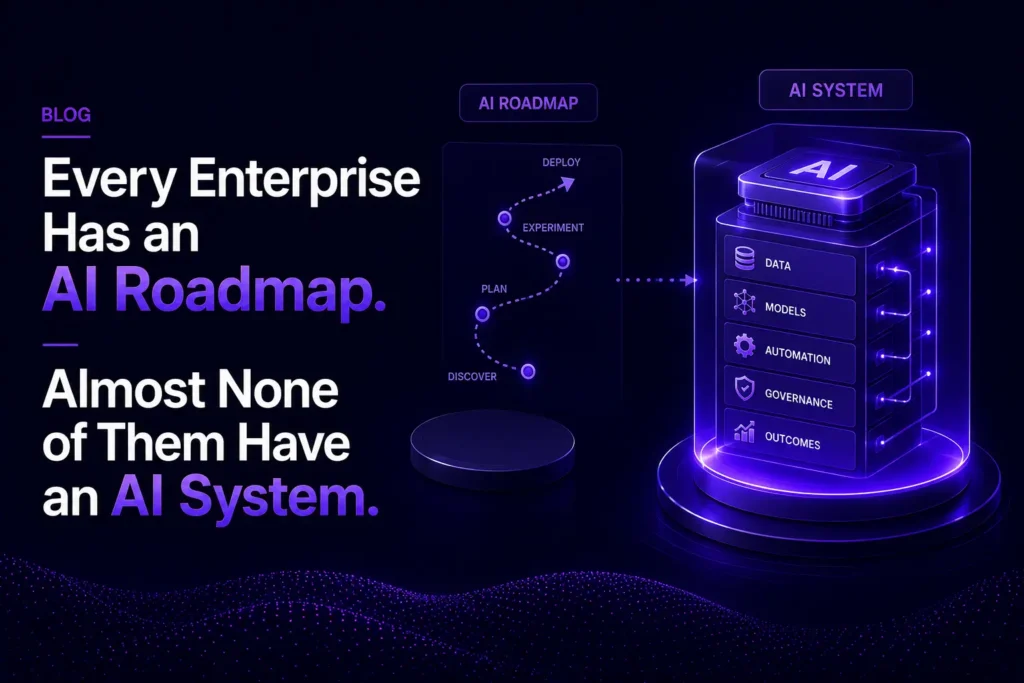
The Roadmap Trap
The numbers are striking. According to Writer’s 2026 Enterprise AI Adoption Survey of 1,200 C-suite executives, 75% admit their company’s AI strategy is “more for show” than genuine internal guidance. Meanwhile, only 29% of organizations report significant ROI from generative AI despite 59% investing over $1 million annually in AI technology.
Deloitte’s State of AI 2026 report reinforces the pattern: just 25% of organizations have converted 40% or more of their pilots into production systems. Forrester data is even starker 88% of AI agent pilots never reach production. And per Harvard Business Review and Cloudera’s 2026 study, only 7% of enterprises say their data is completely ready for AI.
A roadmap without infrastructure is just aspiration with a Gantt chart.
What Separates a Roadmap from a System
An AI roadmap answers the question: where do we want to go? An AI system answers the harder question: how does this actually work on a Tuesday morning when something breaks?
The distinction comes down to four realities that roadmaps routinely underestimate:
Data is almost never ready. Only 7% of enterprises have data that is fully prepared for AI deployment (Cloudera/HBR, 2026). Models are only as good as what they are grounded in. Without clean, connected, governed data, even the best foundation model hallucinates or returns irrelevant outputs.

Governance is an afterthought. Deloitte’s 2026 report shows that governance readiness trails all other preparedness metrics at just 30%. Yet 67% of executives believe their company has already suffered a data breach due to unapproved AI tools (Writer, 2026). Governance built after deployment is damage control, not strategy.
Integration is underestimated. According to StackAI’s 2026 Enterprise AI analysis, the defining production requirement is permissions-aware retrieval, audit logs, and the ability to swap models without rebuilding integrations. Most pilots are not built with any of this in mind.
Pilots optimize for the wrong question. As StackAI’s 2026 benchmarks note, pilots ask “can it work?” while production demands “will it keep working safely?” Those are fundamentally different engineering problems and they require fundamentally different architecture.
The Cost of Staying in Pilot Mode
There is a common belief that staying in pilot mode is low-risk. In reality, it is the most expensive place to be.
Organizations deploying AI across core operations report 20–40% productivity gains in year one (Q1 2026 State of AI adoption data). AI super-users are 5x more productive than laggards and 3x more likely to receive a promotion (Writer, 2026). The organisations building real AI systems are already pulling ahead and the lead compounds.
Meanwhile, 56% of CEOs surveyed by PwC’s 2026 Global CEO Survey report getting “nothing” from their AI adoption efforts. The common factor: investment without infrastructure. Tools without systems. Roadmaps without production.
Where Wizr AI Fits In
Wizr AI is an AI product engineering company. That distinction matters. Wizr does not hand you a platform and a user manual. It engineers AI systems end to end designed to work inside your specific business context, integrated with your existing stack, and built to operate reliably in production.
Think of it less like buying software and more like engaging an engineering partner that takes your roadmap seriously enough to actually build what it describes. The work includes:
- Engineering production-ready AI agents across CX, ITSM, HR, Finance, and Sales scoped to your workflows, not a generic demo
- Designing agentic systems with real orchestration multi-agent coordination, context memory, and auditable decision trails built in from day one
- Grounding AI in your enterprise data via RAG architecture so outputs are accurate, governed, and connected to the systems your business actually runs on
- Architecting for security and compliance – SOC 2 Type 2, ISO 27001, and GDPR-aligned, with access controls and audit capabilities engineered in, not bolted on after
- Accelerating software delivery and modernization through AI-powered engineering services that help teams ship faster and reduce technical debt in parallel
The difference between a platform and an engineering partner is accountability. A platform gives you tools. An engineering company gives you outcomes and owns the gap between the two.
The Honest Audit
The most valuable thing any technology leader can do right now is separate what they have from what they have planned. How many AI use cases are in production versus pilot? Which of them run weekly, with real users, on real data? Which have audit trails? Which could survive an unplanned compliance review?
A roadmap that cannot answer those questions is not a strategy. It is a placeholder. The enterprises winning in 2026 have stopped perfecting the plan and started building the system. The question is simply when you join them.
References
1. Writer- Enterprise AI Adoption 2026 Survey
2. Deloitte – State of AI in the Enterprise 2026
3. Cloudera & Harvard Business Review – Taming the Complexity of AI Data Readiness (March 2026)
4. Digital Applied – AI Agent Adoption 2026: 120+ Enterprise Data Points
https://www.digitalapplied.com/blog/ai-agent-adoption-2026-enterprise-data-points
5. StackAI – Enterprise AI Adoption 2026: Trends, Benchmarks, and Best Practices
6. Deloitte State of AI Execution Gap – BigDATAwire Analysis (March 2026)
7. B. Sykes State of AI Adoption in the Enterprise Q1 2026
https://bsykes.substack.com/p/the-state-of-ai-adoption-in-the-enterprise
Ready to stop roadmapping and start engineering? Wizr AI is an AI product engineering company that helps enterprises build and ship production-grade AI systems
Connect with the Wizr AI engineering team!
About Wizr AI
Wizr AI helps enterprises build autonomous operations and accelerate software delivery with practical, production-ready AI. Our secure, modular platform enables teams to build, govern, and scale AI agents and intelligent workflows across Customer Support, IT Support Management, and Finance & Accounting. Through AI-powered engineering services, Wizr also helps organizations accelerate software development and modernization. With pre-built and configurable AI agents, along with enterprise-grade security and integrations, Wizr makes it easy to move from pilot to production with real business impact.
See how Wizr AI can help your teams move faster. 👉 Get in touch.



![Agentic AI vs AI Agents: Key Differences Every CIO Must Know [2025 Guide]](https://wizr.ai/wp-content/uploads/2025/07/Agentic-AI-vs-AI-Agents.webp)
![Agentic AI vs Traditional Automation: Why Enterprises Shift for Better CX [2025]](https://wizr.ai/wp-content/uploads/2025/06/Agentic-AI-vs-Traditional-Automation.webp)


![11 Real-World AI Agents Examples + Use Cases for Enterprises [2025]](https://wizr.ai/wp-content/uploads/2025/05/AI-Agents-Examples-Use-Cases.webp)


