You already know this. Pharma today is not just about research and trials. It is about how quickly you can work through data, make decisions, and still stay compliant. And that is not easy when every step comes with complex processes and growing data volumes in the AI in Pharmaceutical Industry.
This is where AI starts to help in a real way. It is not a future idea anymore. It is already shaping how pharma teams work through AI Technology in the Pharmaceutical Industry. According to Grand View Research, the global AI in healthcare market is expected to reach USD 36.67 billion in 2025 and grow to over USD 505.59 billion by 2033, which shows how fast companies are moving toward AI-driven systems and AI Implementation in the Pharmaceutical Industry. Many organizations are adopting enterprise AI software solutions to improve operational efficiency, automate workflows, and support compliance-driven processes in the pharmaceutical sector.
![11 Best AI Solutions for Pharma Companies in 2026 [CIO & CTO Guide]](https://wizr.ai/wp-content/uploads/2026/04/11-Best-AI-Solutions-for-Pharma-Companies-1024x683.webp)
You can see this shift around you. Teams are using AI to reduce research time, automate routine work, and make better decisions without adding more pressure on compliance. This reflects the growing impact of AI in the Pharmaceutical Industry.
So the real question is simple. Where do you begin, and which tools actually fit your needs? In this blog, you will explore the best AI Solutions for Pharma Companies in 2026.
Why Pharma Companies Are Investing in AI Solutions
You are expected to move faster than ever. But in pharma, speed cannot come at the cost of accuracy or compliance. Every delay impacts timelines, and every mistake carries risk in the AI in Pharmaceutical Industry 2026 landscape.
This is why AI is becoming part of everyday operations. It helps you handle growing data, reduce manual effort, and improve decision-making without slowing things down using AI Technology in the Pharmaceutical Industry. Organizations are increasingly adopting enterprise AI solutions to support compliance-driven workflows, automate operations, and improve decision-making across pharmaceutical and healthcare environments.
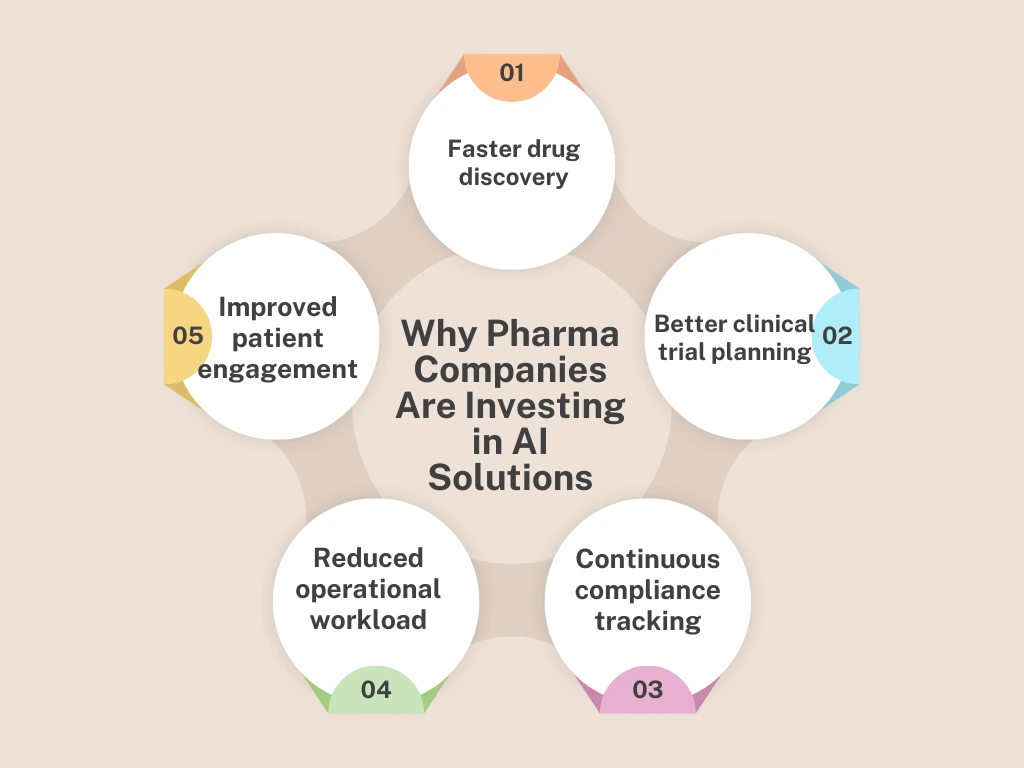
Here’s what is driving this shift:
- Faster drug discovery
AI helps you identify potential compounds earlier, which reduces time spent on initial research using Generative AI Use Cases in Pharma. - Better clinical trial planning
You can use real-world data to improve patient selection and trial outcomes using AI Tools in Pharmaceutical Industry. - Continuous compliance tracking
AI systems monitor data, flag risks, and maintain audit-ready records using Agentic AI Solutions in Pharmaceutical Industry. - Reduced operational workload
Routine tasks like reporting and data handling can be automated using Agentic AI Use Cases in Pharma. - Improved patient engagement
AI assistants can manage queries and support, improving the experience using Use of AI in Pharmaceutical Industry.
Organizations implementing these capabilities often collaborate with a trusted AI application development company to build secure, scalable, and compliance-ready AI solutions for pharmaceutical operations.
This shift is not small. It is changing how pharma innovation works. According to Statista, AI adoption in the pharmaceutical industry is steadily increasing, especially in areas like drug discovery and clinical development.
When you look at these changes together, one thing is clear. AI is helping you move faster while keeping processes accurate and controlled, highlighting the overall Benefits of AI in the Pharmaceutical Industry.

Also Read: AI in Pharma and Biotech: How Enterprises Scale AI Beyond Pilots to Production
11 Best AI Solutions for Pharma Companies in 2026 [CIO & CTO Guide]
Choosing the right AI platform can feel overwhelming because each solution focuses on a different part of the pharma value chain. Some tools improve drug discovery, while others support diagnostics or operations. The key is to align each platform with your immediate business priorities within the AI in Pharmaceutical Industry 2026 landscape.
1. WIZR AI
WIZR AI is an enterprise-focused AI services and solutions provider that helps organizations automate workflows, manage knowledge, and deploy AI across business functions in a secure and structured way. Unlike many pharma AI tools that focus only on drug discovery, WIZR supports enterprise operations such as IT, HR, compliance, and support, along with AI-powered software engineering and enterprise workflows as part of broader AI Solutions for Pharma Companies.
What Makes WIZR Special:
WIZR is built for enterprises that want to adopt AI beyond isolated use cases. It brings together AI automation, AI agents, intelligent workflows, and governance to help organizations scale AI across enterprise processes. Its services support the design, development, implementation, and scaling of AI agents and agentic workflows, helping teams work faster without losing control over data or compliance requirements. This aligns with Agentic AI Solutions in Pharmaceutical Industry and supports scalable adoption.
Core Features:
- Visual workflow builder: Create automation flows with low-code tools
- AI agents: Deploy assistants for internal support and operations
- Secure governance: Role-based access, audit logs, and compliance controls
- Data integrations: Connect with enterprise apps and databases
- Pre-built and configurable AI agents for functions like customer support, IT support, and finance workflows
Why It Matters for You:
If you want to scale AI across your enterprise while maintaining compliance and visibility, WIZR provides the AI services, automation capabilities, and governance support needed to put AI into practice. It helps reduce manual work, improve response times, and ensure that automation aligns with enterprise standards and regulatory expectations while enabling end-to-end AI-driven workflow automation and enterprise operations through strong AI Implementation in Pharmaceutical Industry.
2. IBM Watson Health
IBM Watson Health applies AI to healthcare and clinical data analysis. It helps you process large datasets and extract insights that support research and treatment decisions within the AI in Pharmaceutical Industry.
What Makes Watson Health Stand Out:
Watson Health is known for its ability to work with complex healthcare datasets and convert them into meaningful insights. It combines machine learning with domain knowledge to support both clinical and research workflows, making it useful for organizations that depend on data-driven decisions across multiple functions.
Core Features:
- Clinical data analysis: Process structured and unstructured data
- AI-assisted diagnostics: Support medical decision-making
- Research insights: Identify patterns across datasets
- Scalable infrastructure: Handle large healthcare data volumes
Why It Matters for You:
If your organization relies heavily on clinical and research data, this platform helps you extract value from it. It improves decision-making accuracy and supports better outcomes without increasing manual effort across your teams.
3. BenevolentAI
BenevolentAI focuses on AI-driven drug discovery using biomedical data, representing strong Generative AI Use Cases in Pharma.
What Makes BenevolentAI Stand Out:
BenevolentAI stands out because it connects multiple sources of scientific data into a single knowledge framework. This allows researchers to identify relationships that are difficult to detect manually, helping teams focus on the most promising drug targets earlier in the discovery process.
Core Features:
- Knowledge graph technology: Links biomedical data sources
- Target identification: Discover potential drug candidates
- Data analysis: Process complex biological datasets
- Research acceleration: Reduce early-stage discovery time
Why It Matters for You:
If you want to reduce the time spent in early-stage research, this platform helps you focus on high-potential targets. It improves efficiency in R&D and supports faster progression from discovery to development.
4. Insilico Medicine
Insilico Medicine uses generative AI to design new drug molecules, showcasing Generative AI in Pharma.
What Makes Insilico Medicine Stand Out:
Insilico Medicine goes beyond analyzing data by generating new molecular structures using AI. This approach reduces reliance on traditional trial-and-error methods and allows researchers to explore new possibilities more efficiently within digital environments before moving to lab testing.
Core Features:
- Generative AI models: Design new molecular structures
- Drug discovery pipelines: Accelerate candidate selection
- Aging research: Focus on longevity and disease models
- Predictive analytics: Evaluate molecule effectiveness
Why It Matters for You:
If your goal is to improve speed and efficiency in drug design, this platform helps reduce development cycles. It allows you to test and refine ideas digitally, which saves both time and resources. Many pharmaceutical organizations are adopting enterprise AI platforms to scale AI-driven research, automate workflows, and accelerate innovation across drug discovery processes.
5. Atomwise
Atomwise uses deep learning to predict molecular interactions, strengthening AI Technology in the Pharmaceutical Industry.
What Makes Atomwise Stand Out:
Atomwise uses advanced neural networks trained on chemical data to predict how molecules will behave. This allows researchers to screen a large number of compounds quickly and identify promising candidates without relying entirely on physical experiments.
Core Features:
- Molecular prediction models: Analyze drug-target interactions
- Virtual screening: Test compounds digitally
- Data-driven insights: Improve candidate selection
- Scalable computing: Handle large datasets
Why It Matters for You:
If you want to speed up compound screening and reduce lab dependency, Atomwise helps you do that efficiently. It supports faster decision-making during early-stage drug discovery.
6. PathAI
PathAI focuses on improving diagnostics through AI-powered pathology, highlighting the Use of AI in Pharmaceutical Industry.
What Makes PathAI Stand Out:
PathAI improves diagnostic processes by analyzing medical images with AI. It helps reduce variability in human interpretation and provides consistent results, which is especially important in clinical trials and treatment planning.
Core Features:
- Image analysis: Detect patterns in pathology slides
- Clinical trial support: Improve data quality
- Diagnostic consistency: Reduce interpretation errors
- AI-assisted workflows: Support pathologists
Why It Matters for You:
If accuracy in diagnostics is a priority, PathAI helps improve consistency and reliability. It supports better clinical outcomes and reduces the risk of errors in decision-making.
7. Tempus
Tempus works on precision medicine using clinical and genomic data, reflecting AI Tools in Pharmaceutical Industry.
What Makes Tempus Stand Out:
Tempus brings together clinical data and genomic insights to support personalized treatment strategies. It helps healthcare providers make informed decisions based on real patient data, improving the quality of care and treatment outcomes.
Core Features:
- Genomic sequencing: Analyze patient data
- Clinical insights: Provide treatment recommendations
- Data platform: Aggregate and structure healthcare data
- AI analytics: Support decision-making
Why It Matters for You:
If your focus is precision medicine, Tempus helps connect data with treatment strategies. It allows you to deliver more targeted therapies and improve patient outcomes.
8. Cloud Pharmaceuticals
Cloud Pharmaceuticals focuses on computational drug design, supporting AI Implementation in the Pharmaceutical Industry.
What Makes Cloud Pharmaceuticals Stand Out:
Cloud Pharmaceuticals uses AI to simulate how drugs behave before they are tested in labs. This approach reduces uncertainty in early-stage research and helps teams focus on compounds with higher chances of success.
Core Features:
- Molecular design: Create new compounds digitally
- Predictive modeling: Evaluate drug interactions
- Simulation tools: Test molecules virtually
- R&D acceleration: Reduce early-stage timelines
Why It Matters for You:
If you want to reduce costs and time in early research, this platform helps you make better decisions before moving to physical testing.
9. Exscientia
Exscientia combines AI with automated drug discovery, reflecting Agentic AI Use Cases in Pharma.
What Makes Exscientia Stand Out:
Exscientia integrates AI models with automated lab processes to improve efficiency in drug development. It enables faster testing and refinement of drug candidates, which helps reduce delays in the development pipeline.
Core Features:
- AI-driven design: Identify drug candidates
- Automation systems: Support lab workflows
- Data analytics: Improve decision-making
- Clinical pipeline support: Speed up trials
Why It Matters for You:
If you want a more efficient drug development process, Exscientia helps improve both speed and accuracy across research and testing phases.
10. Deep Genomics
Deep Genomics focuses on genetic data and RNA biology, advancing AI Technology in the Pharmaceutical Industry.
What Makes Deep Genomics Stand Out:
Deep Genomics uses AI to understand how genetic variations impact disease. It focuses on RNA biology, which plays a key role in how genes are expressed, helping researchers develop more targeted therapies.
Core Features:
- Genomic analysis: Study DNA and RNA data
- Disease modeling: Identify root causes
- Target discovery: Develop therapies
- AI predictions: Support research decisions
Why It Matters for You:
If your research depends on genetic data, this platform helps you uncover insights that are difficult to detect manually and supports the development of targeted treatments.
11. Recursion Pharmaceuticals
Recursion Pharmaceuticals combines AI with automated lab experimentation, demonstrating Agentic AI Use Cases in Pharma for CIOs & CTOs.
What Makes Recursion Stand Out:
Recursion generates large-scale biological datasets through automated experiments and applies AI to analyze them. This approach allows researchers to identify patterns and test hypotheses faster than traditional methods.
Core Features:
- Automated labs: Run high-throughput experiments
- Data generation: Build large datasets
- AI analysis: Identify drug candidates
- Scalable workflows: Accelerate research cycles
Why It Matters for You:
If you want to combine experimentation with AI-driven insights, Recursion provides a scalable way to accelerate discovery and improve research efficiency.
Together, these platforms show how AI Solutions for Pharma Companies are expanding across research, diagnostics, and enterprise operations. The right choice depends on your current priorities and how you plan to scale AI across your organization while maximizing the Benefits of AI in Pharmaceutical Industry.
Also Read: How AI Solutions Help Pharma Companies Automate Regulated Workflows
How to Choose the Best AI Platform for Pharma Companies
Once you decide to adopt AI, choosing the right platform becomes your next big step. Not every solution will match your systems or compliance needs in the AI in Pharmaceutical Industry.
You need something that fits into your existing workflows and supports long-term growth using the right AI Solutions for Pharma Companies.
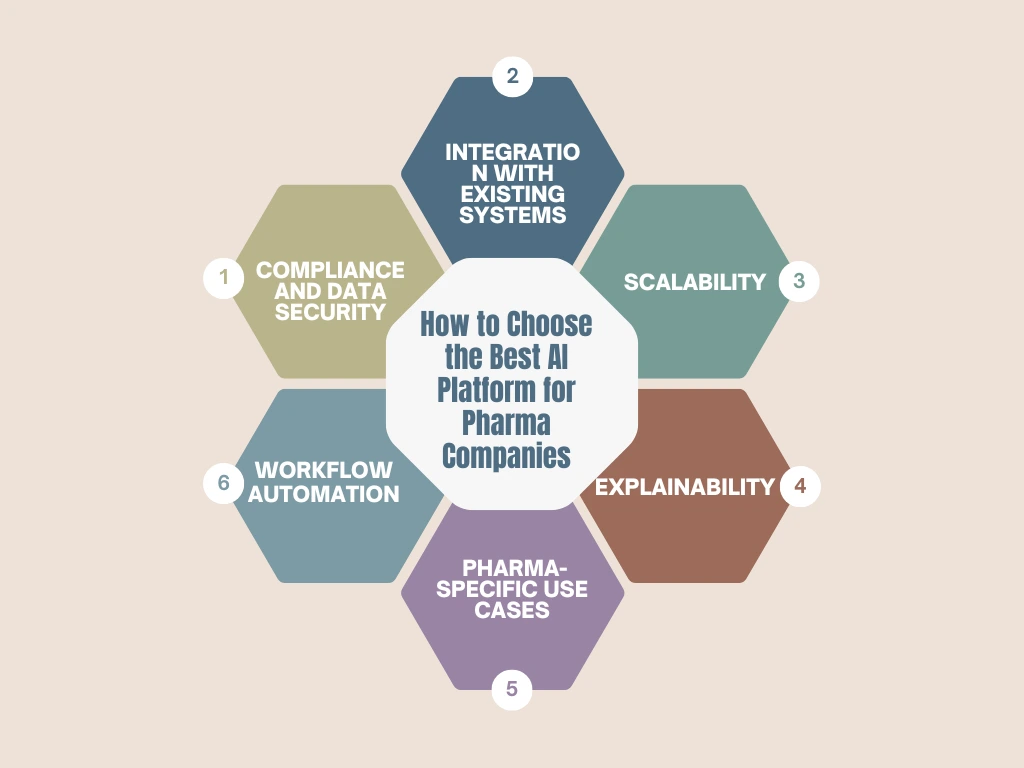
Here’s what you should check:
1. Compliance and Data Security
You handle sensitive patient and research data. Your AI platform should meet strict regulatory standards and maintain clear audit trails, which is critical for AI Implementation in the Pharmaceutical Industry.
2. Integration with Existing Systems
Your AI solution should connect easily with CRM, ERP, LIMS, and clinical systems. This avoids data silos and improves efficiency using AI Technology in the Pharmaceutical Industry.
3. Scalability
Your data will keep growing. Choose a platform that can handle higher workloads without performance issues, especially when scaling AI Tools in the Pharmaceutical Industry.
4. Explainability
You should be able to understand how the AI makes decisions. This is important during audits and internal reviews in the Use of AI in Pharmaceutical Industry.
5. Pharma-Specific Use Cases
Look for tools that already support workflows like drug discovery, clinical trials, or pharmacovigilance, including Generative AI Use Cases in Pharma.
6. Workflow Automation
Choose platforms that reduce manual work across departments using Agentic AI Solutions in the Pharmaceutical Industry.
AI platforms are also evolving quickly. According to Gartner, emerging AI innovations continue to shape enterprise adoption, which means your platform should be flexible enough to adapt to new capabilities and reflect the impact of AI in the Pharmaceutical Industry.
When evaluating AI Solutions for Pharma Companies, focus on how well the platform fits your operations and delivers measurable results over time, ensuring strong Benefits of AI in Pharmaceutical Industry for CIOs.
How Wizr AI Helps Pharma Companies Improve Compliance and Workflow Automation
Wizr AI helps you connect workflows, data, and teams through AI-powered automation and intelligent solutions. It focuses on automation, knowledge access, and governance, along with AI-powered engineering and agentic workflows, so you can improve efficiency without compromising compliance using AI Tools in Pharmaceutical Industry.
Key capabilities:
- Centralized knowledge access across systems
- Automated IT and support workflows
- Built-in compliance controls with audit trails
- AI assistants for HR, IT, and operations
- Scalable AI agents and workflows deployed across enterprise functions
If you want to improve efficiency while staying audit-ready, explore how Wizr AI can support your pharma workflows with Enterprise AI Services and AI-powered solutions.
Final Thoughts
AI is no longer limited to research use cases in pharma. It now supports everything from drug discovery to compliance and daily operations through Generative AI in Pharma. The right AI Solutions for Pharma Companies help you move faster, reduce manual effort, and stay aligned with regulatory requirements. The key is to start with your biggest challenge and choose AI solutions that fit your workflows, not just your technology environment.
Wizr AI stands out when your focus goes beyond R&D. It helps you bring automation, knowledge access, and compliance into your operations through AI-powered enterprise workflows and software engineering services, so your teams can work efficiently without losing control over data and processes, delivering strong benefits of AI in the Pharmaceutical Industry.
If you are looking to improve workflows, reduce operational load, and stay audit-ready, the next step is simple. Explore how Wizr AI can support your pharma operations and identify see where you can start.
FAQs
1. What are AI Solutions for Pharma Companies and why are they important in 2026?
AI Solutions for Pharma Companies include platforms that help with drug discovery, clinical trials, compliance, and operations. In 2026, the AI in Pharmaceutical Industry is no longer optional it’s essential for handling massive data, improving accuracy, and speeding up decision-making.
For example, companies using AI Tools in Pharmaceutical Industry are reducing drug discovery timelines by months through predictive modeling and automation.
Wizr AI plays a key role here by extending AI beyond R&D into enterprise operations**, helping** pharma teams automate workflows, improve compliance, and connect data across departments through AI agents, agentic workflows, and Enterprise AI Services.
2. How is Generative AI transforming the pharmaceutical industry?
Generative AI in Pharmaceutical Industry is changing how drugs are designed and tested. Instead of relying only on traditional lab methods, teams can now simulate molecules and predict outcomes digitally.
Some common Generative AI Use Cases in Pharma include:
- Designing new drug compounds
- Predicting molecular interactions
- Accelerating early-stage research
This is why Generative AI Solutions in Pharma 2026 are becoming a priority for CIOs and CTOs.
Wizr AI complements this by focusing on operational efficiency, helping teams manage workflows, knowledge, and compliance through AI-powered enterprise workflows and AI-powered engineering services.
3. What are Agentic AI solutions in pharma, and why do they matter for CIOs and CTOs?
Agentic AI Solutions in Pharmaceutical Industry go beyond automation. They use AI agents to make decisions, trigger workflows, and manage tasks across systems.
For leaders, Agentic AI Use Cases in Pharma for CIOs & CTOs include:
- Automating IT and support operations
- Managing compliance workflows
- Coordinating cross-functional processes
This reduces manual effort and improves speed without losing control.
Wizr AI supports this approach by helping enterprises deploy AI agents and agentic workflows that automate operations and orchestrate end-to-end workflows across enterprise systems while maintaining governance and audit readiness.
4. What are the key benefits of AI in the pharmaceutical industry?
The Benefits of AI in Pharmaceutical Industry are clear, especially for large enterprises managing complex systems.
Here’s what you typically gain:
- Faster drug discovery and research cycles
- Improved clinical trial outcomes
- Better compliance and audit readiness
- Reduced manual workload across teams
According to Statista, AI adoption in pharma continues to grow, especially in drug discovery and clinical development.
Wizr AI supports these benefits by focusing on enterprise-wide automation, helping teams reduce operational load while improving efficiency and compliance through AI-driven workflows, AI agents, and Enterprise AI Services.
5. How should pharma companies approach AI implementation in 2026?
Successful AI Implementation in Pharmaceutical Industry starts with aligning technology to real business needs. Instead of adopting AI everywhere, focus on high-impact areas first.
A simple approach:
- Identify key bottlenecks (e.g., compliance, data silos)
- Choose scalable AI Technology in Pharmaceutical Industry
- Run pilots before full rollout
This ensures long-term value and reduces risk.
Wizr AI fits well into this approach by providing Enterprise AI Services and AI-powered solutions that help scale AI across operations, enabling pharma companies to move from isolated use cases toward a connected, enterprise-wide AI strategy.
About Wizr AI
Wizr AI helps enterprises build autonomous enterprises and accelerate product and software engineering with practical, production-ready AI. We help organizations automate business workflows, modernize legacy applications and digital platforms, and build intelligent AI solutions.
Our core services include Enterprise AI Services, AI-Powered Engineering & Legacy Modernization, AI Product Engineering, and AI Governance. We also leverage AI Assembly capabilities, including the Agentic AI Framework, Agentic Workflows, Security, and Integrations.
Through our AI solutions, including AI Agents, Pharma & Life Sciences AI, Oracle AI, and Salesforce AI, we help enterprises apply AI across business and technology needs.
See how we can help your enterprise move faster with AI. 👉 Talk to an AI Expert.


![Agentic AI vs AI Agents: Key Differences Every CIO Must Know [2025 Guide]](https://wizr.ai/wp-content/uploads/2025/07/Agentic-AI-vs-AI-Agents.webp)
![Agentic AI vs Traditional Automation: Why Enterprises Shift for Better CX [2025]](https://wizr.ai/wp-content/uploads/2025/06/Agentic-AI-vs-Traditional-Automation.webp)


![11 Real-World AI Agents Examples + Use Cases for Enterprises [2025]](https://wizr.ai/wp-content/uploads/2025/05/AI-Agents-Examples-Use-Cases.webp)