


Testing is no longer something you can leave for the final stage of a release. If you work in an enterprise setup, you are already dealing with constant updates, complex systems, and tight timelines. Relying only on manual testing starts to slow you down.
That is where AI-Powered Test Automation Tools come in. They help you cut down repetitive work, improve accuracy, and release faster without adding extra pressure on your team.
In fact, Grand View Research highlights that the test automation market is growing as more enterprises focus on faster and more reliable software delivery.
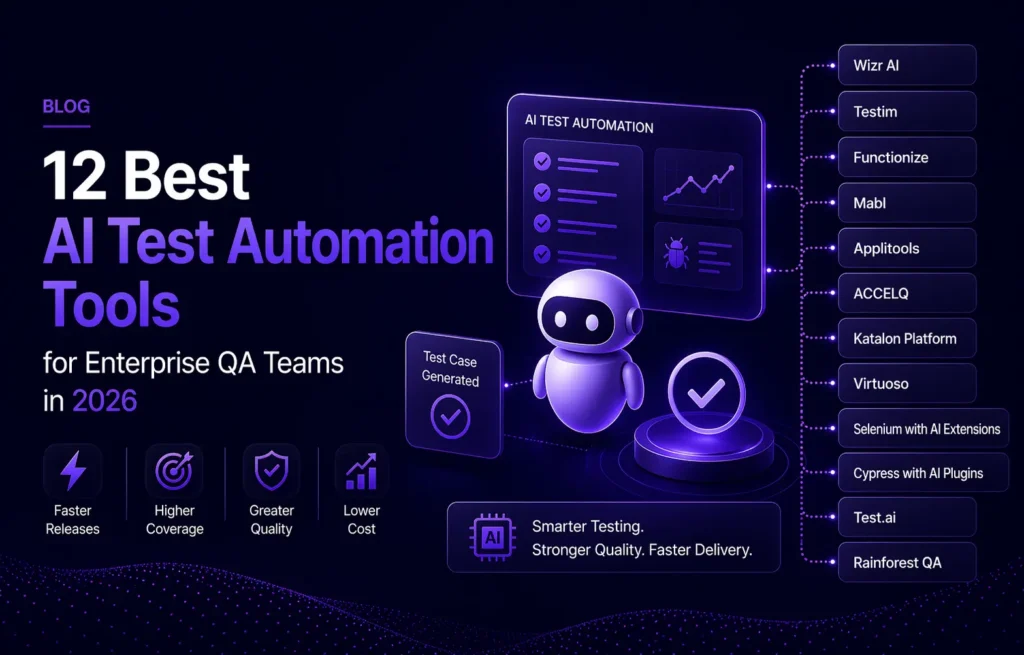
In this blog, you will understand what AI test automation means, what features you should look for, and how to choose the right tool. You will also explore the top tools enterprise QA teams are using in 2026.
What Is AI Test Automation?
AI test automation improves how you handle testing across the entire lifecycle, not just execution. It brings intelligence into how tests are created, updated, and maintained, so your team spends less time reacting to changes and more time improving quality.
Instead of writing and updating every test manually, you can rely on AI to:
- Generate test cases based on real user behavior and historical data
- Detect UI or workflow changes and update scripts automatically
- Identify patterns that often lead to defects
- Reduce the effort needed to maintain large test suites
Think about a common situation. Your UI changes after a release. With traditional automation, your scripts break, and your team spends hours fixing them. With AI-Enabled Test Automation Tools for Enterprise QA and AI-Powered Automated Testing Tools for Enterprise, the system detects the change and updates the test flow on its own. You avoid delays and keep your pipeline moving.

AI also helps you shift from reactive testing to proactive testing. Instead of finding bugs late, you can catch risks earlier in the cycle.
In simple terms, AI Test Automation Tools helps you test smarter, not just faster.
Also Read: AI Workflow Automation: Top 7 Tools & Strategies to Get Started [2026 Guide]
Key Features to Look for in AI-Powered Test Automation Tools
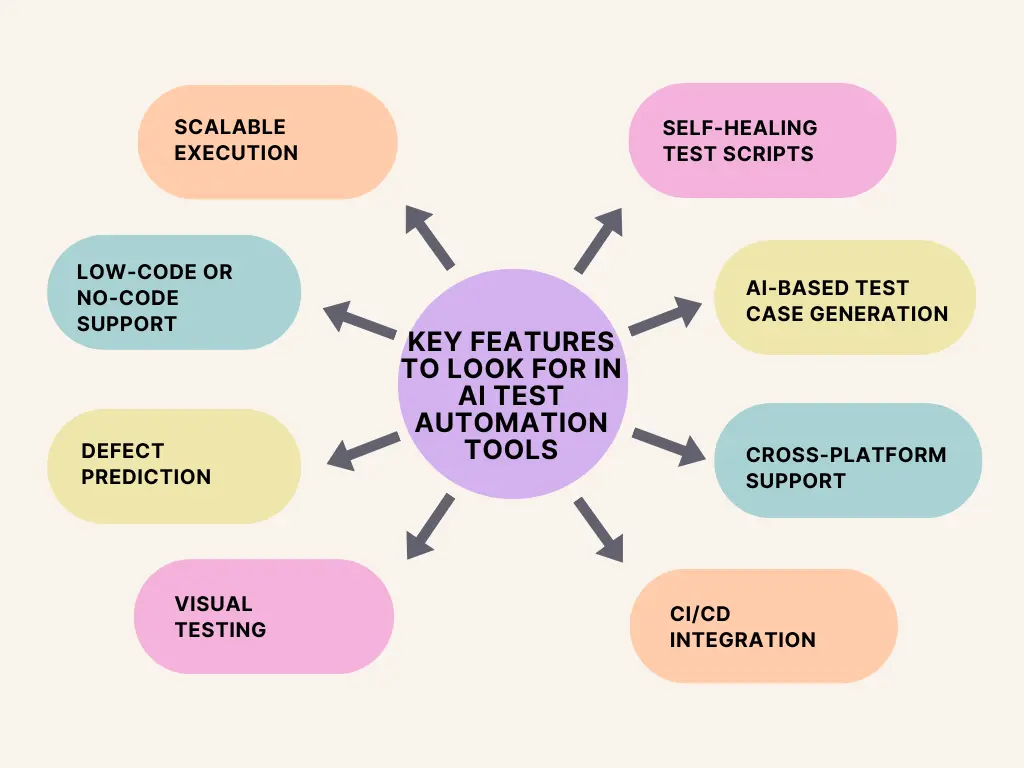
Not all AI Test Automation Tools offer the same value. Some focus only on execution, while others support the full QA workflow. As an enterprise team, you should look for features that reduce effort and improve consistency at scale using AI-Powered Test Automation Tools.
1. Self-Healing Test Scripts
Your tests should adjust automatically when UI elements or workflows change. This reduces the time your team spends fixing broken scripts when using AI-Driven Test Automation Tools.
2. AI-Based Test Case Generation
Look for tools that create test cases from real usage patterns, requirements, or past defects. This improves coverage without adding manual effort using AI Tools for Test Automation.
3. Cross-Platform Support
Enterprise applications run across multiple environments. Your tool should support web, mobile, APIs, and desktop from a single platform using AI Software Testing Tools.
4. CI/CD Integration
Testing should fit into your existing pipeline. The tool should integrate easily with your build and deployment workflows using AI Tools for Enterprise Software Testing.
5. Visual Testing
AI should detect layout issues, missing elements, or UI inconsistencies across devices and browsers using AI-Powered Automated Testing Tools for Enterprise.
6. Defect Prediction
Advanced tools analyze past data to highlight high-risk areas. This helps your team focus on what matters most with AI-Based QA Automation Tools.
7. Low-Code or No-Code Support
Not every team member writes code. A simple interface allows QA, product, and business teams to contribute to testing using AI-Enabled Test Automation Tools for Enterprise QA.
8. Scalable Execution
You should be able to run thousands of tests in parallel. This is important when you handle large systems and frequent releases using the Best AI Tools for Test Automation.
A report by Market.us shows that AI in software testing is growing rapidly as enterprises look for faster and more scalable testing approaches.
Also Read: 11 Best Agentic AI Tools for Enterprise Automation in 2026
12 Best AI Test Automation Tools for Enterprise QA Teams in 2026
Now that you know what to look for, the next step is choosing the right tool for your setup. Not every tool solves the same problem. Some focus on speed, others on usability, and a few connect testing with the full lifecycle. Let’s explore them.
1. Wizr AI
Wizr AI is built for enterprise teams that want testing to connect with the full software lifecycle. It reduces gaps between QA, development, and operations, so your releases move faster. You also gain better visibility into issues and quicker feedback across complex systems.
What sets Wizr AI apart:
- AI-powered test automation integrated into the broader software delivery lifecycle
- Early defect detection and intelligent diagnostics using historical data and AI insights
- AI-assisted bug identification and resolution across development and testing workflows
- Reduced test maintenance through adaptive and AI-driven automation
- Strong alignment across QA, DevOps, and engineering teams through integrated workflows
2. Testim
If your focus is speed with stability, Testim is a practical option. It helps you create tests quickly while keeping them reliable even when UI elements change. This reduces time spent fixing broken scripts and keeps your automation consistent across frequent updates.
Key strengths:
- AI-powered test creation
- Smart element locators
- Strong CI/CD integration
3. Functionize
Functionize is useful when you want to simplify how tests are created and maintained. It allows you to write tests using natural language, which reduces dependency on scripting. This makes it easier for different team members to contribute without slowing down workflows.
What you get:
- Natural language test creation
- Self-healing tests
- Cloud-based execution
4. Mabl
As your release cycles become faster, testing needs to keep up without delays. Mabl supports continuous testing, so you can validate changes as they happen. This helps you catch issues earlier and maintain quality throughout your development process.
Highlights:
- Auto-healing tests
- Integrated performance insights
- Easy pipeline integration
5. Applitools
When user experience matters, visual testing becomes important alongside functional checks. Applitools helps you ensure your application looks consistent across browsers and devices. It detects visual differences that traditional automation may miss, improving overall product quality.
Key features:
- Visual UI validation
- Cross-browser testing
- Layout comparison
6. ACCELQ
ACCELQ is designed for teams that want to reduce coding effort while maintaining strong automation capabilities. It offers a no-code approach that still supports complex enterprise needs. This makes it easier to scale testing without increasing technical overhead.
It offers:
- AI-driven test design
- API and UI automation
- Scalable cloud execution
7. Katalon Platform
Katalon works well for teams with different skill levels and testing needs. It provides both scripted and scriptless options, giving you flexibility in how you approach automation. This helps you manage multiple testing types within a single platform.
You can use it for:
- Web, mobile, and API testing
- Scripted and scriptless automation
- Test analytics
8. Virtuoso
As test suites grow, maintaining them can take significant time and effort. Virtuoso helps reduce this by using AI to create and update tests automatically. This allows your team to focus more on improving coverage instead of managing scripts.
Key benefits:
- Natural language automation
- Self-healing scripts
- Faster execution
9. Selenium with AI Extensions
Selenium remains a strong choice for teams that prefer open-source tools and full control. With AI extensions, you can improve efficiency and reduce manual effort. It works best when your team has the expertise to manage custom automation frameworks.
Use it if you want:
- Open-source flexibility
- Custom integrations
- Full control over testing
10. Cypress with AI Plugins
Cypress is widely used for modern web applications due to its speed and ease of use. With AI plugins, it becomes more stable and efficient. This helps your team debug faster and maintain consistent performance across test runs.
With AI plugins, you get:
- Better test stability
- Faster debugging
- Improved developer experience
11. Test.ai
Test.ai focuses on mobile testing by simulating real user interactions within your application. This helps you identify usability and UI issues that scripted tests may miss. It is especially useful when mobile experience directly impacts your business outcomes.
It helps you:
- Automate mobile testing
- Detect UI issues
- Run tests on real devices
12. Rainforest QA
Rainforest QA combines AI with human validation to improve accuracy in complex testing scenarios. This approach helps you handle edge cases where automation alone may not be enough. It also allows you to scale testing without compromising reliability.
Key advantages:
- Scalable testing
- Fast execution
- Reduced manual effort
Each of these AI Test Automation Tools serves a different purpose. As you evaluate them, focus on what matters most for your team, whether it is speed, ease of use, scalability, or better coordination across your development lifecycle.
Also Read: 11 Best AI-Powered Software Development Tools for Enterprise Teams in 2026
How to Choose the Best AI Test Automation Tool for Your Enterprise
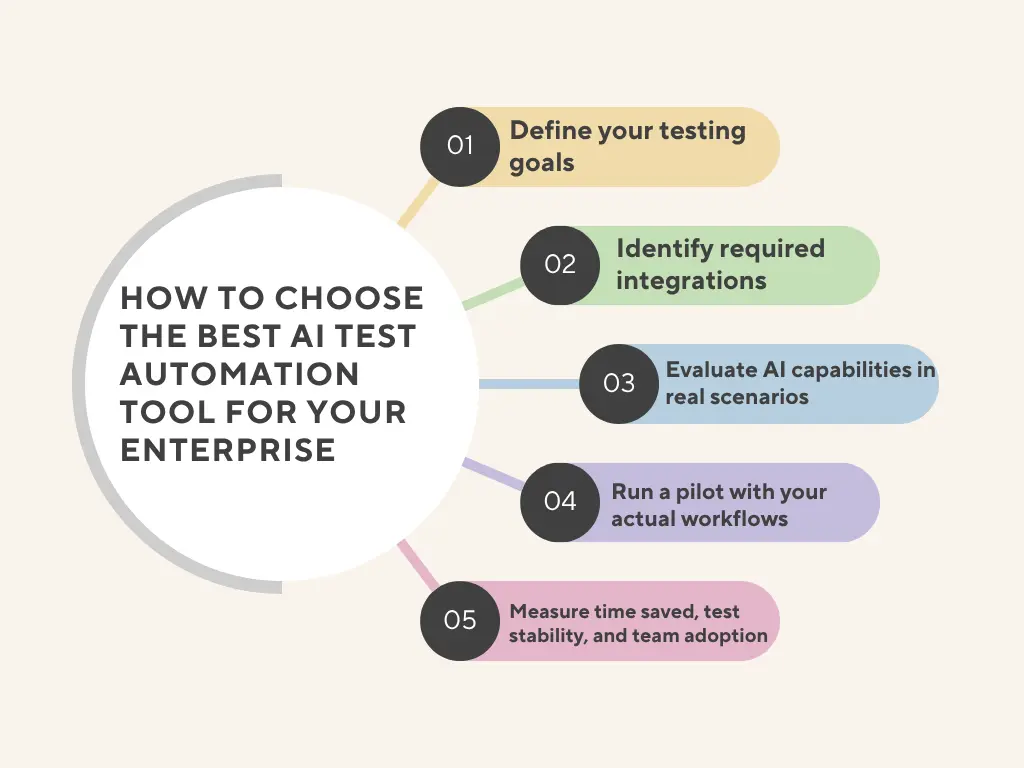
Choosing the right tool is less about features and more about fit. A tool may look strong on paper, but it should align with your workflows, team skills, and system complexity when evaluating AI Test Automation Tools.
Start by Asking the Right Questions
Before selecting a tool, you should evaluate how it fits into your current environment. The goal is to avoid tools that look promising but create friction later. These questions help you focus on practical usability and long-term value when choosing AI Software Testing Tools.
- Does the tool support your application types?
- Can it integrate with your CI/CD pipeline?
- Will it reduce test maintenance over time?
- Is it easy for your team to adopt?
- Can it scale with your testing needs?
These questions help you avoid tools that create more work instead of reducing it.
Follow a Structured Evaluation Approach
After narrowing down your options, you should test them in a structured way. This helps you move beyond assumptions and understand how each tool performs in real scenarios. It also ensures your decision is based on actual results, not just feature lists when comparing Best AI Tools for Software Testing.
- Define your testing goals
- Identify required integrations
- Evaluate AI capabilities in real scenarios
- Run a pilot with your actual workflows
- Measure time saved, test stability, and team adoption
When you test tools in your own environment, you get a clearer picture of their real impact.
Research shared on ResearchGate shows that teams moving from manual to automated testing see clear improvements in efficiency and consistency, especially in large enterprise systems.
This is why your decision should focus on long-term value, not just short-term features when selecting Top AI-Powered Test Automation Tools 2026.
Also Read: Top 10 Enterprise AI Automation Platforms & Service Providers in 2026
How Wizr AI Helps Enterprise QA Teams Improve Testing and Software Delivery
As you review different tools, you will notice that most focus only on testing. Enterprise teams, however, need better coordination across QA, development, and operations. Wizr AI addresses this by connecting testing with your overall delivery process using AI-powered test automation as part of a broader AI-driven software engineering approach.
It helps you catch issues earlier, reduce delays, and keep releases on track without adding extra effort.
What makes Wizr AI effective:
- AI-powered test automation embedded within end-to-end software engineering workflows
- Early defect detection and predictive insights to reduce risks
- Faster bug identification and resolution using AI-assisted diagnostics
- Reduced test maintenance through adaptive automation
- Better alignment across QA, DevOps, and engineering teams
With Wizr AI, you spend less time fixing tests and more time improving quality through AI-driven engineering and automation.
If you want faster releases with fewer issues, start by exploring how Wizr AI fits into your current workflow.
Final Thoughts
AI is changing how you approach testing, especially in enterprise environments where speed and scale matter. You can no longer rely only on manual effort or basic automation if you want to keep up with frequent releases and growing system complexity.
The right AI Test Automation Tools help you reduce effort, improve accuracy, and maintain consistency across your testing workflows. More importantly, they help you shift from reacting to issues to preventing them early in the cycle.
As you evaluate your options, focus on how well a tool fits into your existing processes. Look beyond features and think about long-term impact on your team’s productivity, release timelines, and overall software quality.
If you want to take a more connected approach to testing and delivery, solutions like Wizr AI can help you move in that direction by combining AI-powered automation with enterprise-grade engineering and services. Start small, test with real workflows, and build a setup that supports your team as your systems grow.
FAQs
1. What are AI Test Automation Tools and how are they different from traditional tools?
AI Test Automation Tools use machine learning to make testing smarter, not just faster. Unlike traditional automation, they can adapt to UI changes, generate test cases, and predict defects instead of relying only on pre-written scripts.
For example, if a button ID changes, traditional tools fail but AI-Powered Test Automation Tools can automatically adjust and continue execution. This reduces maintenance effort significantly in enterprise environments.
For enterprise teams, platforms like Wizr AI go beyond testing by connecting QA with broader software engineering workflows and enterprise operations, helping you move from isolated testing to a more unified, AI-driven delivery approach.
2. What are the key benefits of using AI-Powered Test Automation Tools for enterprise QA?
Adopting AI Tools for Software Testing helps teams improve speed, accuracy, and scalability especially in complex systems.
Here’s what enterprise teams typically gain:
- Faster test creation and execution
- Reduced manual effort and maintenance
- Early defect detection with predictive insights
- Better test coverage across applications
According to Grand View Research, demand for intelligent automation is growing as enterprises aim for faster release cycles.
Wizr AI supports these outcomes by enabling AI-powered test automation as part of a broader AI-driven software engineering approach, helping teams reduce delays and improve release quality.
3. How do I choose the best AI Test Automation Tools in 2026?
Choosing the Best AI Test Automation Tools 2026 is less about features and more about fit. You need to evaluate how well a tool works with your systems, team, and processes.
Start with a few simple checks:
- Does it integrate with your CI/CD pipeline?
- Can it reduce test maintenance over time?
- Is it easy for both QA and non-QA teams to use?
The best AI-Driven Test Automation Tools should improve productivity without adding complexity.
Wizr AI stands out here by offering a connected approach bringing together QA, DevOps, and engineering workflows in a unified AI-driven ecosystem supported by platform capabilities and enterprise services.
4. Are AI-Based Test Automation Tools suitable for large enterprise environments?
Yes, AI-Based Test Automation Tools are especially useful for enterprises dealing with complex systems and frequent releases. They help scale testing without increasing manual effort.
For example:
- Large applications → AI helps manage thousands of test cases
- Frequent UI updates → self-healing tests reduce failures
- Distributed teams → centralized insights improve coordination
Research from ResearchGate shows that automation significantly improves consistency in enterprise-scale systems.
Wizr AI is designed specifically for enterprise use cases, enabling scalable testing while integrating with broader AI-driven software delivery and engineering workflows.
5. What makes the best AI-Powered QA Tools for Enterprise stand out?
The Best AI-Powered QA Tools for Enterprise are not just about automation—they help improve the entire testing lifecycle.
Look for tools that offer:
- Self-healing test automation
- AI-driven test generation
- Predictive defect analysis
- Seamless integration with DevOps pipelines
These capabilities define the Top AI-Powered Test Automation Tools 2026.
Wizr AI differentiates itself by combining AI-powered test automation with end-to-end software engineering visibility and enterprise-grade AI services, helping enterprises move faster while maintaining quality across complex systems.
About Wizr AI
Wizr AI helps enterprises build autonomous operations and accelerate software delivery with practical, production-ready AI. Our secure, modular platform enables teams to build, govern, and scale AI agents and intelligent workflows across Customer Support, IT Support Management, and Finance & Accounting. Through AI-powered engineering services, Wizr also helps organizations accelerate software development and modernization. With pre-built and configurable AI agents, along with enterprise-grade security and integrations, Wizr makes it easy to move from pilot to production with real business impact.
See how Wizr AI can help your teams move faster. 👉 Get in touch.



![Agentic AI vs AI Agents: Key Differences Every CIO Must Know [2025 Guide]](https://wizr.ai/wp-content/uploads/2025/07/Agentic-AI-vs-AI-Agents.webp)
![Agentic AI vs Traditional Automation: Why Enterprises Shift for Better CX [2025]](https://wizr.ai/wp-content/uploads/2025/06/Agentic-AI-vs-Traditional-Automation.webp)


![11 Real-World AI Agents Examples + Use Cases for Enterprises [2025]](https://wizr.ai/wp-content/uploads/2025/05/AI-Agents-Examples-Use-Cases.webp)


